CHAPTER 15
Mechanisms of Cell Communication
Questions
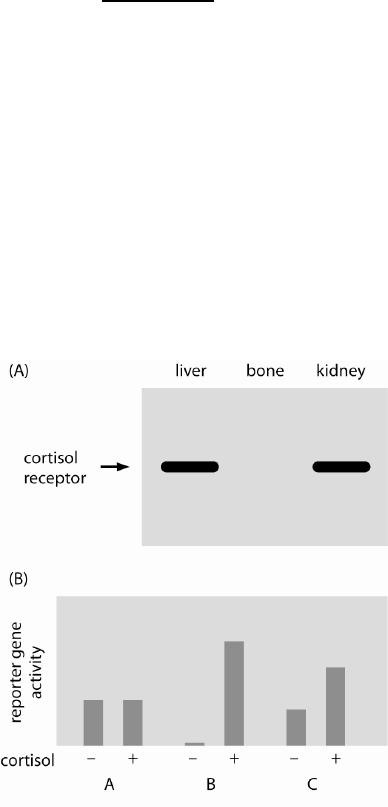
15-1 Your friend is trying to understand how the hormone cortisol affects kidney, liver,
and bone cells by examining a set of cell lines derived from kidney cells, liver
cells, and bone cells. She gets the following result when she examines her cell
lines for expression of the cortisol receptor on a Western blot depicted in Figure
Q15-1A.
Unfortunately, after she performs this experiment, she mixes up her cell lines and
is not sure which line comes from which cells. She labels the cell lines A, B, and
C and then examines the activity of a cortisol-responsive reporter gene’s
expression in the presence and absence of cortisol and collects the data depicted
in Figure Q15-1B.
Figure Q15-1
A. Which cell line do you think is the bone cell line? Explain.
B. Provide a possible explanation for why cell line B and cell line C could
show differences in their cortisol response.
15-2 You are interested in the function of a protein, Mtm1, that has a PH domain, an
SH3 domain, and a PTB domain. Mtm1 functions downstream of the insulin
receptor and binds to this receptor in an insulin-dependent fashion via its PTB
domain. You create mutant forms of Mtm1 that delete the various protein
domains. You find that these mutations do not seem to affect the protein level or
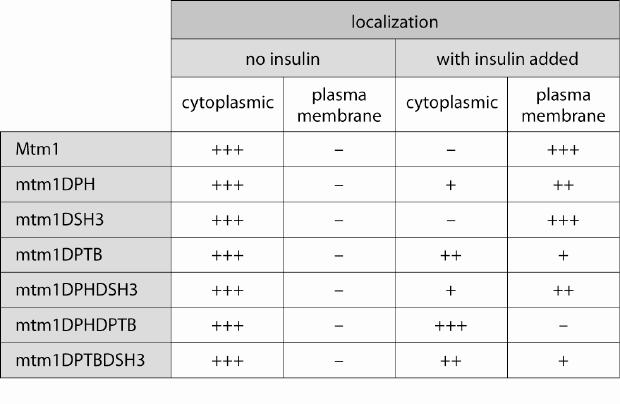
folding of Mtm1. You examine the localization of Mtm1 and your results are
summarized in Table Q15-2.
Table Q15-2
In Table Q15-2, the symbol indicates that the following protein domain is
deleted. For example, mtm1PH indicates an Mtm1 protein that lacks the PH
domain; mtm1PHSH3 indicates an mtm1 protein that lacks both the PH
domain and the SH3 domain.
Given what you know about these three protein domains and the data above,
explain the role of the PH, PTB, and SH3 domains in localizing the Mtm1 protein.
15-3 You are studying a cell line that responds to a peptide ligand called Fge1 by
activating a MAP kinase pathway. In these cells, activation of the MAP kinase
pathway ultimately leads to phosphorylation of a transcription factor, Goh1, and
the transcription of several genes, including the Suf1 gene. You treat cells with
Fge1 and measure Suf1 mRNA production and are very excited to see that cells
seem to respond to Fge1 in a graded fashion such that an increasing concentration
of Fge1 seems to increase Suf1 mRNA production, as illustrated in Figure Q15-3.
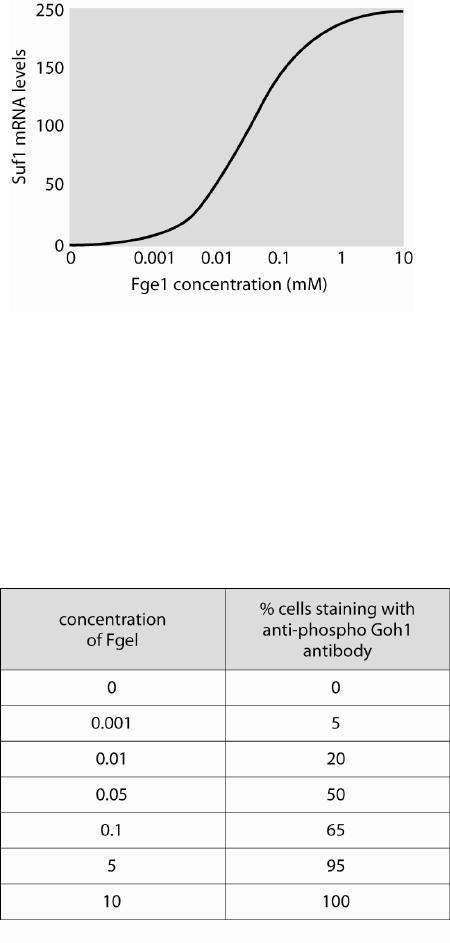
Figure Q15-3
You also raise an antibody that specifically recognizes the phosphorylated form of
Goh1. Using this antibody for immunofluorescence studies, you examine the
phosphorylation state of Goh1 in cells that have been treated with varying
concentrations of Fge1. You see that cells seem to either stain with the antibody
or not, with no difference in the intensity of staining between the cells that stain.
Furthermore, the percentage of cells that stain seems to vary with Fge1
concentration, as seen in Table Q15-3.
Table Q15-3
Are your immunofluorescence results more consistent with the possibility that
phosphorylated Goh1 increases progressively in individual cells as the
concentration of Fge1 increases, or are they more consistent with the possibility
that individual cells respond in an all-or-nothing fashion? Propose an explanation
for how cells respond to Fge1 that is consistent with both your observations.
15-4 You are interested in cell size regulation and discover that signaling through a
GPCR is important in controlling cell size in rat white blood cells. The G protein
downstream of this receptor activates adenylyl cyclase, which ultimately leads to
the activation of PKA. You find that cells that lack the GPCR are 15% smaller
than normal cells, whereas cells that express a mutant, constitutively activated
version of PKA are 15% larger than normal cells. Furthermore, the normal blood
cells become smaller when treated with cholera toxin, which has been shown to
inhibit certain subclasses of the subunit of the G protein. Given these results,
explain what you predict would happen to the cell’s size (bigger, smaller, or no
change) if cells were treated in the following fashion.
A. You add pertussis toxin.
B. You inhibit the RGS protein that normally works on the subunit of the G
protein involved in this pathway.
C. You add a drug that increases the activity of cyclic AMP
phosphodiesterase.
D. You add a drug that inhibits adenylyl cyclase.
E. You mutate the cAMP-binding sites in the regulatory subunits of PKA, so
that the PKA binds more tightly to cAMP.
15-5 Calmodulin, a protein found in all eucaryotic cells, mediates many of the cell
changes that occur in response to changes in Ca2+ levels. Calmodulin does not
seem to have any enzymatic activity. Explain how calmodulin is nonetheless able
to mediate calcium-dependent changes in the cell.
15-6 The olfactory receptor neurons in frogs resemble those of mammals, in that they
express olfactory receptors that are coupled to a G protein. When the G protein is
activated, it activates an adenylyl cyclase to produce cAMP, which then opens
cyclic-AMP gated cation channels in the plasma membrane. The opening of these
channels depolarizes the membrane, leading to the production of an action
potential. Your friend is interested in why neurons stop responding to an odor
after prolonged exposure to it, a process called adaptation. He has conducted
experiments examining the depolarization of the olfactory receptor neuron, the
binding of odorant to the receptor, the activation of the G protein, the levels of
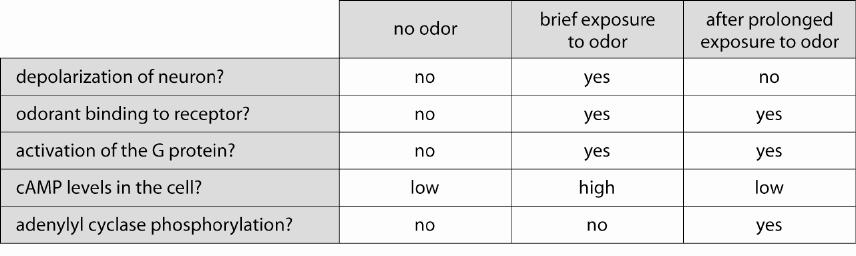
cAMP in the cell, and the phosphorylation of adenylyl cyclase. His results are
summarized in Table Q15-6.
Table Q15-6
From these results, what step in the odor transduction pathway is altered to elicit
adaptation? Propose a possible molecular mechanism to explain why olfactory
neurons no longer respond to an odor after prolonged exposure to it.
15-7 The inappropriate expression of a metabotropic glutamate receptor (called Grm1)
in melanocytes causes melanomas. Grm1 is normally expressed in neurons and
not in melanocytes, but ectopic expression of Grm1 in mouse melanocytes is
sufficient on its own to induce melanoma development. Interestingly, the effects
of Grm1 activity in melanoma cells depends on Ras activity. Your friend works in
a pharmaceutical company that develops anti-cancer drugs. She offers to
collaborate with you to study new cures for melanoma. You discuss the use of a
drug that her company has developed that stimulates Ras-GAP activity. Your
friend tells you that this drug has been tested as a possible treatment for several
cancers but has failed. Recent work indicates that those cancers have a
hyperactive mutant form of Ras, which is locked into a GTP-bound active state.
This mutant form of Ras is resistant to Ras-GAP GTPase stimulation. Explain
why your friend’s drug may be worth testing on patients with Grm1-expressing
melanoma cells, even though it has not worked on some other cancer cells.
15-8 Explain how the Notch protein can both bind to the Delta ligand at the cell surface
and also interact with the DNA-binding protein Rbpsuh in the nucleus.
Answers