Chapter 15 Metabolism: Basic Concepts and Design
Matching Questions
Use the following to answer questions 1-10:
Choose the correct answer from the list below. Not all of the answers will be used.
a) O2
b) niacin
c) phototrophs
d) ATP
e) CO2
f) coenzyme A
g) vitamins
h) amphibolic
i) ADP
j) NADPH
k) chemotrophs
l) FAD
1.
____________ These organisms use energy from sunlight and convert it to chemical energy.
2.
____________ These organisms obtain chemical energy from oxidation of foodstuffs.
Ans: k
Section: 15.1
3.
____________ Pathways that can be either anabolic or catabolic depending on the energy
conditions of the cell.
Ans: h
Section: 15.2
4.
____________ In aerobic organisms, this is the ultimate acceptor of electrons.
Ans: a
5.
____________ In aerobic metabolism, this is the product of oxidation of carbon containing
fuels.
Ans: e
Section: Introduction
Ans: c
Section: 15.1
Chapter 15 Metabolism: Basic Concepts and Design
2
6.
____________ The electron carrier, NADH, is derived from this vitamin.
7.
____________ This substance is the electron donor in most reductive biosyntheses.
Ans: j
Section: 15.5
8.
____________ This compound serves as an acyl carrier in metabolism.
Ans: f
Section: 15.5
9.
____________ This is the “chemical currency” of metabolism.
Ans: d
Section: 15.2
10.
Ans: g
Section: 15.5
____________ These small organic compounds are required in the diet of higher organisms and
are components of coenzymes.
Fill–in-the-Blank Questions
11.
is the type of metabolism where useful energy is harvested.
Ans: Catabolism Section: Introduction
12.
A thermodynamically unfavorable reaction can be driven by a thermodynamically favorable
reaction to which it is .
Ans: coupled Section: 15.2
13.
ATP is considered an “energy rich” compound because it contains two bonds.
Ans: phosphoanhydride Section: 15.3
14.
In the cell, the hydrolysis of an ATP molecule in a coupled reaction changes the equilibrium
ratio of products to reactants by a factor of .
Ans: 108 Section: 15.3
15.
In vertebrate muscle, serves as a reservoir of high-potential phosphoryl groups that can be
readily transferred to ADP to regenerate ATP.
Ans: creatine phosphate Section: 15.3
16.
is the process of building larger molecules from smaller ones.
Ans: b
Section: 15.5
Chapter 15 Metabolism: Basic Concepts and Design
3
17.
FAD is an electron carrier that is derived from the vitamin .
18.
The acetyl group is attached to coenzyme A by a bond.
Ans: thioester Section:15.5
19.
ATP-generating (catabolic) pathways are inhibited by a (high, low) energy charge.
Ans: high Section:15.6
20.
One way that metabolism is regulated is through control of the accessibility of .
Ans: substrates Section: 15.6
Multiple-Choice Questions
21.
The major purpose(s) for which organisms require energy is/are:
A)
performance of mechanical work.
D)
A and C.
B)
active transport.
E)
A, B, and C.
C)
synthesis of biomolecules.
Ans: E Section: 15.1
22.
Reaction pathways that transform fuels into cellular energy are:
A)
anabolic.
D)
All of the above.
B)
catabolic.
E)
None of the above.
C)
allobolic.
Ans: B Section: 15.2
23.
Metabolic pathways that require energy and are often biosynthetic processes are:
A)
anabolic.
D)
All of the above.
B)
catabolic.
E)
None of the above.
C)
allobolic.
Ans: A Section: 15.2
24.
Electron carrier(s) that include ATP are:
A) NAD+ B) FAD C) FMN D) A and B. E) A, B, and C.
Ans: D Section: 15.5
25.
What is the standard-state free energy (G°′) for the hydrolysis of ATP to ADP?
A)
+45.6 kJ/mol
D)
−14.6 kJ/mol
B)
−45.6 kJ/mol
E)
+ kJ/mol
C)
− kJ/mol
Ans: C Section: 15.3
26.
Which of the following molecule(s) have a higher phosphoryl-transfer potential than ATP?
A)
phosphoenolpyruvate
D)
A and B.
B)
creatine phosphate
E)
C, B, and C.
C)
1,3-bisphosphoglycerate
Ans: E Section: 15.3
Ans: riboflavin Section:15.5

Chapter 15 Metabolism: Basic Concepts and Design
4
27.
This energy source is used to regenerate ATP from ADP and Pi.
A)
oxidation of carbon to CO2
B)
electrochemical potential of stored glycogen
C)
reduction of pyruvate to lactate
D)
All of the above.
E)
None of the above.
28.
The reduced form of flavin adenine dinucleotide is:
A) FADH. B) FAD. C) FADH++. D) FADH2. E) None of the above.
Ans: D Section: 15.5
29.
Which of the following is the electron donor used for reductive biosynthesis?
A)
NADH
D)
CoASH
B)
NADPH
E)
ATP
C)
FADH2
Ans: B Section: 15.5
30.
Pantothenate kinase associated degeneration:
A)
is a predominantly neurological
disorder.
D)
A and C.
B)
can cause anemia.
E)
A, B, and C.
C)
affects tissues that are dependent on
aerobic metabolism.
Ans: D Section: 15.5
31.
Which is the correct coenzyme: carrier pair?
A)
NADH: acyl
B)
tetrahydrofolate: electrons
C)
coenzyme A: acyl
D)
lipoamide: aldehyde.
E)
thiamine pyrophosphate: glucose
Ans: C Section: 15.5
32.
Which activated carriers contain adenosine phosphate units?
A) NADH B) FADH2 C) coenzyme A D) A and B. E) A, B, and C.
Ans: E Section: 15.5
Ans: A Section: 15.2

Chapter 15 Metabolism: Basic Concepts and Design
5
33.
Which of the following is an example of an oxidation reaction?
A)
–O2CCH2CH2CO2–FAD C C CO2–
–O2CH
HFADH2
++
B)
+CO2
CH3CCO2–
O
ATP ADP Pi
+ + +
–O2CCH2CCO2–
O
C)
CO2–
C
CH3
HH2N
CO2–
C
CH3
NH2
H
D)
Ala-Ser + H2O → Ala + Ser
E)
None of the above.
34.
Metabolic processes are regulated by:
A)
transcriptional regulation of the amount of enzyme.
B)
allosteric control of enzyme activity.
C)
accessibility of substrates by compartmentalization.
D)
A and B.
E)
A, B, and C.
Ans: E Section: 15.6
35.
Some of the mechanisms by which enzyme catalytic activity is controlled are:
A)
allosteric control.
D)
A and C.
B)
feedback inhibition.
E)
A, B, and C.
C)
covalent modification .
Ans: E Section: 15.6
36.
The phosphorylation of fructose-6-phosphate is an endergonic reaction with a ΔGoˊ of 16.3
kJ/mol. How do cells overcome this thermodynamic barrier for this reaction under standard
conditions?
A)
The enzyme that catalyzes this reaction couples it with the condensation of ADP and
inorganic phosphate, resulting in an overall ΔGoˊ of –46.8 kJ/mol.
B)
The enzyme that catalyzes this reaction couples it with the hydrolysis of ATP to ADP and
inorganic phosphate, resulting in an overall ΔGoˊ of –14.2 kJ/mol.
C)
This reaction will proceed to the right because the Keq is small.
D)
This reaction will proceed to the right because the Keq is negative.
E)
By uncoupling the reaction to the hydrolysis of ATP, the reaction can be driven forward.
Ans: B Section: 15.2
Ans: A Section: 15.4
Chapter 15 Metabolism: Basic Concepts and Design
6
37.
You are interested in studying bacteria found in peat swamps and you identify a new bacterium
that you believe is a chemotroph. Which of the following would you use to verify your belief?
A)
screen for ATP synthesis
B)
screen for enzymes that oxidize carbon
C)
screen for light gathering structures
D)
screen for digestive enzymes
E)
screen for linked reactions
38.
The formation of ATP by creatine kinase is shown in the reaction below:
creatine phosphate + ADP ↔ ATP + creatine
Using the Table of Standard Free Energies (Table 15.1 in text), determine if this reaction is
thermodynamically favored under standard conditions.
A)
No, it is not thermodynamically favored because the Kˊeq is 12.6.
B)
No, it is not thermodynamically favored because the ΔGoˊis 12.6 kJ/mol.
C)
No, it is not thermodynamically favored because the ΔGoˊis is -73.6 kJ/mol.
D)
Yes, it is thermodynamically favored because the Kˊeq is 73.6.
E)
Yes, it is thermodynamically favored because the ΔGoˊis is -12.6 kJ/mol.
Ans: E Section: 15.3
39.
The hydrolysis of a phosphate group from ATP releases 30.5 kj/mol, whereas the hydrolysis of a
phosphate from glucose 6-phosphate releases only 13.82 kJ/mol. In that the product is the same,
what accounts for the difference?
A)
ATP has greater resonance stabilization than the product orthophosphate.
B)
There is a greater increase in entropy when ATP is hydrolyzed.
C)
Water hydrates ATP greater than glucose 6-phosphate.
D)
ATP has a larger phosphoryl-transfer potential.
E)
The phosphate ester in ATP is more thermodynamically stable than in glucose 6-
phosphate.
Ans: D Section: 15.3
Short-Answer Questions
40.
Explain how a metabolic pathway can contain an energetically unfavorable reaction yet still
occur.
Ans:
The free-energy changes of the individual steps in a pathway are summed to determine
the overall free-energy change. Thus, a step that might not normally occur can be driven
if it is coupled to a thermodynamically stable reaction.
Section: 15.2
41.
What are the two criteria that must be satisfied by a biochemical pathway?
Ans:
Section: 15.2
Ans: C Section: 15.1
Chapter 15 Metabolism: Basic Concepts and Design
7
42.
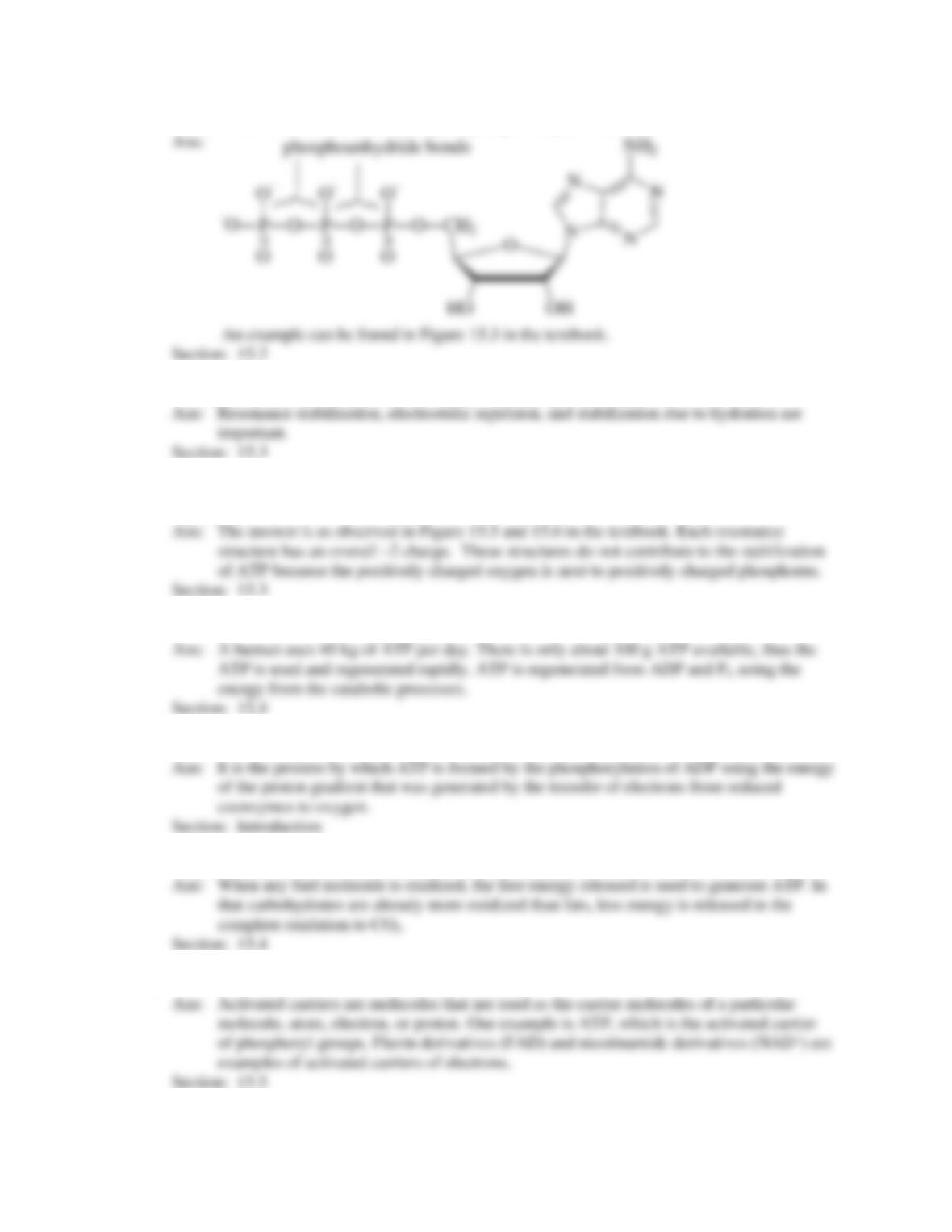
Draw the structure of ATP and identify the phosphoanhydride bond(s).
43.
What general factors contribute to the high phosphoryl-group transfer of ATP?
Ans:
Resonance stabilization, electrostatic repulsion, and stabilization due to hydration are
important.
44.
Draw the resonance structures of orthophosphate and explain why these structures are not
significant in ATP.
structure has an overall –2 charge. These structures do not contribute to the stabilization
of ATP because the positively charged oxygen is next to positively charged phosphorus.
Section: 15.3
45.
How much ATP is used daily by a typical human? How is it regenerated?
energy from the catabolic processes.
Section: 15.4
46.
What is oxidative phosphorylation?
of the proton gradient that was generated by the transfer of electrons from reduced
coenzymes to oxygen.
Section: Introduction
47.
Why are fats a more efficient fuel source than carbohydrates?
complete oxidation to CO2.
Section: 15.4
48.
What is an activated carrier? Provide two examples.
of phosphoryl groups. Flavin derivatives (FAD) and nicotinamide derivatives (NAD+) are
examples of activated carriers of electrons.
Section: 15.5
An example can be found in Figure 15.3 in the textbook.
Section: 15.2
Chapter 15 Metabolism: Basic Concepts and Design
8
49.
Compare ATP to acetyl CoA.
50.
How are metabolic processes unified? How can you use this to help learn and understand
biochemistry?
knowing common molecules (such as ATP) and mechanisms (oxidation-reduction),
makes it simpler to understand the myriad paths of metabolism.
Section: 15.5
51.
List five activated carriers in metabolism and give the vitamins that are the precursors of these
carriers.
Ans:
Activated carrier
Vitamin
NADH and NADPH
niacin
FADH2
riboflavin
acetyl-coenzyme A
pantothenate
biotin
biotin
tetrahydrofolate
folic acid
Section: 15.5 and Table 15.2
52.
What is the relationship between the energy charge of a cell and control of the ATP-generating
pathway?
Ans:
When the energy charge is high, ATP-generating pathways are inhibited and visa versa.
Section: 15.6
53.
How is metabolism controlled?
Ans:
The amounts of enzymes and their catalytic activity are two controllable aspects of
metabolism. Substrate accessibility is also important.
Section: 15.6
54.
If many compounds are common to both anabolic and catabolic paths, how can metabolism be
controlled?
different compartments in the cell. Thus, the two opposing processes can be controlled
independently.
Section: 15.6
transfer potential, whereas ATP carries phosphate groups with high phosphoryl-group
transfer. Both molecules are common to several pathways.
Section: 15.4 and 15.5

Chapter 15 Metabolism: Basic Concepts and Design
9
55.
Why do we call ATP a carrier of phosphoryl groups and not a storage molecule for phosphoryl
groups?
Section: 15.3