32) A cold transmitted by a facial tissue is an example of
A) direct contact.
B) droplet transmission.
C) fomite.
D) vector.
E) vehicle transmission.
33) A researcher has performed a prospective study on a disease. To which specific kind of
epidemiological study is this referring?
A) analytical
B) case control
C) descriptive
D) experimental
E) prodromal
34) The CDC is located in
A) Atlanta, GA.
B) Washington, DC.
C) New York City, NY.
D) Los Angeles, CA.
E) Chicago, IL.
35) A disease in which the causative agent remains inactive for a time before producing
symptoms is referred to as
A) subacute.
B) subclinical.
C) latent.
D) zoonotic.
E) acute.
36) A needlestick is an example of
A) direct contact.
B) droplet transmission.
C) indirect contact transmission by fomite.
D) direct biological transmission by vector.
E) vehicle transmission.
37) Which of the following is NOT a predisposing factor of disease?
A) lifestyle
B) genetic background
C) climate
D) occupation
E) All of these are predisposing factors of disease.
38) In which of the following diseases can gender be considered a viable predisposing factor?
A) urinary tract infections
B) pneumonia
C) salmonellosis
D) tetanus
E) anthrax
39) In which of the following patterns of disease does the patient experience no signs or
symptoms?
A) prodromal
B) decline
C) convalescence
D) incubation
E) both incubation and convalescence
Situation 14.1
During a six-month period, 239 cases of pneumonia occurred in a town of 300 people. A clinical
case was defined as fever ≥ 39°C lasting >2 days with three or more symptoms (i.e., chills,
sweats, severe headache, cough, aching muscles/joints, fatigue, or feeling ill). A laboratory-
confirmed case was defined as a positive result for antibodies against Coxiella burnetii. Before
the outbreak, 2000 sheep were kept northwest of the town. Of the 20 sheep tested from the flock,
15 were positive for C. burnetii antibodies. Wind blew from the northwest, and rainfall was 0.5
cm compared with 7 to 10 cm during each of the previous three years.
40) Situation 14.1 is an example of
A) human reservoirs.
B) a zoonosis.
C) a nonliving reservoir.
D) a vector.
E) a focal infection.
41) The etiologic agent of the disease in Situation 14.1 is
A) sheep.
B) soil.
C) Coxiella burnetii.
D) pneumonia.
E) wind.
42) The method of transmission of the disease in Situation 14.1 was
A) direct contact.
B) droplet.
C) indirect contact.
D) vector-borne.
E) vehicle.
43) Which of the following is NOT an example of microbial antagonism?
A) acid production by bacteria
B) bacteriocin production
C) bacteria occupying host receptors
D) bacteria causing disease
E) bacteria producing vitamin K
44) The yeast Candida albicans does NOT normally cause disease because of
A) symbiotic bacteria.
B) antagonistic bacteria.
C) parasitic bacteria.
D) commensal bacteria.
E) other fungi.
45) If a prodromal period exists for a certain disease, it should occur prior to
A) incubation.
B) illness.
C) decline.
D) convalescence.
46) Which one of the following is NOT a zoonosis?
A) cat-scratch disease
B) Hantavirus pulmonary syndrome
C) rabies
D) tapeworm
E) All of these are zoonoses.
47) Pseudomonas bacteria colonized the bile duct of a patient following his liver transplant
surgery. This is an example of a
A) communicable disease.
B) latent infection.
C) nosocomial infection.
D) sporadic disease.
E) None of the answers is correct.
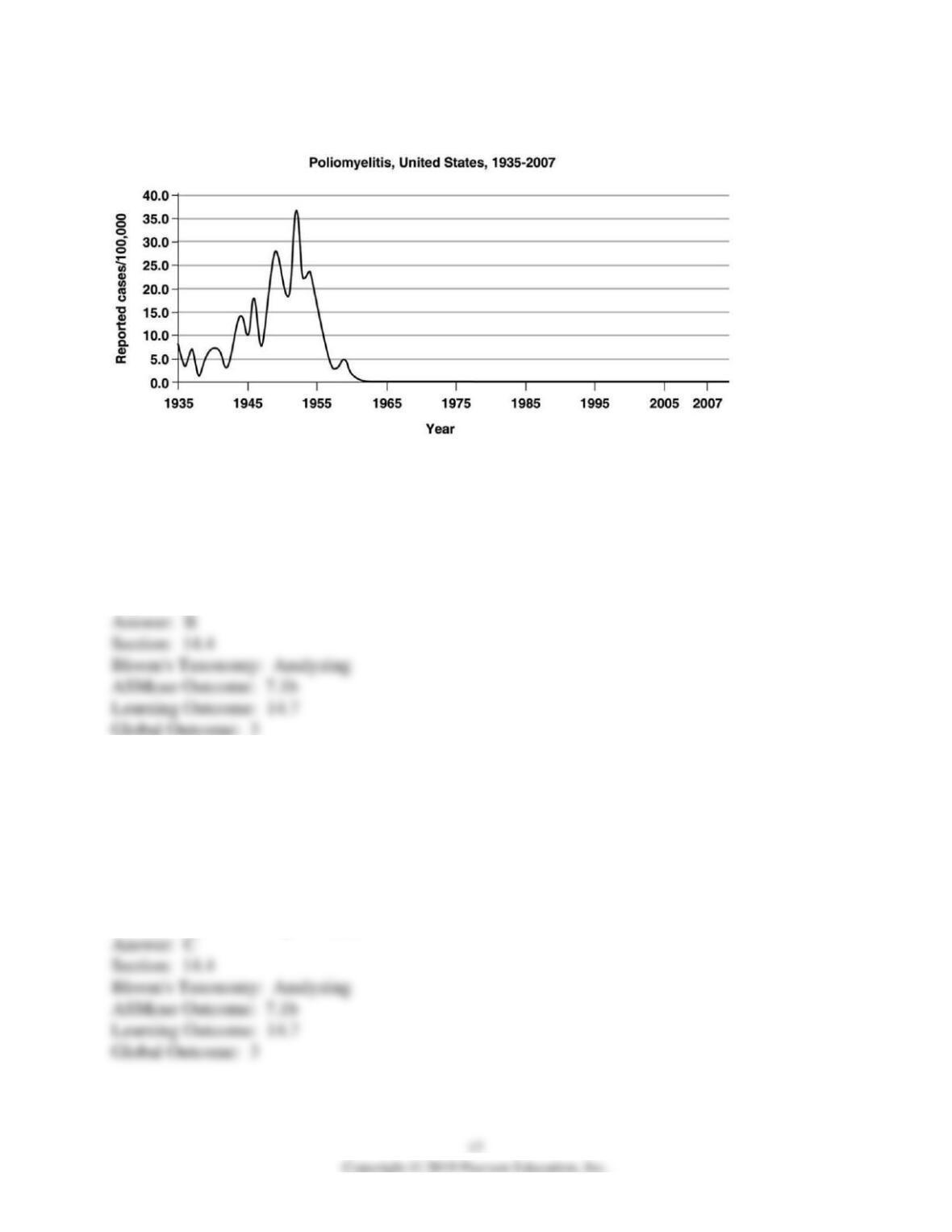
Refer to Figure 14.3 for the next several questions.
48) The graph in Figure 14.3 shows the incidence of polio in the United States. The period
between 1945 and 1955 indicates a(n)
A) endemic level.
B) epidemic level.
C) sporadic infection.
D) communicable disease.
E) pandemic.
49) Interpreting this graph, can we conclude that polio has been eradicated globally? Why or
why not?
A) Yes, as the number of reported cases goes to zero around 1965.
B) No, because polio is part of the normal microbiota, and could become resurgent if vaccination
efforts lapse.
C) No, because the graph only depicts incidence of polio in the United States.
D) Yes, because a zero incidence rate for over 40 years clearly indicates there are no longer any
susceptibles left in the global population.
50) Which of the following statements is FALSE?
A) Antimicrobial therapy for hemodialysis-associated infections increases antibiotic resistance.
B) S. aureus is differentiated from other mannitol+ cocci by the coagulase test.
C) The M in MRSA stands for mannitol.
D) The USA100 strain accounts for most hospital-acquired MRSA.
E) The USA300 strain accounts for most community-acquired MRSA.
14.2 True/False Questions
1) For a particular disease at a specific time period, morbidity rates should always be equal or
greater than mortality rates.
2) Testing the effectiveness of a new drug for anthrax would be best performed as an
experimental study.
3) MMWR is a publication by the CDC that reports specifically and only on emerging diseases.
4) A researcher only needs to select a cohort group when implementing an analytical
epidemiological study.
5) Diseases that are referred to as emerging infectious diseases have only been discovered in the
past fifty years.
6) A burn patient is one example of a compromised host.
7) A host is not considered diseased until an infection changes one’s state of health.
8) Reservoirs of infections are always inanimate objects.
9) Bloodstream infections are the least common forms of nosocomial infections.
10) Both normal and transient flora can become opportunistic pathogens.
14.3 Essay Questions
1) Situation 14.2
A 37-week-old infant was delivered by cesarean section and discharged from a Connecticut
hospital when he was ten days old. Two days later he was lethargic and had a fever. When he
was readmitted to the hospital, he had multiple brain abscesses caused by Citrobacter diversus.
After a prolonged illness, the baby died. A second infant with a normal pregnancy and delivery
died of C. diversus meningitis after a short illness. Nine infants in the hospital nursery had
umbilical cord colonization by C. diversus. Environmental cultures were negative for hospital
equipment.
Refer to Situation 14.2 What is the normal habitat of this gram-negative, facultatively anaerobic,
non-endospore-forming, lactose-positive rod? Provide a plan for identifying the source of
infection and preventing further infection.
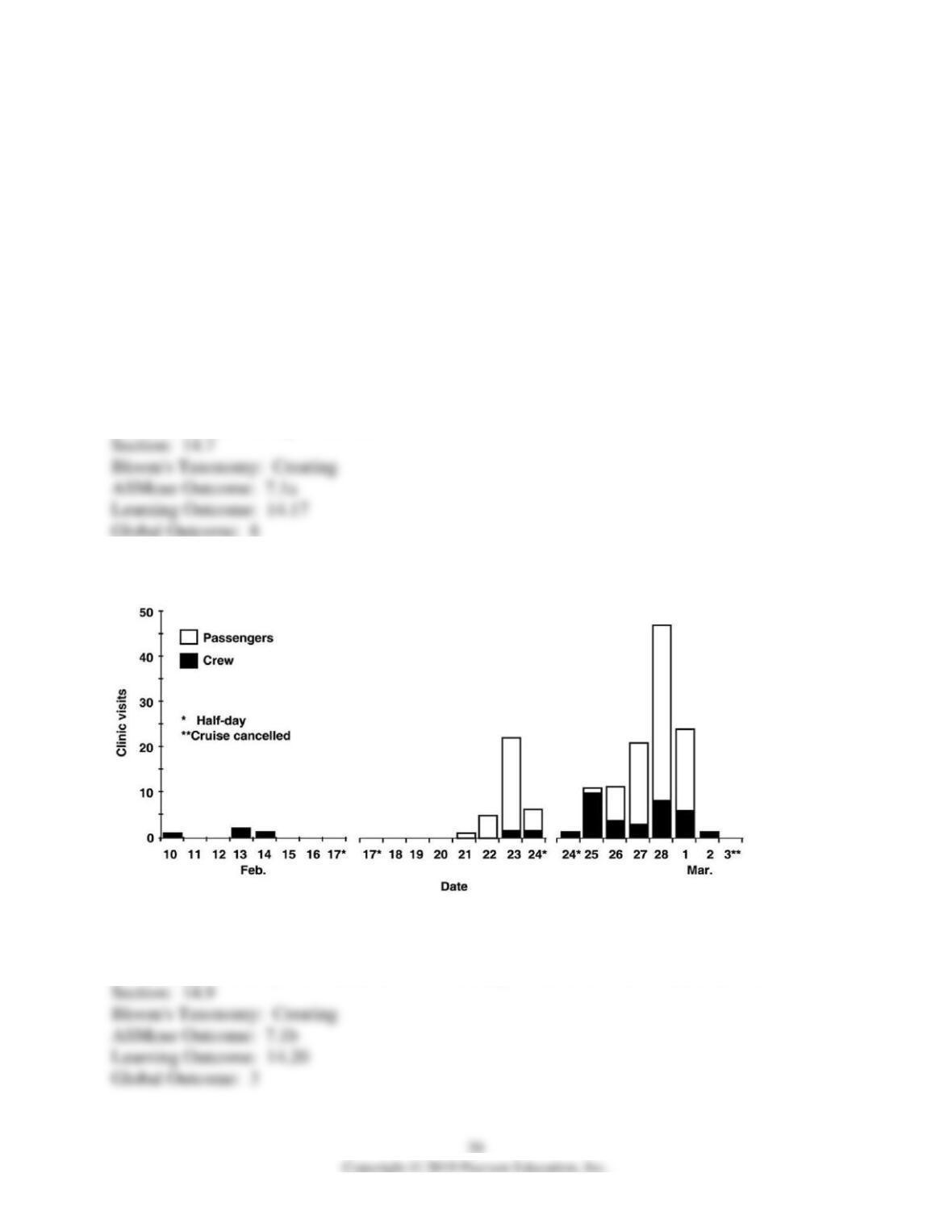
2) Figure 14.4
Salmonella Heidelberg gastroenteritis occurred on three cruises aboard the T.S.S. Festivale.
Figure 14.4 shows on-board clinic visits for diarrheal illness between February 10 and March 3.
Explain the incidence pattern shown on the graph. What are probable modes of transmission?
What changes would you recommend before the ship books more cruises after March 3?
3) Zika virus infection, a zoonotic disease, produced somewhat sizable outbreaks recently in
certain areas of Central America, but not in the U.S (although there were some infected
individuals uncovered in the U.S.). Provide two plausible explanations for this dichotomy, and
explain.
4) When studying the epidemiology of a particular disease, why are retrospective studies
commonly undertaken before prospective studies?
5) Would you expect all EIDs to be on the notifiable infectious disease list? Explain.