47) Which of the following types of mutations could result in a frameshift mutation?
A) a base insertion only
B) a base deletion only
C) a base substitution only
D) deletion of three consecutive bases
E) either an insertion or a deletion of a base
48) Which of the following DNA mutations is likely to have the most negative effect on the
protein it specifies?
A) a base-pair deletion
B) a codon substitution
C) a substitution in the last base of a codon
D) a codon deletion
49) Which small-scale mutation would be most likely to have the greatest negative effect on the
functioning of a protein?
A) a base substitution
B) a base deletion near the start of a gene
C) a base deletion near the end of the coding sequence, but not in the terminator codon
D) deletion of three bases near the start of the coding sequence, but not in the initiator codon
E) a base insertion near the end of the coding sequence, but not in the terminator codon
50) The most commonly occurring mutation in people with cystic fibrosis is a deletion of a
single codon. What is the most likely result of this mutation in the protein product?
A) a base-pair substitution
B) a nucleotide mismatch
C) a frameshift mutation
D) a polypeptide missing an amino acid
E) a nonsense mutation
51) Which of the following mutations is most likely to cause a phenotypic change?
A) a duplication of all or most introns
B) a nucleotide substitution in an exon coding for a transmembrane protein
C) a single nucleotide deletion in an exon coding for an active site of a protein
D) a frameshift mutation one codon away from the 3′ end of the nontemplate strand
52) Which of the following statements is true about protein synthesis in prokaryotes?
A) Extensive RNA processing is required before prokaryotic transcripts can be translated.
B) Translation can begin while transcription is still in progress.
C) Prokaryotic cells have multiple mechanisms for targeting proteins to the appropriate cellular
organelles.
D) Unlike eukaryotes, prokaryotes require no initiation or elongation factors.
53) Of the following, which is the most current and complete description of a gene?
A) a unit of heredity that causes formation of a phenotypic characteristic
B) a DNA subunit that codes for a single complete protein
C) a DNA sequence that is expressed to form a functional product: either RNA or polypeptide
D) a DNA-RNA sequence combination that results in an enzymatic product
E) a discrete unit of hereditary information that consists of a sequence of amino acids
54) In comparing DNA replication with RNA transcription in the same cell, which of the
following is true only of replication?
A) It uses RNA polymerase.
B) It makes a new molecule from its 5′ end to its 3′ end.
C) The process is extremely fast once it is initiated.
D) The process occurs in the nucleus of a eukaryotic cell.
E) The entire template molecule is represented in the product.
55) When the genome of a particular species is said to include 20,000 protein-coding regions,
what does this imply?
A) There are 20,000 genes.
B) Each gene codes for one protein.
C) There are also additional genes for RNAs other than mRNA.
D) The species is highly evolved.
14.2 Art Questions
Figure 14.1
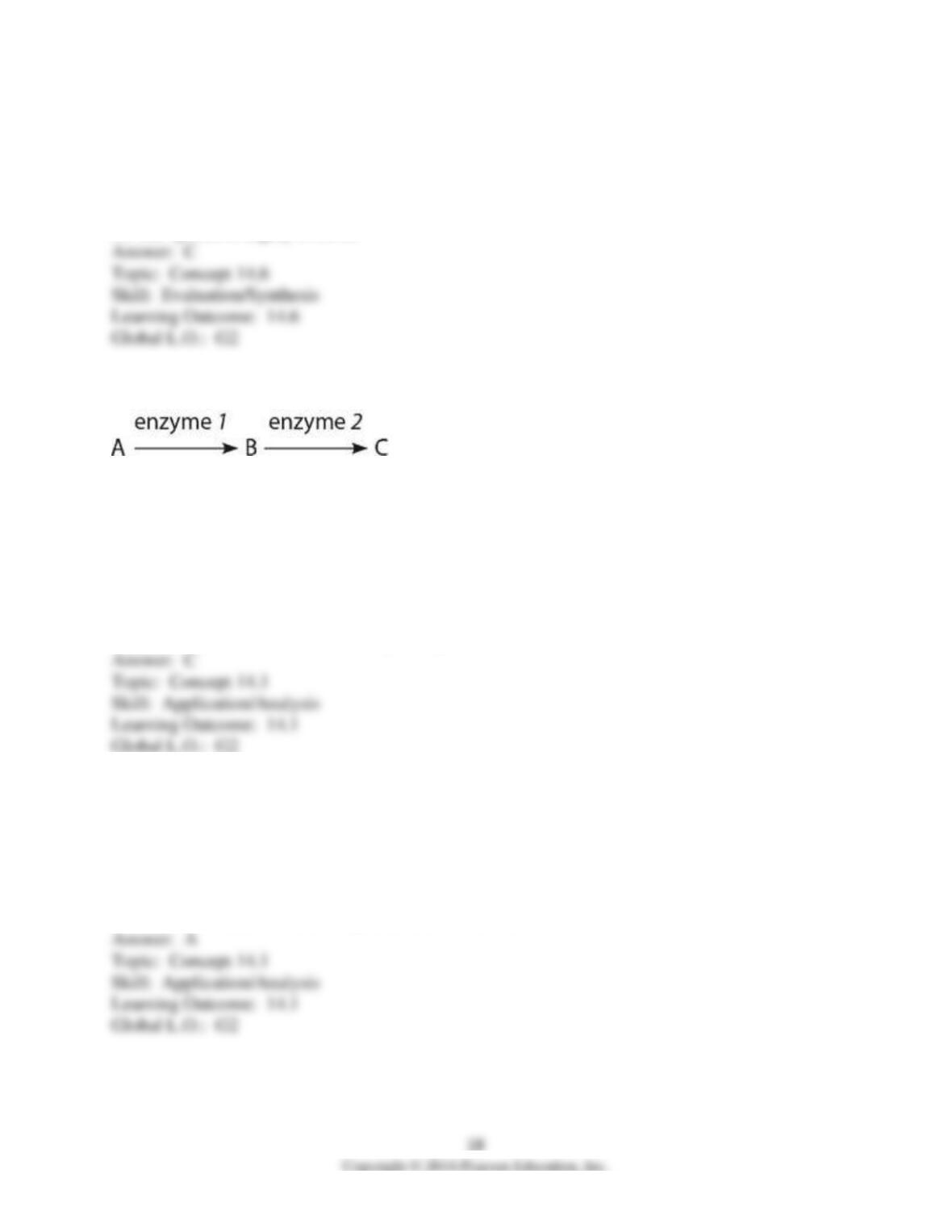
1) Examine the simple metabolic pathway in Figure 14.1. According to Beadle and Tatum’s
hypothesis, how many genes are necessary for this pathway?
A) 0
B) 1
C) 2
D) 3
E) It cannot be determined from the pathway.
2) Examine the simple metabolic pathway in Figure 14.1. A mutation results in a defective
enzyme A. Which of the following results would be a consequence of that mutation?
A) an accumulation of A and no production of B and C
B) an accumulation of A and B and no production of C
C) an accumulation of B and no production of A and C
D) an accumulation of B and C and no production of A
E) an accumulation of C and no production of A and B
3) Examine the simple metabolic pathway in Figure 14.1. If A, B, and C are all required for
growth, a strain that is mutant for the gene-encoding enzyme 1 would be able to grow on which
of the following media?
A) minimal medium
B) minimal medium supplemented with nutrient A only
C) minimal medium supplemented with nutrient B only
D) minimal medium with no supplements
4) Examine the simple metabolic pathway in Figure 14.1. If A, B, and C are all required for
growth, a strain mutant for the gene-encoding enzyme 2 would be capable of growing on which
of the following media?
A) minimal medium
B) minimal medium supplemented with A only
C) minimal medium supplemented with B only
D) minimal medium supplemented with C only
E) minimal medium supplemented with nutrients A and B
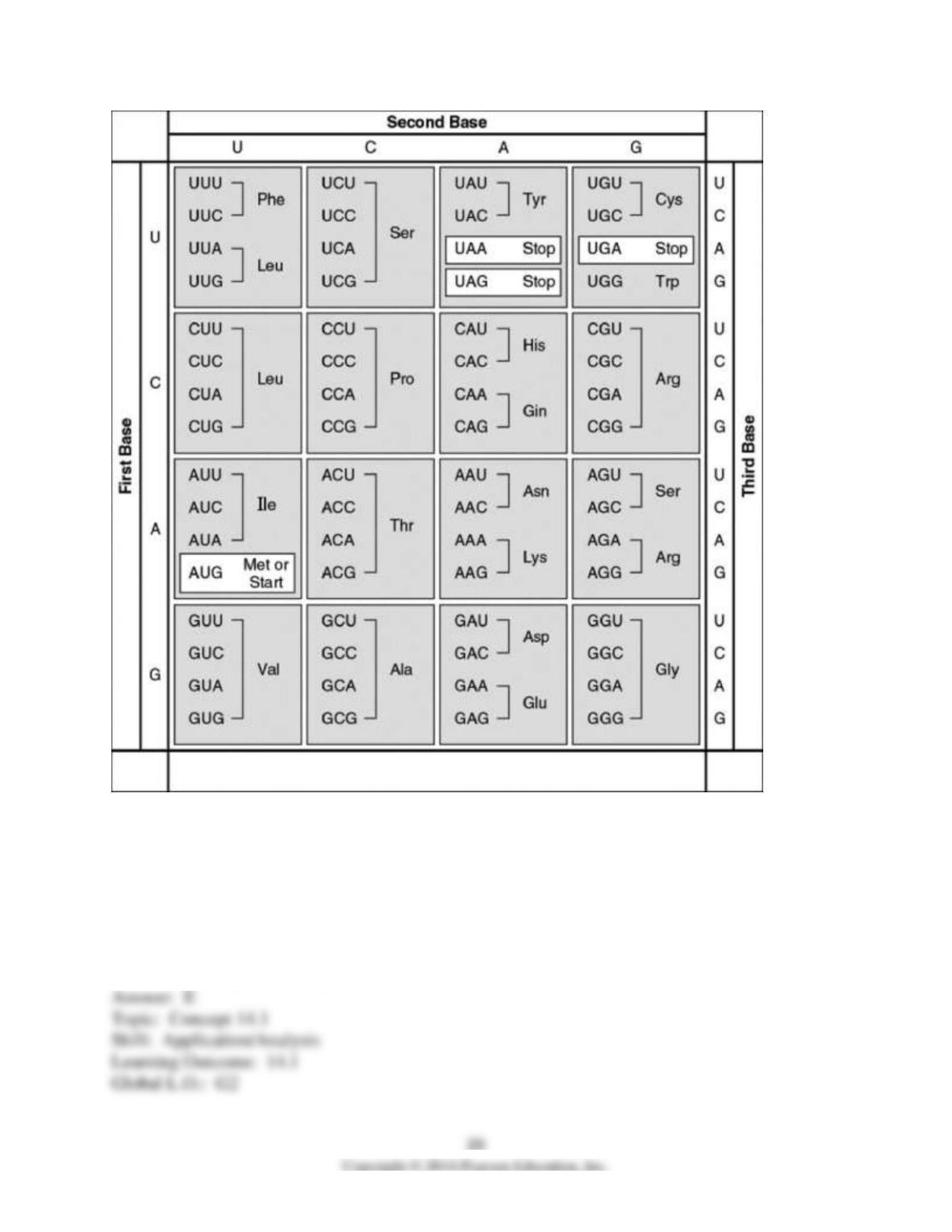
Figure 14.2
5) Examine the table of codons in Figure 14.2. A possible sequence of nucleotides in the
template strand of DNA that would code for the polypeptide sequence phe-leu-ile-val would be
A) 5′-TTG-CTA-CAG-TAG-3′.
B) 3′-AAC–GAC-GUC-AUA-5′.
C) 5′-AUG-CTG-CAG-TAT-3′.
D) 3′-AAA-AAT-ATA-ACA-5′.
E) 3′-AAA–GAA-TAA-CAA-5′.
6) Examine the table of codons in Figure 14.2. What amino acid sequence will be produced
based on the following mRNA codon sequence?
5′-AUG-UCU-UCG-UUA-UCC-UUG-3′
A) met-arg-glu-arg-glu-arg
B) met-glu-arg-arg-glu-leu
C) met-ser-leu-ser-leu-ser
D) met-ser-ser-leu-ser-leu
E) met-leu-phe-arg-glu-glu
7) Examine the table of codons in Figure 14.2. A peptide has the sequence NH2-phe-pro-lys-gly-
phe-pro-COOH. Which of the following sequences in the coding strand of the DNA could code
for this peptide?
A) 3′-UUU-CCC–AAA–GGG-UUU-CCC
B) 3′-AUG–AAA-GGG-TTT–CCC–AAA-GGG
C) 5′-TTT–CCC–AAA-GGG-TTT–CCC
D) 5′-GGG-AAA–TTT-AAA-CCC-ACT-GGG
E) 5′-ACT-TAC-CAT-AAA-CAT-TAC-UGA
Answer: C
Topic: Concept 14.1
Skill: Application/Analysis
Learning Outcome: 14.1
Global L.O.: G2
Figure 14.3
8) Given the locally unwound double strand in Figure 14.3, in which direction does the RNA
polymerase move?
A) 3′ → 5‘ along the template strand
B) 5′ → 3′ along the template strand
C) 3′ → 5′ along the complementary strand
D) 5′ → 3′ along the complementary strand
E) 5′ → 3′ along the double-stranded DNA
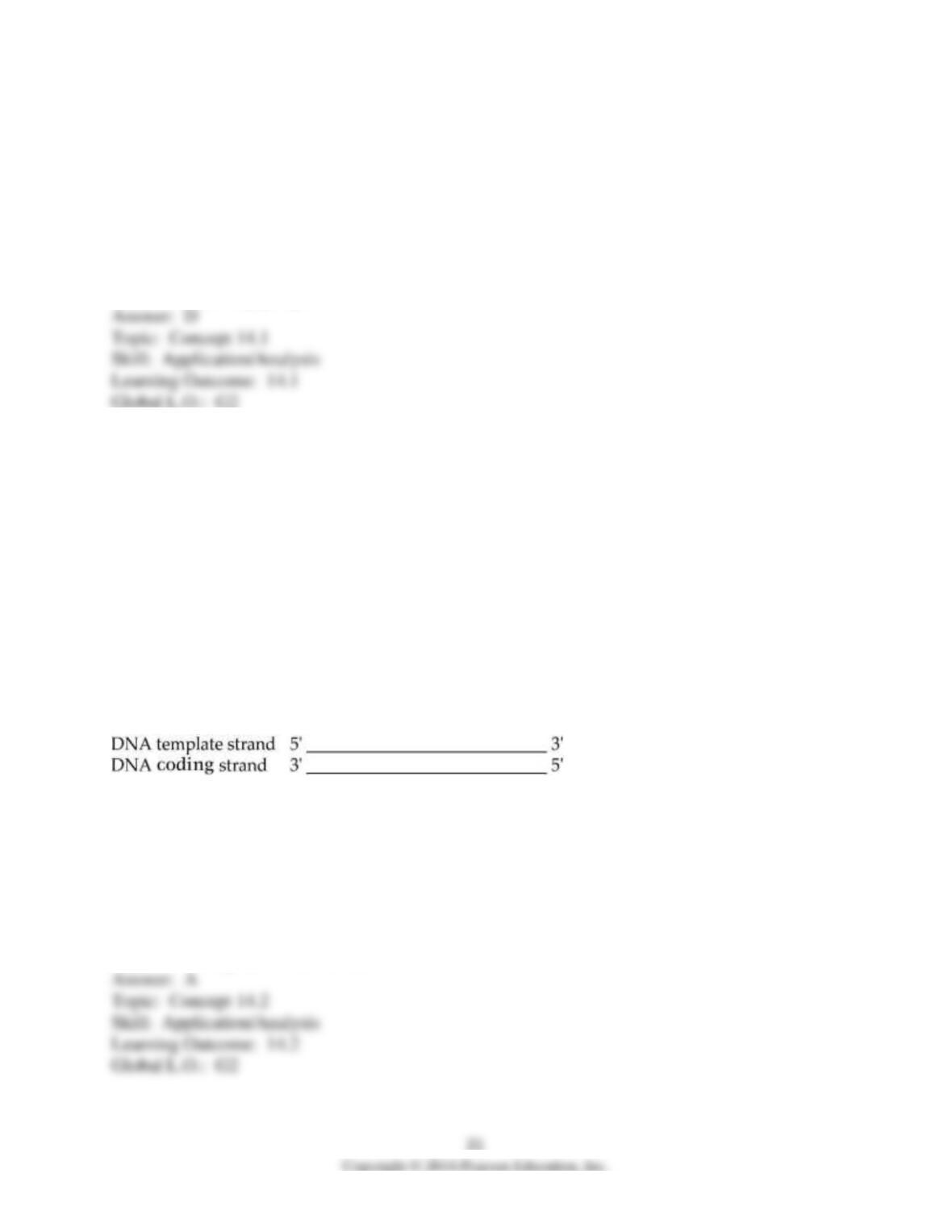
9) In the transcription event of the DNA in Figure 14.3, where would the promoter be located?
A) at the 3′ end of the newly made RNA
B) to the right of the template strand
C) to the left of the template strand
D) to the right of the sense strand
E) to the left of the sense strand
Please use the following information to answer the question(s) below.
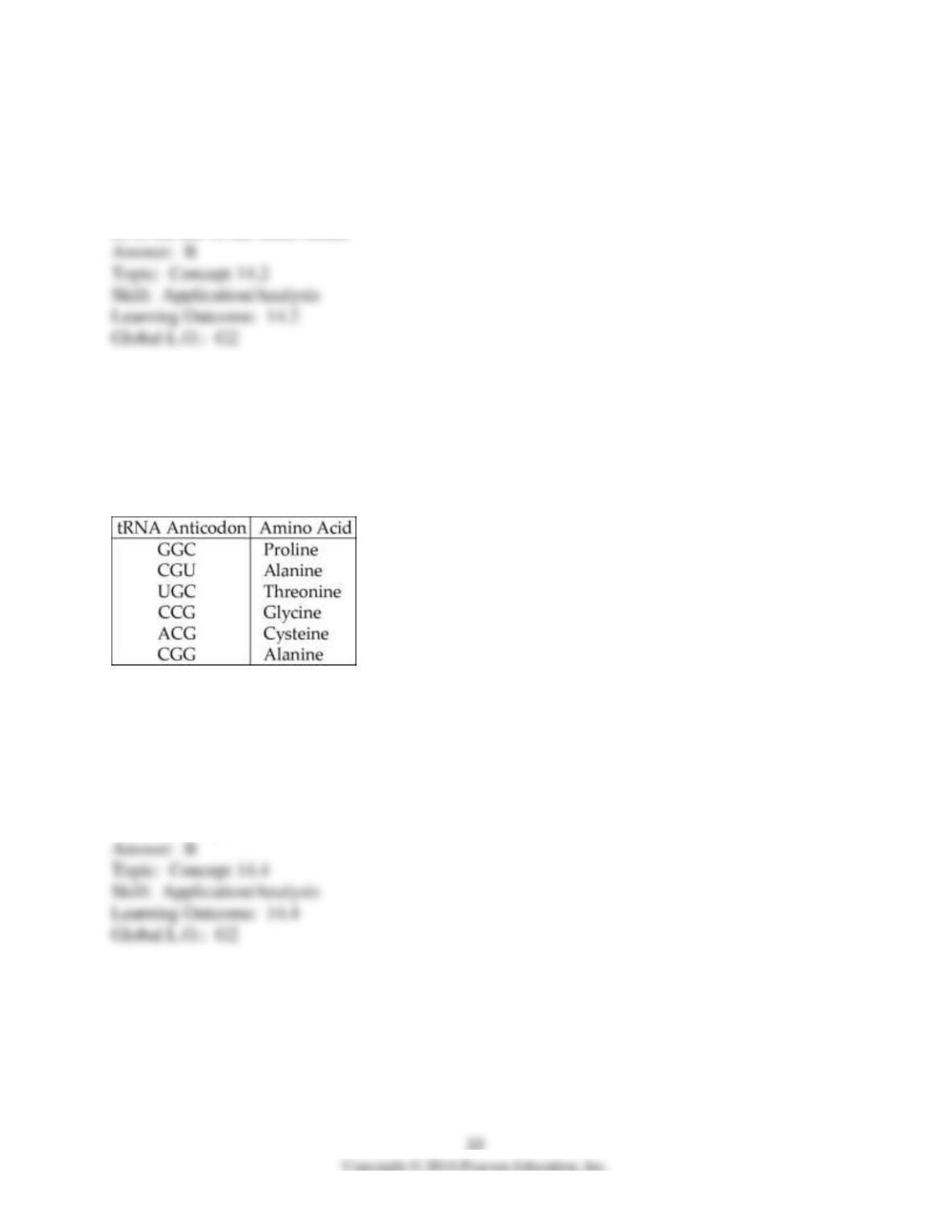
A part of an mRNA molecule with the following sequence is being read by a ribosome: 5′-CCG–
ACG-3′ (mRNA). The charged transfer RNA molecules shown in Figure 14.4 (with their
anticodons shown in the 3′ to 5′ direction) are available. Two of them can correctly match the
mRNA so that a dipeptide can form.
Figure 14.4
10) The dipeptide that will form will be
A) cysteine-alanine.
B) proline-threonine.
C) glycine-cysteine.
D) alanine-alanine.
E) threonine-glycine.
11) The anticodon loop of the first tRNA that will complement this mRNA is
A) 3′-GGC-5′.
B) 5′-GGC-3′.
C) 5′-ACG-3′.
D) 5′-UGC-3′.
E) 3′-UGC-5′.
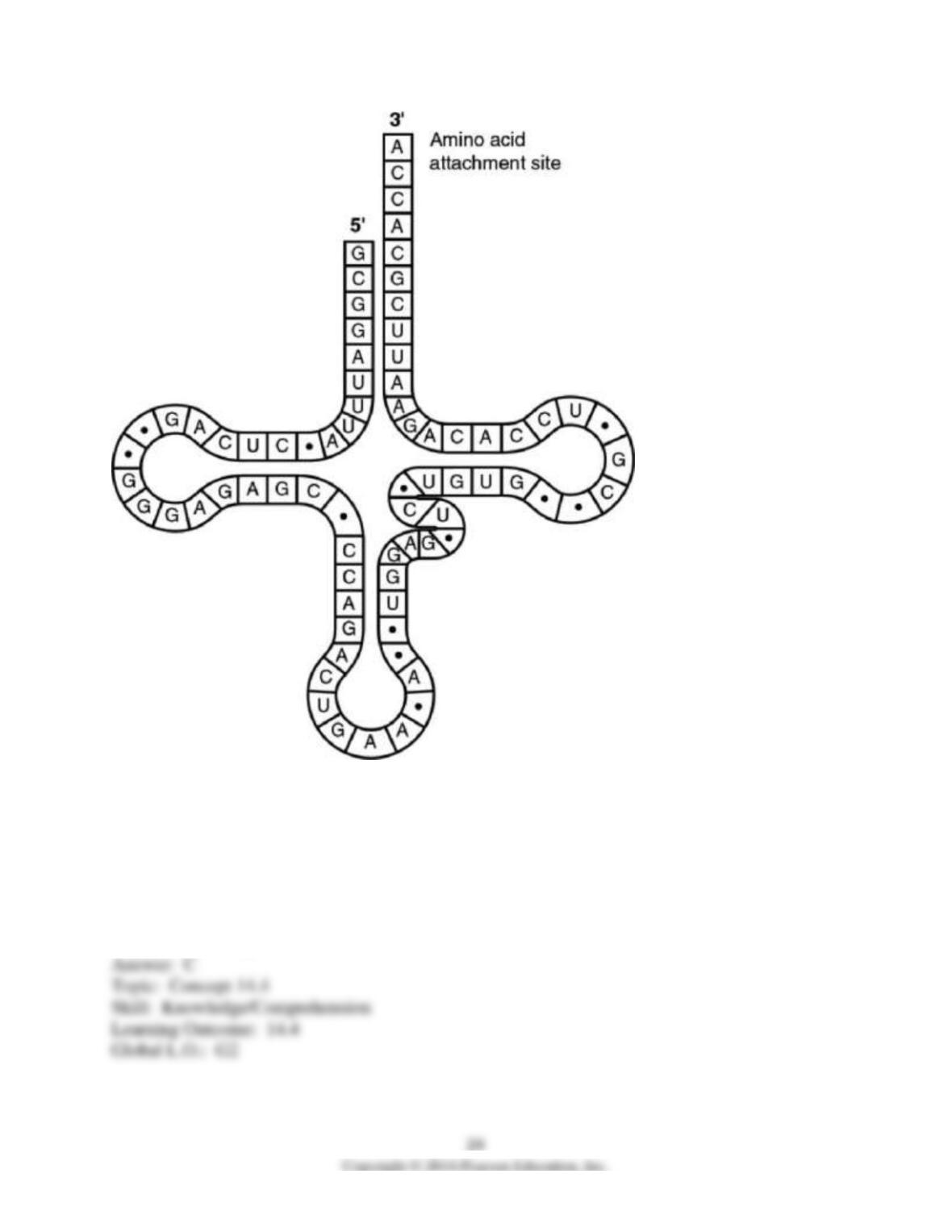
Figure 14.5
12) What type of bonding is responsible for maintaining the shape of the tRNA molecule in
Figure 14.5?
A) covalent bonding between sulfur atoms
B) ionic bonding between phosphates
C) hydrogen bonding between base pairs
D) van der Waals interactions between hydrogen atoms
E) peptide bonding between amino acids
13) Figure 14.5 represents tRNA that recognizes and binds a particular amino acid (in this
instance, phenylalanine). Which codon on the mRNA strand codes for this amino acid?
A) UGG
B) GUG
C) GUA
D) UUC
E) CAU
14) The tRNA shown in Figure 14.5 has its 3′ end projecting beyond its 5′ end. What will occur
at this 3′ end?
A) The codon and anticodon will complement one another.
B) The amino acid will bind covalently.
C) The small and large subunits of the ribosome will attach to it.
D) The 5′ cap of the mRNA will become covalently bound.
14.3 Scenario Questions
Please use the following information to answer the question(s) below.
The enzyme polynucleotide phosphorylase randomly assembles nucleotides into a
polynucleotide polymer.
1) You add polynucleotide phosphorylase to a solution of adenosine triphosphate and guanosine
triphosphate. How many artificial mRNA three-nucleotide codons would be possible?
A) 3
B) 4
C) 8
D) 16
E) 6
2) You add polynucleotide phosphorylase to a solution of ATP, GTP, and UTP. How many
artificial mRNA three-nucleotide codons would be possible?
A) 3
B) 6
C) 9
D) 27
E) 81
Please use the following information to answer the question(s) below.
A transfer RNA (#1) attached to the amino acid lysine enters the ribosome. The lysine binds to
the growing polypeptide on the other tRNA (#2) already in the ribosome.
3) Where does tRNA #2 move to after this bonding of lysine to the polypeptide?
A) A site
B) P site
C) E site
D) exit tunnel
E) directly to the cytosol
4) Which component of the complex described enters the exit tunnel through the large subunit of
the ribosome?
A) tRNA with attached lysine (#1)
B) tRNA with polypeptide (#2)
C) tRNA that no longer has attached amino acid
D) newly formed polypeptide
E) initiation and elongation factors
14.4 End-of-Chapter Questions
1) In eukaryotic cells, transcription cannot begin until
A) the two DNA strands have completely separated and exposed the promoter.
B) several transcription factors have bound to the promoter.
C) the 5′ caps are removed from the mRNA.
D) the DNA introns are removed from the template.
2) Which of the following is not true of a codon?
A) It may code for the same amino acid as another codon.
B) It never codes for more than one amino acid.
C) It extends from one end of a tRNA molecule.
D) It is the basic unit of the genetic code.
3) The anticodon of a particular tRNA molecule is
A) complementary to the corresponding mRNA codon.
B) complementary to the corresponding triplet in rRNA.
C) the part of tRNA that bonds to a specific amino acid.
D) catalytic, making the tRNA a ribozyme.
4) Which of the following is not true of RNA processing?
A) Exons are cut out before mRNA leaves the nucleus.
B) Nucleotides may be added at both ends of the RNA.
C) Ribozymes may function in RNA splicing.
D) RNA splicing can be catalyzed by spliceosomes.
5) Which component is not directly involved in translation?
A) GTP
B) DNA
C) tRNA
D) ribosomes
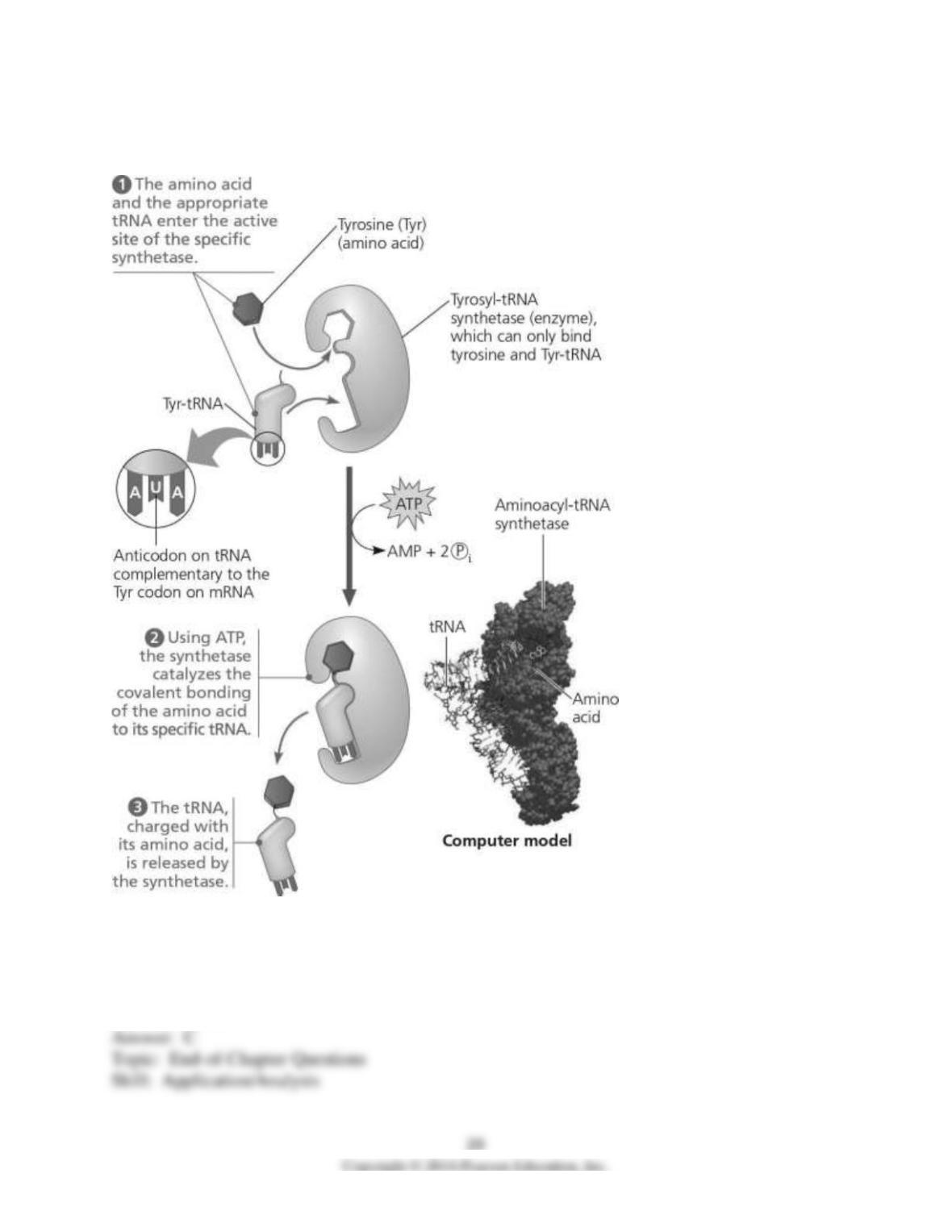
6) Using the figure below, identify a 5′ → 3′ sequence of nucleotides in the DNA template strand
for an mRNA coding for the polypeptide sequence Phe-Pro-Lys.
Figure 14.6
A) 5′-UUUCCCAAA-3′
B) 5′-GAACCCCTT-3′
C) 5′-CTTCGGGAA-3′
D) 5′-AAACCCUUU-3′
7) Which of the following mutations would be most likely to have a harmful effect on an
organism?
A) a deletion of three nucleotides near the middle of a gene
B) a single nucleotide deletion in the middle of an intron
C) a single nucleotide deletion near the end of the coding sequence
D) a single nucleotide insertion downstream of, and close to, the start of the coding sequence