
1
Campbell Essential Biology, 6e (Simon/Dickey/Hogan/Reece)
Chapter 14 How Biological Diversity Evolves
Chapter 14 Learning Outcomes
14 Biology and Society: The Sixth Mass Extinction
14.1. Explain why scientists think we may be at the start of the sixth mass extinction.
14.1 The Origin of Species
14.2 Explain the biological species concept and speciation, providing past and present
examples as well as limitations when applied to all types of living organisms.
14.3 Compare the following, noting examples of each: prezygotic and postzygotic
reproductive barriers; allopatric and sympatric speciation; taxonomy, cladistics, and
systematics; the two-kingdom, five-kingdom, and three-domain systems of classification;
homologous and analogous structures.
14.2 Earth History and Macroevolution
14.4 List, in order, the four broad divisions in the history of Earth and its life and explain how
the boundaries of each division are defined.
14.5 Explain how the age of fossils is determined and how the formation and breakup of the
supercontinent Pangaea affected the evolution of life on Earth.
14 The Process of Science: Did a Meteor Kill the Dinosaurs?
14.6 Explain how an extraterrestrial object could have caused the mass extinction around 65
million years ago, how mass extinctions can be seen as times of great opportunity, and
how the extinction of most of the dinosaurs affected mammalian evolution.
14.3 Mechanisms of Macroevolution
14.7 Explain what is studied in the field of evo-devo, including the role of homeotic genes in
diversity of body forms and exaptations (i.e., the gradual evolution of eyes).
14.8 Describe how paedomorphosis may lead to speciation using human traits as an example.
14.9 Describe the practical applications of phylogenetic trees and how homologies are used to
create classification systems.
14.4 Classifying the Diversity of Life
14.10 Explain how convergent evolution can make interpreting homologies difficult.
Global Learning Outcomes
1. Demonstrate an understanding of the principles of scientific inquiry.
2. Demonstrate the ability to think critically and employ critical-thinking skills.
3. Read and interpret models, graphs, and data.
4. Demonstrate the quantitative skills needed to succeed in biology.
5. Demonstrate an understanding of the impact of science on society.
6. Evaluate the credibility of scientific information from various sources.
7. Demonstrate the ability to make connections between concepts across biology.
8. Communicate effectively in writing.
9. Apply the scientific method in lab experiences to interpret information and draw
conclusions.

14.1 Multiple Choice Questions
1) Which of the following is the strongest piece of evidence for why some scientists believe that
we are at the start of a sixth mass extinction?
A) decrease in biodiversity
B) decrease in fossil discoveries
C) decrease in allopatric species
D) decrease in hybrid fertility
2) Biological species consist of groups of ________.
A) populations
B) domains
C) families
D) genera
3) Under the biological species concept, what criterion is used to assign populations of
organisms to the same biological species?
A) a very similar appearance
B) being able to interbreed and produce fertile offspring
C) responding to the environment in the same way
D) having 99% of their genes in common

4) When brought together in a zoo, two species are capable of mating and producing fertile
offspring. Why may they still be considered two distinct species?
A) Wild populations of the two species have different geographic distributions.
B) In the wild, members of one species prey upon members of the other species.
C) Zoos are not natural environments.
D) The two species look very different.
5) The biological species concept cannot be applied to ________.
A) fungi that live on land
B) bacteria that reproduce only asexually
C) complex plants that have flowers
D) animals that use asexual and sexual reproduction
6) The biological species concept cannot be applied to fossils. Which alternate approach to
identifying species would be most useful for classifying fossil organisms?
A) an approach based on use of reproductive barriers
B) an approach based on genetic history
C) an approach based on measurable physical traits
D) an approach based on molecular biology
7) A reproductive barrier that prevents individuals from closely related species from
interbreeding is an example of ________.
A) a prezygotic barrier
B) allopatric speciation
C) sympatric speciation
D) geographic isolation of populations

8) What type of reproductive isolating mechanism is described by a situation in which female
fireflies mate only with males who emit light in a particular pattern?
A) habitat isolation
B) temporal isolation
C) mechanical isolation
D) behavioral isolation
9) The type of reproductive barrier that occurs when two species mate but produce sterile hybrids
is referred to as ________.
A) mechanical isolation
B) temporal isolation
C) a postzygotic barrier
D) a prezygotic barrier
10) When two frog species, Rana pipiens and Rana sylvatica, mate, the offspring die early in
embryonic development. This is an example of ________.
A) hybrid sterility
B) mechanical isolation
C) reduced hybrid viability
D) reduced hybrid fertility
11) Speciation requires ________.
A) periods of rapid evolutionary change
B) geographic isolation
C) long periods of time
D) genetic isolation

12) Which of the following describes allopatric speciation?
A) A population of squirrels is separated by the Grand Canyon. The two subpopulations evolve
into two distinct species.
B) A tetraploid plant species evolves from a diploid ancestor. Both the tetraploid and diploid
species are found in the same habitat.
C) One population breeds in the fall; another population breeds in the spring.
D) A male horse and a female donkey mate, producing a sterile hinny.
13) Sympatric speciation specifically EXCLUDES ________.
A) behavioral isolation
B) postzygotic barriers
C) geographic isolation
D) temporal isolation
14) Some fish have bony fins. If the body of water they are in dries out, these fins can be used to
help the fish “walk” to another body of water. In this context, bony fins are an example of
________.
A) an exaptation
B) an adaptation
C) a macroevolutionary event
D) paedomorphosis
15) Feathers in birds appear to have first evolved for insulation but later conveyed a new
advantage in helping create light aerodynamic surfaces. This switch in function is an example of
a(n) ________.
A) paedomorphosis
B) an analogy
C) an adaptation
D) exaptation

16) Which of the following would be an example of paedomorphosis?
A) starfish regenerating severed limbs
B) rapid evolution in a small, isolated population
C) two species evolving a similar appearance
D) insects that can reproduce in larval stages without reaching mature development stages
17) The current geological era is the ________.
A) Paleozoic
B) Cenozoic
C) Mesozoic
D) Cambrian
18) Uranium-235, with a half-life of 713,000,000 years, decays to lead-207. If a rock sample is
determined to have one-quarter of the uranium-235 content it had when it formed, the age of the
rock sample can be estimated to be approximately ________ years old.
A) 178 million
B) 713 million
C) 28.5 billion
D) 1.4 billion
19) Plate tectonics has been responsible for instances of all of the following EXCEPT ________.
A) volcanic explosions
B) sympatric speciation
C) allopatric speciation
D) mass extinction
20) The Permian mass extinction is associated with ________.
A) an asteroid impact
B) global warming
C) the formation of Pangaea
D) the diversification of mammals
21) Characid fishes are found naturally only in South America and Africa. Fossils of these fish
are not found on any other continents. What is the most likely explanation of this distribution
pattern?
A) These fishes arose in either Africa or South America and migrated across the South Atlantic
Ocean to the other continent.
B) Characid fishes arose prior to the separation of the African and South American continents.
C) Characid fishes arose in the South Atlantic Ocean and migrated to Africa and South America.
D) Convergent evolution is responsible for the distribution of characid fishes.
22) Dinosaurs (aside from the lineage that produced birds) were extinct by the end of the
________.
A) Cretaceous
B) Silurian
C) Eocene
D) Permian
23) A period of mass extinction is often followed by ________.
A) explosive diversification
B) paedomorphosis
C) global warming
D) continental drift

24) ________ is the discipline of biology that focuses on classifying organisms and determining
their evolutionary relationships.
A) Taxonomy
B) Evo-devo
C) Systematics
D) Biogeography
25) The science of naming, identifying, and classifying organisms is called ________.
A) biogeography
B) systematics
C) phylogeny
D) taxonomy
26) Which of the following taxonomic levels is most inclusive?
A) order
B) genus
C) family
D) class
27) Of the following taxonomic levels, species found within the same ________ are the most
closely related.
A) family
B) phylum
C) order
D) domain

28) The wing of a bald eagle is ________ the wing of a penguin.
A) convergent with
B) homologous to
C) unrelated to
D) analogous to
29) The wing of a penguin is ________ the wing of a butterfly.
A) structurally identical to
B) superior to
C) homologous to
D) analogous to
30) Homology is evidence of ________.
A) convergent evolution
B) polyploidy
C) common ancestry
D) paedomorphosis
31) Analogous structures are evidence of ________.
A) common ancestry
B) divergent evolution
C) stabilizing selection
D) convergent evolution
32) Molecular systematics might examine all of the following types of data EXCEPT ________.
A) proteins
B) DNA sequences
C) amino acid sequences
D) anatomical features
33) An ancestral species and all its evolutionary descendants define a(n) ________.
A) outgroup
B) clade
C) genus
D) ingroup
34) Which one of the following is the only domain that contains eukaryotes?
A) Animalia
B) Plantae
C) Archaea
D) Eukarya
35) When you go outside, it is common to hear a variety of bird songs. These songs vary among
bird species as well as bird flocks. Interestingly, some bird species that are highly unrelated have
very similar song qualities. What can you conclude from this phenomenon?
A) The bird songs are homologous traits.
B) The bird songs have achieved speciation after coming from allopatric species.
C) The bird songs are analogous traits.
D) The bird songs have different molecular DNA.

36) What hypothesis did Luis and Walter Alvarez test in relation to the mass extinction of
dinosaurs 65 million years ago (MYA)?
A) The mass extinction 65 MYA was caused by a surge of catastrophic cyclones.
B) The mass extinction 65 MYA was caused by a slow but steady increase in climate
temperatures.
C) The mass extinction 65 MYA was caused by an impact of an extraterrestrial object.
D) The mass extinction 65 MYA was caused by the loss of preferred plants for food.
37) Why is it INCORRECT to assume that mass extinctions carry only negative impact on the
evolution of life on Earth?
A) Mass extinctions are sometimes followed by periods of evolutionary change when other
organism groups can flourish and expand in diversity and size.
B) Mass extinctions enable scientists to better study embryonic development in two species of
organisms and therefore identify possible homology.
C) Mass extinctions enable scientists to better study paedomorphosis.
D) Mass extinctions disprove Darwin’s theory of evolution.
14.2 Art Questions
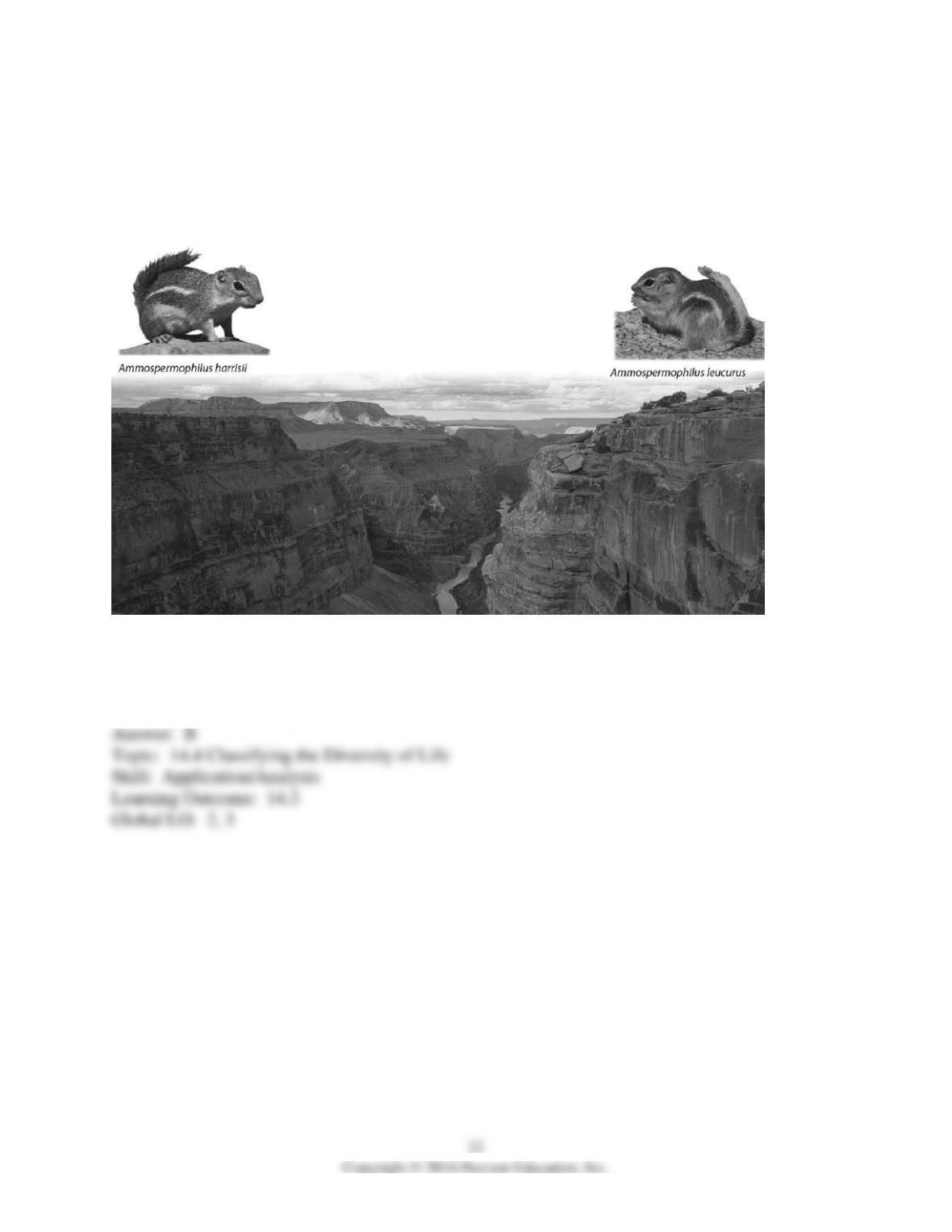
1) Examine the two squirrel populations in the following figure. The populations are separated
by a geographic barrier. If after a long period of time the two species are no longer separated,
what evidence is needed to determine if speciation has occurred?
A) Hybrid offspring of the two populations begin to appear.
B) The two populations are not interbreeding freely.
C) One species will increase into a population size twice as large as the other species.
D) Polyploidy is creating new species.
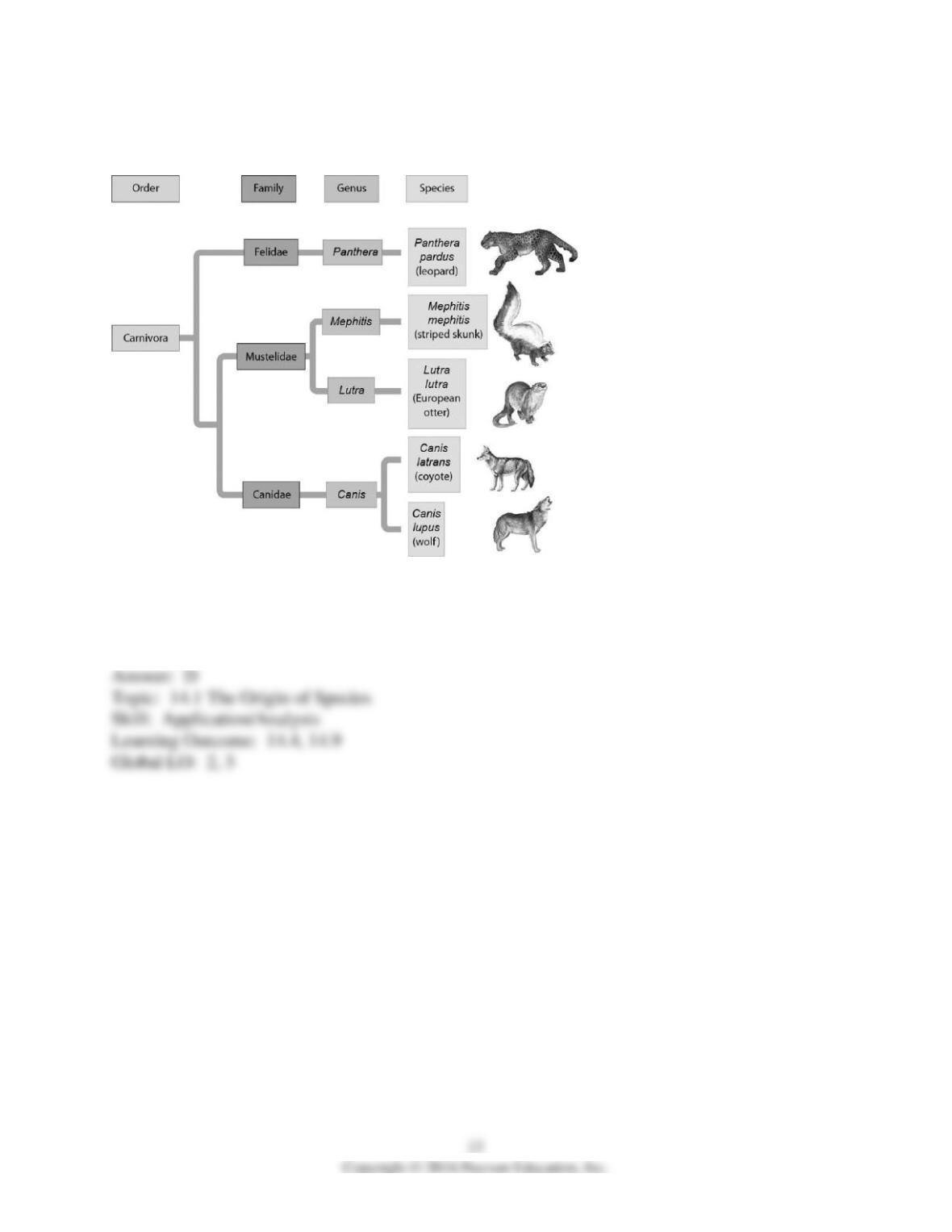
2) Examine the evolutionary relationships represented in the following figure. Based upon this
diagram, the two most closely related species are ________.
A) leopards and striped skunks
B) leopards and European otters
C) European otters and coyotes
D) coyotes and wolves
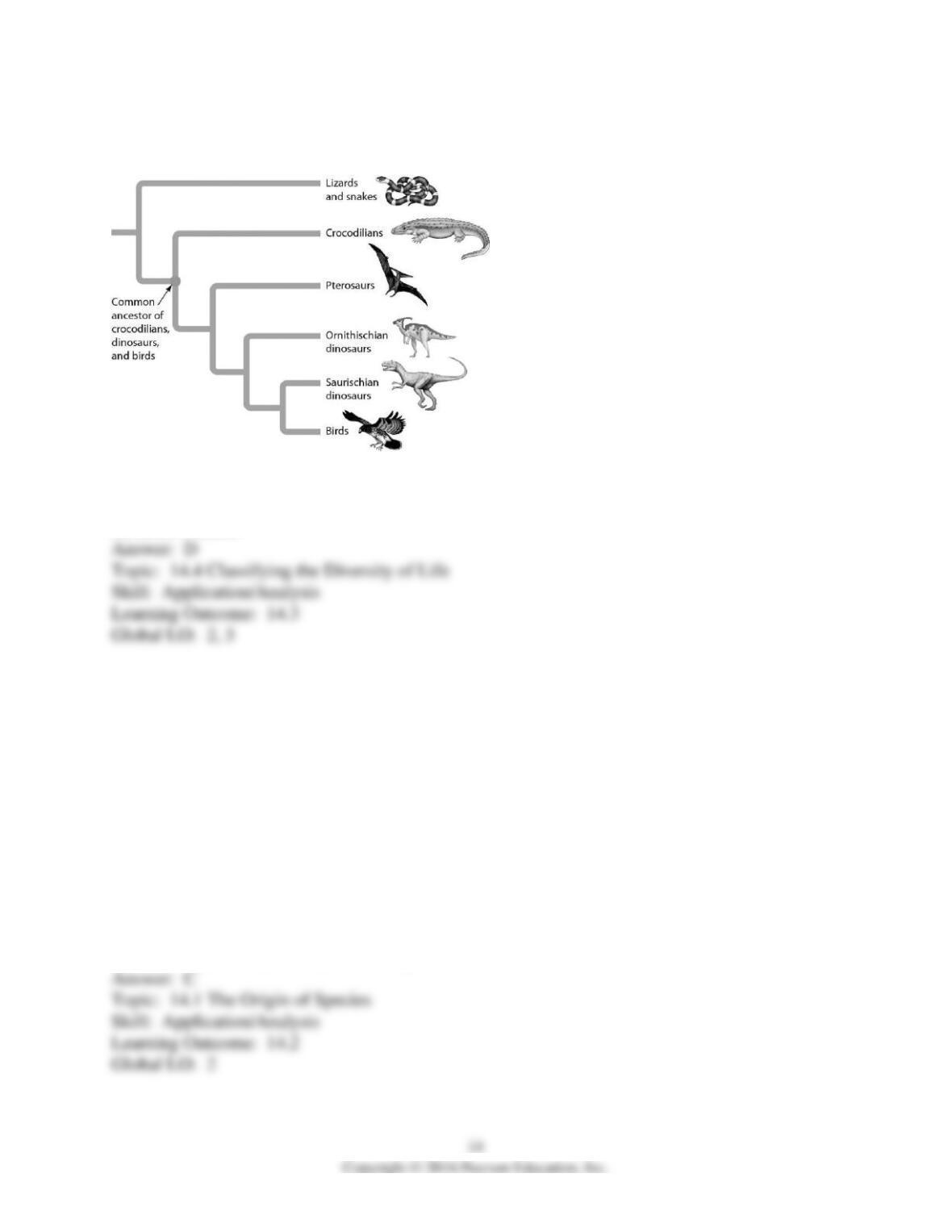
3) Examine the figure below. According to the figure, cladistic analysis indicates that crocodiles
are more closely related to ________ than to ________.
A) birds… pterosaurs
B) snakes… birds
C) Ornithischian dinosaurs… pterosaurs
D) birds… lizards
14.3 Scenario Questions
Read the following scenario to answer the following questions.
In some zoos, rare crosses between a male lion and a female tiger have produced hybrid
offspring called “ligers.” Male ligers are sterile but some female ligers are fertile. In the wild,
lion and tiger ranges do not naturally overlap, making such a cross unlikely. Furthermore, the
solitary behavior of tigers and the social organizations of lions create behavioral differences.
1) Applying the biological species concept, the sterility of ligers reveals that ________.
A) a new species called “ligers” is forming
B) tigers and lions are actually the same species
C) tigers and lions are separate species
D) lions are probably a subspecies of tigers

2) The natural differences in the ranges of wild tigers and lions is an example of ________.
A) a prezygotic barrier
B) a postzygotic barrier
C) the impact of mutations
D) sympatric speciation
3) The production of sterile male ligers is an example of ________.
A) sympatric speciation
B) the founder effect
C) a postzygotic barrier
D) a prezygotic barrier
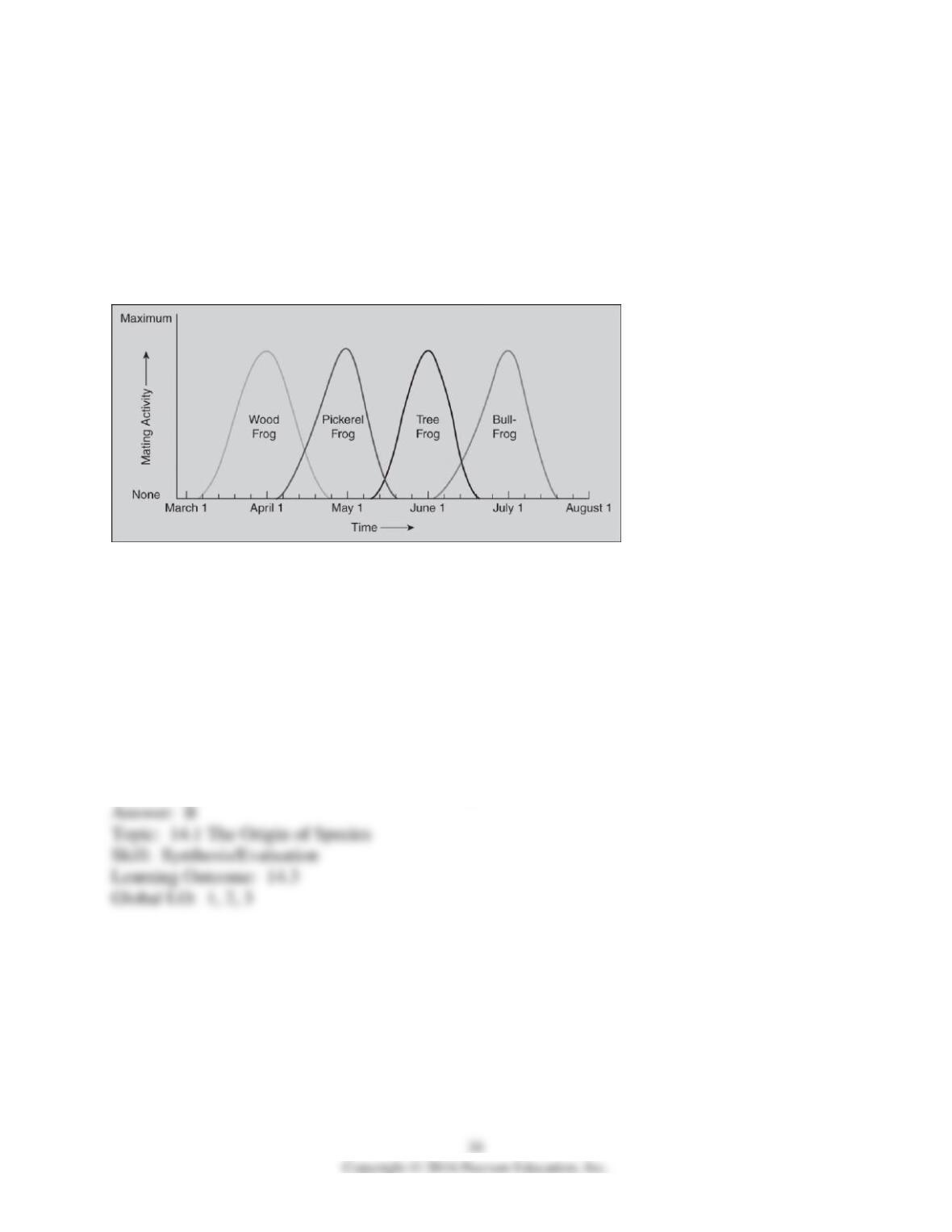
Read the following scenario to answer the following questions.
As part of a semester-long biology field research course, you are studying reproductive barriers
among four different frog species. Your goal is to determine what type of reproductive barrier
likely causes the gene pools of the four different frog species to be isolated. These four species
share common geographic habitats and are both anatomically and gametically compatible. Your
research professor gives you the following figure to consider. After studying the figure, answer
the questions that follow.
4) If the researchers of this study wanted to collect reliable data about natural behavior, which
methodology should they choose?
A) The researchers collected multiple male and female frogs from each species and studied them
in a lab environment to determine their normal breeding seasons.
B) The researchers studied multiple male and female frogs from each species in their natural
environments to determine their normal breeding seasons.
C) The researchers collected multiple male and female frogs from each species, mixed males and
females from each species, and studied the mixed pairs in a lab environment to determine their
normal breeding seasons.
D) The researchers studied one male and female frog from each species in their natural
environments to determine their normal breeding seasons.

5) Based on the independent and dependent variables represented in the figure and the
information you have about common geographic habitats as well as anatomical and gametic
compatibility of the four frog species, you initially conclude that reproductive barriers may be
due to ________.
A) habitat isolation
B) mechanical isolation
C) temporal isolation
D) gametic isolation
6) What can you conclude about the breeding characteristics of these four frog species?
A) The maximum mating activity of the four frog species at different times reduces and/or
removes interbreeding.
B) The minimum mating activity of the four frog species at different times reduces and/or
removes interbreeding.
C) The average mating activity of the four frog species at different times reduces and/or removes
interbreeding.
D) The individual mating activity of each of the four frog species at the beginning of their
mating periods reduces and/or removes interbreeding.