CHAPTER 14
Energy Conversion: Mitochondria and Chloroplasts
Questions
14-1 You want to study the biochemical properties of the respiratory enzyme
complexes required for oxidative phosphorylation. Your initial goal is to measure
proton pumping by the NADH dehydrogenase complex. You mix purified NADH
dehydrogenase complex with phospholipids and a pH indicator dye that changes
color at acidic pH, and you follow a protocol for making liposomes. After
verifying that the protein complex was incorporated into liposomes, you add
NADH and incubate at 37°C. You are dismayed to observe no color change in the
pH indicator dye.
A. One labmate says the result is not surprising, because you forgot to add a
key component. What is this key component? Explain why it is important.
B. Another labmate suggests that the failure to observe a pH change occurred
because protein complexes are inserted in the lipid bilayer in both possible
orientations. Do you agree that this might prevent the establishment of a
pH gradient in your experiment?
14-2 Consider a redox reaction between molecules A and B. Molecule A has a redox
potential of –100 mV and molecule B has a redox potential of +100 mV. For the
transfer of electrons from A to B, is the G° positive or negative or zero? Under
what conditions will the reverse reaction, transfer of electrons from B to A,
occur?
14-3 Which of the following reactions have a large enough free-energy change to
enable it to be used, in principle, to provide the energy needed to synthesize one
molecule of ATP from ADP and Pi under standard conditions? See Table Q14-3.
Recall that G°
= –n F E0 (where F is a constant, 0.023, and n is the
number of electrons transferred) and that E0 = E0 (acceptor) – E0 (donor). For
the ATP synthesis reaction, G° is –7.3 kcal/mol, which corresponds to G°/F =
313 mV.
(a) The reduction of a molecule of pyruvate by NADH.
(b) The reduction of a molecule of cytochrome b by NADH.
(c) The reduction of a molecule of cytochrome b by reduced ubiquinone.
(d) The oxidation of a molecule of reduced ubiquinone by cytochrome c.
(e) The oxidation of cytochrome c by oxygen.
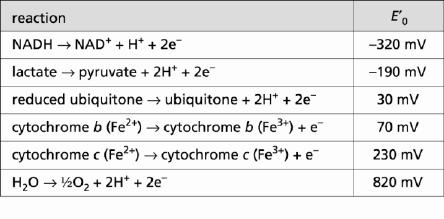
Table Q14-3
14-4 Consider what will happen to a cell if an H+ ionophore causes a partial dissipation
of the electrochemical gradient across the mitochondrial inner membrane,
reducing the gradient from 200 mV to 100 mV.
A. Will oxygen consumption increase or decrease? Will proton pumping
increase or decrease? Explain.
B. Will the ratio of ATP to ADP increase or decrease? Explain.
C. Will the G for the ATP synthesis reaction increase or decrease or remain
the same? Explain.
14-5 Both chloroplasts and mitochondria use electron transport chains to convert the
energy from high-energy electrons into a form of potential energy, an
electrochemical gradient across an internal membrane. This potential energy is
then converted into chemical energy in the form of a high-energy phosphate bond
in ATP via a so-called proton-motive force: the highly favorable thermodynamic
release of energy as protons flow down the gradient across this internal
membrane. In both organelles, ATP synthase harnesses the energy released by the
proton flow to form ATP from ADP and Pi.
A. What is the source of high-energy electrons for chloroplasts? What is the
source of high-energy electrons for mitochondria?
B. What is the name of the membrane in each organelle in which the electron
transport chain and the ATP synthase reside?
C. For each organelle, what is the name of the space into which the protons
are pumped to generate the proton-motive force?
D. The proton-motive force in both organelles is about 180 mV. In both
organelles, the compartment where ATP is synthesized is maintained at
pH 7.5. The pH difference, a measure of the difference in proton
concentration between the two sides of the membrane, is 3.0 in
chloroplasts and 0.3–0.5 in mitochondria. Why must the pH difference be
kept so small in mitochondria? Given the small pH difference, how can
the proton-motive force be so high in mitochondria?
14-6 Below is a picture of the Z scheme of noncyclic photophosphorylation (Figure
Q14-6). Superimposed on this, in gray shading, is the reaction loop involved in
cyclic photophosphorylation.
A. What chemical reactions do the squiggly vertical lines designate?
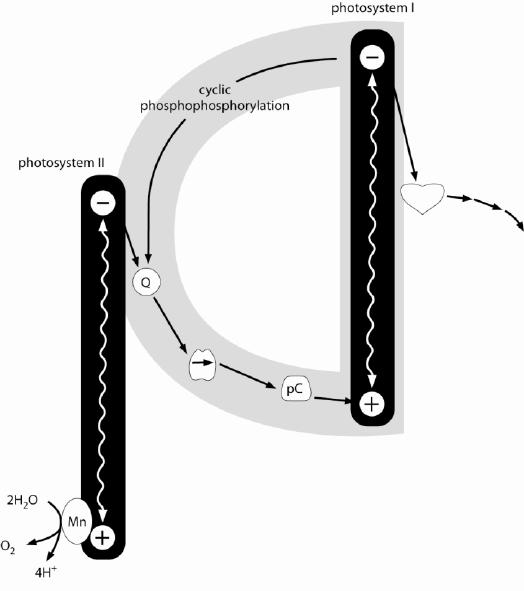
B. What products of noncyclic photophosphorylation do the so-called dark
reactions require? What products of cyclic photophosphorylation do the
dark reactions require? Indicate on the figure where these products are
made.
C. Why does the chloroplast need cyclic photophosphorylation?
Figure Q14-6
14-7 You discover a mutant yeast strain that cannot grow when provided with pyruvate
as its sole carbohydrate, although it grows normally when given glucose as a
carbon energy source; you call this the Pyr– trait. Wild-type yeast can grow well
using either carbon source; you designate this the Pyr+ trait. You suspect that the
mutant yeast have defective mitochondria.
A. Why is mitochondrial function critical for growing on pyruvate?
B. You want to determine whether the mutation responsible for the Pyr– trait
is carried in the nuclear or mitochondrial genome. Your experiment is to
mate Pyr– haploid cells to Pyr+ haploid cells and examine segregation of
the trait in the progeny. After mating, the hybrid diploid cells can grow on
pyruvate (Pyr+). You send these diploid cells through meiosis and examine
the four haploid cells generated from a single diploid cell. If the mutation
is in mitochrondrial DNA, will the four haploid cells probably be all Pyr–,
all Pyr+, or a combination? What if the mutation is in nuclear DNA?
C. Consider a hereditary human disease that involves mitochondrial
dysfunction. Jane has the disease and she marries Joe, who does not have
the disease. They have two sons and two daughters, who all have the
disease. Each of the four children grows up, marries a spouse without the
disease, and has a son and a daughter. What is the most likely condition
(diseased or not) of Jane’s eight grandchildren if the mutation responsible
for the disease is in mitochondrial DNA? What if it is in nuclear DNA?
14-8 Consider the following statement. “When a chlorophyll molecule within an
antenna complex absorbs a photon of sunlight, one of its electrons jumps up to a
high-energy state. This excited electron is then transferred directly to the
photochemical reaction center to initiate the electron transport chain.” Identify
and explain the two errors in the second sentence of the statement. In your
answer, refer to the properties of resonance energy transfer.
Answers