42) How does a bacterial cell protect its own DNA from restriction enzymes?
A) by adding methyl groups to adenines and cytosines
B) by using DNA ligase to seal the bacterial DNA into a closed circle
C) by adding histones to protect the double-stranded DNA
D) by forming “sticky ends” of bacterial DNA to prevent the enzyme from attaching
43) What is the most logical sequence of steps for splicing foreign DNA into a plasmid and
inserting the plasmid into a bacterium?
A) Transform bacteria with a recombinant DNA molecule. Cut the plasmid DNA using
restriction enzymes. Hydrogen-bond the plasmid DNA to nonplasmid DNA fragments. Extract
plasmid DNA from bacterial cells. Use ligase to seal plasmid DNA to nonplasmid DNA.
B) Cut the plasmid DNA using restriction enzymes. Hydrogen-bond the plasmid DNA to
nonplasmid DNA fragments. Use ligase to seal plasmid DNA to nonplasmid DNA. Extract
plasmid DNA from bacterial cells. Transform bacteria with a recombinant DNA molecule.
C) Extract plasmid DNA from bacterial cells. Cut the plasmid DNA using restriction enzymes.
Hydrogen-bond the plasmid DNA to nonplasmid DNA fragments. Use ligase to seal plasmid
DNA to nonplasmid DNA. Transform bacteria with a recombinant DNA molecule.
D) Extract plasmid DNA from bacterial cells. Hydrogen-bond the plasmid DNA to nonplasmid
DNA fragments. Use ligase to seal plasmid DNA to nonplasmid DNA. Transform bacteria with a
recombinant DNA molecule. Cut the plasmid DNA using restriction enzymes.
44) Why is it so important to be able to amplify DNA fragments when studying genes?
A) DNA fragments are too small to use individually.
B) A gene may represent only a millionth of the cell’s DNA.
C) Restriction enzymes cut DNA into fragments that are too small.
D) A clone requires multiple copies of each gene per clone.
E) It is important to have multiple copies of DNA in the case of laboratory error.

45) Which of the following statements accurately describes why Taq polymerase is used in PCR?
A) It is heat stable and can withstand the heating step of PCR.
B) Only minute amounts are needed for each cycle of PCR.
C) It binds more readily than other polymerases to the primers.
D) It has regions that are complementary to the primers.
E) It is heat stable, and it binds more readily than other polymerases to the primers.
13.2 Art Questions
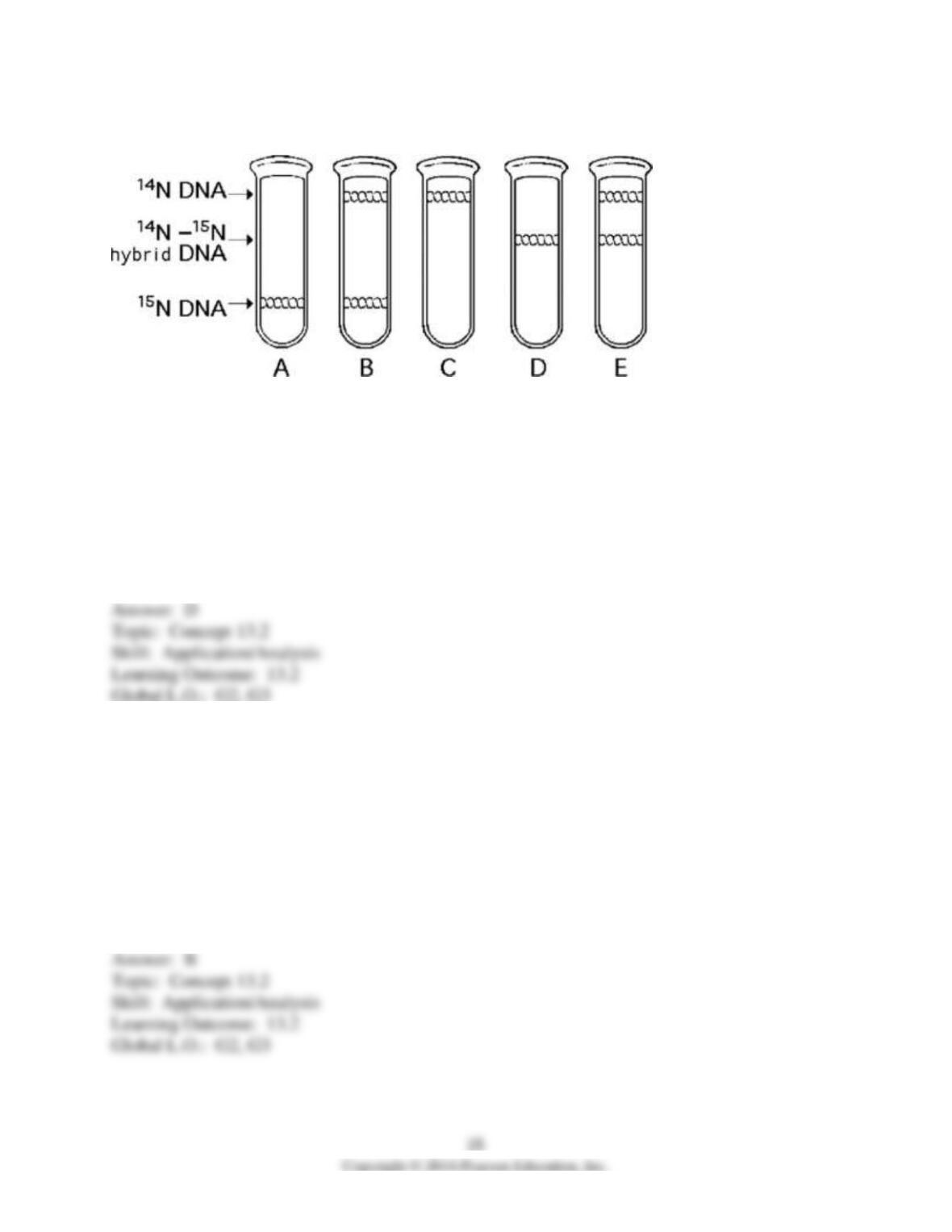
Figure 13.1
1) In the late 1950s, Meselson and Stahl grew bacteria in a medium containing “heavy” nitrogen
(15N) and then transferred them to a medium containing 14N. Which of the results in Figure
13.1 would be expected after one round of DNA replication in the presence of 14N?
A) A
B) B
C) C
D) D
E) E
2) A space probe returns with a culture of a microorganism found on a distant planet. Analysis
shows that it is a carbon-based life-form that has DNA. You grow the cells in 15N medium for
several generations and then transfer them to 14N medium. Which pattern in Figure 13.1 would
you expect after one round of DNA replication if the DNA was replicated in a conservative
manner?
A) A
B) B
C) C
D) D
E) E
3) Once the pattern found after one round of replication was observed, Meselson and Stahl could
be confident of which of the following conclusions?
A) Replication is semiconservative.
B) Replication is not dispersive.
C) Replication is not semiconservative.
D) Replication is not conservative.
E) Replication is neither dispersive nor conservative.
4)
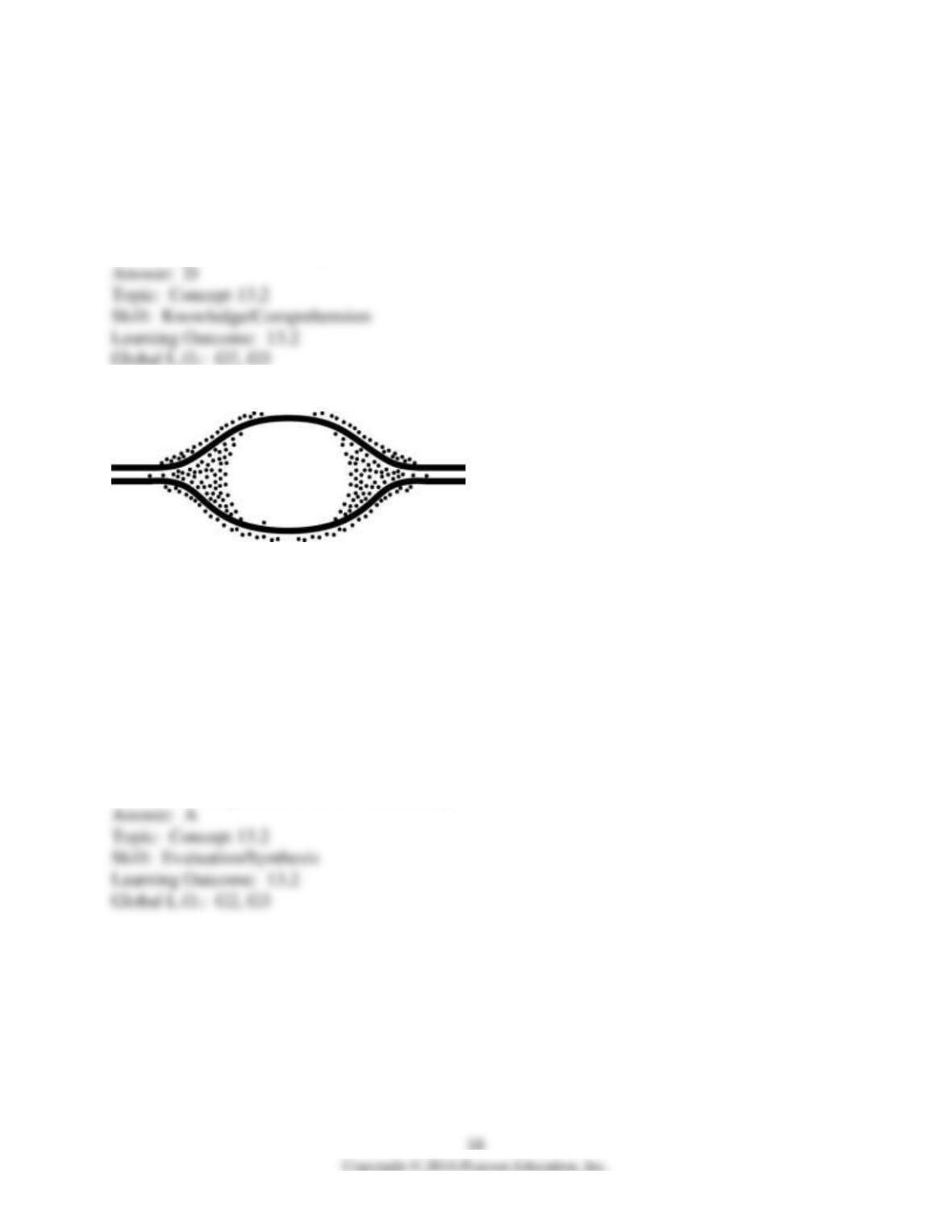
Figure 13.2
In an experiment, DNA is allowed to replicate in an environment with all necessary enzymes,
dATP, dCTP, dGTP, and radioactively labeled dTTP (3H thymidine). After several minutes, the
DNA is switched to nonradioactive medium and is then viewed by electron microscopy and
autoradiography. Figure 13.2 represents the results. It shows a replication bubble, and the dots
represent radioactive material. Which of the following is the most likely interpretation of the
results?
A) There are two replication forks going in opposite directions.
B) Thymidine is being added only where the DNA strands are farthest apart.
C) Thymidine is being added only at the very beginning of replication.
D) Replication proceeds in one direction only.
5)
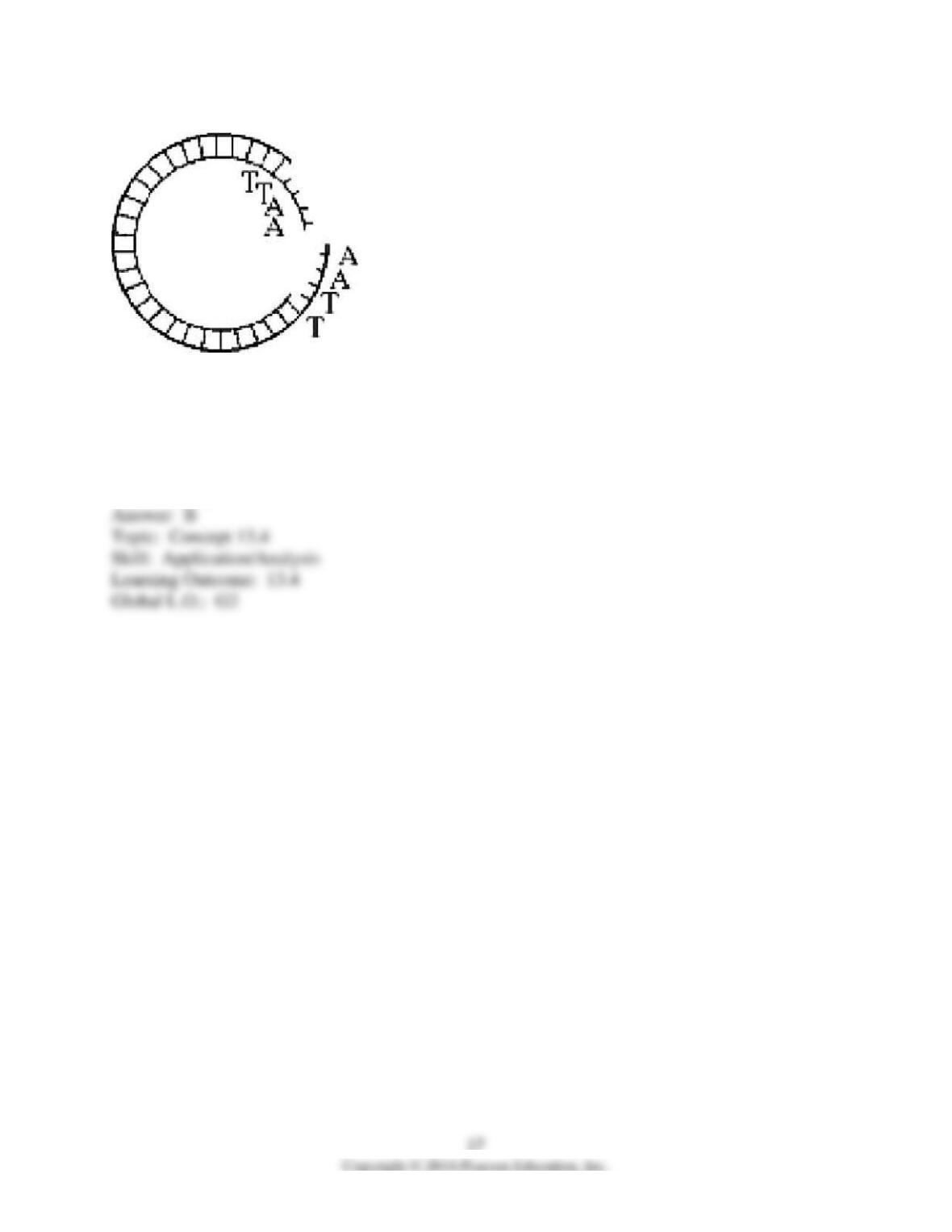
Figure 13.3
Which enzyme was used to produce the molecule in Figure 13.3?
A) ligase
B) a restriction enzyme
C) RNA polymerase
D) DNA polymerase
6)
Figure 13.4
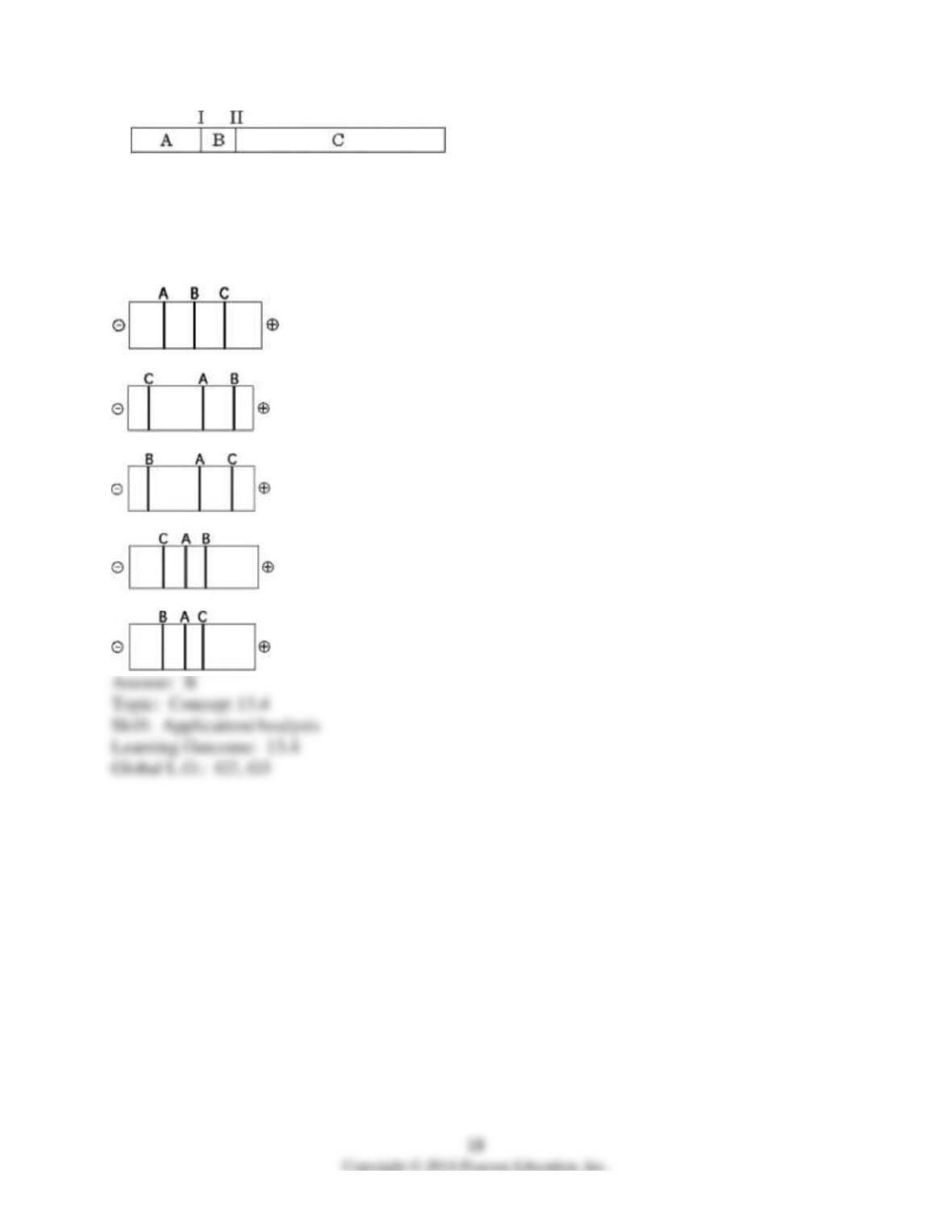
The segment of DNA shown in Figure 13.4 has restriction sites I and II, which create restriction
fragments A, B, and C. Which of the gels produced by electrophoresis shown below best
represents the separation and identity of these fragments?
A)
B)
C)
D)
E)

1) For a science fair project, two students decided to repeat the Hershey and Chase experiment,
with modifications. They decided to label the nitrogen of the DNA, rather than the phosphate.
They reasoned that each nucleotide has only one phosphate and two to five nitrogens. Thus,
labeling the nitrogens would provide a stronger signal than labeling the phosphates. Why won’t
this experiment work?
A) There is no radioactive isotope of nitrogen.
B) Avery et al. have already concluded that this experiment showed inconclusive results.
C) Although there are more nitrogens in a nucleotide, labeled phosphates actually have 16 extra
neutrons; therefore, they are more radioactive.
D) Amino acids (and thus proteins) also have nitrogen atoms; thus, the radioactivity would not
distinguish between DNA and proteins.
2) You briefly expose bacteria undergoing DNA replication to radioactively labeled nucleotides.
When you centrifuge the DNA isolated from the bacteria, the DNA separates into two classes.
One class of labeled DNA includes very large molecules (thousands or even millions of
nucleotides long), and the other includes short stretches of DNA (several hundred to a few
thousand nucleotides in length). These two classes of DNA probably represent
A) leading strands and Okazaki fragments.
B) lagging strands and Okazaki fragments.
C) Okazaki fragments and RNA primers.
D) leading strands and RNA primers.
E) RNA primers and mitochondrial DNA.

Please use the following information to answer the question(s) below.
A eukaryotic gene has “sticky ends” produced by the restriction endonuclease EcoRI. The gene is
added to a mixture containing EcoRI and a bacterial plasmid that carries two genes conferring
resistance to the antibiotics ampicillin and tetracycline. The plasmid has one recognition site for
EcoRI located in the tetracycline resistance gene. This mixture is incubated for several hours,
exposed to DNA ligase, and then added to bacteria growing in nutrient broth. The bacteria are
allowed to grow overnight and are streaked on a plate using a technique that produces isolated
colonies that are clones of the original. Samples of these colonies are then grown in four
different media: nutrient broth plus ampicillin, nutrient broth plus tetracycline, nutrient broth
plus ampicillin and tetracycline, and nutrient broth without antibiotics.
3) Bacteria that contain the plasmid, but not the eukaryotic gene, would grow
A) in the nutrient broth plus ampicillin, but not in the broth containing tetracycline.
B) only in the broth containing both antibiotics.
C) in the broth containing tetracycline, but not in the broth containing ampicillin.
D) in all four types of broth.
E) in the nutrient broth without antibiotics only.
4) Bacteria containing a plasmid into which the eukaryotic gene has integrated would grow
A) in the nutrient broth only.
B) in the nutrient broth and the tetracycline broth only.
C) in the nutrient broth, the ampicillin broth, and the tetracycline broth.
D) in all four types of broth.
E) in the ampicillin broth and the nutrient broth.
5) Bacteria that do not take up any plasmids would grow on which media?
A) the nutrient broth only
B) the nutrient broth and the tetracycline broth
C) the nutrient broth and the ampicillin broth
D) the tetracycline broth and the ampicillin broth
E) all three broths

Please use the following information to answer the question(s) below.
A group of six students has taken samples of their own cheek cells, purified the DNA, and used a
restriction enzyme known to cut at zero, one, or two sites in a particular gene of interest.
6) Why might they be conducting such an experiment?
A) to find the location of this gene in the human genome
B) to prepare to isolate the chromosome on which the gene of interest is found
C) to find which of the students has which alleles
D) to collect population data that can be used to assess natural selection
7) Analysis of the data obtained shows that two students each have two fragments, two students
each have three fragments, and two students each have one only. What does this demonstrate?
A) Each pair of students has a different gene for this function.
B) The two students who have two fragments have one restriction site in this region.
C) The two students who have two fragments have two restriction sites within this gene.
D) Each of these students is heterozygous for this gene.
13.4 End-of-Chapter Questions
1) In his work with pneumonia-causing bacteria and mice, Griffith found that
A) the protein coat from pathogenic cells was able to transform nonpathogenic cells.
B) heat-killed pathogenic cells caused pneumonia.
C) some substance from pathogenic cells was transferred to nonpathogenic cells, making them
pathogenic.
D) the polysaccharide coat of bacteria caused pneumonia.
2) What is the basis for the difference in how the leading and lagging strands of DNA molecules
are synthesized?
A) DNA polymerase can join new nucleotides only to the 3′ end of a preexisting strand.
B) Helicases and single-strand binding proteins work at the 5′ end.
C) The origins of replication occur only at the 5′ end.
D) DNA ligase works only in the 3′ → 5′ direction.
3) In analyzing the number of different bases in a DNA sample, which result would be consistent
with the base-pairing rules?
A) A = G
B) A + G = C + T
C) A + T = G + C
D) A = C
4) The elongation of the leading strand during DNA synthesis
A) progresses away from the replication fork.
B) occurs in the 3′ → 5′ direction.
C) produces Okazaki fragments.
D) depends on the action of DNA polymerase.
5) In a nucleosome, the DNA is wrapped around
A) polymerase molecules.
B) ribosomes.
C) histones.
D) a thymine dimer.
6) Which of the following sequences in double-stranded DNA is most likely to be recognized as
a cutting site for a restriction enzyme?
A) AAGG
TTCC
B) GGCC
CCGG
C) ACCA
TGGT
D) AAAA
TTTT
7) E. coli cells grown on 15N medium are transferred to 14N medium and allowed to grow for
two more generations (two rounds of DNA replication). DNA extracted from these cells is
centrifuged. What density distribution of DNA would you expect in this experiment?
A) one high-density and one low-density band
B) one intermediate-density band
C) one high-density and one intermediate-density band
D) one low-density and one intermediate-density band
8) A student isolates, purifies, and combines in a test tube a variety of molecules needed for
DNA replication. After adding some DNA to the mixture, replication occurs, but each DNA
molecule consists of a normal strand paired with numerous segments of DNA a few hundred
nucleotides long. What has the student probably left out of the mixture?
A) DNA polymerase
B) DNA ligase
C) Okazaki fragments
D) primase

9) The spontaneous loss of amino groups from adenine in DNA results in hypoxanthine, an
uncommon base, opposite thymine. What combination of proteins could repair such damage?
A) nuclease, DNA polymerase, DNA ligase
B) topoisomerase, primase, DNA polymerase
C) topoisomerase, helicase, single-strand binding protein
D) DNA ligase, replication fork proteins, adenylyl cyclase