CHAPTER 13
Intracellular Vesicular Traffic
Questions
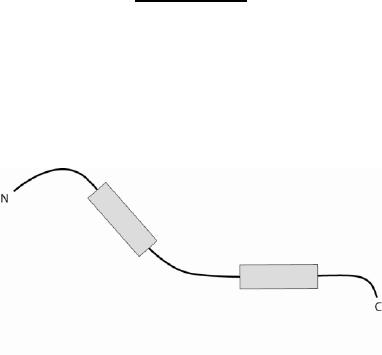
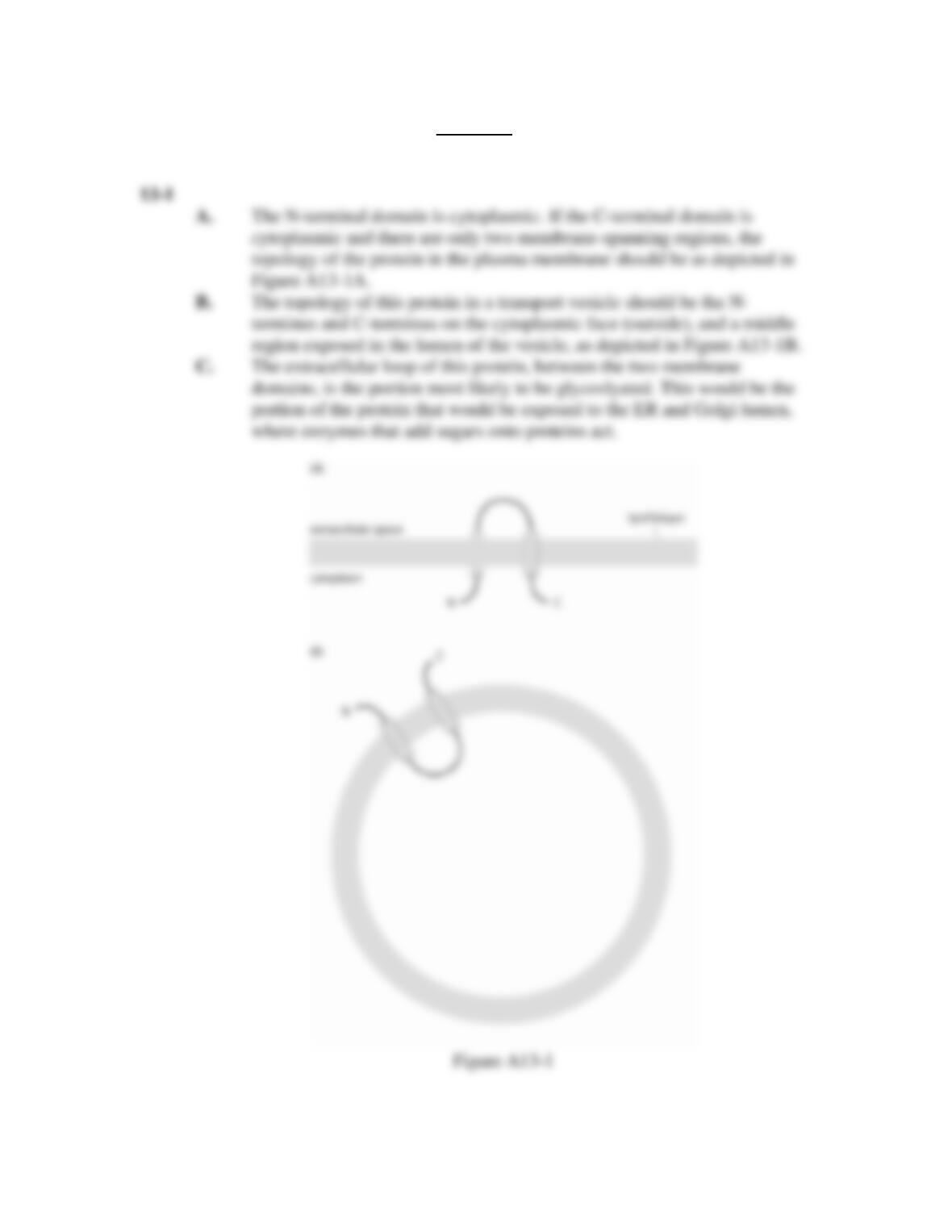
13-1 You have a protein that has two transmembrane domains. The spacing of the
transmembrane domains is shown as gray boxes in Figure Q13-1. The C-terminal
domain of this protein is cytoplasmic.
Figure Q13-1
A. Is the N-terminal domain of the protein cytoplasmic or extracellular? Why?
B. Draw the topology of this protein in a transport vesicle as it transits from the
Golgi to the plasma membrane.
C. Your friend discovers that this protein is glycosylated. Which portion of this
protein is most likely to be glycosylated? Explain.
13-2 Your friend is studying a secreted protein called Inp1. Inp1 is produced as a
precursor form called pro-Inp1. The maturation of Inp1 requires that a short N-
terminal segment be cleaved. Your friend has raised two sets of antibodies that he
calls Pro and C-Inp1. Pro antibodies specifically bind to the peptide removed by
cleavage during maturation. C-Inp1 antibodies were raised using the C-terminal
half of Inp1 as the antigen. Your friend wanted to use these antibodies to
determine where within the secretory pathway propeptide cleavage occurs. He
collected three different cellular fractions that contain ER, cis Golgi, and trans
Golgi. He was about to assay these fractions with his Pro antibody and his Inp1
antibody when he realized that the labels had come off his cellular fractions in the
freezer. He comes to you for sympathy, but you tell him to stop whining, run the
fractions, and also probe the fractions with anti-COPII and anti-clathrin antibodies
you have in your lab. He comes to you with his results, which are summarized in
Table Q13-2.
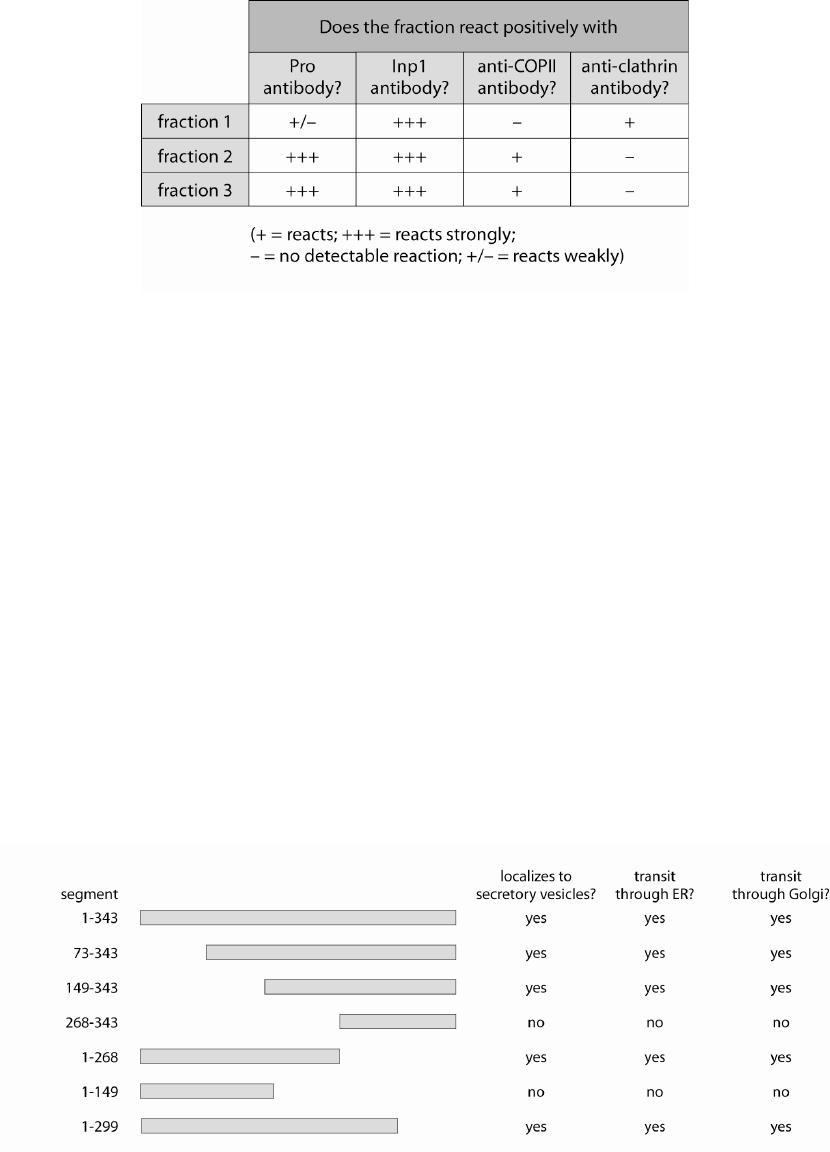
Table Q13-2
From these results, can you determine in which compartment Inp1 is likely to be
processed into the mature form? Explain.
13-3 Two graduate students down the hall, Mary and Jenny, are having an argument.
Mary has purified a novel protein she is calling ECM1. Mary hypothesizes that
ECM1 is an extracellular matrix protein because it seems to be soluble and is
glycosylated. Jenny has tested the protein and found it to be N-glycosylated with a
mannose 6-phosphate added to the N-linked oligosaccharide. Jenny claims that
her findings should convince Mary that ECM1 is unlikely to be an extracellular
matrix protein. Whom do you agree with and why?
13-4 Your friend is studying a protein of 343 amino acids localized to secretory
vesicles. She wants to define the regions of the protein responsible for its
localization to this particular class of vesicles. She creates a series of deletion
constructs in which she deletes different amino acid segments from the protein.
She expresses each of her proteins in cells and monitors the proteins’ localizations
within the cell, obtaining the data depicted in Figure Q13-4.
Figure Q13-4
A. From these data, where do you predict the localization sequence is for this
protein?
B. If your friend made a protein that lacked only those sequences you defined
in part A and if she expressed this protein in cells, where would you
predict that it would end up? Explain.
13-5 The lab you work in studies a protein called PER that you believe normally
resides in the ER and is involved in detecting misfolded proteins in the ER. You
have made an antibody that recognizes the PER protein and perform some
electron microscopy studies in collaboration with a new postdoc who is highly
trained in this technique. The new postdoc comes to you in a panic with his latest
results. Not only does he see PER localizing to the ER, he also sees PER in some
transport vesicles and some weak Golgi staining. Your adviser overhears this
conversation and tells him not to worry and that he should check to see whether
those transport vesicles will react with an antibody against COPI that you have in
the lab. Explain what you think your adviser was thinking about when she
suggested this experiment.
13-6 Your friend has just joined a lab studying a phospholipase that normally resides in
the lysosome. You have recently developed an assay to study the activity of
cytoplasmic phospholipase C in vitro. Because your friend would like to develop
an in vitro assay for his phospholipase, he asks you for the protocol you use for
your assay. He is particularly interested in the buffers you use. Why you should
advise your friend not to use your protocol?
13-7 Your friend is trying to create an in vitro system for studying the formation of
COPII vesicles. He finds that to get efficient vesicle budding from artificial
membranes, he needs to add the coat proteins, the Sar1 GTP-binding protein, the
GTPase-activating protein (GAP) for Sar1, and GMP-PNP (a nonhydrolyzable
analog of GTP) to synthetic membranes; his experiment will not work in the
presence of GTP. Explain why your friend needs to add GMP-PMP instead of
GTP.
13-8 Your friend comes to you confused. She has been working on a protein that she
thinks is rapidly degraded when cells are given serum. She has been assaying this
degradation by using Western blot analysis. Furthermore, she has also seen that
her protein is ubiquitylated, because antibodies that recognize ubiquitin will
recognize her protein after serum treatment. She expected to isolate her protein
from a cytoplasmic fraction because the proteosome is in the cytoplasm, but when
she fractionated cells she found that her protein was found in a membrane
fraction. In which cellular compartment do you think your friend’s protein is
located? Explain.
Answers