
Chapter 13 Characterizing and Classifying Viruses, Viroids, and Prions
13.1 Multiple Choice Questions
1) In what ways do viruses differ from other pathogens?
A) Viruses lack genetic material.
B) Viruses lack cytoplasm and organelles.
C) Viruses have no protein structure.
D) Viruses are composed of protein only.
E) Viruses are composed of both protein and lipid.
2) The outermost layer of a virion fulfills which of the following functions of the virus?
A) protection
B) recognition
C) replication
D) both protection and recognition
E) both recognition and replication
3) A(n) ________ is a virus that infects bacterial cells.
A) virion
B) prion
C) bacteriophage
D) nucleocapsid
E) envelope
4) Which of the following is a characteristic by which viruses are classified?
A) type of nucleic acid
B) type of life cycle
C) number of chromosomes
D) type of host
E) size

5) Host specificity of a virus is due to
A) particular genes that it shares with the infected cell.
B) the presence of an envelope.
C) differences in size between the virus and the host cell.
D) the presence or absence of a cell wall on the host cell.
E) interactions between viral and cellular surface molecules.
6) Which of the following is primarily responsible for the shape of a virion?
A) the type of nucleic acid
B) the number of segments of the viral genome
C) the source of the envelope
D) the capsid
E) the specific host protein the virus targets
7) How are fungal viruses different from viruses that infect other organisms?
A) They have no extracellular state.
B) They have only DNA for genetic material.
C) They have no capsid.
D) They have no intracellular state.
E) They cannot pass through a filter.
8) Some viruses have a dsDNA genome. Others may have a ________ genome.
A) ssDNA
B) dsRNA
C) ssRNA
D) ssRNA or dsRNA
E) ssDNA, ssRNA, or dsRNA

9) Which of the following is CORRECT regarding the viral envelope?
A) It contains only viral proteins.
B) It contains only host cell proteins.
C) It is composed of sterols.
D) It is composed of cellular phospholipid membrane, cellular and viral proteins.
E) It is composed of sterols of viral proteins only.
10) Which of the following statements regarding virus taxonomy is true?
A) Viruses are classified on the basis of the taxonomy of their host organisms.
B) Virus classes are well established.
C) Some virus family names are derived from the name of an important member of the family.
D) The species epithet is a Latin descriptor of the virion structure.
E) Virus classes are based on the domain of the host organism.
11) Which of the following taxa are used for classification of viruses as well as organisms?
A) Kingdom
B) Class
C) Division
D) Family
E) Division, Class, and Family are used in both taxonomic schemes.

12) Which of the following lists stages of a lytic replication cycle in order, from earliest to
latest stages?
I. Synthesis
II. Assembly
III. Attachment
IV. Release
V. Entry
A) III, V, I, II, IV
B) III, II, V, I, IV
C) V, III, II, IV, I
D) I, III, V, II, IV
E) I, II, III, V, IV
13) Which of the following is associated with the attachment of a bacteriophage to a bacterial
cell?
A) random collisions
B) chemical attractions
C) receptor specificity
D) both chemical attractions and receptor specificity
E) random collisions, chemical attractions, and receptor specificity
14) The enzyme lysozyme is critical for which of the stages of a bacteriophage T4 infection
cycle?
A) entry
B) assembly
C) entry and release
D) synthesis
E) attachment

15) A(n) ________ is a bacterial virus which is integrated into the host cell DNA.
A) lytic phage
B) prophage
C) plasmid
D) transposon
E) insertion phage
16) Which of the following events occurs in the lytic cycle of bacteriophage T4 infection but
NOT in the lysogenic cycle?
A) attachment
B) entry
C) digestion of host DNA
D) viral protein synthesis
E) both digestion of host DNA and viral proteins synthesis
17) Why is lysogeny advantageous to a bacteriophage?
A) It speeds up the viral infection cycle.
B) The genetic material of the bacteriophage is amplified many times over that seen in a lytic
phage.
C) It allows the bacteriophage to infect cells it would not normally infect.
D) It allows the bacteriophage to destroy the host cell’s DNA.
E) It enables the bacteriophage to take over the cell.
18) Which of the following agents is capable of inducing conversion of a prophage to the lytic
cycle?
A) UV light
B) X rays
C) presence of +ssRNA
D) both UV light and X rays
E) both UV light and the presence of +ssRNA

19) Replication of most ________ viruses is similar to normal cellular processes.
A) dsDNA
B) ssDNA
C) +ssRNA
D) -ssRNA
E) dsRNA
20) Attachment of herpesviruses results in ________, a process in which the host cell facilitates
viral entry.
A) direct penetration
B) membrane fusion
C) endocytosis
D) exocytosis
E) lysogeny
21) Reverse transcriptase is associated with which of the following?
A) dsDNA viruses
B) +ssRNA viruses
C) -ssRNA viruses
D) retroviruses
E) dsRNA viruses
22) The genome of which of the following types of animal virus can act directly as mRNA?
A) retroviruses
B) +ssRNA viruses
C) -ssRNA viruses
D) ssDNA viruses
E) dsRNA viruses

23) Which of the following types of animal virus requires RNA-dependent RNA transcriptase
to be replicated?
A) +ssRNA viruses
B) ssDNA viruses
C) -ssRNA viruses
D) retroviruses
E) dsDNA viruses
24) Naked capsid animal viruses are commonly released from the infected cell by ________, a
process the host cell does not survive.
A) budding
B) lysis
C) endocytosis
D) membrane fusion
E) exocytosis
25) Which of the following membranes can give rise to a viral envelope?
A) the nuclear membrane
B) the cytoplasmic membrane
C) the endoplasmic reticulum
D) the nuclear and cytoplasmic membranes
E) the nuclear and cytoplasmic membranes and the endoplasmic reticulum
26) A cell is infected with a virus carrying an oncogene sequence in its genome. What process
may occur if the oncogene is expressed in the infected cell?
A) lysis
B) neoplasia
C) lysogeny
D) latency
E) both lysis and neoplasia

27) How is the HIV provirus different from a lambda-phage prophage?
A) The HIV provirus is integrated permanently into the host cell’s DNA.
B) All subsequent generations of HIV-infected cells carry the provirus.
C) All the offspring of a cell infected with a prophage will contain the virus.
D) The HIV provirus is inactive inside the host cell.
E) Lambda phage-infected cells produce virus slowly over time.
28) Which of the following laboratory procedures is used for culturing animal viruses in the
laboratory?
A) cell cultures
B) broth cultures
C) embryonated eggs
D) both cell cultures and embryonated eggs
E) synthetic cytoplasm
29) One mechanism by which viruses may cause cancer is to interrupt the genetic regulatory
sequences of repressor proteins. Which of the following types of viruses is most likely to be
involved in causing cancer by this mechanism?
A) +ssRNA viruses
B) dsRNA viruses
C) -ssRNA viruses
D) retroviruses
E) both +ssRNA and -ssRNA viruses
30) Tumors invade other organs and tissues in a process called
A) neoplasia.
B) a plaque assay.
C) latency.
D) budding.
E) metastasis.

31) Plaque assays are used for
A) evaluating the cancer-causing ability of a virus.
B) determining the density of phage in a culture.
C) the study of prions.
D) cultivating viruses that cannot be grown any other way.
E) counting the number of latent phages in a cell.
32) Disadvantages of continuous cell cultures include
A) they only grow for a limited number of generations.
B) the expense of preparation.
C) they may be significantly different genetically from the original source animal.
D) viruses do not reliably infect them.
E) they are both expense and have a limited number of division.
33) Viroids infect
A) bacteria.
B) plants.
C) fungi.
D) plants and animals.
E) all organisms.
34) How are prions different from all other known infectious agents?
A) They cannot reproduce outside a cell.
B) They act as slow viruses.
C) They cause neurological problems.
D) They can be destroyed by incineration.
E) They lack nucleic acid.

35) Which of the following infectious particles do NOT have protein in their structure?
A) bacteriophages
B) prions
C) animal viruses
D) viroids
E) both prions and viroids
36) A lipid membrane is present in which of the following?
A) naked viruses
B) enveloped viruses
C) prions
D) viroids
E) both prions and viroids
37) What is a virion?
A) A virus genome inside a cell.
B) An empty capsid.
C) A single virus particle outside a cell.
D) An extracellular virus genome.
E) A virus genome integrated into a host cell genome.
38) Double-stranded RNA genomes can be found
A) only in cells.
B) only in viruses.
C) only in prions.
D) in both cells and viruses.
E) in both prions and viruses.

39) Which of the following is a feature shared by viruses and living organisms?
A) possession of a genome that directs synthesis of materials necessary for replication
B) presence of cytoplasm
C) metabolic capability
D) responsiveness
E) the ability to increase in size
40) Small circular RNAs called ________ are plant pathogens.
A) plasmids
B) viruses
C) viroids
D) prions
E) phages
41) The ________ of a virion determines the type of cell it enters.
A) nucleic acid
B) matrix proteins
C) glycoproteins
D) lipid molecules
E) shape
42) During ________, viruses remain dormant in animal cells.
A) budding
B) latency
C) lytic replication
D) persistent infection
E) oncogenesis
43) Virus replication results in the death of the cell in ________ infection(s).
A) a lytic
B) a latent
C) a persistent
D) a lysogenic
E) both latent and persistent
44) A ________ is a mass of neoplastic cells.
A) diploid culture
B) metastasis
C) tumor
D) gall
E) plaque
45) The process known as ________ is a mechanism of release for enveloped viruses.
A) lytic replication
B) persistent infection
C) metastasis
D) latency
E) budding
13.2 True/False Questions
1) Viruses cause most human cancers.
2) Most viruses cannot be seen by light microscopy.

3) Protozoa are susceptible to viral attack.
4) Budding release of virus may result in long lasting or persistent infection.
5) Members of a virus family have the same type of nucleic acid.
6) Enveloped animal viruses enter cells in a process similar to the bacteriophage infection
process.
7) Bacteriophage release is a gradual process in which small numbers are released at a time.
8) Bovine spongiform encephalopathy is an example of a prion disease.
9) All viruses use the host cell’s nucleic acid polymerases for replication.

10) Fertilized chicken eggs are used to culture some vaccine strains.
13.3 Short Answer Questions
1) The combination of a virus’s protein coat and nucleic acid core is called the
(capsid/virion/nucleocapsid).
2) Viral capsids are composed of subunits called (capsomeres/nucleocapsids/prions).
3) Viruses with -ssRNA require the activity of (DNA polymerase/reverse transcriptase/RNA-
dependent RNA polymerase) for their replication.
4) Continuous cell cultures are developed from (embryonic/haploid/neoplastic) cells.
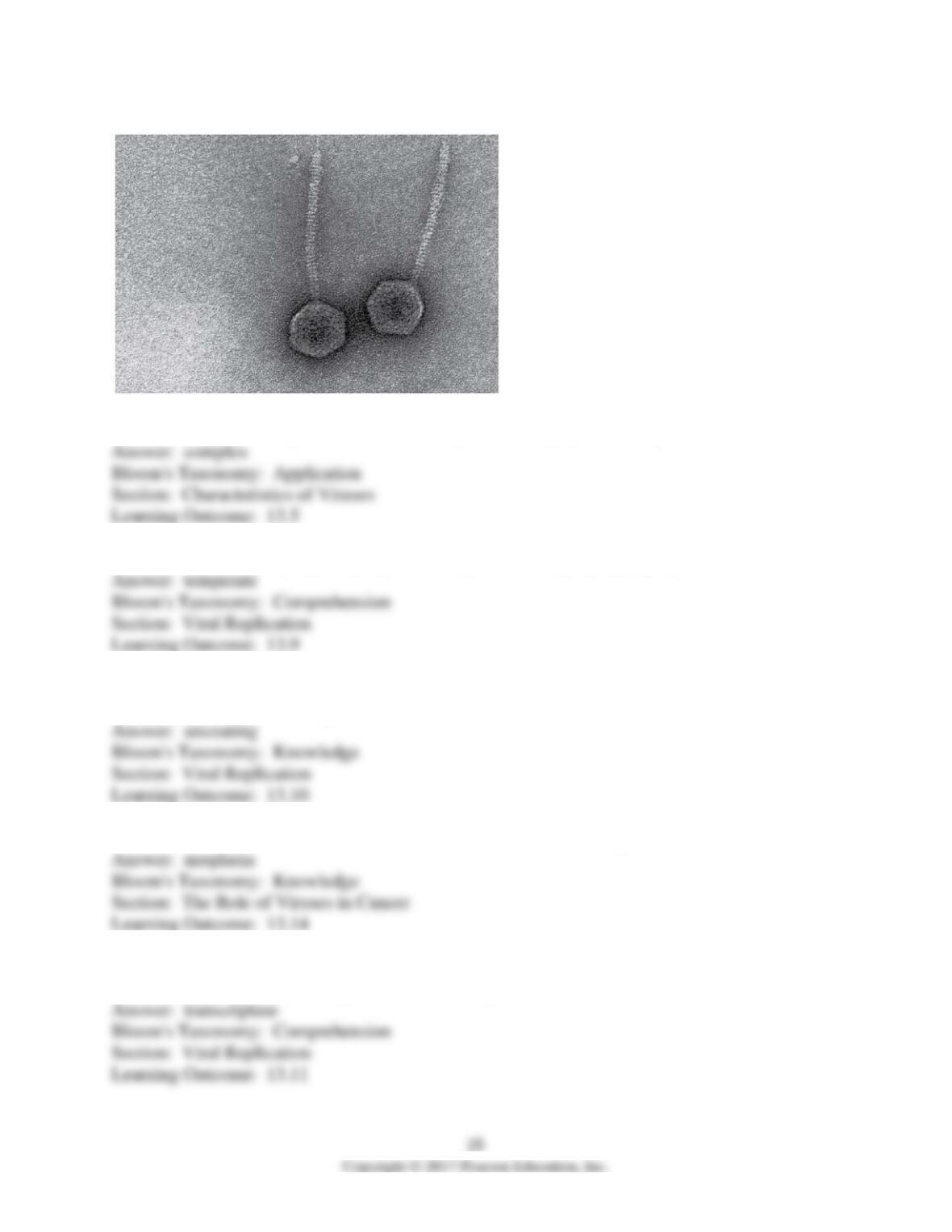
5)
The virions shown in Figure 13.1 have a (complex/helical/polyhedral) capsid.
6) Another term for a lysogenic phage is a (temperate/latent/prophage) phage.
7) The process in which viral capsids are removed within the infected cell is called
(entry/disassembly/uncoating).
8) Uncontrolled cell division in animals is known as (metastasis/neoplasia/cancer).
9) RNA viruses such as HIV require the activity of reverse
(polymerase/transcriptase/transposase) to become proviruses.

10) The stage of virus infection called (assembly/entry/synthesis) is the stage most dependent
on host cell proteins.
11) Genes that play a role in proper cell division but may also play a role in some types of
cancer are called (oncogenes/protooncogenes/promoters).
12) A (colony/plaque/prophage) is a clear zone on a bacterial lawn where cells have been killed
by the activity of a bacteriophage.
13) Seven (orders/families/classes) represent the highest level of taxonomic rank used in
classifying viruses.
14) Prions are composed of a single protein called (plaque/BSE/PrP).
15) An animal virus that does not have an envelope is described as a(n)
(naked/unenveloped/capsid) virion.
13.4 Essay Questions
1) Compare and contrast the ways in which animal, plant, and bacterial viruses gain entry into
their host cells.
2) Why is the synthesis of mRNA a central issue for all viruses? How do different types of
viruses achieve this goal?
3) In contrast to most dsDNA animal viruses, the poxviruses replicate solely in the cytoplasm
of the host cell. What does this suggest about the virus?
4) A scientist discovers a new virus associated with a cancer. She is able to culture it in the
laboratory and begins to analyze it. What features will help her determine the virus’
classification? How does this help her understand the virus’ mechanism for causing cancer?
5) Describe the mechanism by which PrP is infectious.