
1
Campbell Essential Biology, 6e (Simon/Dickey/Hogan/Reece)
Chapter 13 How Populations Evolve
Chapter 13 Learning Outcomes
13 Biology and Society: Evolution Today
13.1. Explain why an understanding of evolution is essential to the study of biology.
13.1 The Diversity of Life
13.2. Describe the hierarchical system of grouping species and how the binomial name of a
species is created.
13.3. Compare the ways that Aristotle and Lamarck viewed the properties of living species and
why simple observations today provide evidence against Lamarck’s evolutionary
mechanism.
13.2 Charles Darwin and The Origin of Species
13.4. Explain how Darwin’s voyages on the Beagle influenced the development of his thoughts
on evolution (natural selection), including how Lyell’s ideas impacted Darwin’s thinking,
and the publication of Darwin’s work, On the Origin of Species.
13.3 Evidence of Evolution
13.5. Explain how the fossil record and homologies are evidence for evolution and why fossils
represented a problem for the idea of fixed, permanent species.
13.6. Explain how evolutionary trees are constructed and what they represent.
13.4 Natural Selection as the Mechanism for Evolution
13.7. Compare the processes of artificial selection and natural selection.
13.8. Explain how natural selection is more a process of editing than a creative mechanism.
13.5 The Evolution of Populations
13.9. Explain the role of mutation and sexual reproduction in the evolution of life.
13.10. Explain why a population is considered the smallest unit of evolution.
13.11. Use the Hardy-Weinberg formula to determine the frequency of genotypes in a gene pool
including determining if the situation meets conditions of equilibrium.
13.6 Mechanisms That Alter Allele Frequencies in a Population
13.12. Distinguish between the following concepts: genetic drift and gene flow; the bottleneck
effect and the founder effect; directional selection, disruptive selection, and stabilizing
selection; sexual selection and natural selection.
Evolution Connection: The Rising Threat of Antibiotic Resistance
13.13. Explain how humans are contributing to the increase in antibiotic-resistant bacteria.
Global Learning Outcomes
1. Demonstrate an understanding of the principles of scientific inquiry.
2. Demonstrate the ability to think critically and employ critical-thinking skills.
3. Read and interpret models, graphs, and data.
4. Demonstrate the quantitative skills needed to succeed in biology.
5. Demonstrate an understanding of the impact of science on society.
6. Evaluate the credibility of scientific information from various sources.
7. Demonstrate the ability to make connections between concepts across biology.
8. Communicate effectively in writing.
9. Apply the scientific method to interpret information and draw conclusions.
13.1 Multiple Choice Questions
1) Which is NOT a benefit of the understanding of evolution to understanding the field of
biology?
A) Understanding evolution helps us to understand molecules.
B) Understanding evolution helps us to analyze ecosystems.
C) Understanding evolution helps advance biotechnology and medicine.
D) Understanding evolution helps us to understand why stars and galaxies change over time.
2) The common house mouse species, Mus musculus, has the following taxonomic classification:
Mus, Muridae, Rodentia, Mammalia, Chordata, Animalia, Eukarya. Which part of the name is
the Family?
A) Rodentia
B) Chordata
C) Muridae
D) Animalia
3) ________ believed that use (or lack of use) of body parts enables individual to develop certain
traits that it passes on to its offspring while ________ believed that species are fixed forms that
do not change over time.
A) Aristotle… Lamarck
B) Lamarck… Aristotle
C) Darwin… Aristotle
D) Lamarck… Darwin
4) Natural selection can be defined as ________.
A) the evolution of a population of organisms
B) a process in which changes in gene frequencies result from evolution
C) the production of more offspring than can survive in a given environment
D) a process in which organisms with certain inherited traits are more likely to survive and
reproduce than individuals with other traits
5) Natural selection ________.
A) results in evolutionary adaptation
B) is a very rare phenomenon
C) does not affect allelic frequencies
D) prepares organisms for future changes in the environment
6) The first basic idea of evolutionary adaptation can be traced back to ________.
A) ancient Greeks about 2,500 years ago
B) Aristotle
C) Lamarck
D) Darwin
7) Which of the following statements about the voyage of the Beagle is TRUE?
A) Its purpose was to identify the fastest route from the Atlantic to the Pacific Ocean.
B) It lasted almost 2 years.
C) It turned into a tremendous opportunity for Darwin to collect fossils, plants, and animals.
D) It ended with the sinking of the ship off of the coast of Australia, almost 4 years into its
journey.
8) During his trip on the Beagle, Darwin found that ________.
A) plants and animals living in temperate regions were most similar to each other, regardless of
the continent on which they were found
B) plants and animals living on a continent seemed more closely related to each other than to
plants and animals living in similar regions on other continents
C) fossils found on a particular continent were clearly not related to the plants and animals living
on that continent today
D) plants and animals were similar on every continent and in every type of region
9) While on the Beagle, Darwin was influenced by a book by Charles Lyell that suggested that
Earth was ________ and sculpted by geologic processes that ________ today.
A) old… continue
B) old… no longer occur
C) young… continue
D) young… no longer occur
10) In The Origin of Species, Darwin argued that the mechanism of descent with modification
was ________.
A) artificial selection
B) natural selection
C) inheritance of acquired characteristics
D) uniformitarianism
11) Which of the following is a component of the fossil record?
A) the distribution of murid rodents in Australia and Asia
B) the similarity of the forelimbs of cats and bats
C) molecular sequences
D) bones of extinct whales
12) The fossil record suggests that whales ________.
A) are descended from one branch of marine reptiles
B) are closely related to land mammals such as pigs, hippos, and cows
C) are not closely related to dolphins and porpoises, despite a superficial similarity
D) once had well-developed hind flippers
13) Homology is evidence of ________.
A) binomial classification
B) artificial selection
C) natural selection
D) common ancestry
14) Which of the following are homologous?
A) the forelimb of a dog and the hindlimb of a cat
B) the forelimb of a dog and the forelimb of a cat
C) wings of a butterfly and wings of a sparrow
D) the mouth of a mosquito and the beak of a hummingbird
15) The similarity of the embryos of fish, frogs, birds, and humans is evidence of ________.
A) analogy
B) common ancestry
C) genetic drift
D) decreased genetic variation
16) Natural selection generally results in ________.
A) increased genetic variation
B) a population that is better adapted to a future environment
C) a population that is adapted to its current environment
D) an increase in the size of a population
17) Which of the following is NOT a requirement of natural selection?
A) differential reproductive success
B) overproduction of offspring
C) genetic variation
D) gene flow
18) Which one of the following statements is TRUE?
A) Natural selection works on variation already present in a population.
B) Natural selection works on nonheritable traits.
C) Individuals evolve through natural selection.
D) Individual organisms evolve structures that they need.
19) Which of the following is a population?
A) the termites infesting your house along with the microorganisms living in their guts
B) all of the termites that have ever lived
C) all organisms living in your house
D) the termites infesting your house
20) Which one of the following can create new alleles?
A) natural selection
B) sexual reproduction
C) mutation
D) genetic drift
21) The total collection of alleles in a population at any one time makes up that population’s
________.
A) gene pool
B) genotype
C) heterozygote frequency
D) allele frequency
22) If the frequency of one allele in a population is 0.7 in a population with two alleles at a
particular locus, what is the frequency of the alternate allele?
A) 0.09
B) 0.21
C) 0.30
D) 0.42
23) In the Hardy-Weinberg formula, what does p2 represent?
A) frequency of the dominant allele
B) frequency of heterozygotes
C) frequency of the recessive allele
D) frequency of the homozygotes for one allele
24) In the Hardy-Weinberg formula, what does 2pq represent?
A) frequency of the dominant allele
B) frequency of heterozygotes
C) frequency of the recessive allele
D) frequency of the homozygous dominants
25) The presence of freckles is due to a dominant allele. Four percent of the individuals in a
particular population lack freckles. Use the Hardy-Weinberg formula to calculate the percentage
of individuals in this population who are homozygous dominant for freckles.
A) 32%
B) 4%
C) 64%
D) 80%
26) The original source of genetic variation that serves as the raw material for natural selection is
________.
A) mutation
B) gene flow
C) geographic isolation
D) random fertilization
27) Which of the following is a characteristic of a population at Hardy-Weinberg equilibrium?
A) The population is subject to natural selection.
B) The population is not evolving.
C) Genetic drift is occurring.
D) Gene flow in and out of the population occurs.
28) Genetic drift is the result of ________.
A) natural selection
B) chance
C) a large gene pool
D) environmental variation
29) Which one of the following will prevent significant genetic drift?
A) Gene flow is absent.
B) There is genetic variation.
C) There is mutation.
D) The population size is large.
30) After surviving a bottleneck, a population recovers to the point where it consists of as many
individuals as it did prior to the bottleneck. Which of the following statements is most likely to
apply to this population?
A) The postbottleneck population exhibits less genetic variation than the prebottleneck
population.
B) The bottleneck subjected the population to stabilizing selection.
C) The postbottleneck population has less of a chance of going extinct than did the prebottleneck
population.
D) The postbottleneck population exhibits more genetic variation than the prebottleneck
population.
31) The founder effect differs from a population bottleneck in that the founder effect ________.
A) requires a small population
B) is a type of natural selection
C) can occur only on an oceanic island colony
D) involves the isolation of a small colony of individuals from a larger population
32) Which of the following is the most likely explanation for a particular human population with
a higher incidence of polydactyly (extra fingers/toes) than the human population as a whole?
A) directional selection
B) disruptive selection
C) founder effect
D) bottleneck effect
33) Gene flow is accomplished by ________.
A) migration
B) sexual recombination
C) mutation
D) natural selection
34) What does evolutionary fitness measure?
A) physical health
B) longevity
C) relative reproductive success
D) population size
35) Which of the following is an example that results from directional selection?
A) The birth weight at which newborn humans are most likely to survive and the average weight
of newborn humans are about the same.
B) There is an increase in antibiotic-resistant strains of bacteria.
C) There is an increase in the number of different breeds of dog.
D) Garter snakes with different coloration patterns behave differently when threatened.
36) Which of the following examples results from disruptive selection?
A) The birth weight at which newborn humans are most likely to survive and the average weight
of newborn humans are about the same.
B) There is an increase in antibiotic-resistant strains of bacteria.
C) There is an increase in the number of different breeds of dog.
D) Garter snakes with different coloration patterns behave differently when threatened.
37) Which of the following is most likely to decrease genetic variation?
A) directional selection
B) mutation
C) stabilizing selection
D) diversifying selection
38) Which of the following examples results from stabilizing selection?
A) The birth weight at which newborn humans are most likely to survive and the average weight
of newborn humans are about the same.
B) There is an increase in antibiotic-resistant strains of bacteria.
C) There is an increase in the number of different breeds of dog.
D) Garter snakes with different coloration patterns behave differently when threatened.
39) Which of the following is an example of sexual selection?
A) Bacteria evolve resistance to antibiotics.
B) Cheetahs experienced a population bottleneck.
C) Peahens choose to mate with peacocks that have the most beautiful tails.
D) Female butterflies have a higher survival rate than male butterflies.
40) What leads paleontologists to hypothesize that whales evolved from wolf-like carnivores?
A) molecular analysis of whale DNA
B) observations of fossil teeth
C) the presence of vestigial structures in both species
D) mathematical analysis using the Hardy-Weinberg formula
13.2 Art Questions
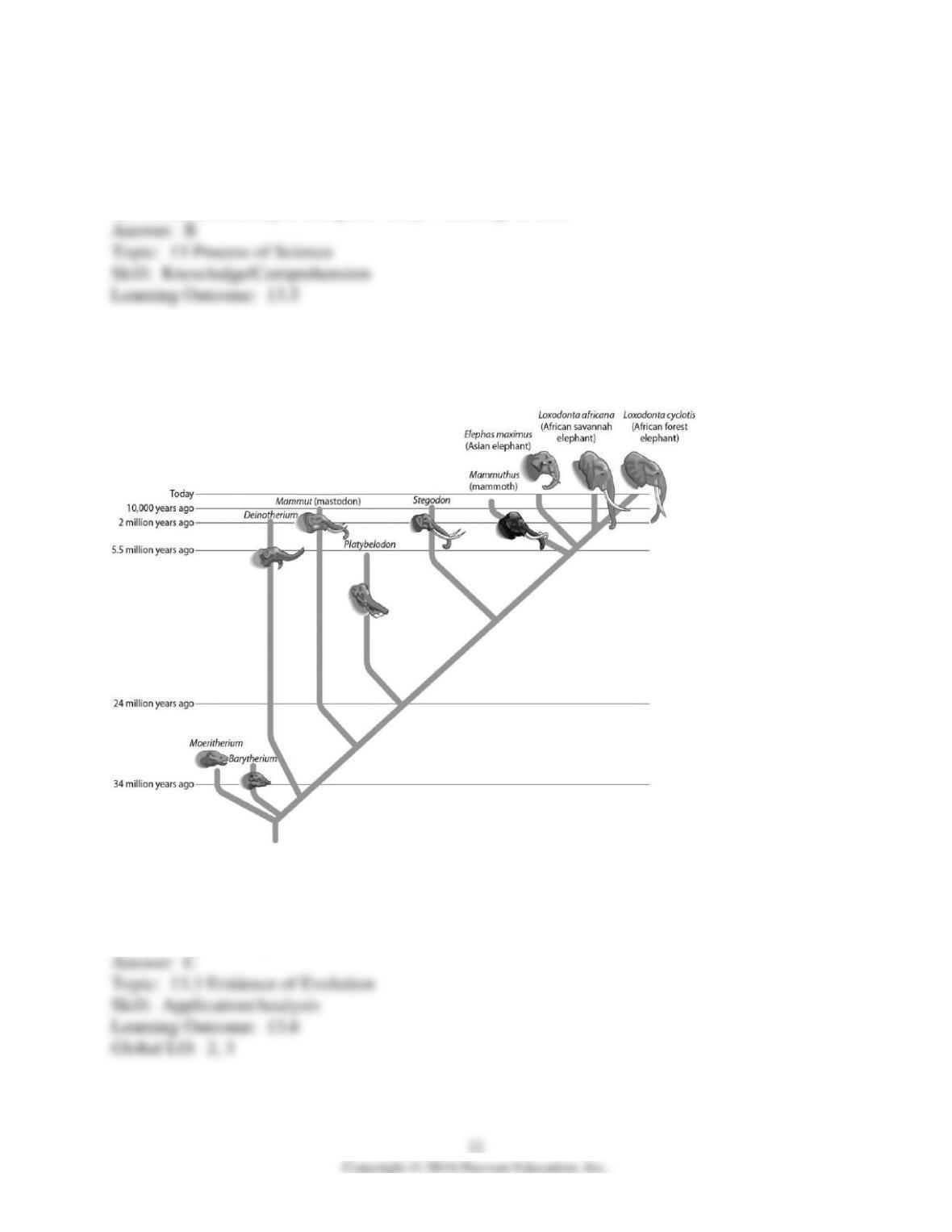
1) Examine the relationships between the elephants in the figure below. Which one of the
following pairs is most closely related?
A) Deinotherium and Platybelodon
B) Barytherium and Stegodon
C) Loxodonta africana and Loxodonta cyclotis
D) Mammut and Stegodon
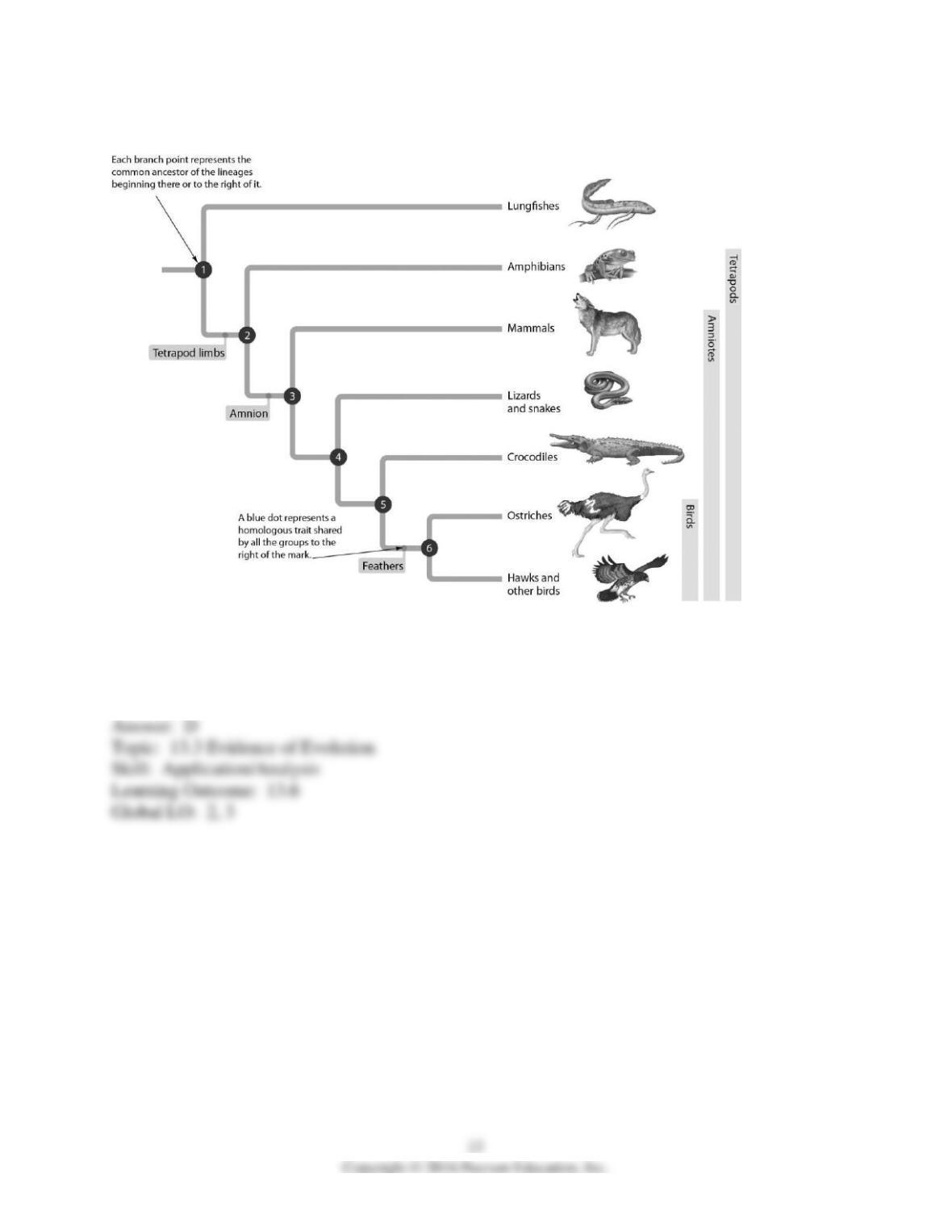
2) Examine the evolutionary tree below. This tree tells us that the amnion is found in ________.
A) lungfishes and amphibians
B) amphibians only
C) mammals, lizards, and snakes only
D) mammals, lizards, snakes, crocodiles, and birds
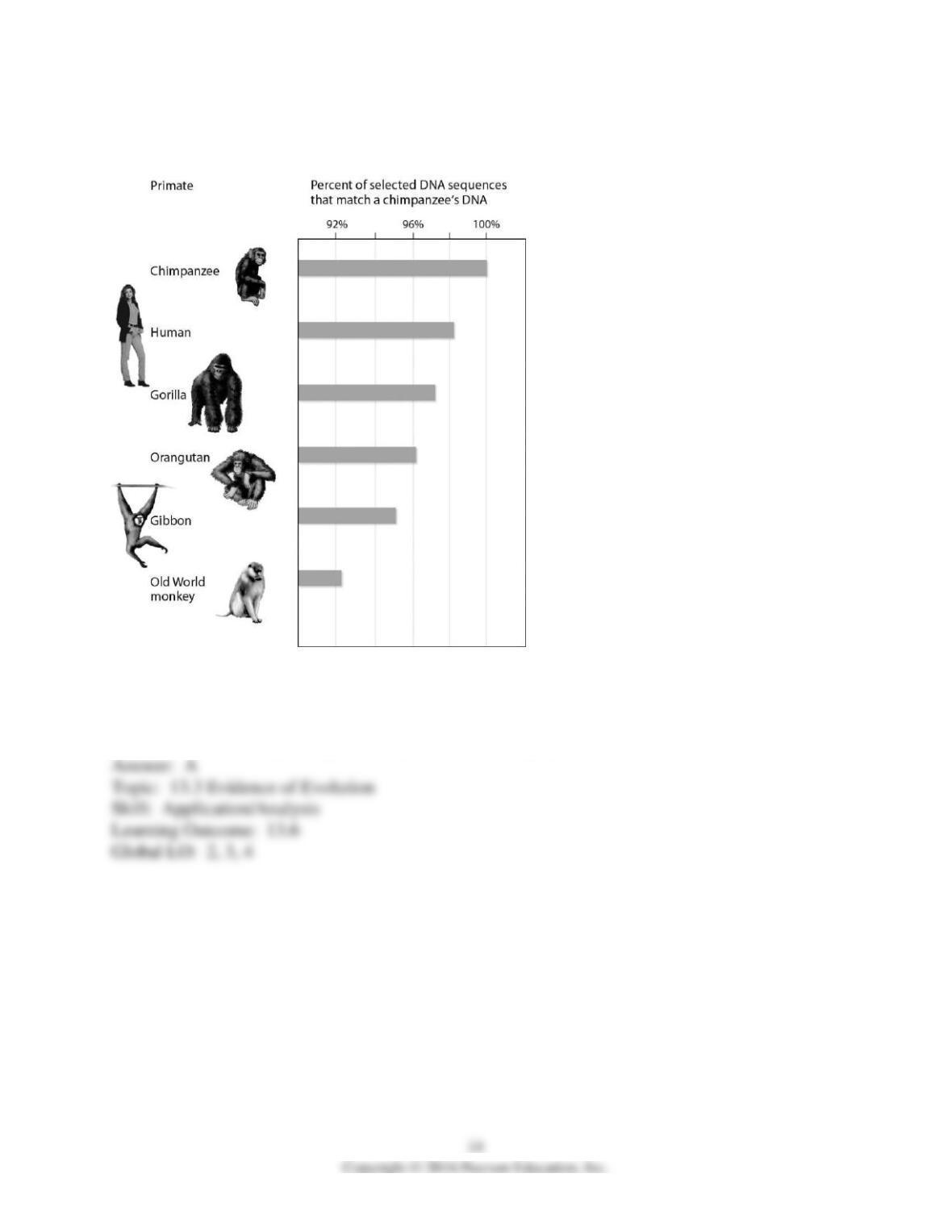
3) The figure below shows the percent of selected DNA sequences that match between a
chimpanzee and other primates. These data support the hypothesis that ________.
A) the chimpanzee’s closest surviving relative is humans
B) chimpanzees and gibbons are the most closely related
C) orangutans are the primates least closely related to chimpanzees
D) Old World monkeys and gibbons are the most closely related
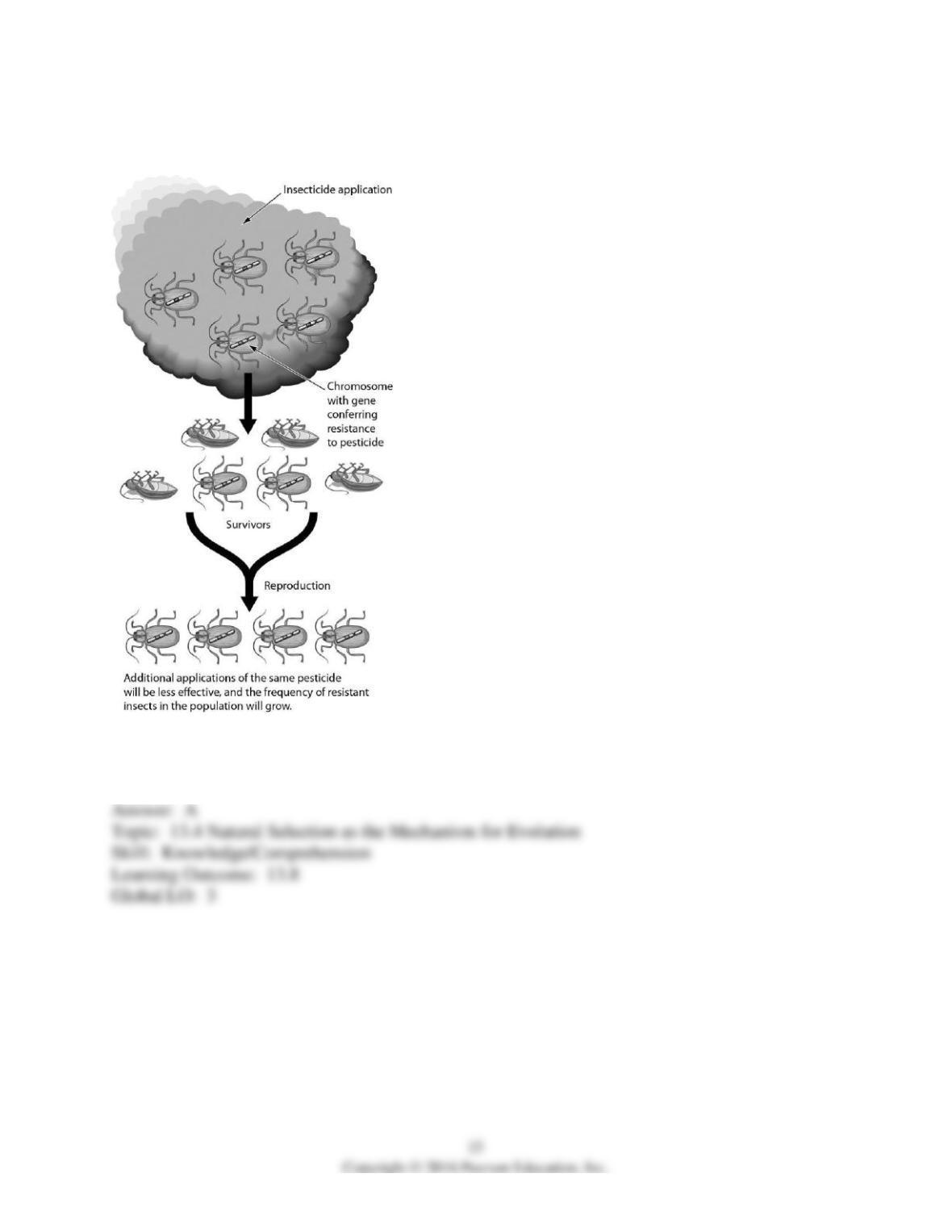
4) The figure below shows what happens in insect populations when crops are sprayed with
insecticides. This is an example of ________.
A) natural selection
B) genetic drift
C) founder effect
D) gene flow
13.3 Scenario Questions
Read the following scenario to answer the following questions.
Over the past 60 years, many amphibian species have experienced significant population
declines, and some species have become extinct. Scientists suspected that local human activities
such as the destruction of wetlands, regional pollution, and deforestation were the main reasons
for these losses. However, research over the past 20 years reveals significant amphibian
population declines in protected areas of the world, such as nature preserves and parks. These
global declines suggest widespread problems including increased ultraviolet radiation, acid rain,
and disease. In Switzerland, for example, 14 of the 20 native amphibian species are threatened
with extinction.
1) Some biologists urge the collection of the few remaining individuals of some of the most
threatened amphibian species in order to preserve them if they become extinct in the wild. If
such captive-breeding programs could produce thousands of individuals from just a few of the
remaining survivors, the species will still be threatened because of ________.
A) a bottleneck effect
B) directional selection
C) mutations
D) artificial selection
2) When most populations of a wide-ranging amphibian species are lost and the few remaining
populations are widely separated, we expect to see that ________.
A) artificial selection becomes a greater factor in microevolution
B) the founder effect becomes increasingly important
C) gene flow between populations is reduced
D) microevolution no longer occurs
3) Chytridiomycosis is a fungal disease first identified in 1998 as a cause of massive amphibian
deaths. In some severely impacted populations, a few individuals have survived, perhaps because
of some natural resistance. If these resistant individuals continue to survive and prosper, new
resistant populations might emerge. This would be an example of ________.
A) genetic drift
B) natural selection
C) the founder effect
D) sexual selection
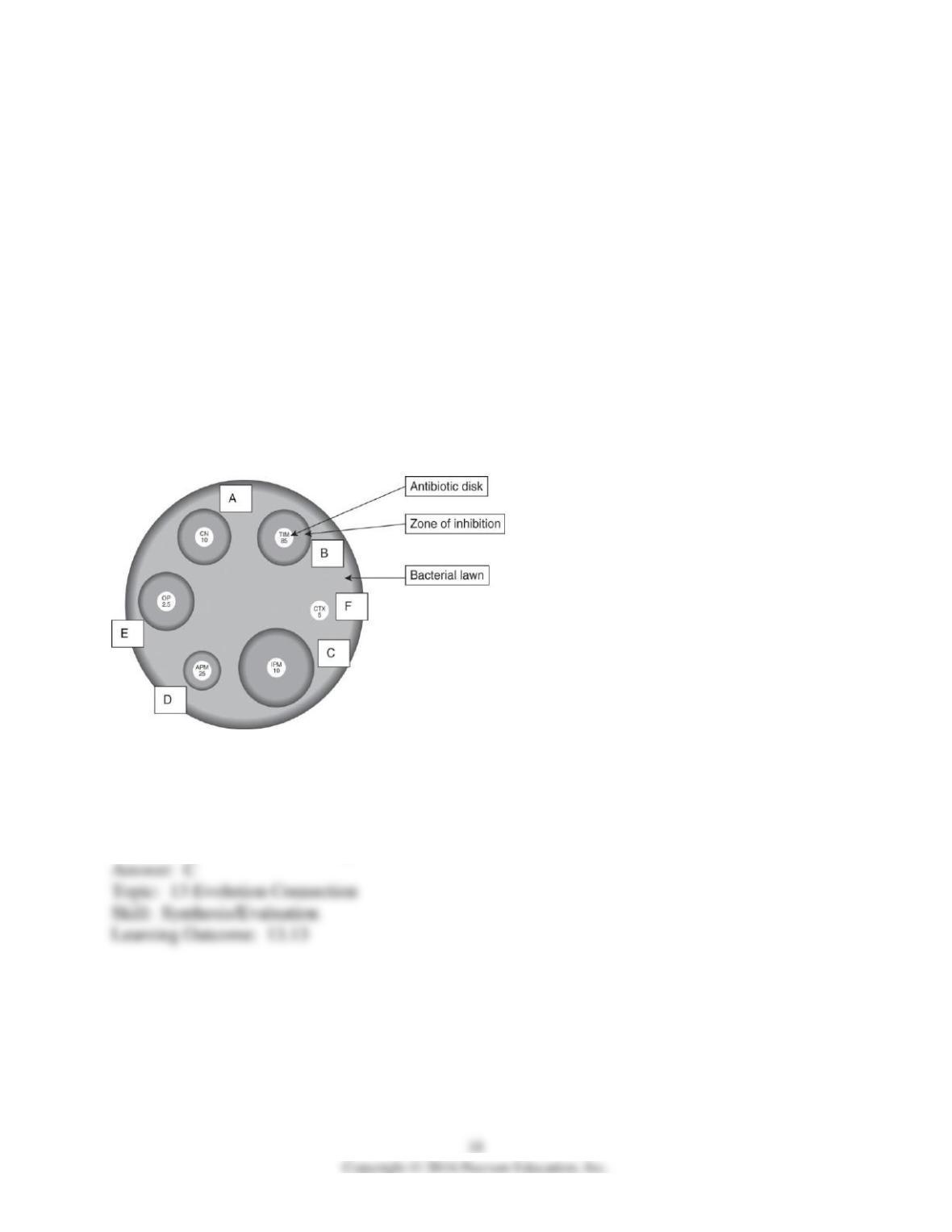
Read the following scenario to answer the questions that follow.
In order to test the susceptibility of bacteria to an antibiotic, a common laboratory test called the
Bauer-Kirby Disk Diffusion test is used. First, a petri dish (a shallow, circular, transparent dish
with a flat lid) is partially filled with nutrient-enriched agar (a gelatinous material). The nutrients
encourage growth of specific bacterial species. The agar is poured as liquid but then typically
solidifies to a soft consistency. Once the agar is set, a “lawn” of bacteria is spread such that a thin
layer covers the top of the agar. Antibiotics are then applied to the lawn in a small dose, often
through small saturated paper disks. The dish is typically incubated for 24—48 hours and then
observed for susceptibility. If the antibiotic is effective, it will kill the bacteria and leave a clear
area called the “zone of inhibition” due to inhibited bacterial growth. The area starts at the source
of the antibiotic and radiates outward. Scientists measure the diameter of the zone and then
compare it to an established “cutoff value” for a zone specific to antibiotic/organism
combinations. A large zone of inhibition in comparison to the standard indicates susceptibility
while a small or no zone indicates resistance. Consider the following image, and answer the
questions that follow:
4) What can you conclude about the susceptibility of the bacteria to the antibiotics?
A) The bacteria are more susceptible to antibiotic A than antibiotic C.
B) The bacteria are more susceptible to antibiotic D than antibiotic B.
C) The bacteria are more susceptible to antibiotic C than antibiotic E.
D) The bacteria are more susceptible to antibiotic D than antibiotic A.
5) After rigorous testing, the Federal Drug Administration (FDA) must decide which of the four
antibiotics to approve to fight a bacterial infection that results in high fevers and localized rashes.
Which antibiotic do you predict that the FDA scientists will likely approve?
A) A
B) C
C) E
D) F
6) After 1 year of widely prescribed use, reports surface that bacterial infections disappear for up
to 2 weeks after taking the prescribed antibiotic but then reappear, sometimes worse than the first
time. Which of the following explanations might the FDA use to defend their choice of antibiotic
to treat the infection?
A) Patients are not taking the antibiotic for the length of time prescribed and so selection for
resistant bacteria that can survive a limited course of antibiotic is occurring.
B) Stabilizing selection over the year has allowed for the bacteria to remain at a high level in
patients’ bodies.
C) Patients’ bodies are evolving over the year to create environments that are friendly to the
growth of the bacteria.
D) Sexual dimorphism allowed for larger bacteria cells to outcompete smaller ones, therefore
enabling larger bacteria cells to continue to multiply.