
Microbiology: An Introduction, 13e (Tortora et al.)
Chapter 13 Viruses, Viroids, and Prions
13.1 Multiple-Choice Questions
1) How do all viruses differ from bacteria?
A) Viruses are filterable.
B) Viruses are obligate intracellular parasites.
C) Viruses do not have any nucleic acid.
D) Viruses are not composed of cells.
E) Viruses do not reproduce.
2) A feature that may be found in viruses but never in bacteria is
A) the ability to pass through 0.22 micrometer pore filters.
B) may contain an RNA genome.
C) they cannot reproduce themselves outside a host.
D) a sensitivity to antibiotics.
E) an ability to infect more than one type of host.
3) Which of the following statements about viral spikes is FALSE?
A) They are composed of carbohydrate-protein complexes.
B) They are used for attachment.
C) They may cause hemagglutination.
D) They bind to receptors on the host cell surface.
E) They are found only on nonenveloped viruses.

4) Which of the following is NOT used as a criterion to classify viruses?
A) biochemical tests
B) morphology
C) nucleic acid
D) size
E) number of capsomeres
5) Which of the following is NOT utilized to culture viruses?
A) laboratory animals
B) culture media
C) embryonated eggs
D) animal cell cultures
E) bacterial cultures
6) Bacteriophages and animal viruses do NOT differ significantly in which one of the following
steps?
A) attachment
B) penetration
C) uncoating
D) biosynthesis
E) release
7) The definition of lysogeny is
A) phage DNA is incorporated into host cell DNA.
B) lysis of the host cell due to a phage.
C) the period during replication when virions are not present.
D) when the burst time takes an unusually long time.
E) attachment of a phage to a cell.
8) A viroid is a(n)
A) complete, infectious virus particle.
B) infectious piece of RNA without a capsid.
C) capsid without nucleic acid.
D) provirus.
E) infectious protein.
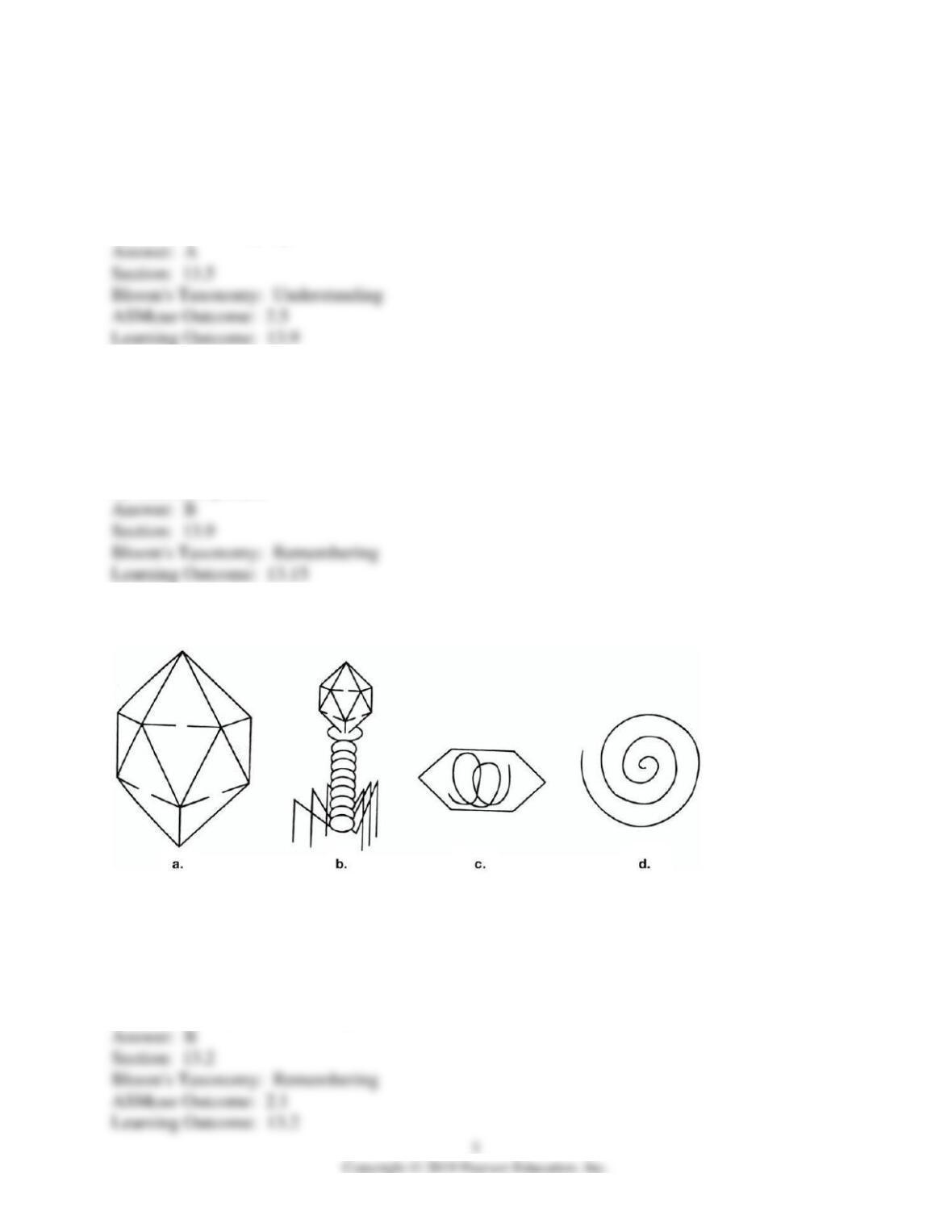
Figure 13.1
9) In Figure 13.1, which structure is a complex virus?
A) a
B) b
C) c
D) d
E) All of the structures are complex viruses.

10) The morphological types of viruses illustrated in Figure 13.1 are ultimately determined by
the
A) nucleic acid.
B) envelope.
C) capsomeres.
D) viroids.
E) membrane spikes.
11) A clear area against a confluent “lawn” of bacteria is called a
A) phage.
B) pock.
C) cell lysis.
D) plaque.
E) rash.
12) Continuous cell lines differ from primary cell lines in that
A) viruses can be grown in continuous cell lines.
B) continuous cell lines always have to be re-isolated from animal tissues.
C) continuous cell lines are derived from primary cell lines.
D) continuous cell lines can be maintained through an indefinite number of generations.
E) continuous cell lines are from human embryos.
13) Which of the following is necessary for replication of a prion?
A) DNA
B) DNA polymerase
C) lysozyme
D) PrPSc
E) RNA

14) A persistent infection is one in which
A) the virus remains in equilibrium with the host without causing a disease.
B) viral replication is unusually slow.
C) the disease process occurs gradually over a long period.
D) host cells are gradually lysed.
E) host cells are transformed.
15) An example of a persistent viral infection is
A) Hepatitis A infection.
B) Influenza.
C) Herpes Simplex Virus infection.
D) Human Immunodeficiency Virus infection.
E) Varicellavirus infection.
16) Lysogeny can result in all of the following EXCEPT
A) immunity to reinfection by the same phage.
B) acquisition of new characteristics by the host cell.
C) immunity to reinfection by any phage.
D) specialized transduction.
E) phage conversion.

17) Which of the following would be the first step in biosynthesis of a virus with a – (minus)
strand of RNA?
A) synthesis of DNA from an RNA template
B) synthesis of double-stranded RNA from an RNA template
C) synthesis of double-stranded RNA from a DNA template
D) transcription of mRNA from DNA
E) synthesis of DNA from a DNA template
18) An infectious protein is a
A) bacteriophage.
B) prion.
C) retrovirus.
D) viroid.
E) papovavirus.
19) An envelope is acquired during which of the following steps?
A) penetration
B) adsorption
C) uncoating
D) biosynthesis
E) release
20) Which of the following statements is NOT true of lysogeny?
A) It can give infected pathogens the genetic information for toxin production.
B) Prophage is inserted into the host genome.
C) Lytic cycle may follow lysogeny.
D) It is a “silent” infection; the virus does not replicate.
E) It causes lysis of host cells.

21) An example of a latent viral infection is
A) subacute sclerosing panencephalitis.
B) cold sores.
C) influenza.
D) smallpox.
E) mumps.
22) A virus’s ability to infect an animal cell depends primarily upon the
A) host cell’s ability to phagocytize viral particles.
B) presence of receptor sites on the cell membrane.
C) type of viral nucleic acid.
D) enzymatic activity of a host cell.
E) presence of pili on the host cell wall.
23) Assume you have isolated an unknown virus. This virus has a single, positive sense strand of
RNA, and possesses an envelope. To which group does it most likely belong?
A) herpesvirus
B) picornavirus
C) retrovirus
D) togavirus
E) papovavirus

24) The mechanism whereby an enveloped virus leaves a host cell is called
A) transduction.
B) budding.
C) abduction.
D) lysogeny.
E) penetration.
25) The most conclusive evidence that viruses cause cancers was provided by
A) finding oncogenes in viruses.
B) the presence of antibodies against viruses in cancer patients.
C) cancer that developed in chickens following injection of cell-free filtrates.
D) treating cancer with antibodies.
E) some liver cancer patients having had hepatitis.
26) Bacteriophages derive all of the following from the host cell EXCEPT
A) lysozyme.
B) tRNA.
C) amino acids.
D) nucleotides.
E) ATP.

27) Bacteriophage replication differs from animal virus replication because only bacteriophage
replication involves
A) adsorption to specific receptors.
B) assembly of viral components.
C) replication of viral nucleic acid.
D) injection of naked nucleic acid into the host cell.
E) lysis of the host cell.
28) Generally, in an infection caused by a DNA-containing virus, the host animal cell supplies
all of the following EXCEPT
A) RNA polymerase.
B) nucleotides.
C) DNA polymerase.
D) tRNA.
E) None of the answers are correct; all of these are supplied by the host animal cell.
29) Which of the following places these items in the correct order for DNA-virus replication?
1. Maturation
2. DNA synthesis
3. Transcription
4. Translation
A) 1; 2; 3; 4
B) 2; 3; 4; 1
C) 3; 4; 1; 2
D) 4; 1; 2; 3
E) 4; 3; 2; 1

30) A viral species is a group of viruses that
A) has the same morphology and nucleic acid.
B) has the same genetic information and ecological niche.
C) infects the same cells and cause the same disease.
D) cannot be defined.
31) Viruses that utilize reverse transcriptase belong to the virus families
A) Retroviridae and Picornaviridae.
B) Herpesviridae and Retroviridae.
C) Hepadnaviridae and Retroviridae.
D) Herpesviridae and Poxviridae.
E) Rhabdoviridae and Herpesviridae.
32) DNA made from an RNA template will be incorporated into the virus capsid of
A) Retroviridae.
B) Herpesviridae.
C) Hepadnaviridae.
D) bacteriophage families.
E) influenzavirus.
33) Which of the following statements about viruses is FALSE?
A) Viruses contain DNA or RNA but never both.
B) Viruses contain a protein coat.
C) Viruses use the anabolic machinery of the cell.
D) Viruses use their own catabolic enzymes.
E) Viruses have genes.

34) A lytic virus has infected a patient. Which of the following would best describe what is
happening inside the patient?
A) The virus is causing the death of the infected cells in the patient.
B) The virus is not killing any cells in the host.
C) The virus is incorporating its nucleic acid with that of the patient’s cells.
D) The virus is slowly killing the patient’s cells.
E) The virus is infecting cells and then releasing only small amounts of virus.
35) Some viruses, such as human herpesvirus 1, infect a cell without causing symptoms. These
are called
A) latent viruses.
B) lytic viruses.
C) phages.
D) slow viruses.
E) unconventional viruses.
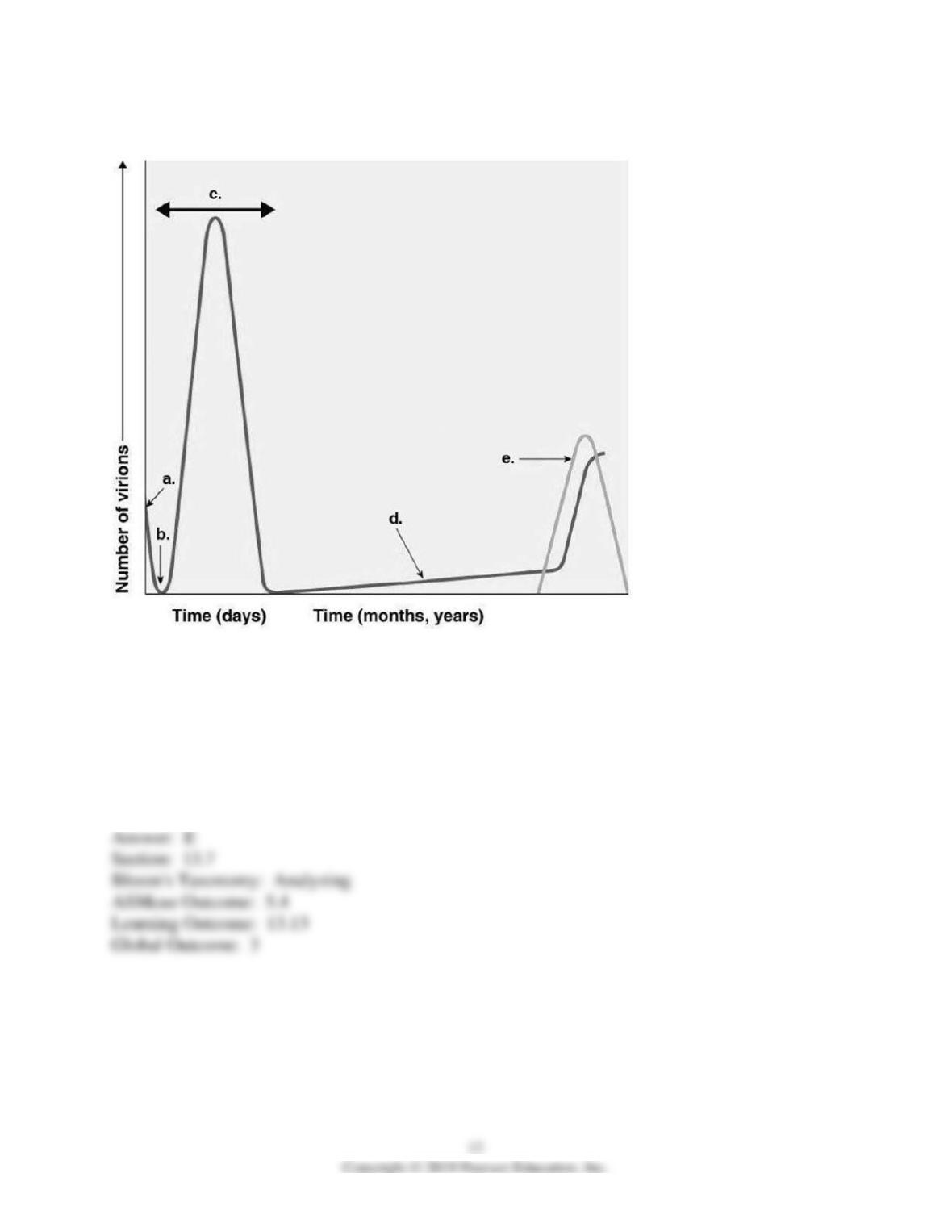
Figure 13.2
36) Assume a patient had chickenpox (human herpesvirus 3) as a child. Which line on the graph
in Figure 13.2 would show the number of viruses present in this person as a 60-year-old with
shingles (human herpesvirus 3)?
A) a
B) b
C) c
D) d
E) e

37) Assume a patient has influenza. During which time on the graph in Figure 13.2 would the
patient show the symptoms of the illness?
A) a
B) b
C) c
D) d
E) e
38) The following steps occur during multiplication of herpesviruses. Which is the third step?
A) attachment
B) biosynthesis
C) penetration
D) release
E) uncoating
39) The following steps occur during multiplication of retroviruses. Which is the fourth step?
A) synthesis of double-stranded DNA
B) synthesis of +RNA
C) attachment
D) penetration
E) uncoating

40) Oncogenic viruses
A) cause acute infections.
B) are genetically unstable.
C) cause tumors to develop.
D) are lytic viruses that kill the host cell.
E) have no effect on the host cell.
41) Which one of the following steps does NOT occur during multiplication of a picornavirus?
A) synthesis of + strands of RNA
B) synthesis of – strands of RNA
C) synthesis of viral proteins
D) synthesis of DNA
E) None of the answers is correct.
42) Which of the following is most likely a product of an early gene?
A) capsid proteins
B) DNA polymerase
C) envelope proteins
D) spike proteins
E) lysozyme
43) Most RNA viruses carry which of the following enzymes?
A) DNA-dependent DNA polymerase
B) lysozyme
C) RNA-dependent RNA polymerase
D) reverse transcriptase
E) ATP synthase

44) What is NOT true regarding viruses that infect plants?
A) They can spread via pollination.
B) They must enter through a wound or be introduced by an inset feeding.
C) They can sometimes be cultured in insect cells.
D) They are often cultured in embryonated chicken eggs.
E) They are morphologically similar to animal viruses.
45) What contributes to antigenic shift in influenza viruses?
A) worldwide distribution of the virus
B) a segmented genome
C) attachment spikes
D) ease of virus transmission
E) different virus subtypes
46) ________ were first identified in cancer-causing viruses and can induce ________ in
infected cells.
A) Herpes viruses; lesions
B) Oncogenes; transformation
C) T antigens; lysis
D) Glycoprotein spikes; syncytia formation
E) Segmented genomes; reassortment

47) What is an oncogene?
A) a problematic gene found exclusively in viruses
B) an altered form of a gene that may induce cancer
C) a toxin gene transferred by a virus
D) a viral polymerase
E) a viral ligand found in a family of viruses
48) What is the key characteristic of a transformed cell?
A) has acquired tumor-forming properties
B) is producing toxins affecting neighboring cells
C) is producing budding viruses
D) has undergone chromosomal rearrangements
E) is infected with a lytic virus
49) Shingles is an example of
A) reactivation of latent virus.
B) lytic virus.
C) persistent virus.
D) lysogeny.
E) transformation.
50) Why do most scientists agree that viruses are nonliving entities?
A) They cannot replicate outside host cells.
B) They are composed of relatively simple components.
C) They pass through filters.
D) They cause diseases in host cells.
E) They are not composed of cells.

13.2 True/False Questions
1) The basic mechanism of viral multiplication is similar for all viruses.
2) A viroid is a completely developed infectious agent composed of nucleic acid and surrounded
by a capsid.
3) Binomial nomenclature is used to name viruses.
4) Glycoprotein spikes are found on the capsids of all viruses.
5) Positive sense RNA strands of viruses are treated like mRNA inside the host cell.
6) Dogs do not get measles because their cells lack the correct receptor sites for that virus.
7) Helical and icosahedral are terms used to describe the shapes of a virus envelope.
8) Viruses are the only known infectious agents that are obligatory intracellular parasites.
9) A segmented genome can result in antigenic shift.
10) Most drugs that interfere with viral multiplication also interfere with host cell function.
13.3 Essay Questions
1) Bacteriophages are used as vectors in genetic engineering to insert new genes into bacteria.
Describe the process that makes this genetic recombination possible.
2) Compare and contrast the lytic cycle of infection of a DNA virus and an RNA virus.

3) Discuss why viruses are considered infectious “particles” on the borderline between living and
non-living.
4) Explain the steps involved in bacteriophage DNA entering a bacterial cell.
5) How is the replication of the viral genome of retroviruses unique among the viruses?
6) Researchers studying tissues of diseased marine mammals have identified what appear to be
viral particles by electron microscopy. Describe three methods you might use to attempt to
culture this virus for further study.