
Campbell Biology, 10e (Reece)
Chapter 13 Meiosis and Sexual Life Cycles
1) If a horticulturist breeding gardenias succeeds in having a single plant with a particularly
desirable set of traits, which of the following would be her most probable and efficient route to
establishing a line of such plants?
A) Backtrack through her previous experiments to obtain another plant with the same traits.
B) Breed this plant with another plant with much weaker traits.
C) Clone the plant.
D) Force the plant to self-pollinate to obtain an identical one.
2) Which of the following defines a genome?
A) the complete set of an organism’s polypeptides
B) the complete set of a species’ polypeptides
C) a karyotype
D) the complete set of an organism’s genes and other DNA sequences
3) Asexual reproduction occurs during _____.
A) meiosis
B) mitosis
C) fertilization
D) chromosome exchange between organisms of different species
4) Quaking aspen can send out underground stems for asexual reproduction. Sexual reproduction
is not as common, but when it does happen, the haploid gametes have 19 chromosomes. How
many chromosomes are in the cells of the underground stems?
A) 9
B) 10
C) 19
D) 38

5) Which of the following is a true statement about sexual vs. asexual reproduction?
A) Asexual reproduction, but not sexual reproduction, is characteristic of plants and fungi.
B) In sexual reproduction, individuals transmit half of their nuclear genes to each of their
offspring.
C) In asexual reproduction, offspring are produced by fertilization without meiosis.
D) Asexual reproduction produces only haploid offspring.
6) At which stage of mitosis are chromosomes usually photographed in the preparation of a
karyotype?
A) prophase
B) metaphase
C) anaphase
D) interphase
7) Which of the following is true of a species that has a chromosome number of 2n = 16?
A) The species is diploid with 32 chromosomes per cell.
B) The species has 16 sets of chromosomes per cell.
C) Each diploid cell has eight homologous pairs.
D) A gamete from this species has four chromosomes.
8) Eukaryotic sexual life cycles show tremendous variation. Of the following elements, which do
all sexual life cycles have in common?
I. Alternation of generations
II. Meiosis
III. Fertilization
IV. Gametes
V. Spores
A) I, II, and IV
B) II, III, and IV
C) II, IV, and V
D) I, II, III, IV, and V

9) In a plant’s sexual life cycle _____.
A) sporophytes produce gametes by meiosis
B) gametophytes produce gametes by mitosis
C) gametophytes produce gametes by meiosis
D) sporophytes produce gametes by mitosis
10) Which of the following is an example of alternation of generations?
A) A grandparent and grandchild each have dark hair, but the parent has blond hair.
B) A diploid plant (sporophyte) produces, by meiosis, a spore that gives rise to a multicellular,
haploid pollen grain (gametophyte).
C) A diploid animal produces gametes by meiosis, and the gametes undergo fertilization to
produce a diploid zygote.
D) A haploid mushroom produces gametes by mitosis, and the gametes undergo fertilization,
which is immediately followed by meiosis.
11) A given organism has 46 chromosomes in its karyotype. Therefore, we can conclude that it
must _____.
A) be human
B) be an animal
C) reproduce sexually
D) have gametes with 23 chromosomes
12) A triploid cell contains sets of three homologous chromosomes. If a cell of a usually diploid
species with 42 chromosomes per cell is triploid, this cell would be expected to have which of
the following?
A) 63 chromosomes in pairs
B) 63 chromosomes in 21 sets of 3
C) 63 chromosomes, each with three chromatids
D) 21 chromosome pairs and 21 unique chromosomes

13) Which of the following might result in a human zygote with 45 chromosomes?
A) an error in either egg or sperm meiotic anaphase
B) failure of the egg nucleus to be fertilized by the sperm
C) failure of an egg to complete meiosis II
D) incomplete cytokinesis during spermatogenesis after meiosis I
14) In a human karyotype, chromosomes are arranged in 23 pairs. If we choose one of these
pairs, such as pair 14, which of the following do the two chromosomes of the pair have in
common?
A) length and position of the centromere only
B) length, centromere position, and staining pattern only
C) length, centromere position, staining pattern, and traits coded for by their genes
D) They have nothing in common except that they are X-shaped.
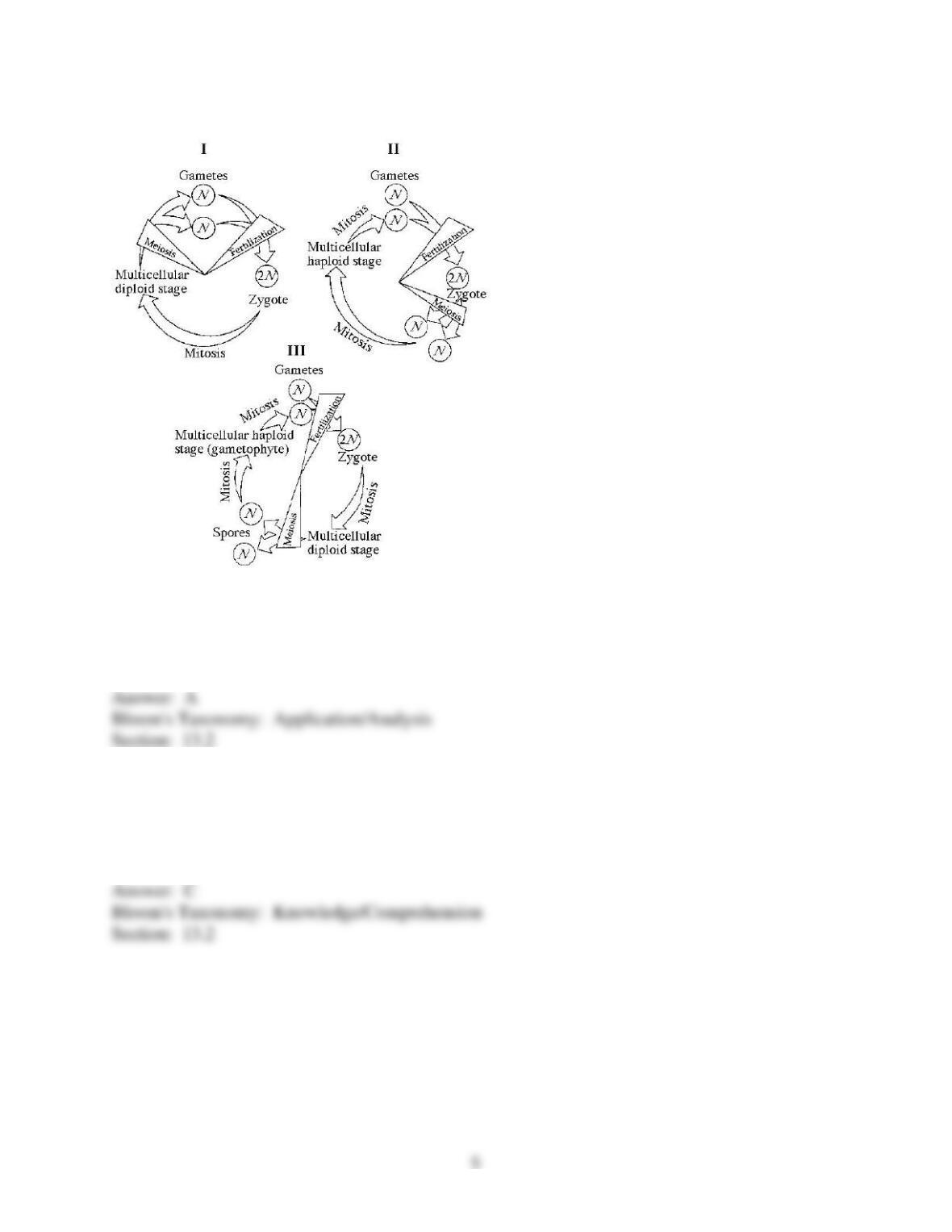
Refer to the life cycles illustrated in the figure below to answer the following question(s).
15) Which of the life cycles is typical for animals?
A) I only
B) II only
C) III only
D) I and III
16) Which of the life cycles is typical for plants and some algae?
A) I only
B) II only
C) III only
D) I and III

6
17) Which of the life cycles is typical for most fungi and some protists?
A) I only
B) II only
C) III only
D) I and II
18) In a life cycle such as that shown in part III of the figure above, if the zygote’s chromosome
number is 10, which of the following will be true?
A) The sporophyte’s chromosome number per cell is 10 and the gametophyte’s is 5.
B) The sporophyte’s chromosome number per cell is 5 and the gametophyte’s is 10.
C) The sporophyte and gametophyte each have 10 chromosomes per cell.
D) The sporophyte and gametophyte each have 5 chromosomes per cell.
19) Homologous chromosomes _____.
A) are identical
B) carry information for the same traits
C) carry the same alleles
D) align on the metaphase plate in meiosis II
20) If meiosis produces haploid cells, how is the diploid number restored for those organisms
that spend most of their life cycle in the diploid state?
A) DNA replication
B) reverse transcription
C) synapsis
D) fertilization
21) The human X and Y chromosomes _____.
A) are both present in every somatic cell of males and females
B) are the same size and have the same number of genes
C) include genes that determine an individual’s sex
D) are called autosomes
22) Which of these is a karyotype?

A) a display of all of the cell types in an organism
B) organized images of a cell’s chromosomes
C) the appearance of an organism
D) a display of a cell’s mitotic stages
23) If a cell has completed meiosis I and is just beginning meiosis II, which of the following is
an appropriate description of its contents?
A) It has half the amount of DNA as the cell that began meiosis.
B) It has half the chromosomes but twice the DNA of the originating cell.
C) It has one-fourth the DNA and one-half the chromosomes as the originating cell.
D) It is identical in content to another cell formed from the same meiosis I event.
24) The somatic cells of a privet shrub each contain 46 chromosomes. How do privet
chromosomes differ from the chromosomes of humans ,who also have 46?
A) Privet cells cannot reproduce sexually.
B) Privet sex cells have chromosomes that can synapse with human chromosomes in the
laboratory.
C) Genes of privet chromosomes are significantly different than those in humans.
D) Privet shrubs must be metabolically more like animals than like other shrubs.
25) After telophase I of meiosis, the chromosomal makeup of each daughter cell is _____.
A) diploid, and the chromosomes are each composed of a single chromatid
B) diploid, and the chromosomes are each composed of two chromatids
C) haploid, and the chromosomes are each composed of a single chromatid
D) haploid, and the chromosomes are each composed of two chromatids

26) How do cells at the completion of meiosis compare with cells that are in prophase of meiosis
I? They have _____.
A) half the number of chromosomes and half the amount of DNA.
B) the same number of chromosomes and half the amount of DNA.
C) half the number of chromosomes and one-fourth the amount of DNA.
D) half the amount of cytoplasm and twice the amount of DNA.
27) Which of the following happens at the conclusion of meiosis I?
A) Homologous chromosomes of a pair are separated from each other.
B) The chromosome number per cell remains the same.
C) Sister chromatids are separated.
D) Four daughter cells are formed.
28) Sister chromatids separate from each other during _____.
A) meiosis I only
B) meiosis II only
C) mitosis and meiosis I
D) mitosis and meiosis II
29) Which of the following occurs in meiosis but not in mitosis?
A) chromosome replication
B) synapsis of chromosomes
C) alignment of chromosomes at the equator
D) condensation of chromosomes
30) When we first see chiasmata under a microscope, we know that _____.
A) meiosis II has occurred
B) anaphase II has occurred
C) prophase I is occurring
D) separation of homologs has occurred

For the following questions, match the key event of meiosis with the stages listed below.
I. Prophase I V. Prophase II
II. Metaphase I VI. Metaphase II
III. Anaphase I VII. Anaphase II
IV. Telophase I VIII. Telophase II
31) Homologous chromosomes are aligned at the equator of the spindle.
A) I
B) II
C) IV
D) VI
32) Centromeres of sister chromatids disjoin and chromatids separate.
A) III
B) IV
C) V
D) VII
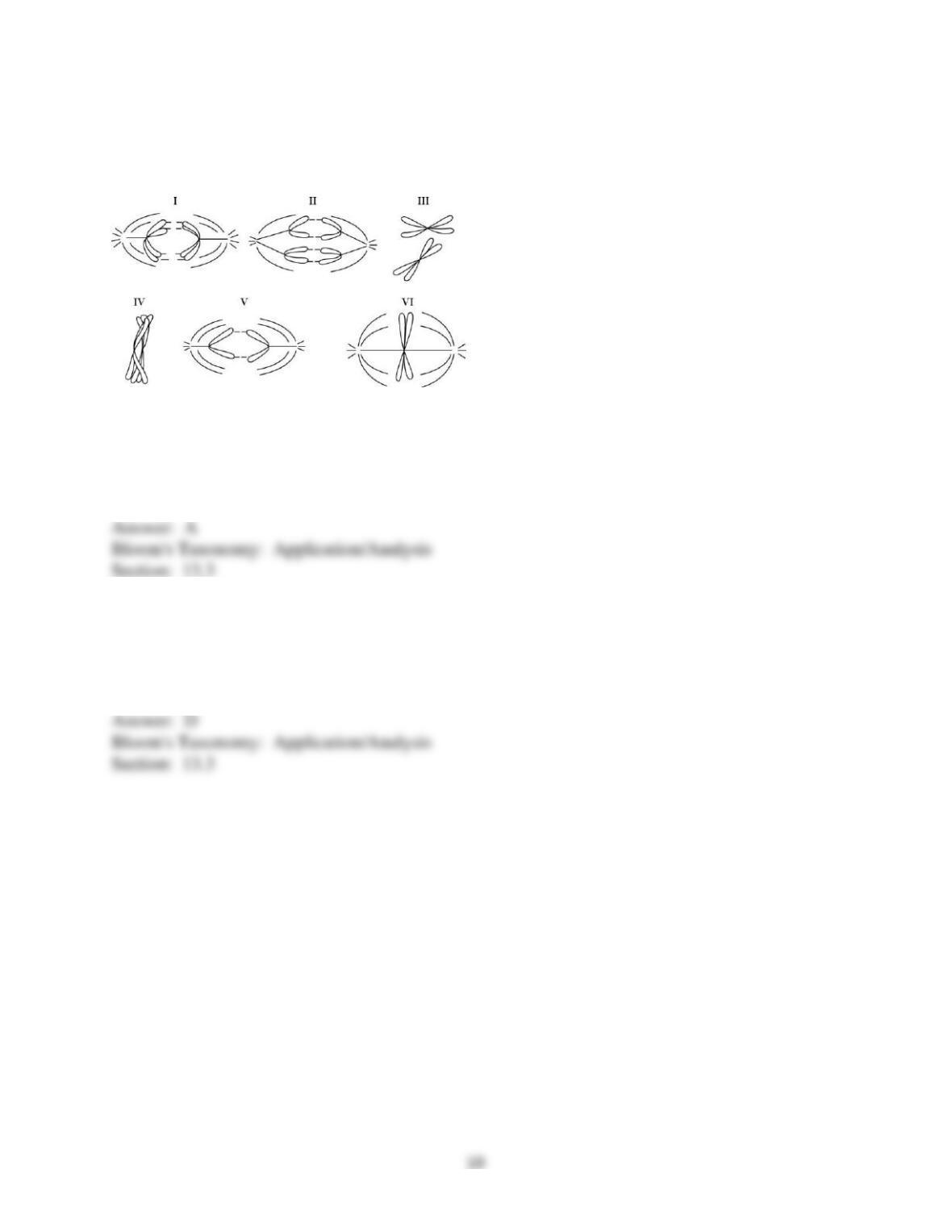
Refer to the drawings in the figure below of a single pair of homologous chromosomes as they
might appear during various stages of either mitosis or meiosis, and answer the following
questions.
33) Which diagram represents anaphase I of meiosis?
A) I
B) II
C) IV
D) V
34) Which diagram represents anaphase II of meiosis?
A) I
B) III
C) IV
D) V
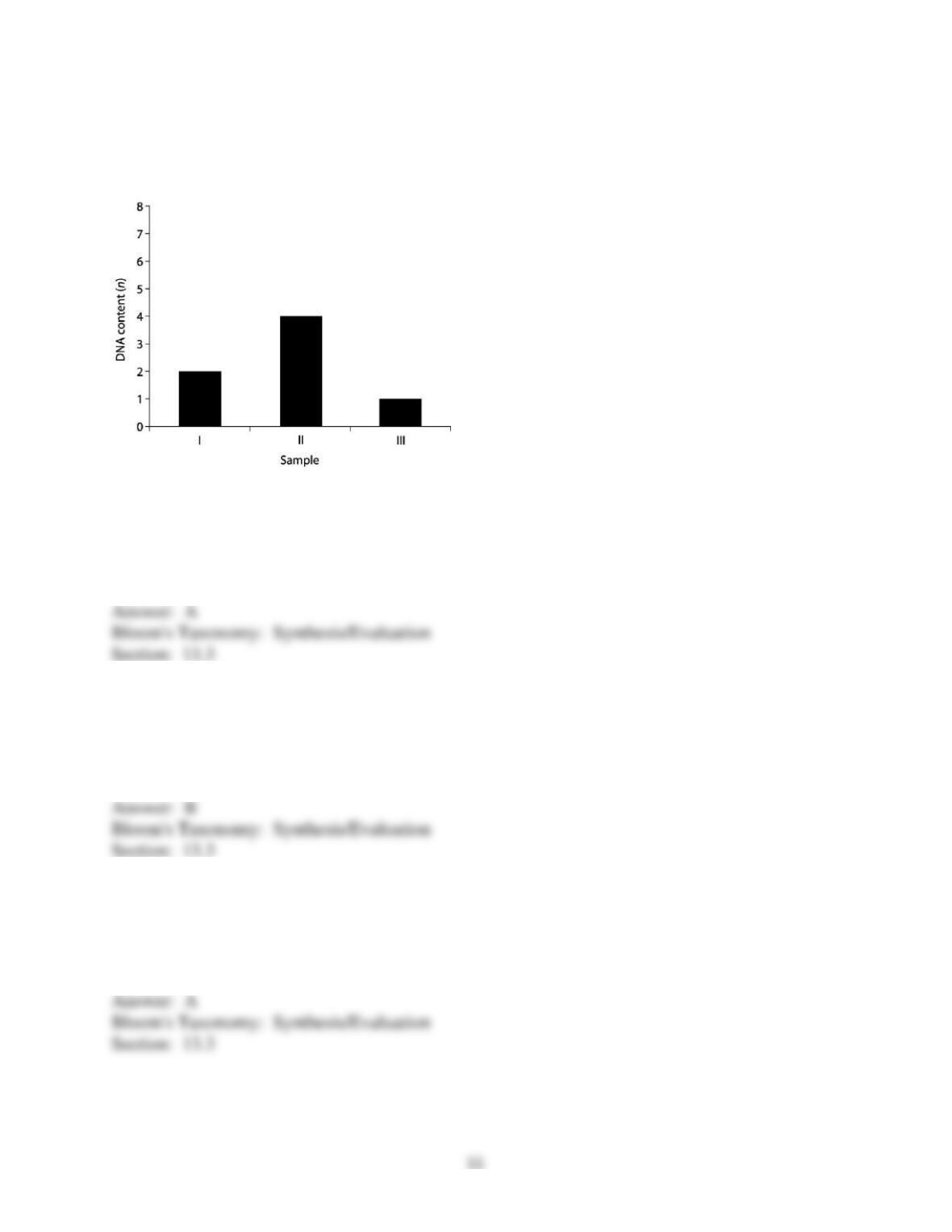
You have isolated DNA from three different cell types of the same organism, determined the
relative DNA content for each type, and plotted the results on the graph shown in the figure
below. Refer to the graph to answer the following question(s).
35) Which sample of DNA might be from a nerve cell arrested in G0 of the cell cycle?
A) I
B) II
C) III
D) either I or II
36) Which sample might represent an animal cell in the G2 phase of the cell cycle?
A) I
B) II
C) III
D) both I and II
37) Which sample might represent a zygote?
A) I
B) II
C) III
D) either I or II

Refer to the information and figure below to answer the following question(s).
A certain (hypothetical) organism is diploid, has either blue or orange wings as the consequence
of one of its genes on chromosome 12, and has either long or short antennae as the result of a
second gene on chromosome 19, as shown in the figure.
38) A certain female’s number 12 chromosomes both have the blue gene and number 19
chromosomes both have the long gene. As cells in her ovaries undergo meiosis, her resulting
eggs (ova) may have which of the following?
A) either two number 12 chromosomes with blue genes or two with orange genes
B) either two number 19 chromosomes with long genes or two with short genes
C) either one blue or one orange gene in addition to either one long or one short gene
D) one chromosome 12 with one blue gene and one chromosome 19 with one long gene
39) If a female of this species has one chromosome 12 with a blue gene and another chromosome
12 with an orange gene, and has both number 19 chromosomes with short genes, she will
produce which of the following egg types?
A) only blue short gene eggs
B) only orange short gene eggs
C) one-half blue short and one-half orange short gene eggs
D) three-fourths blue short and one-fourth orange short gene eggs
40) A female with a paternal set of one orange and one long gene chromosome and a maternal
set comprised of one blue and one short gene chromosome is expected to produce which of the
following types of eggs after meiosis?
A) All eggs will have maternal types of gene combinations.
B) All eggs will have paternal types of gene combinations.
C) Half the eggs will have maternal and half will have paternal combinations.
D) Each egg has a one-fourth chance of having either blue long, blue short, orange long, or
orange short combinations.

41) Somatic cells of roundworms have four individual chromosomes per cell. How many
chromosomes would you expect to find in an ovum from a roundworm?
A) four
B) two
C) eight
D) a diploid number
42) Which of the following can occur by the process of meiosis but not mitosis?
A) Haploid cells fuse to form diploid cells.
B) Haploid cells multiply into more haploid cells.
C) Diploid cells form haploid cells.
D) A diploid cell combines with a haploid cell.
43) In meiosis, homologous chromosomes are separated during _____.
A) anaphase II
B) prophase I
C) mitosis
D) anaphase I
44) What is a major difference between meiosis II and mitosis in a diploid animal?
A) Homologues align on the metaphase plate in meiosis II.
B) Sister chromatids separate in mitosis, and homologues separate in meiosis II.
C) Meiosis II occurs in a haploid cell, while mitosis occurs in diploid cells.
D) Crossover takes place in meiosis II.
45) What is a major difference between mitosis and meiosis I in a diploid organism?
A) Sister chromatids separate in mitosis, while homologous pairs of chromosomes separate in
meiosis I.
B) Sister chromatids separate in mitosis, while homologous pairs of chromosomes separate in
meiosis II.
C) DNA replication takes place prior to mitosis, but not before meiosis I.
D) Only meiosis I results in daughter cells that contain identical genetic information.

46) Crossing over normally takes place during which of the following processes?
A) meiosis II
B) meiosis I
C) mitosis
D) mitosis and meiosis II
47) For the duration of meiosis I, each chromosome _____.
A) is paired with a homologous chromosome
B) consists of two sister chromatids joined by a centromere
C) consists of a single strand of DNA
D) is joined with its homologous pair to form a synaptonemal complex
48) Homologous pairs of chromosomes align opposite of each other at the equator of a cell
during _____.
A) mitosis metaphase
B) meiosis metaphase I
C) meiosis telophase II
D) meiosis metaphase II
49) Centromeres split and sister chromatids migrate to opposite poles in meiosis _____.
A) anaphase I
B) telophase I
C) anaphase II
D) telophase II
50) Quaking aspen can send out underground stems for asexual reproduction. Sexual
reproduction is not as common, but when it does happen, the haploid gametes have 19
chromosomes. How many chromosomes are in the cells of the underground stems?
A) 9
B) 10
C) 19
D) 38

51) Independent assortment of chromosomes occurs during _____.
A) meiosis I only
B) meiosis II only
C) mitosis and meiosis I
D) mitosis and meiosis II
52) For a species with a haploid number of 23 chromosomes, how many different combinations
of maternal and paternal chromosomes are possible for the gametes?
A) 23
B) 46
C) about 1000
D) about 8 million
53) Independent assortment of chromosomes is a result of _____.
A) the random way each pair of homologous chromosomes lines up at the metaphase plate
during meiosis I
B) the random combinations of eggs and sperm during fertilization
C) the random distribution of the sister chromatids to the two daughter cells during anaphase II
D) the diverse combination of alleles that may be found within any given chromosome
54) When homologous chromosomes cross over, what occurs?
A) Two chromatids get tangled, resulting in one re-sequencing its DNA.
B) Two sister chromatids exchange identical pieces of DNA.
C) Corresponding segments of non-sister chromatids are exchanged.
D) Maternal alleles are “corrected” to be like paternal alleles and vice versa.
55) How is natural selection related to sexual reproduction as opposed to asexual reproduction?
A) Sexual reproduction results in many new gene combinations, some of which will lead to
differential reproduction.
B) Sexual reproduction results in the greatest number of new mutations.
C) Sexual reproduction allows the greatest number of offspring to be produced.
D) Sexual reproduction utilizes far less energy than asexual reproduction.

56) The diploid number of a roundworm species is 4. Assuming there is no crossover, and
random segregation of homologues during meiosis, how many different possible combinations of
chromosomes might there be in the offspring (not including variety generated by crossing over)?
A) 4
B) 8
C) 16
D) 64
57) The bulldog ant has a diploid number of two chromosomes. Therefore, following meiosis,
each daughter cell will have a single chromosome. Diversity in this species may be generated by
mutations and _____.
A) crossing over
B) independent assortment
C) crossing over and independent assortment
D) nothing else
58) The fastest way for organisms to adapt to a changing environment involves _____.
A) mutation
B) asexual reproduction
C) sexual reproduction
59) Imagine that there are twenty-five different species of protists living in a tide pool. Some of
these species reproduce both sexually and asexually, and some of them can reproduce only
asexually. The pool gradually becomes infested with disease-causing viruses and bacteria. Which
species are more likely to thrive in the changing environment?
A) the sexually reproducing species
B) the asexually reproducing species
C) Sexually and asexually reproducing species are equally likely to thrive.

60) In eukaryotes, genetic information is passed to the next generation by processes that include
mitosis or meiosis. Which of the explanations identifies the correct process and supports the
claim that heritable information is passed from one generation to another?
A) During mitosis, DNA replication occurs twice within the cell cycle to insure a full set of
chromosomes within each of the daughter cells produced.
B) Mitosis, followed by cytokinesis, produces daughter cells that are genetically different from
the parent cell, thus insuring variation within the population.
C) In asexual reproduction, a single individual is the sole parent and passes copies of its genes to
its offspring without the fusion of gametes.
D) Single-celled organisms can fuse their cells, reproducing asexually through mitosis to form
new cells that are not identical to the parent cell.
61) Genetic variation leads to genetic diversity in populations and is the raw material for
evolution. Biological systems have multiple processes, such as reproduction, that affect genetic
variation. They are evolutionarily conserved and shared by various organisms.
Which statement best represents the connection between reproduction and evolution?
A) Plants that use sexual reproduction are rare since this type of reproduction in plants does not
contribute to genetic diversity.
B) In order to increase genetic diversity for evolution in sexually reproducing organisms,
mutations must occur in the zygote after fertilization.
C) Since prokaryotic organisms reproduce asexually, there is no mechanism for them to add
genetic diversity for evolution.
D) Sexual reproduction increases genetic variation because random mutations can be shuffled
between organisms.