Chapter 12 Characterizing and Classifying Eukaryotes
12.1 Multiple Choice Questions
1) The fusion of two gametes produces a
A) zygote.
B) schizont.
C) chromatid.
D) centromere.
E) merozoite.
2) Replication of the DNA occurs during
A) metaphase.
B) prophase.
C) telophase.
D) anaphase.
E) interphase.
3) Sister chromatids separate and move toward the poles of the cell during ________ of
mitosis.
A) telophase
B) anaphase
C) metaphase
D) interphase
E) prophase
4) An aligned pair of homologous chromosomes is called a
A) chromatid.
B) spindle.
C) tetrad.
D) coenocyte.
E) gamete.
5) Which of the following pairs is MISMATCHED?
A) animals; usually diploid
B) fungi; usually diploid
C) protozoa; usually diploid
D) slime mold; usually haploid
E) plants; usually diploid
6) Sister chromatids separate during ________ of meiosis.
A) anaphase I
B) prophase II
C) metaphase II
D) anaphase II
E) telophase I
7) Which of the following statements regarding meiosis is most accurate?
A) Crossing over occurs during metaphase I.
B) A diploid cell produces haploid daughter cells.
C) Haploid cells produce diploid cells.
D) Homologous (non-sister) chromatids separate during anaphase II.
E) Meiosis has the same number of stages as mitosis.
8) Merozoites are a result of
A) meiosis.
B) schizogony.
C) mitosis.
D) crossing over.
E) conjugation.
9) Which of the following pairs is MISMATCHED?
A) Diplomonadida; two nuclei
B) Rhizaria; pseudopodia
C) Parabasala; two mitochondria
D) Euglenids; flagellum
E) Ciliophora; cilia
10) Which of the following is a protozoan stage that allows for transmission of intestinal
parasites from one host to another?
A) cyst
B) merozoite
C) schizont
D) foraminifera
E) kinetoplast
11) Single-celled eukaryotes lacking a cell wall are
A) protozoa.
B) fungi.
C) algae.
D) insects.
E) water molds.
12) The Apicomplexa are named for their apical complexes which allow them to
A) be motile by means of multiple flagella.
B) penetrate the cytoplasmic membranes of host cells.
C) undergo schizogony.
D) carry out photosynthesis.
E) attach to surfaces.
13) The ________ have silicate shells and thin pseudopods.
A) Amebozoa
B) Euglenids
C) Ciliates
D) Dinoflagellates
E) Radiolaria
14) A single-celled eukaryote that is both photosynthetic and a chemoheterotroph is a(n)
A) apicomplexan.
B) dinoflagellate.
C) euglenid.
D) ciliate.
E) kinetoplastid.
15) Which of the following is a protozoan with two nuclei and no mitochondria?
A) Plasmodium
B) Paramecium
C) Euglena
D) Giardia
E) Trichomonas
16) Which of the following has NOT been a basis for classification of the protozoa?
A) means of locomotion
B) genetic sequences
C) photosynthetic ability
D) habitat
E) ability to form a dormant stage
17) The ________ is the entire interwoven mass of one multicellular fungal organism.
A) hyphae
B) sporangium
C) mycelium
D) pseudoplasmodium
E) conidiophore
18) The asexual spores of molds are classified according to their
A) size.
B) type of metabolism.
C) number of chromosomes.
D) shapes.
E) mode of development.
19) Which of the following is a cell type associated with sexual reproduction in fungi?
A) sporangiospore
B) dikaryon
C) haustoria
D) pneumocyst
E) mycorrhiza
20) Fungal spores produced asexually within a sac-like chamber at the tip of a hypha are called
A) ascospores.
B) basidiospores.
C) sporangiospores.
D) conidia.
E) zygospores.
21) Sexual reproduction in Basidiomycota results in the production of
A) ascospores.
B) basidiospores.
C) conidiospores.
D) endospores.
E) zygospores
22) A fungus which produces sexual spores within a sac-like chamber in a fruiting body is a
member of the
A) Ascomycota.
B) Basidiomycota.
C) Deuteromycetes.
D) Zygomycota.
E) Answer cannot be determined with this information.
23) The large seaweed known as kelp is classified as a member of the
A) Chlorophyta.
B) Phaeophyta.
C) Chrysophyta.
D) Rhodophyta.
E) Deuteromycete.
24) Hyphae are associated with which of the following?
A) yeasts
B) algae
C) molds
D) protozoa
E) helminths
25) Aseptate fungi are classified as
A) Basidiomycota.
B) Deuteromycetes.
C) Zygomycota.
D) Ascomycota.
E) Rhodophyta.
26) Lichens are composed of a symbiosis of fungi and which of the following?
A) green algae
B) cyanobacteria
C) euglenoids
D) cyanobacteria or green algae
E) euglenoids or dinoflagellates
27) Slime molds are classified as
A) amoebozoa.
B) dinoflagellates.
C) fungi.
D) lichens.
E) rhizaria.
28) The division Basidiomycota includes which of the following types of fungi?
A) truffles
B) mushrooms
C) baker’s yeast
D) bread mold
E) ringworm
29) Which of the following organisms grow on higher plants to produce truffles?
A) euglenids
B) kinetoplastids
C) mycorrhizae
D) lichens
E) water molds
30) Which of the following protozoa genera helps termites digest wood?
A) Trichonympha
B) Nosema
C) Trichomonas
D) Pfiesteria
E) Naegleria
31) In a cell that has a diploid number of 8 chromosomes, how many chromatids will be present
at the beginning of mitosis?
A) 8
B) 16
C) 32
D) 4
E) 2
32) Which of the following is present during meiosis but not mitosis?
A) a chromatid
B) a centromere
C) a spindle
D) a tetrad
E) sister chromatids
33) When mitosis occurs without cytokinesis, which of the following is produced?
A) merozoites
B) chromatids
C) cysts
D) macronuclei
E) coenocytes
34) The chromatids move toward opposite poles during ________ of mitosis.
A) anaphase
B) telophase
C) metaphase
D) prophase
E) interphase
35) Multiple mitoses followed by a single cytokinetic event is known as
A) meiosis.
B) schizogony.
C) coenocytic division.
D) encystment.
E) interphase.
36) The chromosomes line up in the middle of the cell during
A) prophase.
B) anaphase.
C) metaphase.
D) telophase.
E) prophase II.
37) The process in which the cytoplasm is divided between daughter cells is known as
A) coenocytosis.
B) budding.
C) meiosis.
D) cytokinesis.
E) nuclear division.
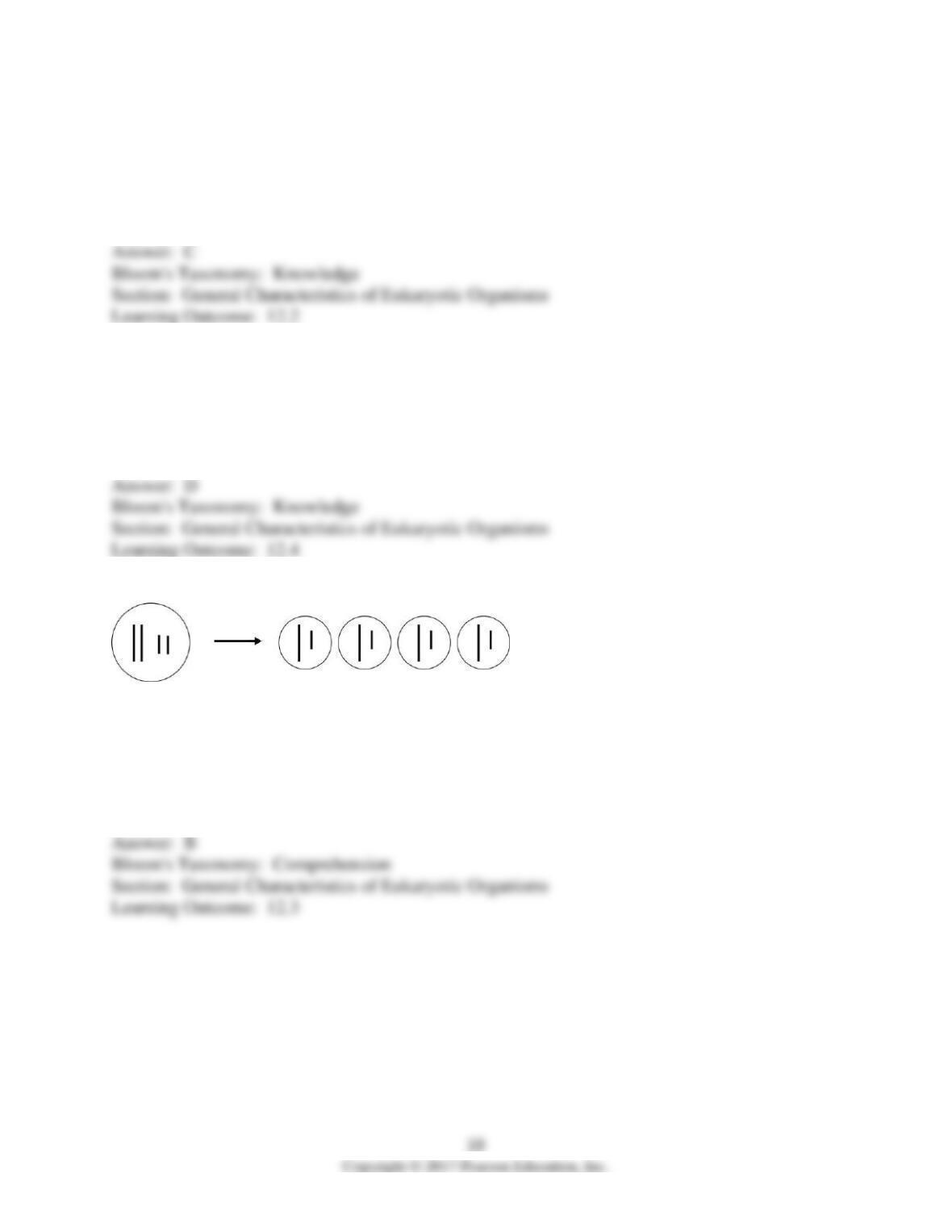
38)
Which process is represented by Figure 12.1?
A) mitosis
B) meiosis
C) cytokinesis
D) schizogony
E) budding
39) The distinguishing characteristic used to classify the algae into four kingdoms is
A) whether they are single celled or multicellular.
B) their cell wall components.
C) their storage products.
D) their habitat.
E) presence or absence of chlorophyll a.
40) Algae that are important sources of thickening agents like agar are known as
A) Rhodophyta.
B) Phaeophyta.
C) Chrysophyta.
D) Rhizobium.
E) Chlorophyta.
41) Simple eukaryotes that carry out oxygenic photosynthesis and reproduce by means of
alternation of generations are known as
A) algae.
B) fungi.
C) slime molds.
D) euglenids.
E) arachnids.
42) Single-celled organisms called ciliates are
A) fungi.
B) protozoa.
C) insects.
D) algae.
E) water molds.
43) Fungi called Deuteromycetes are not known to reproduce sexually. Nonetheless, most of
them are considered members of the ________ on the basis of genetic sequences.
A) Zygomycota
B) Basidiomycota
C) Ascomycota
D) Sporozoa
E) Rhizaria
44) Multicellular organisms with hard exoskeletons, segmented bodies and four pairs of jointed
legs in the adult stage are
A) algae.
B) arachnids.
C) insects.
D) helminths.
E) lice.
45) Which of the following is transmitted by mosquitoes?
A) African sleeping sickness
B) malaria
C) ringworm
D) tapeworms
E) typhus
12.2 True/False Questions
1) Haploid genomes contain two sets of chromosomes.
2) Fungi reproduce only asexually.
3) Protozoa are eukaryotic organisms that lack a cell wall and can be unicellular or
multicellular.
4) Ciliates often have two kinds of nuclei that have different functions.
5) In fungi, aseptate hyphae are coenocytic by definition.
6) Algae can have different types of photosynthetic pigments that allow them to
photosynthesize at various depths in water.
7) Lyme disease is vectored by ticks.
8) In spite of their name, water molds are not true fungi.
9) Conidiospores are the products of mitosis.
10) Current classification of the algae is based on morphologic characteristics.
12.3 Short Answer Questions
1) The fever and chills associated with malaria are due to the release of uninucleate daughter
cells of Plasmodium called (gametocytes/schizonts/coencytes).
2) The vegetative stage of a protozoan is called a (cyst/trophozoite/zygote).
3) The (fungi/algae/lichens) are so sensitive to pollutants that they are used as indicators of
environmental conditions.
4) Protozoa that move and feed by the use of broad pseudopods are called
(amoebozoa/apicomplexa/rhizaria).
5) Limestone is made up of the shells of (foraminifera/parabasala/radiolarians).
6) The asexual reproductive spores produced at the tips of hyphae and not enclosed in a sac are
(conidiospores/ascospores/sporangiospores).
7) Fungi and insects both use the nitrogenous polysaccharide (cellulose/chitin/silica) as a
protective molecule in their outer surfaces.
8) Slime molds are classified with protozoa in part because they have
(flagella/pseudopods/shells).
9) Modified hyphae that allow fungi to derive nutrients from other living organisms are
(septate/pseudohyphae/haustoria).
10) The plague is transmitted by (fleas/lice/ticks/mites).
11) Edible true mushrooms are typically members of the
(Ascomycota/Basidiomycota/Deuteromycetes/Zygomycota).
12) Diatoms are single celled marine algae with walls composed of
(chiton/cellulose/carbonate/silica).
13) Microbiologists interested in parasites study multicellular (insects/fungi/worms) as well as
single-celled protozoa.
14) Sexual reproduction in unicellular algae is accomplished by the cell acting as a
(gamete/spore/zygote).
15) Ticks, lice, and mosquitoes often serve as (carriers/transporters/vectors) by hosting and
transmitting pathogenic microbes.
12.4 Essay Questions
1) Compare and contrast slime molds and water molds.
2) A field biologist finds an unfamiliar single-celled organism in a sample from the surface of a
marshy area. What observations or tests would make it possible to determine whether it is a
protozoan, fungus, or alga? Assume the PCR machine at the field station is not working, but all
other equipment is.
3) Compare and contrast mitosis and meiosis using words, diagrams or both.
4) Describe the ways in which fungi reproduce.
5) Describe the ways in which algae and fungi are useful microbes.