
1
Campbell Essential Biology, 6e (Simon/Dickey/Hogan/Reece)
Chapter 12 DNA Technology
Chapter 12 Learning Outcomes
12 Biology and Society: Using DNA to Establish Guilt and Innocence
12.1. Explain how DNA profiling is used in criminal trials to establish guilt and innocence.
12.1 Genetic Engineering
12.2. Relate useful biological products to the genetic engineering techniques used to produce
them.
12.3. Explain how recombinant DNA is produced using plasmids, restriction enzymes, ligase,
and gel electrophoresis.
12.4. Compare and contrast how genetically modified organisms are used in agriculture.
12.5. Evaluate the pros and cons of human gene therapy and how it can be used to treat disease.
12.2 DNA Profiling and Forensic Science
12.6. Explain how the polymerase chain reaction (PCR), short tandem repeat (STR) analysis,
and gel electrophoresis are used in DNA profiling, the treatment and diagnosis of disease,
and the investigations of crime, paternity, and ancient DNA.
12.3 Bioinformatics
12.7. Compare and contrast what is learned in the fields of genomics, metagenomics,
proteomics, and systems biology.
12.8. Explain how the “whole-genome shotgun” method is used to study genomes.
12.9. Describe how the Human Genome Project and the field of bioinformatics can provide
insights into evolutionary relationships.
12.4 Safety and Ethical Issues
12.10. Evaluate the potential benefits, risks, and concerns of producing genetically modified
foods.
Evolution Connection: The Y Chromosome as a Window on History
12.11. Describe the results of DNA profiling of the human Y chromosome.
Global Learning Outcomes
1. Demonstrate an understanding of the principles of scientific inquiry.
2. Demonstrate the ability to think critically and employ critical-thinking skills.
3. Read and interpret models, graphs, and data.
4. Demonstrate the quantitative skills needed to succeed in biology.
5. Demonstrate an understanding of the impact of science on society.
6. Evaluate the credibility of scientific information from various sources.
7. Demonstrate the ability to make connections between concepts across biology.
8. Communicate effectively in writing.
9. Apply the scientific method to interpret information and draw conclusions.
12.1 Multiple Choice Questions
1) What evidence led to Kirk Odom’s freedom after being wrongly imprisoned for 30 years?
A) an analysis of blood types from the crime scene
B) an analysis of fingerprints from the crime scene
C) accounts from witnesses
D) an analysis of DNA from the crime scene
2) Which of the following is the best definition for recombinant DNA?
A) DNA that results from bacterial conjugation
B) DNA that includes pieces from two different sources
C) an alternate form of DNA that is the product of a mutation
D) DNA that carries a translocation
3) Which of the following is a genetically modified organism?
A) an organism carrying a gene that was acquired by artificial means
B) the first organism in which a particular mutation has appeared
C) a cloned organism carrying two different alleles
D) an organism that gestated in an artificial womb
4) Which of the following best defines the term “transgenic organism”?
A) an organism that is the first of its kind to bear a particular allele
B) an organism in which a genetic defect has been corrected using recombinant DNA therapy
C) an organism containing a gene from another species
D) an organism containing genes from three or more species
5) The world’s first genetically engineered pharmaceutical product was ________.
A) humulin
B) HGH
C) tPA
D) EPO
6) A vaccine works by ________.
A) inhibiting bacterial reproduction
B) stimulating the immune system to develop lasting defenses
C) killing cells infected with a virus
D) preventing translation of mRNA molecules that code for disease-causing proteins
7) Transgenic animals are currently used ________.
A) to produce potentially useful proteins
B) as food
C) as vectors for use in cloning human DNA
D) all of the answer options are correct
8) Which of the following can act as a vector to introduce new genes into a cell?
A) primers
B) ligase
C) restriction enzymes
D) plasmids

9) Of these steps, which occurs first in the production of a recombinant plasmid?
A) cloning
B) cutting DNA into fragments
C) isolation of a plasmid from a bacterium
D) reproduction of the engineered plasmid in bacteria
10) Of these steps, which one occurs earliest in the process of producing recombinant DNA?
A) Human DNA fragments are mixed with the cut plasmids.
B) The same restriction enzyme is used to isolate the gene of interest and to cut the plasmid
DNA.
C) The recombinant plasmids are mixed with bacteria.
D) Bacteria carrying recombinant plasmids are cloned.
11) When plasmids are used to produce a desired protein, the ________.
A) plasmids multiply and produce the protein outside of the bacterium
B) bacterial chromosome is genetically engineered, and the plasmid is used to help the bacterium
replicate
C) desired gene is inserted into the plasmid, and the plasmid is taken up by the bacterium
D) bacterial genome and plasmid are inserted into the genome of the cell containing the desired
gene
12) The process of making multiple copies of a gene by inserting it into a host genome and
culturing the host is an example of ________.
A) gene cloning
B) PCR
C) STR analysis
D) whole-genome shotgun method
13) Restriction enzymes are obtained from ________.
A) archaea
B) eukaryotes
C) viruses
D) bacteria
14) “Sticky ends” are produced as a result of the action of ________.
A) PCR
B) DNA ligase
C) restriction enzymes
D) bacterial plasmids
15) “Sticky ends” are ________.
A) single-stranded ends of fragments of double-stranded DNA
B) regions of double-stranded DNA that can be cut by a restriction enzyme
C) portions of DNA used as markers for STR analysis
D) regions of DNA amplified in PCR
16) A DNA fragment with a sticky end that reads -ATTCG will bind with another DNA
fragment with a sticky end that reads ________.
A) TAAGC-
B) CGGAT-
C) GCCTA-
D) ATTGC-

17) Which enzyme is used to bind DNA fragments together?
A) restriction enzyme
B) lysozyme
C) DNA ligase
D) DNA polymerase
18) Of the following, which is the last step in the production of a recombinant DNA plasmid?
A) cloning
B) using DNA ligase to join DNA fragments
C) cutting the gene of interest into fragments
D) allowing the reproduction of the bacterium bearing the recombinant plasmid
19) HindIII is a restriction enzyme that cuts the DNA sequence AAGCTT between the two A
bases. How many times would HindIII cut the following DNA molecule?
GTAAGCTTCGACAAGCTTGCTGA
A) 0 times
B) 1 time
C) 2 times
D) 3 times
20) You are attempting to link an individual to a crime. The only evidence you have is a tiny
drop of blood. How can you use this drop of blood to definitively make the association?
A) You can use the sample to determine the individual’s blood type.
B) You can use gel electrophoresis to determine the length of the DNA found in the sample.
C) You can use PCR to increase the amount of DNA available for STR analysis.
D) You can use the sample to check for the presence of the Rhesus factor.

21) What name is given to a region of DNA that varies from person to person?
A) genetic marker
B) short tandem repeat
C) sticky end
D) restriction fragment
22) Cutting DNA with a particular restriction enzyme produces DNA fragments that can be
separated by ________.
A) gel electrophoresis
B) enzymes
C) recombinant DNA
D) plasmids
23) To make restriction fragments, a DNA sample is treated with ________.
A) DNA ligase
B) restriction enzymes
C) DNA polymerase
D) lysozyme
24) Gel electrophoresis separates DNA fragments on the basis of differences in their ________.
A) A:C ratio
B) length
C) G:T ratio
D) pH

25) STR analysis is a DNA profiling technique that makes use of the fact that different people
have ________.
A) different numbers of repeats of short DNA sequences at certain sites in the genome
B) different alleles for many genes in the genome
C) different restriction fragments
D) different CODIS DNA sequences
26) FGA is one of the STRs that are used to compare DNA between different people. Why is
FGA useful for comparing DNA between different people?
A) FGA varies in the number of repeats between different people.
B) FGA varies in sequence between different people.
C) FGA is only present in some peoples’ genomes.
D) FGA is present in different places in different peoples’ genomes.
27) The scientific field that studies complete sets of genes is called ________.
A) genomics
B) metagenomics
C) proteomics
D) genetic engineering
28) The human genome contains approximately ________ genes.
A) 1,000
B) 5,000
C) 21,000
D) 30,000

29) Approximately what percentage of the human genome consists of noncoding DNA?
A) 98%
B) 87%
C) 77%
D) 67%
30) The Human Genome Project has the potential to ________.
A) lead to treatments for inherited diseases
B) lead to treatments for contagious diseases
C) increase our understanding of the historical relationships among species
D) play a role in all of the choices listed here
31) Which of these statements can be logically inferred from the amount of DNA shared by
chimpanzees and humans?
A) Humans and chimpanzees share a relatively recent common ancestor.
B) Humans evolved from chimpanzees.
C) Humans are unique and different from all other life forms.
D) Humans are a more complex life form than chimpanzees.
32) To find the nucleotide sequence of human chromosomes, chromosomes had to be digested
into small fragments and then ________.
A) centrifuged and electrophoresed
B) fingerprinted
C) cloned and sequenced
D) restricted

33) The study of the full protein sets that genomes encode is ________.
A) proteomics
B) genomics
C) metagenomics
D) systems biology
34) In human gene therapy ________.
A) normal versions of genes are transferred to patients who carry a mutated allele
B) harmless bacteria make important proteins for humans that cannot produce these proteins on
their own
C) bacterial plasmids are used to transfer genes to human patients
D) genetically engineered alleles, usually from other species, replace mutated alleles
35) The state of human gene therapy today is that ________.
A) the work that has been completed so far is purely theoretical, but some treatments are in
development
B) there have been a small number of successes, including with the disease SCID
C) human gene therapy is used routinely in the treatment of certain rare cancers
D) human gene therapy is used to treat a wide variety of conditions, including diabetes, cancer,
and bone marrow diseases
36) Genetically modifying human ________ cells may directly affect future generations.
A) intestinal
B) immune
C) gametic
D) somatic

37) Ethical dilemmas raised by DNA technology and knowledge of the human genome include
________.
A) the potential for interfering in evolution, only
B) the safety of GM foods, only
C) the potential discrimination against people predisposed to certain diseases, only
D) all of the answer choices are correct
38) The possibility that Mongolian ruler Genghis Khan spread an unusual chromosome to nearly
16 million men living today resulted from studies of ________.
A) proteomics
B) plasmids
C) the X chromosome
D) the Y chromosome
12
12.2 Art Questions
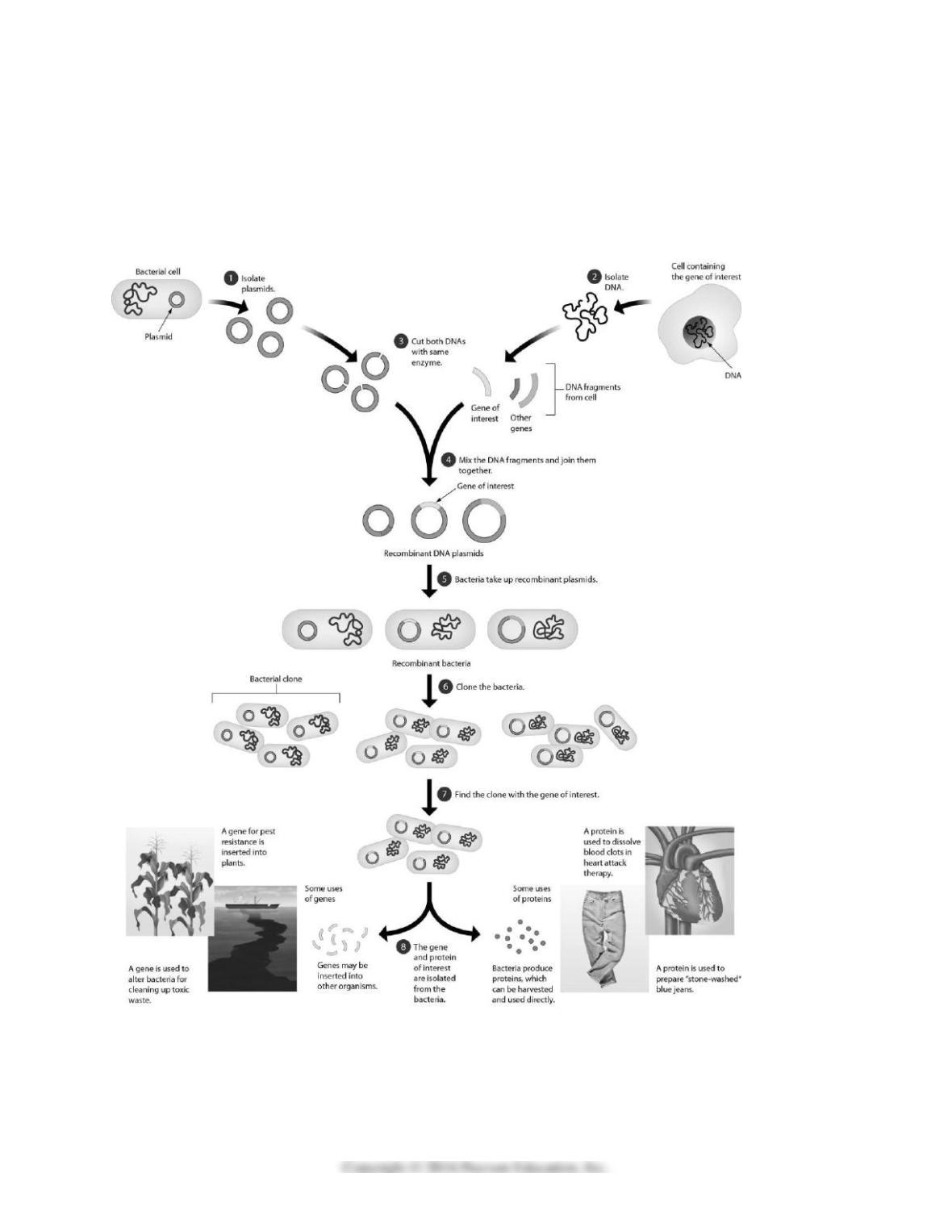
1) The following figure provides you with an overview of recombinant technology. The end
result is a transgenic bacterium with a human gene that codes for marketable quantities of a
human gene product. However, molecular biologists frequently have problems with the product.
One problem might be ________.
A) production of a human protein that is unable to function properly
B) formation of a bacterium that cannot synthesize the product
C) a bacterium with DNA that is resistant to restriction enzymes
D) formation of mutants
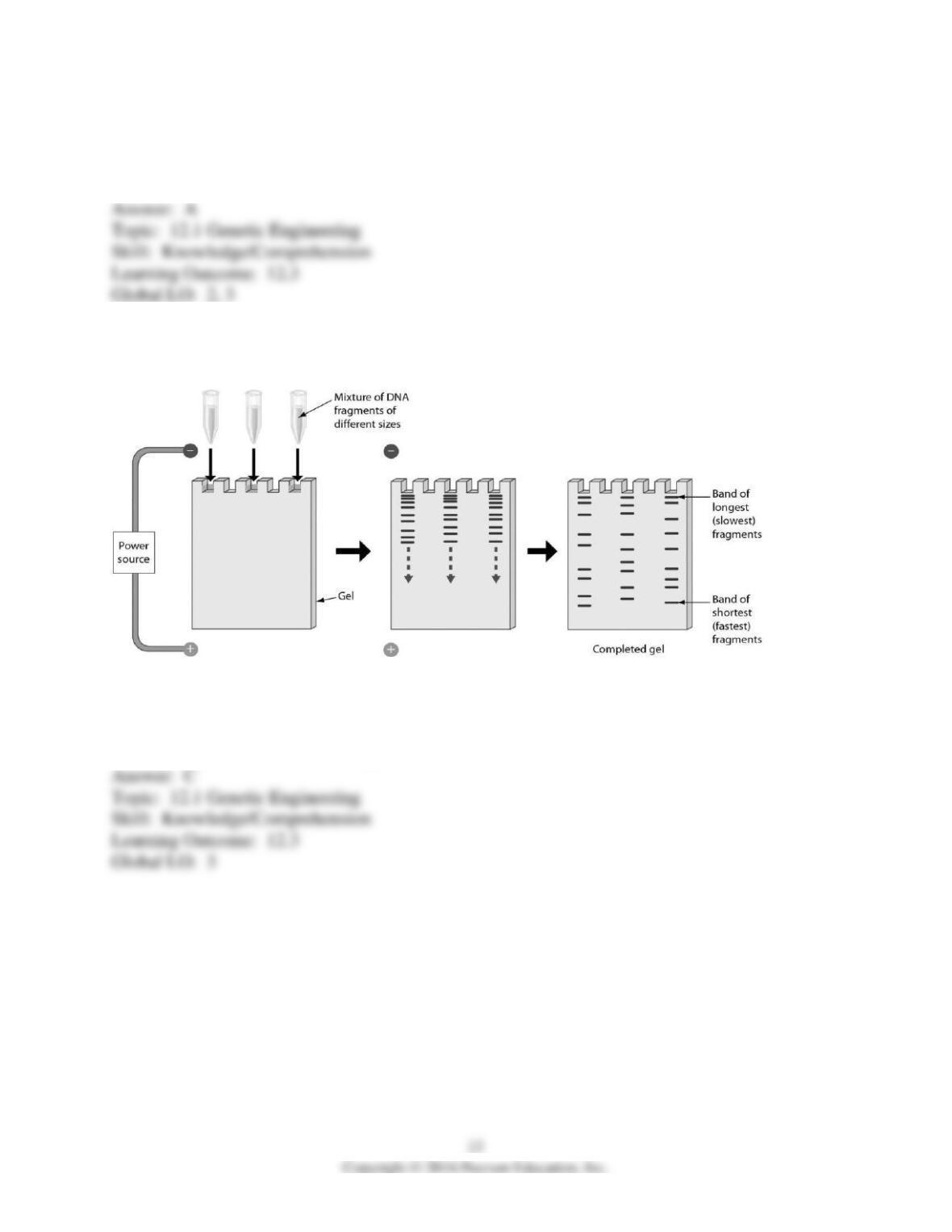
2) The following figure shows that gel electrophoresis can be used to separate repetitive DNA
sequences. Gel electrophoresis separates DNA fragments because ________.
A) double-stranded moves slower than single-stranded DNA
B) of ratios of guanine to cytosine
C) the DNA fragments have different lengths
D) of the salt concentration in the gel matrix
14
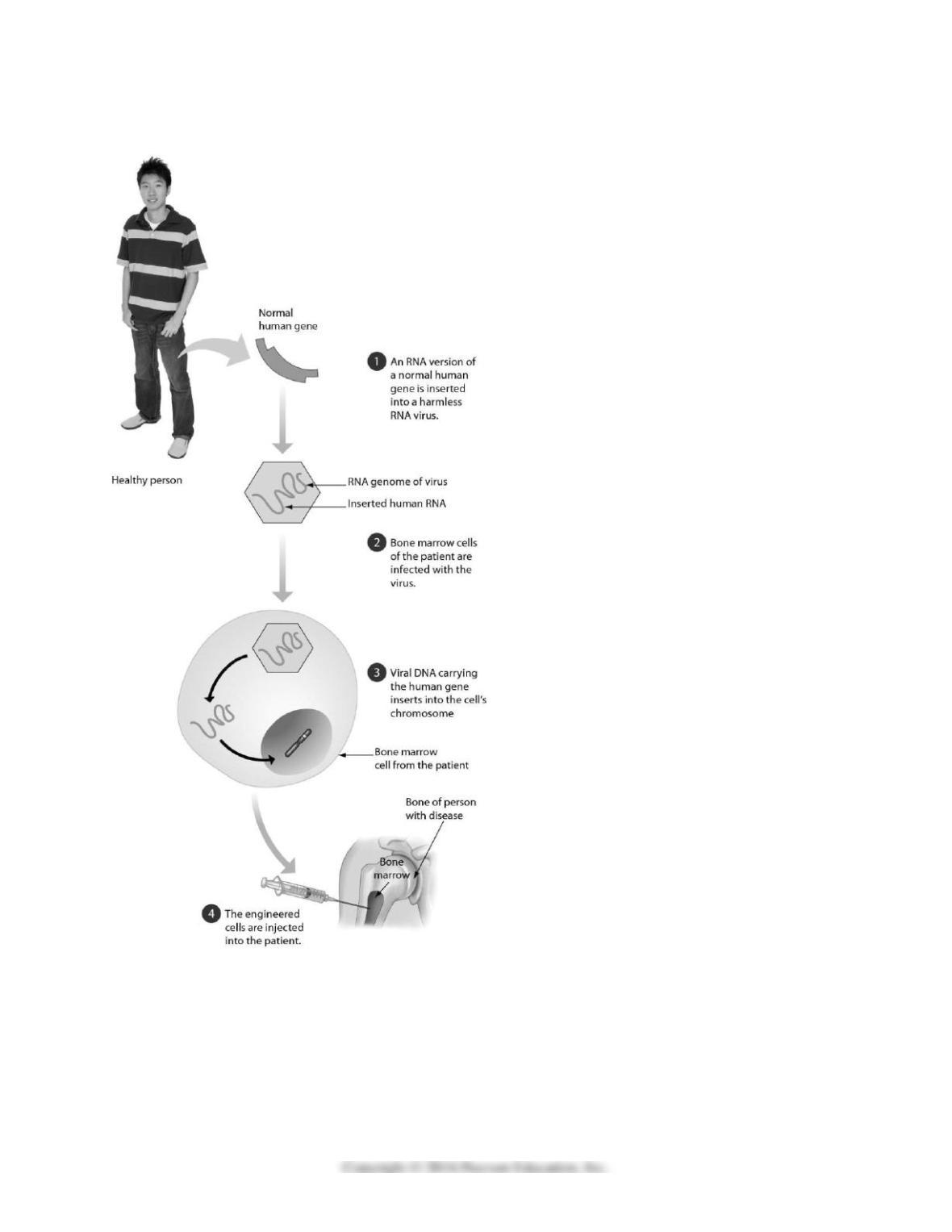
3) The diagram below summarizes ________.
A) gene cloning
B) how a human could be cloned
C) human gene therapy
D) how a vaccine is made
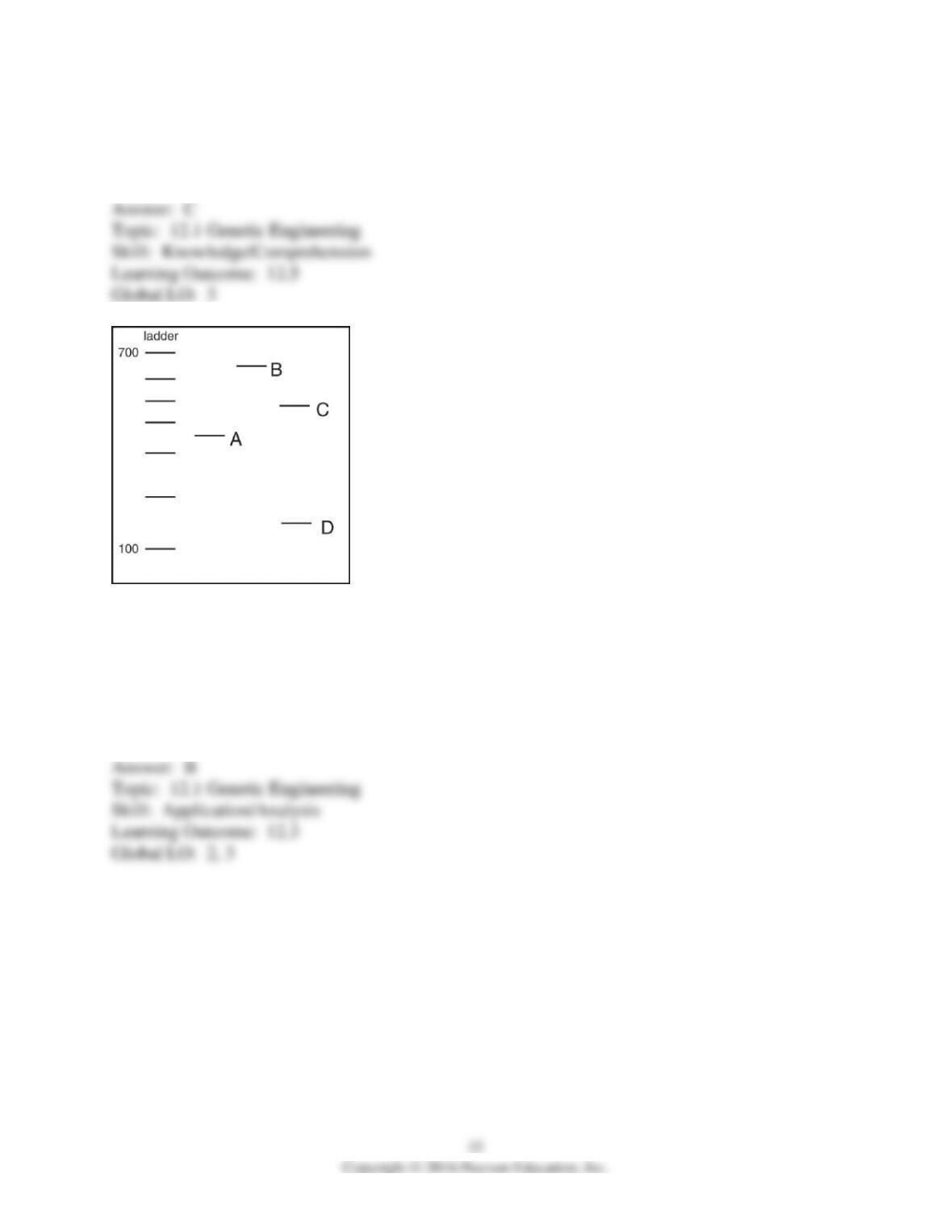
4) The gel shown above includes a DNA ladder that can be used to estimate the sizes of DNA
molecules. The ladder increases in 100 nucleotide increments, from 100 to 700. Four DNA
molecules have been separated on this gel (labeled A to D). Which DNA molecule is the largest?
A) DNA molecule A
B) DNA molecule B
C) DNA molecule C
D) DNA molecule D

5) The gel shown above includes a DNA ladder that can be used to estimate the sizes of DNA
molecules. The ladder increases in 100 nucleotide increments, from 100 to 700. Four DNA
molecules have been separated on this gel (labeled A to D). What is the approximate size of
DNA molecule A?
A) 250 nucleotides
B) 300 nucleotides
C) 350 nucleotides
D) 400 nucleotides
12.3 Scenario Questions
Please read the following scenario and then answer the following questions.
Molecular biologists have perfected DNA fingerprinting so that it is possible to use the technique
to provide evidence to solve crimes and even identify a child’s parents. Recently, a U.S.
immigrant asked the U.S. Citizenship and Immigration Services for permission to have her
young daughter who was living with grandparents in their homeland join her in the United
States. Her request was denied because there was an apparent mix-up with the child’s birth
certificate and it could not be used as proof of maternity. Other forms of proof are required in
cases such as this. The mother requested DNA fingerprinting to show that she was the mother of
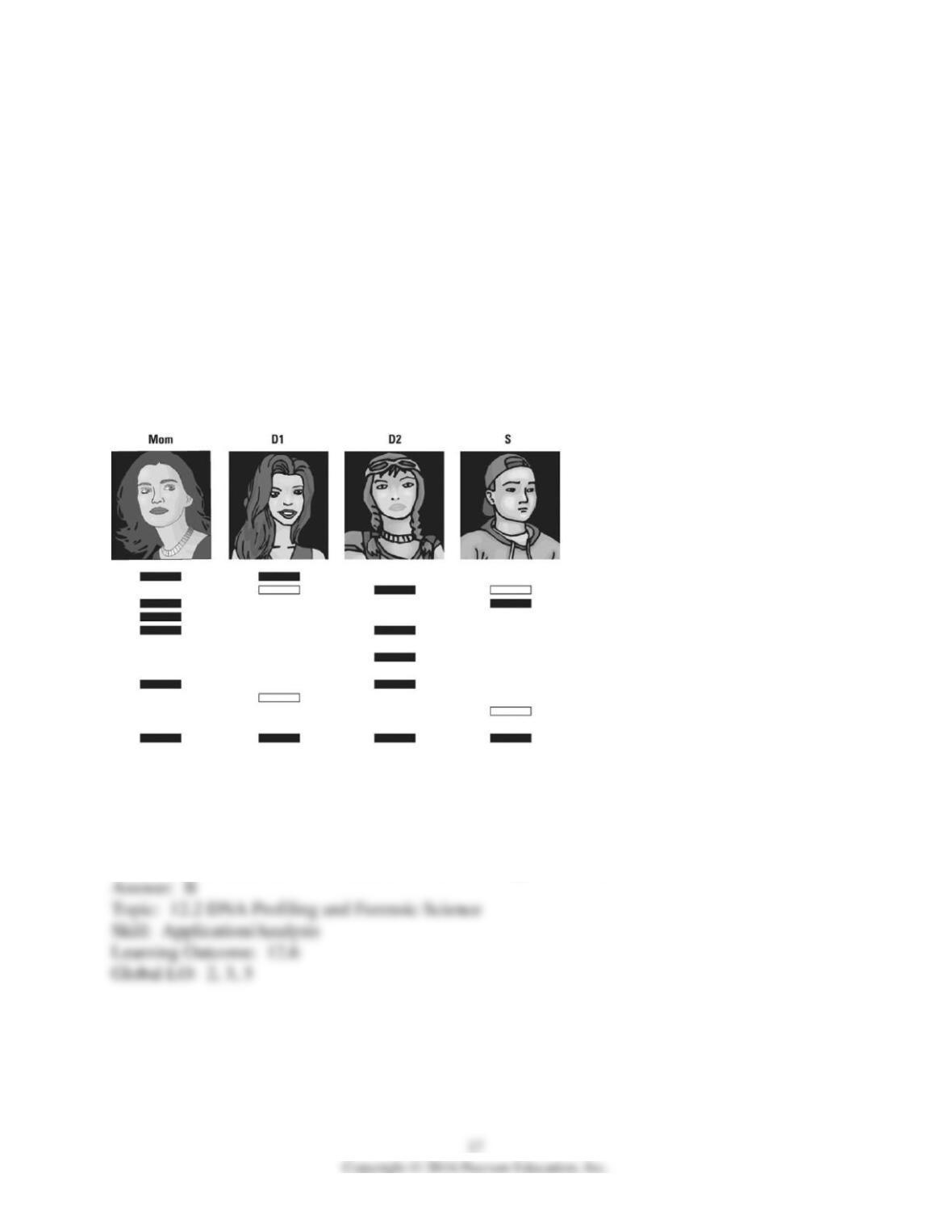
the daughter. Samples of DNA were taken from the mother (Mom) and the daughter (D) as well
as from her son (S) living in the United States with her. STR analysis was run on the three
samples, and the results are shown below.
1) The results indicate that ________.
A) she is not the mother of the son
B) she is the mother of daughter D
C) she is not the mother of daughter D
D) the mother could not be the mother of both the daughter and the son

2) You can use this DNA fingerprinting information to make a judgment about maternity
because ________.
A) the shade of DNA bands will differ
B) both mother and daughter contain only X chromosomes
C) of the position of the bands in the gel
D) of the size of the bands
3) The short tandem repeat analysis ________.
A) compares markers on the sex chromosomes
B) compares repetitive DNA sequences from different individuals
C) does not require DNA amplification
D) checks for purine and pyrimidine ratios
4) STR analysis can also be used for crime scene investigations in addition to maternity testing.
Suppose that the results for the Mom were found at a crime scene, that the daughter’s and the
son’s results were from possible suspects, and that each of the DNA markers in the gel was an
STR marker. Would these results be enough to convince a jury that the results from the daughter
matched the crime scene DNA (Mom)?
A) Yes, because the two STR markers match in size.
B) Yes, because you need only one STR marker to match to definitely make a connection
between two people’s DNA.
C) No, because even though two STR markers matched, there still could be mismatches in the
other 11 markers.
D) No, because blood-typing data analysis was not performed.
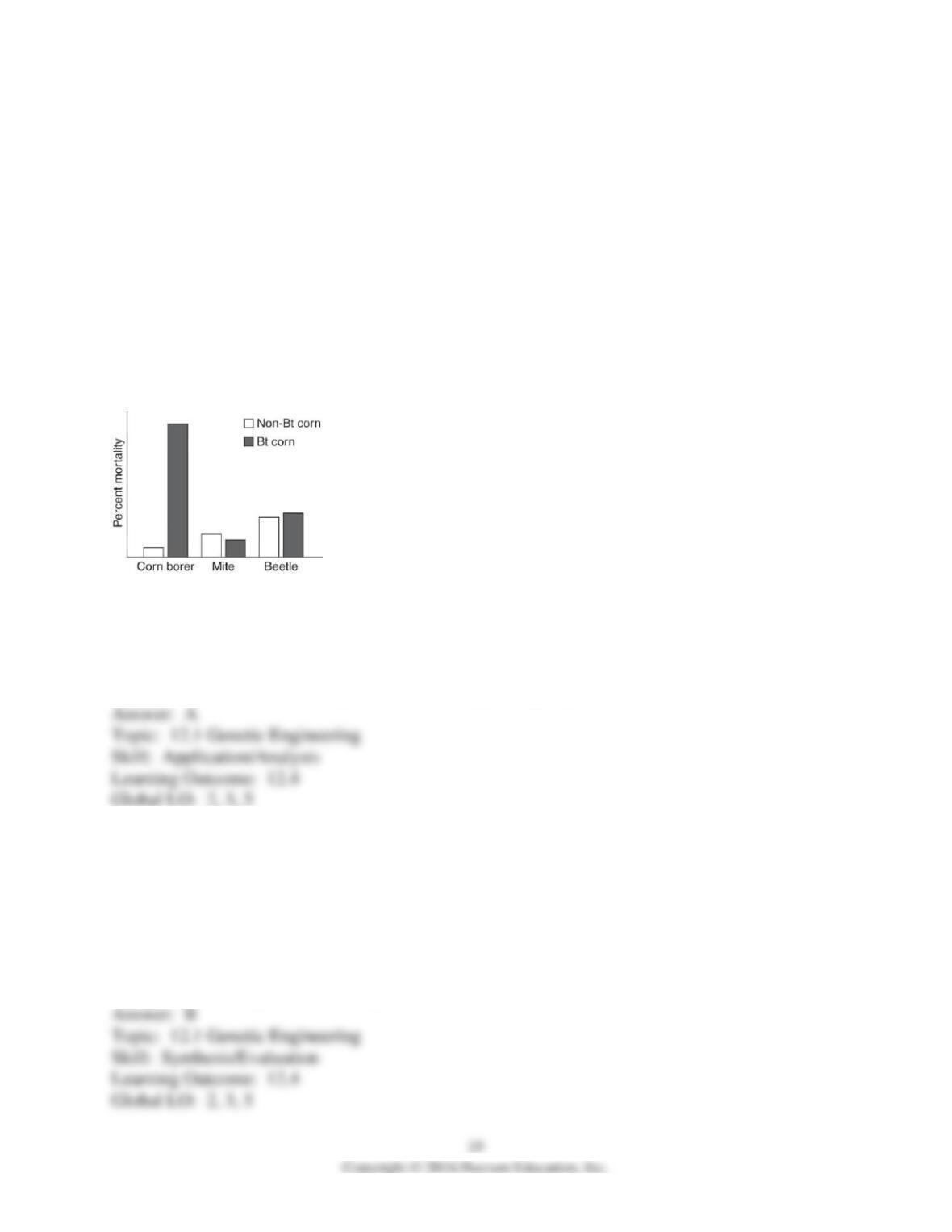
Please read the following scenario and then answer the following questions.
Corn crops are susceptible to damage by different species of corn borer, an insect (a type of
arthropod) that feeds and lives on corn plants. It is estimated that corn borers may cause up to $1
billion of damage a year to corn crops. Because of pests like the corn borer, researchers have
created genetically modified pest-resistant crops. One type of pest-resistant crop, Bt corn,
expresses a bacterial toxin that kills corn borers if they consume the toxin. While Bt corn has
been planted and used in the United States since 1996, some researchers and members of the
public continue to worry about negative effects of the Bt toxin on other animals, including
arthropods and humans. In order to investigate the effects of Bt toxins on other animals,
researchers conducted experiments where they fed arthropods Bt corn or non-Bt corn. A
summary of the effects of eating Bt corn on single species of corn borer, mite, and beetle are
shown in the figure below.
5) What can you conclude from the data in the graph?
A) Corn borers are less likely to survive if they eat Bt corn compared to non-Bt corn.
B) Mites have the highest percent mortality of the arthropods studied.
C) Beetles are more likely to survive than mites when fed Bt corn.
D) Bt corn affects the mortality of all three arthropods equally.
6) Based on the data in the graph, do you think Bt corn is having its intended effect?
A) Yes, because Bt corn affected the mortality of all three arthropods equally.
B) Yes, because Bt corn selectively killed corn borers that ate it while the beetles and mites were
unaffected when eating the Bt corn as compared to the non-Bt corn.
C) No, because Bt corn was designed to kill all arthropods that ate it, and only the corn borers
were killed after eating the Bt corn.
D) No, because corn borer percent mortality increased when corn borers ate Bt corn; if Bt corn
was effective, then percent mortality should have decreased.

7) One of your local newscasters sees these data and announces on the news that “Bt toxins are
safe because they have no negative effects on any arthropods except for the corn borers.” Do you
agree with that statement?
A) Yes, because the data clearly show that the Bt toxin is harmless to arthropods other than the
corn borer.
B) Yes, because only the corn borer was affected when eating the Bt corn.
C) No, because more mites and beetles died after eating Bt corn than after eating non-Bt corn.
D) No, because these data were obtained from testing Bt on two species of mites and beetles;
perhaps other arthropods may respond differently to Bt.