Campbell Biology in Focus, 2e (Urry)
Chapter 11 Mendel and the Gene Idea
11.1 Multiple-Choice Questions
1) What do we mean when we use the term monohybrid cross?
A) A monohybrid cross involves a single parent.
B) A monohybrid cross produces a single offspring.
C) A monohybrid cross involves organisms that are heterozygous for one character.
D) A monohybrid cross is performed for one generation.
E) A monohybrid cross results in a 9:3:3:1 phenotype ratio in the F2 offspring.
2) What do we mean when we use the term dihybrid cross?
A) A dihybrid cross involves two parents.
B) A dihybrid cross produces two offspring.
C) A dihybrid cross involves organisms that are heterozygous for two characters.
D) A dihybrid cross is performed for two generations.
E) A dihybrid cross results in a 3:1 phenotype ratio in the F2 offspring.
3) What was the most significant conclusion that Gregor Mendel drew from his experiments with
pea plants?
A) There is considerable genetic variation in garden peas.
B) Traits are inherited in discrete units, and are not the results of the “blending” of traits.
C) Recessive genes occur more frequently in the F1 generation than do dominant ones.
D) Genes are composed of DNA.
E) An organism that is homozygous for many recessive traits is at a disadvantage.
4) How many unique gametes could be produced through independent assortment by an
individual with the genotype AaBbCCDdEE?
A) 4
B) 8
C) 16
D) 64
5) Which of the following statements describes the major reason that the individual with the
genotype AaBbCCDdEE can make many kinds of gametes?
A) segregation of maternal and paternal alleles
B) crossing over during prophase I
C) different possible assortment of chromosomes into gametes
D) the tendency for dominant alleles to segregate together
6) Why did Mendel continue some of his experiments to the F2 generation?
A) to obtain a larger number of offspring on which to base statistics
B) to observe whether or not a recessive trait would reappear
C) to observe whether or not the dominant trait would reappear
D) to distinguish which alleles were segregating
7) Which of the following statements describes one difference between the law of independent
assortment and the law of segregation?
A) The law of independent assortment explains the segregation of two or more genes relative to
one another.
B) The law of segregation explains the segregation of two or more genes relative to one another.
C) The law of segregation requires having two or more generations to describe.
D) The law of segregation is accounted for by anaphase of mitosis.
8) Two plants are crossed, resulting in offspring with a 3:1 ratio for a particular trait. What does
this suggest?
A) that the parents were true-breeding for contrasting traits
B) that the trait shows incomplete dominance
C) that a blending of traits has occurred
D) that the parents were both heterozygous for a single trait
E) that each offspring has the same alleles for each of two traits
9) A sexually reproducing animal has two unlinked genes, one for head shape (H) and one for
tail length (T). Its genotype is HhTt. Which of the following genotypes is possible in a gamete
from this organism?
A) tt
B) Hh
C) HhTt
D) T
E) HT
10) When crossing an organism that is homozygous recessive for a single trait with a
heterozygote, what is the chance of producing an offspring with the homozygous recessive
phenotype?
A) 0%
B) 25%
C) 50%
D) 75%
11) Mendel accounted for the observation that traits that had disappeared in the F1 generation
reappeared in the F2 generation by proposing that
A) new mutations were frequently generated in the F2 progeny, “reinventing” traits that had been
lost in the F1.
B) the mechanism controlling the appearance of traits was different between the F1 and the F2
plants.
C) traits can be dominant or recessive, and the recessive traits were “hidden” by the dominant
ones in the F1.
D) the traits were lost in the F1 due to dominance of the parental traits.
E) members of the F1 generation had only one allele for each trait, but members of the F2 had
two alleles for each trait.
12) The fact that all seven of the pea plant traits studied by Mendel obeyed the principle of
independent assortment most probably indicates which of the following?
A) None of the traits obeyed the law of segregation.
B) Some traits obeyed the law of segregation and some did not.
C) All of the genes controlling the traits were located on the same chromosome.
D) All of the genes controlling the traits behaved as if they were located on different
chromosomes.
13) Mendel’s observation of the segregation of alleles in gamete formation has its basis in which
of the following phases of cell division?
A) prophase I of meiosis
B) anaphase II of meiosis
C) metaphase I of meiosis
D) anaphase I of meiosis
14) Mendel’s second law of independent assortment has its basis in which of the following events
of meiosis I?
A) synapsis of homologous chromosomes
B) crossing over
C) alignment of synapsed pairs of homologous chromosomes on the metaphase plate
D) separation of homologs at anaphase
E) separation of cells at telophase
15) Why did the F1 offspring of Mendel’s classic pea cross always look like one of the two
parental varieties?
A) No genes interacted to produce the parental phenotype.
B) Each allele affected phenotypic expression.
C) The traits blended together during fertilization.
D) One allele was dominant.
E) Phenotype was not dependent on genotype.
16) Black fur in mice (B) is dominant to brown fur (b). Short tails (T) are dominant to long tails
(t). What fraction of the progeny of crosses BbTt × BBtt will be expected to have black fur and
long tails?
A) 1/16
B) 3/16
C) 3/8
D) 1/2
E) 9/16
17) In certain plants, the tall trait is dominant to the short trait. If a heterozygous plant is crossed
with a homozygous tall plant, what is the probability that the offspring will be short?
A) 1
B) 1/2
C) 1/4
D) 1/6
E) 0
18) In the cross AaBbCc × AaBbCc, what is the probability of producing the genotype AABBCC?
A) 1/4
B) 1/8
C) 1/16
D) 1/32
E) 1/64
19) Given the following cross between parents of the genotypes AABBCc × AabbCc, assume
simple dominance for each trait and independent assortment. What proportion of the progeny
will be expected to phenotypically resemble the first parent?
A) 1/4
B) 1/8
C) 3/4
D) 3/8
E) 1
20) Which of the following is the best description of the addition rule of probability?
A) the probability that two or more independent events will both occur
B) the probability that two or more independent events will both occur in the offspring of one set
of parents
C) the probability that either one of two mutually exclusive events will occur
D) the probability of producing two or more heterozygous offspring
21) Which of the following calculations require that you utilize the addition rule?
A) Calculate the probability of black offspring from the cross AaBb × AaBb, when B is the
symbol for black.
B) Calculate the probability of children with both cystic fibrosis and polydactyly when parents
are each heterozygous for both genes.
C) Calculate the probability of each of four children having cystic fibrosis if the parents are both
heterozygous.
D) Calculate the probability of a child having either sickle-cell anemia or cystic fibrosis if
parents are each heterozygous for both.
22) Marfan syndrome in humans is caused by an abnormality of the connective tissue protein
fibrillin. Patients are usually very tall and thin, with long spindly fingers, curvature of the spine,
sometimes weakened arterial walls, and sometimes eye problems, such as lens dislocation.
Which of the following would you conclude about Marfan syndrome from this information?
A) It is recessive.
B) It is dominant.
C) It is pleiotropic.
D) It is epistatic.
23) In cattle, roan coat color (mixed red and white hairs) occurs in the heterozygous (CRCr)
offspring of red (CRCR) and white (CrCr) homozygotes. Which of the following crosses would
produce offspring in the ratio of 1 red:2 roan:1 white?
A) red × white
B) roan × roan
C) white × roan
D) red × roan
24) Which of the following describes the ability of a single gene to have multiple phenotypic
effects?
A) incomplete dominance
B) multiple alleles
C) pleiotropy
D) epistasis
25) Cystic fibrosis affects the lungs, the pancreas, the digestive system, and other organs,
resulting in symptoms ranging from breathing difficulties to recurrent infections. Which of the
following terms best describes this expression of phenotypes?
A) incomplete dominance
B) multiple alleles
C) pleiotropy
D) epistasis
E) codominance
26) Which of the following traits is an example of polygenic inheritance?
A) pink flowers in snapdragons
B) the ABO blood group in humans
C) Huntington’s disease in humans
D) white and purple flower color in peas
E) skin pigmentation in humans
27) Hydrangea plants of the same genotype are planted in a large flower garden. Some of the
plants produce blue flowers and others produce pink flowers. This can be best explained by
which of the following statements?
A) Multiple alleles are involved in the expression of the phenotype.
B) The allele for blue hydrangea is completely dominant.
C) The alleles are codominant.
D) Environmental factors such as soil pH affect phenotype.
28) Which of the following statements provides an example of epistasis?
A) Recessive genotypes for each of two genes (aabb) result in an albino corn snake.
B) In rabbits and many other mammals, one genotype (ee) prevents any fur color from
developing.
C) In Drosophila (fruit flies), white eyes can be due to a combination of multiple genes.
D) In cacti, there are several genes for the type of spines.
29) A scientist discovers a DNA-based test for one allele of a particular gene. This and only this
allele, if homozygous, produces an effect that results in death at or about the time of birth. Which
of the following statements describes the best use of this discovery?
A) Screen all newborns of an at-risk population.
B) Design a test for identifying heterozygous carriers of the allele.
C) Introduce a normal allele into deficient newborns.
D) Follow the segregation of the allele during meiosis.
30) The frequency of heterozygosity for the sickle-cell anemia allele is unusually high,
presumably because this reduces the frequency of malaria. Such a relationship is related to which
of the following concepts?
A) Mendel’s law of independent assortment
B) Mendel’s law of segregation
C) Darwin’s explanation of natural selection
D) Darwin’s observations of competition
31) One of two major forms of a human condition called neurofibromatosis (NF 1) is inherited as
a dominant allele, although it may range from mildly to very severely expressed. If a young child
is the first in her family to be diagnosed, which of the following is the best explanation?
A) The mother carries the allele but does not express it at all.
B) One of the parents has very mild expression of the gene.
C) The condition skipped a generation in the family.
D) The child has a different allele of the gene than the parents.
11.2 Art Questions
Please use the following information to answer the question(s) below.
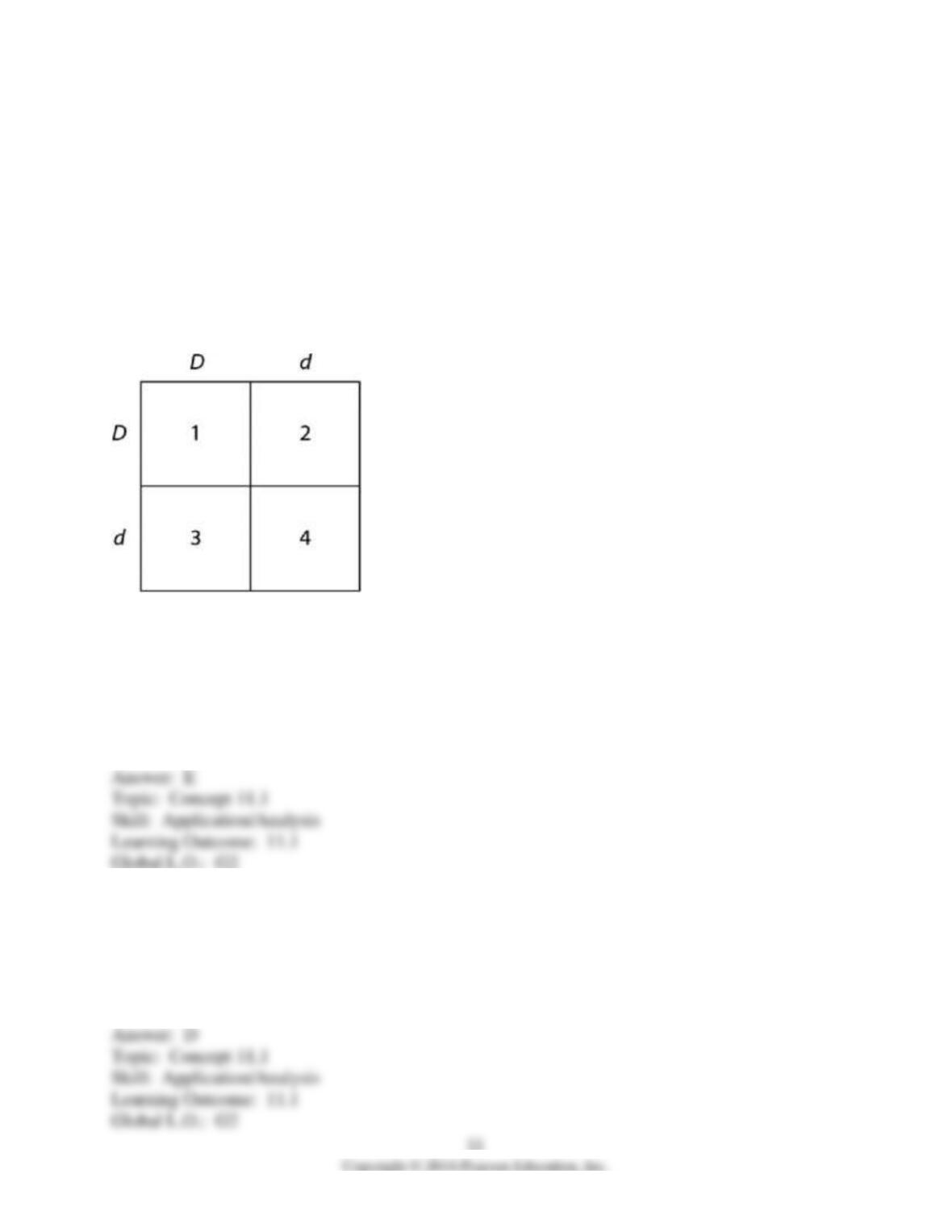
In a particular plant, leaf color is controlled by gene locus D. Plants with at least one D allele
have dark green leaves, and plants with the homozygous recessive dd genotype have light green
leaves. A true-breeding dark-leaved plant is crossed with a light-leaved one, and the F1 offspring
is allowed to self-pollinate. The predicted outcome of the F2 is diagrammed in the Punnett
square shown in Figure 11.1, where 1, 2, 3, and 4 represent the genotypes corresponding to each
box within the square.
Figure 11.1
1) Which of the boxes marked 1-4 correspond(s) to plants with dark leaves?
A) 1 only
B) 1 and 2
C) 2 and 3
D) 4 only
E) 1, 2, and 3
2) Which of the boxes correspond(s) to plants with a heterozygous genotype?
A) 1 only
B) 1 and 2
C) 1, 2, and 3
D) 2 and 3
E) 2, 3, and 4
3) Which of the plants will be true-breeding?
A) 1 and 4 only
B) 2 and 3 only
C) 1, 2, 3, and 4
D) 1 only
E) 1 and 2 only
Please use the following information to answer the question(s) below.
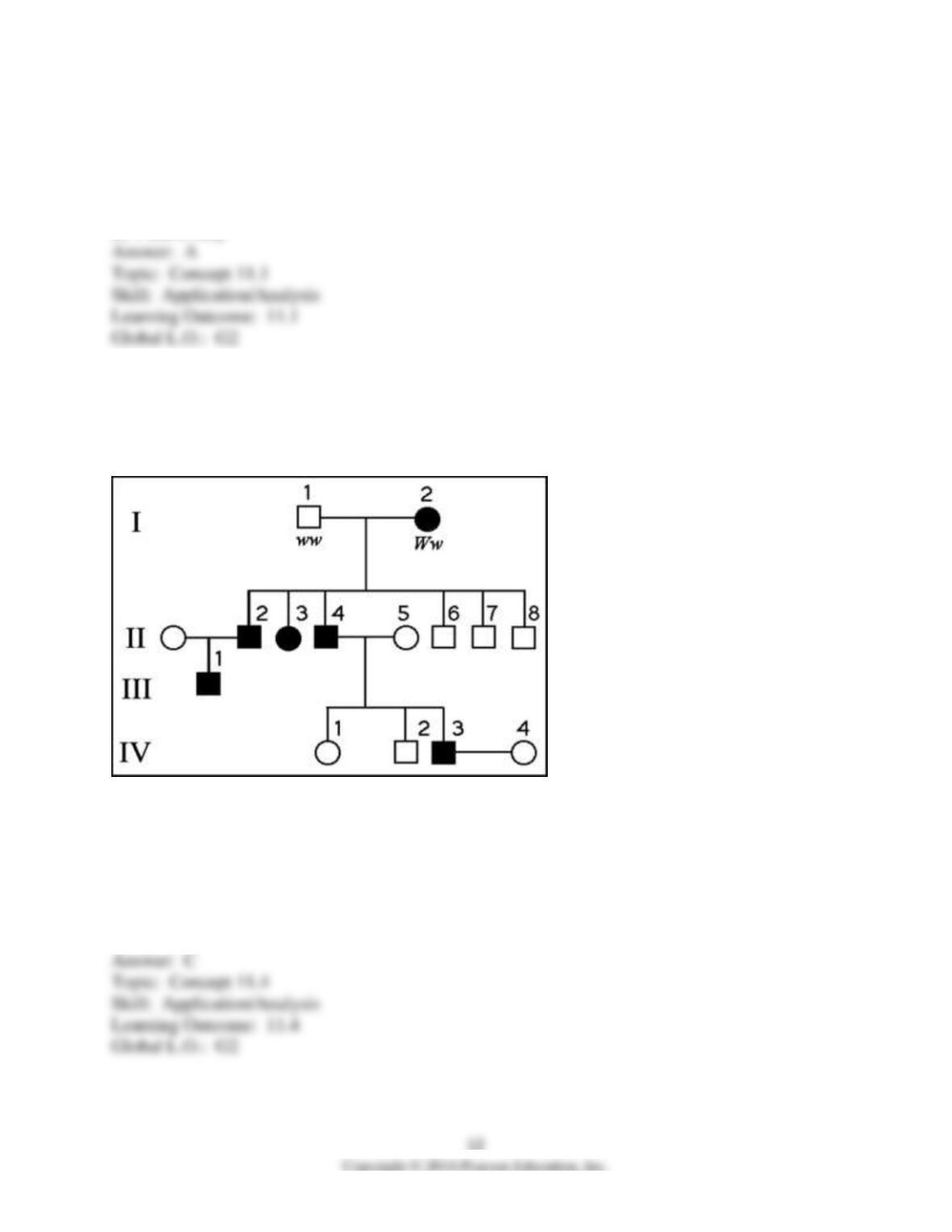
Figure 11.2 shows a pedigree chart for a family, some of whose members exhibit the dominant
trait, W. Affected individuals are indicated by a dark square or circle.
Figure 11.2
4) What is the genotype of individual II-5?
A) WW
B) Ww
C) ww
D) WW or ww
E) ww or Ww
5) What is the likelihood that the offspring of IV-3 and IV-4 will have the trait?
A) 0%
B) 25%
C) 50%
D) 75%
E) 100%
6) What is the probability that individual III-1 is Ww?
A) 3/4
B) 1/4
C) 2/4
D) 2/3
E) 1