CHAPTER 11
Membrane Transport of Small Molecules and the Electrical
Properties of Membranes
Questions
11-1 Is the following statement true or false? Explain your answer.
O2 is bigger than Mg2+ and thus will diffuse more slowly across a lipid bilayer.
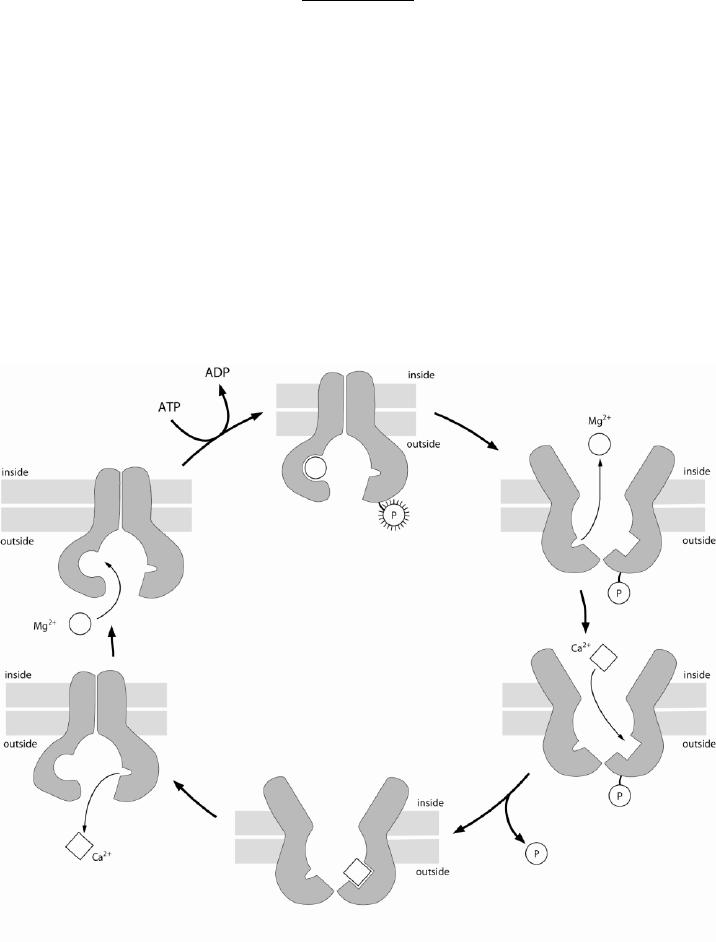
11-2 You have isolated a bacterial transporter that transports Mg2+ and Ca2+ in opposite
directions. You produce lipid vesicles that contain this Mg2+–Ca2+ pump as the
sole membrane protein. The Mg2+–Ca2+ pumps are oriented such that Mg2+ is
pumped into the vesicle while Ca2+ is pumped out. Each pump transports one
Mg2+ ion into the vesicle and one Ca2+ ion out of the vesicle during each pumping
cycle and ATP hydrolysis powers this transport, as illustrated in Figure Q11-2.
Figure Q11-2
A. Predict what would happen if the solution inside the vesicles contained 75
mM Mg2+ and 75 mM Ca2+ ions, while the solution outside the vesicles
contained 75 mM Mg2+ and 75 mM Ca2+ ions as well as 1 mM ATP, and
you had a 10,000 fold excess of fluid outside the vesicles compared with
the volume inside the vesicles. Specifically, be sure to state whether you
think there would be net movement of ions and if so, how the
concentrations of the Mg2+ and Ca2+ ions inside and outside the bilayer
would change. In addition, be sure to state whether you would be creating
an electrical gradient, a chemical gradient, or both.
B. Explain how long the pump will run.
11-3 Your friend works for a biotech company, where they have come up with a top-
secret drug they hope will cure a hereditary kidney disease. He refuses to tell you
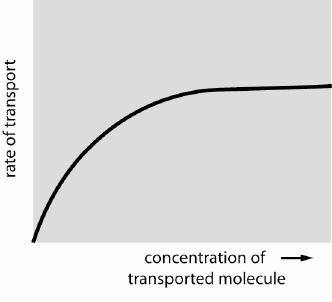
anything about this drug, except to give you a peek at their data (see Figure Q11–
3) regarding the kinetics of uptake of this drug into kidney cells. He thinks his
data support the idea that a protein is required for the uptake of his drug; his
supervisor thinks his data show that this drug simply diffuses into the cell. From
what you have learned in cell biology, who is right: your friend or his supervisor?
Explain your answer.
Figure Q11-3
11-4 To determine the crystal structure of bacterial lactose permease, a mutation that
changed cysteine 154 to glycine was engineered. This mutation locked the protein
into a particular conformation, so that the transporter was inward-facing such that
its sugar-binding domain faced the cytoplasmic portion of the cell. Explain why
using this C154G mutant made it more feasible to determine the structure of
lactose permease.
11-5 Your friend works in a lab that is interested in the properties of an amino acid
transporter called TspZ. The lab has recently isolated two compounds that bind
directly to and act as inhibitors of TspZ; these inhibitors have been named Inh41
and Inh42. Both Inh41 and Inh42 seem to reduce amino acid transport 10-fold
when added to cells individually. To characterize how Inh41 works, your friend
has discovered that Inh41 does not affect the ability of TspZ to bind amino acid,
but instead seems to decrease the rate at which TspZ is able to change its
conformation. Another graduate student in the lab has been working on how
Inh42 affects TspZ and has determined that Inh42 acts in a manner consistent
with its being a competitive inhibitor of TspZ. Given this information, would you
predict that adding Inh41 and Inh42 together to cells would have a greater effect,
a smaller effect, or no effect on TspZ transport compared with the addition of
only one of these inhibitors onto cells? Explain.
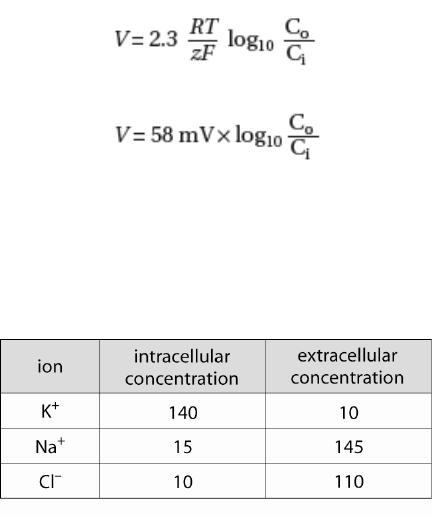
11-6 Recall that the Nernst equation is
.
For univalent ions at 20°C, the equation reduces to
.
A. Given the knowledge that if x > 1 then logx is a positive number; if x < 1
then logx is negative, and given the intracellular and extracellular
concentrations for the ions listed in Table Q11-6 for the neuron in
question, indicate whether the equilibrium potential is positive or negative
for the K+ and Na+ ions in this particular cell.
Table Q11-6
B. If you were to add a drug that causes the chloride channels on this neuron
to open, would this make it easier, harder, or not affect the cell’s ability to
fire an action potential? Explain your answer.
11-7 You are interested in understanding how the neuromuscular junction works.
The normal voltage-gated Na+ channel has the characteristics depicted by the
solid line in Figure Q11-7. You decide to replace this channel with a mutant
voltage-gated Na+ channel with the characteristics depicted by the dotted line.
Do you predict that the cell containing the mutant Na+ channel will require more,
less, or the same amount or acetylcholine to be released from the nerve terminal
to stimulate muscle contraction? Explain your answer.
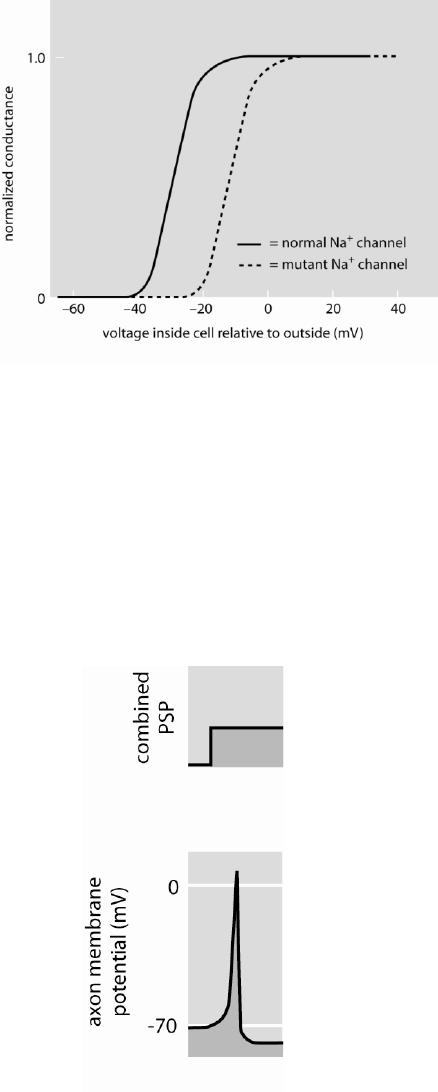
Figure Q11-7
11-8 A neuron can receive inputs from many different presynaptic cells and needs to
integrate information about the excitatory postsynaptic potentials (PSPs) and
inhibitory PSPs it is receiving. Different types of K+ channels are required to
ensure that the frequency of action potentials reflects the magnitude of the
combined PSPs. If a normal cell produces a pattern of membrane depolarization
following the combined PSPs illustrated in Figure Q11-8, how would a drug that
reduces the activity of the delayed K+ channels alter the pattern of membrane
depolarization? Explain.
Figure Q11-8
Answers