Chapter 11—Growth Responses and Regulation of Growth Key
1. A permanent change in position of a plant part in response to external stimuli is called
2. Directional growth of a plant in response to light is known as
3. Root tips exhibit
4. The twining of tendrils is an example of
5. The effects of plant hormones
6. What did Charles and Francis Darwin conclude from their experiments?
7. Auxin
8. Synthetic auxins are
9. If you cut the tops off of your shrubbery, the shrubs will get bushier. This is because, when you remove the
tops, you are removing the source of ____ which is preventing the axillary buds from growing.
10. Which hormone causes “foolish seedling” disease?
11. Gibberellins
12. Cytokinin
13. The ratio of these two hormones controls whether roots or shoots will form in tissue culture.
14. Ethylene
15. Fruit growers have to be careful to keep the levels of ____ low around their fruits in order to slow the
ripening process.
16. Abscisic acid
17. “Dormin” would have been a better name for this hormone because it has little to do with the process that it
is named after.
18. Which of the following is NOT a signaling molecule similar to the other five hormones?
19. The first step in all hormone signal transduction pathways involves
20. Photoperiodism
21. Short-day plants
22. Intermediate-day plants
23. The photoreceptor in plants that absorbs light in photoperiodism is
24. When a plant is exposed to sunlight
25. In long-day plants
26. Phytochrome is involved in
27. In the process of vernalization, the initiation of flowering is in response to
28. Sleep movements and the opening and closing of stomata are common examples of plant processes that
display
29. Turgor movements are caused by changes in turgor of the cells of
30. Thigmotropism is directional growth in response to touch.
31. During phototropism, auxin is redistributed to the shaded side of the plant causing this side to grow more
slowly.

32. Auxin promotes cell elongation.
33. Auxin is the hormone that is distributed during a tropism.
34. Gibberellin controls apical dominance.
35. Bolting, a part of flower initiation in some plants, is triggered by gibberellin.
36. Cytokinins cause senescence.
37. Ethylene accelerates the ripening of fruits.
38. Some seeds will not germinate until the inhibitor gibberellin is removed from them.
39. Jasmonates and systemin are thought to aid the plant in protecting itself from pathogens and herbivores.
40. Florigen is a flower-promoting signal similar to ethylene.
41. Long-day plants are also called short-night plants.

42. More of the Pr form of phytochrome is present during the day.
43. Shade avoidance is a phytochrome response.
44. Instead of having a dark length requirement for flowering, some plants have a temperature requirement.
45. Turgor movements are permanent and irreversible.
46. The directional growth of a plant in response to light is known as ____________________.
47. During gravitropism of a stem, the lower side of the stem grows ____________________ than the upper
side. This difference in growth between the upper and lower sides of the stem results in the upward growth of
the stem.
48. The settling of ____________________ seems to be involved in the plant’s perception of gravity.
49. Organic chemicals produced in one part of a plant and transported to another part where they cause some
physiological response are called ____________________.
50. If you cut the tops off of your shrubbery, the shrubs will get bushier. This is because, when you remove the
tops, you are removing the source of a hormone which is preventing the axillary buds from growing. This
phenomenon is known as ____________________.

51. The hormone ____________________ has two synthetic forms that have been used as herbicides. A
particular mixture of these forms was the banned herbicide Agent Orange.
52. Molecular biologists have genetically engineered a tobacco plant that makes additional
____________________. This plant takes a lot longer for its leaves to senescence than the normal plant.
53. The hormone added to tissue culture media to cause cells to divide is ____________________.
54. The hormone primarily responsible for stem elongation in dwarf varieties is ____________________.
55. The hormone apparently responsible for bolting is ____________________.
56. The hormone produced by cells in the abscission zone in the stems of leaves and fruits is
____________________.
57. During drought conditions, the level of the hormone ____________________ rises causing leaf stomata to
close.
58. The much-sought-after flower-promoting hormone is called ____________________.
59. Plants which initiate flowering in response to stimuli other than day or night length are called
____________________ plants.

60. The active form of phytochrome, ____________________ triggers physiological responses.
61. In short-day plants, the Pfr form of phytochrome ____________________ flowering.
62. The promotion of flowering by a period of low temperature is called ____________________.
63. The internal “biological clock” that approximates a 24-hour cycle is called a(n) ____________________.
64. Two photoreceptors are involved in circadian rhythms, phytochrome and ____________________.
65. Changes in ____________________ are responsible for sleep movements.
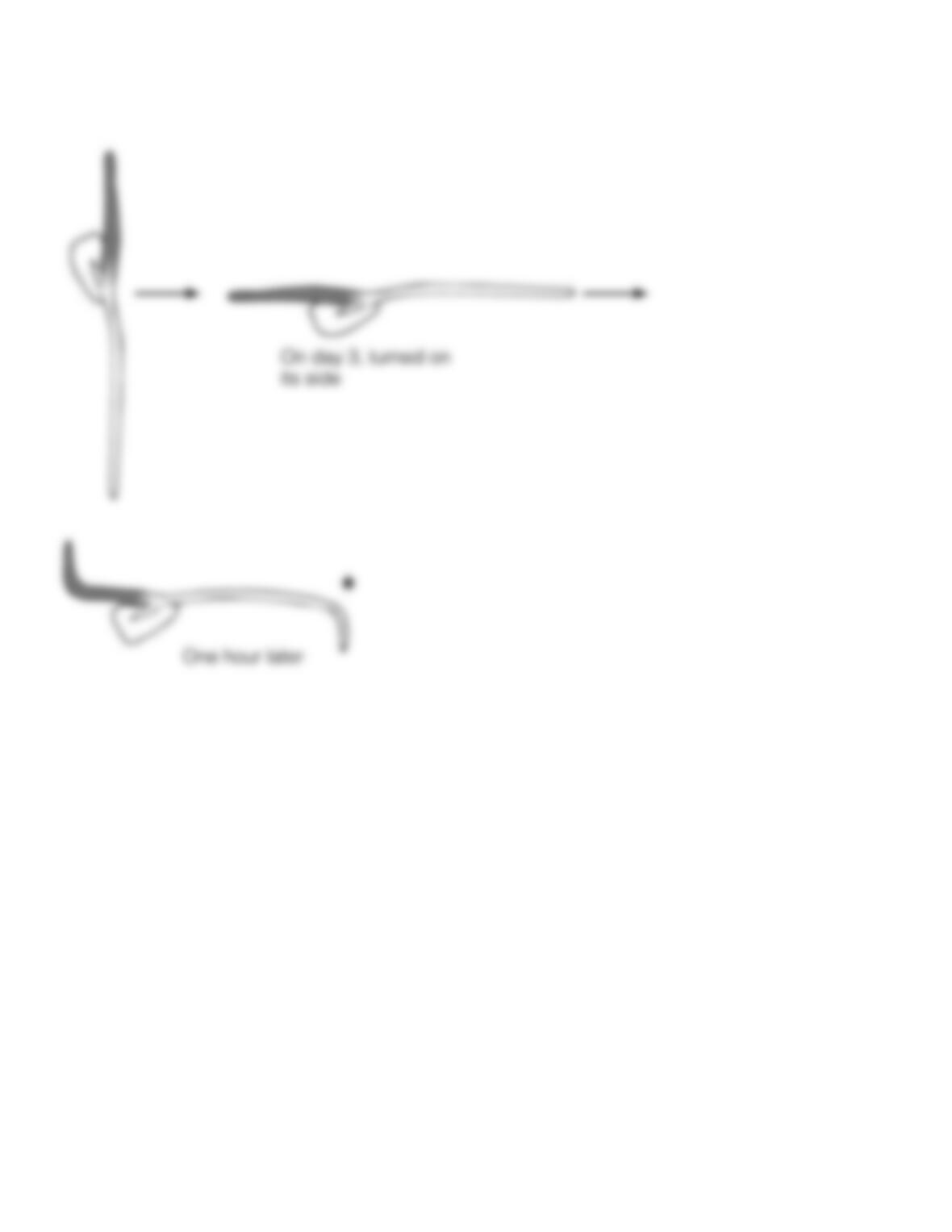
66. A maize seed was germinated. On day 3, the seedling was laid on its side. Draw a picture of what the
seedling will look like the next day. Put a * on the side of the shoot that is growing faster and * on the side of
the root that is growing faster.
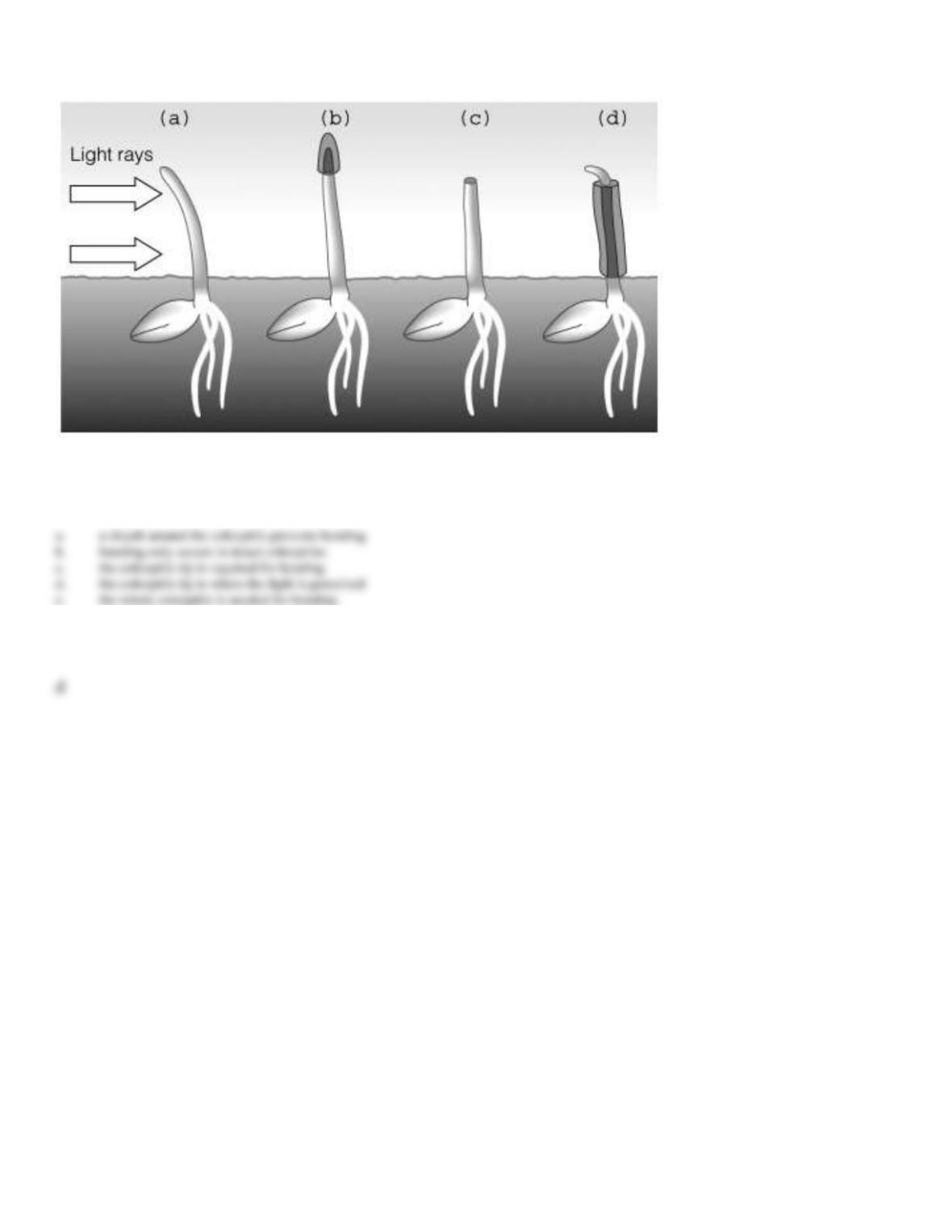
67. Figure 11-1
Refer to Figure 11-1. Charles and Francis Darwin carried out experiments similar to the ones in this picture in
which light was directed at one side of a series of coleoptiles. What did they conclude from their experiments?
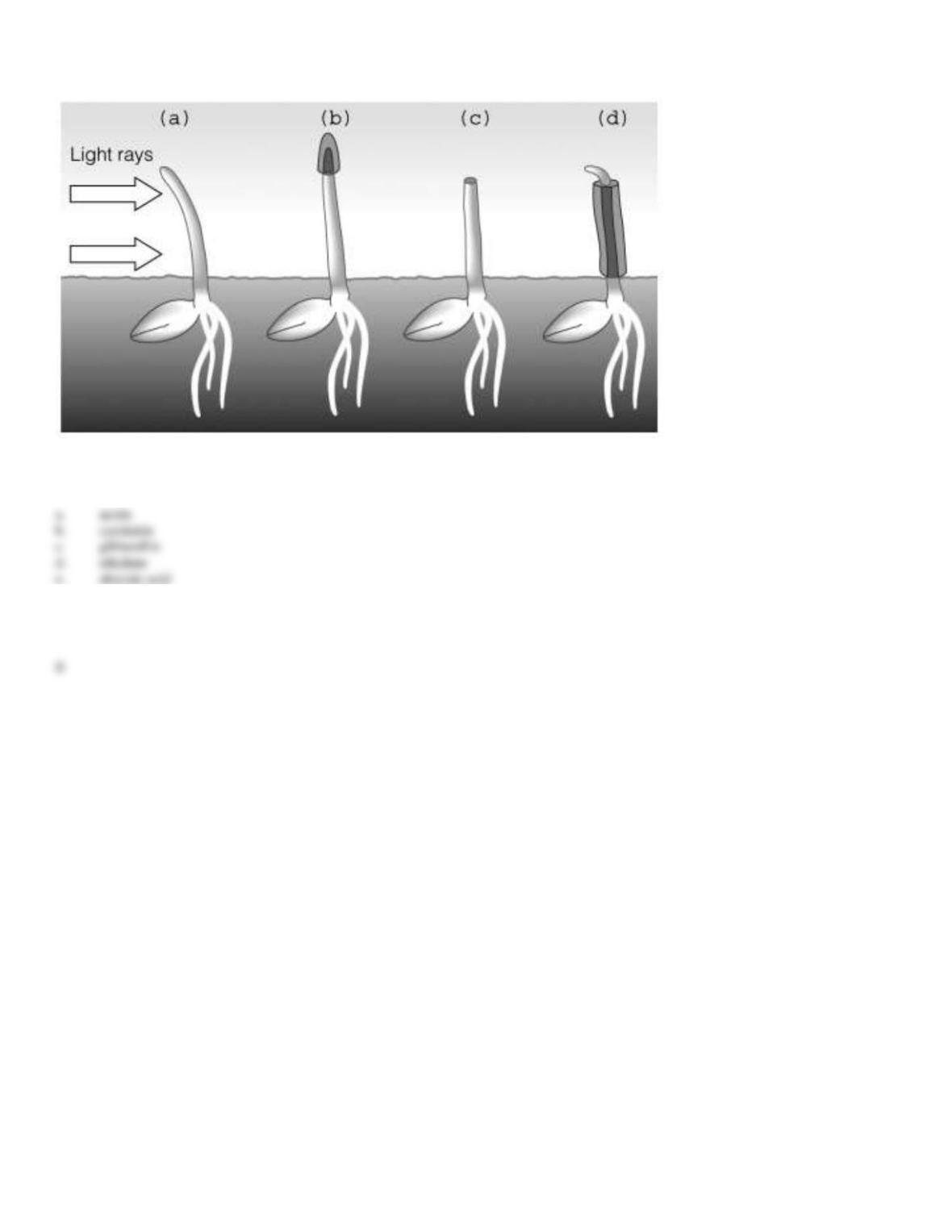
68. Figure 11-1
Refer to Figure 11-1. What hormone were they seeing the effect of?
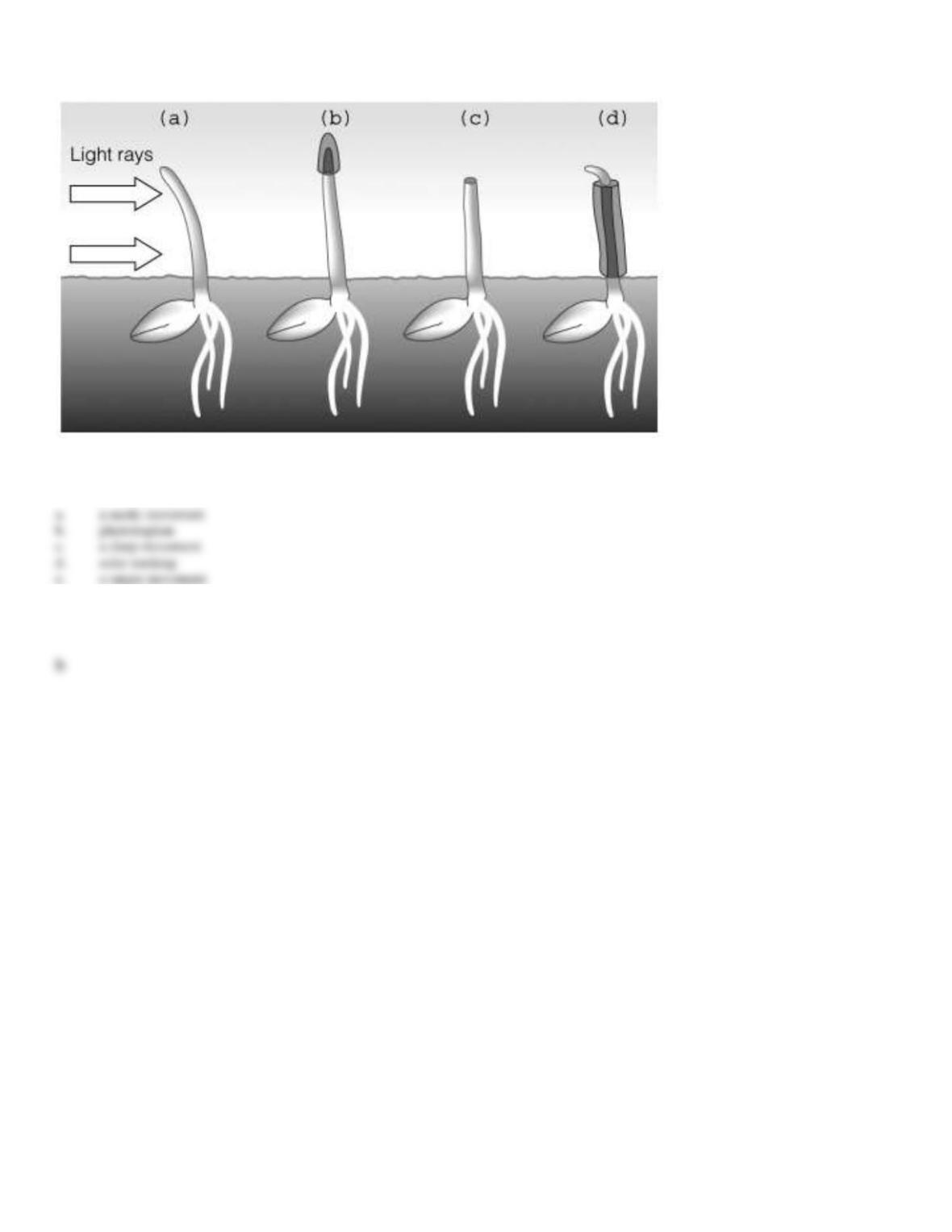
69. Figure 11-1
Refer to Figure 11-1. What phenomenon were they studying?
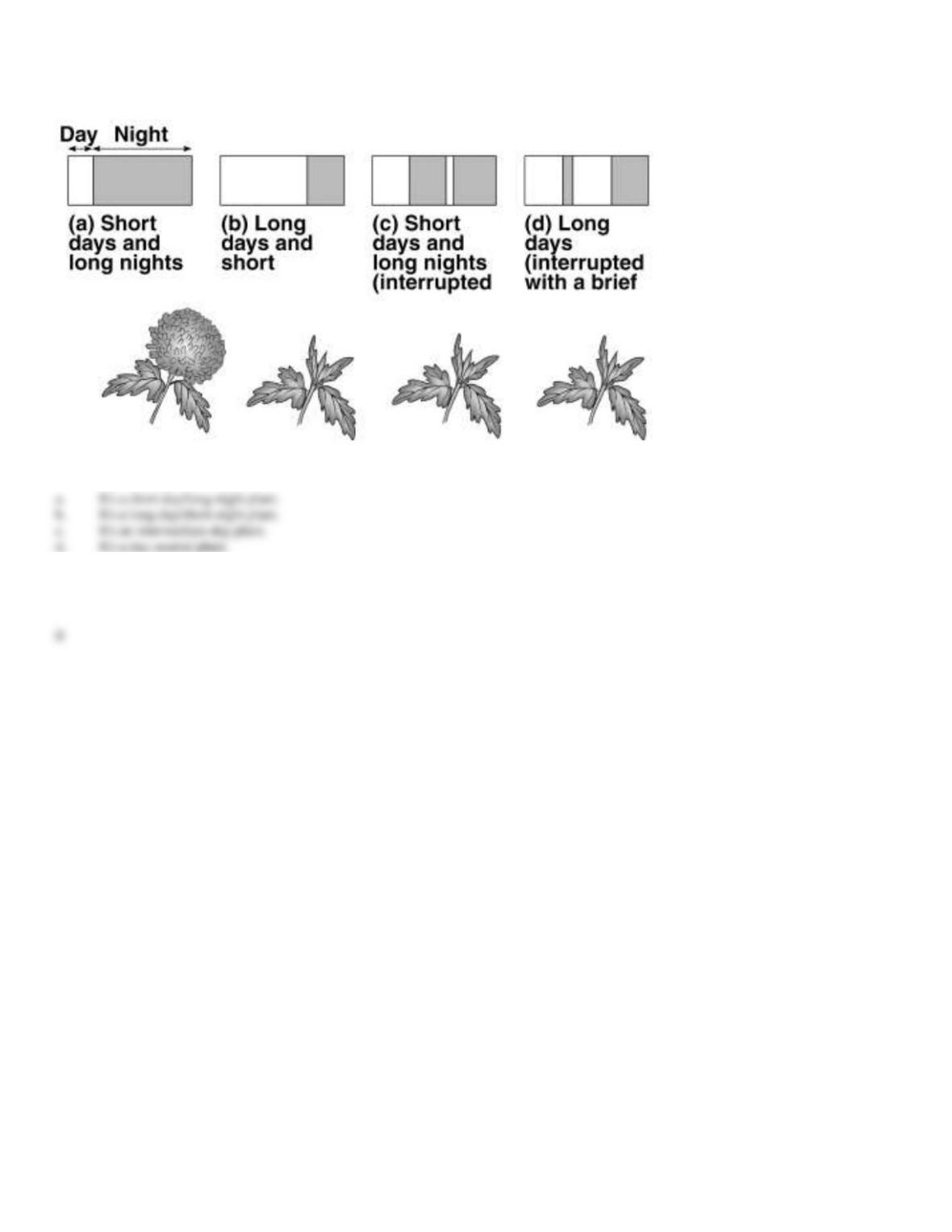
70. A series of experiments was carried out in order to determine whether day length or night length are
important factors in getting this plant to flower. What is the conclusion from this experiment?
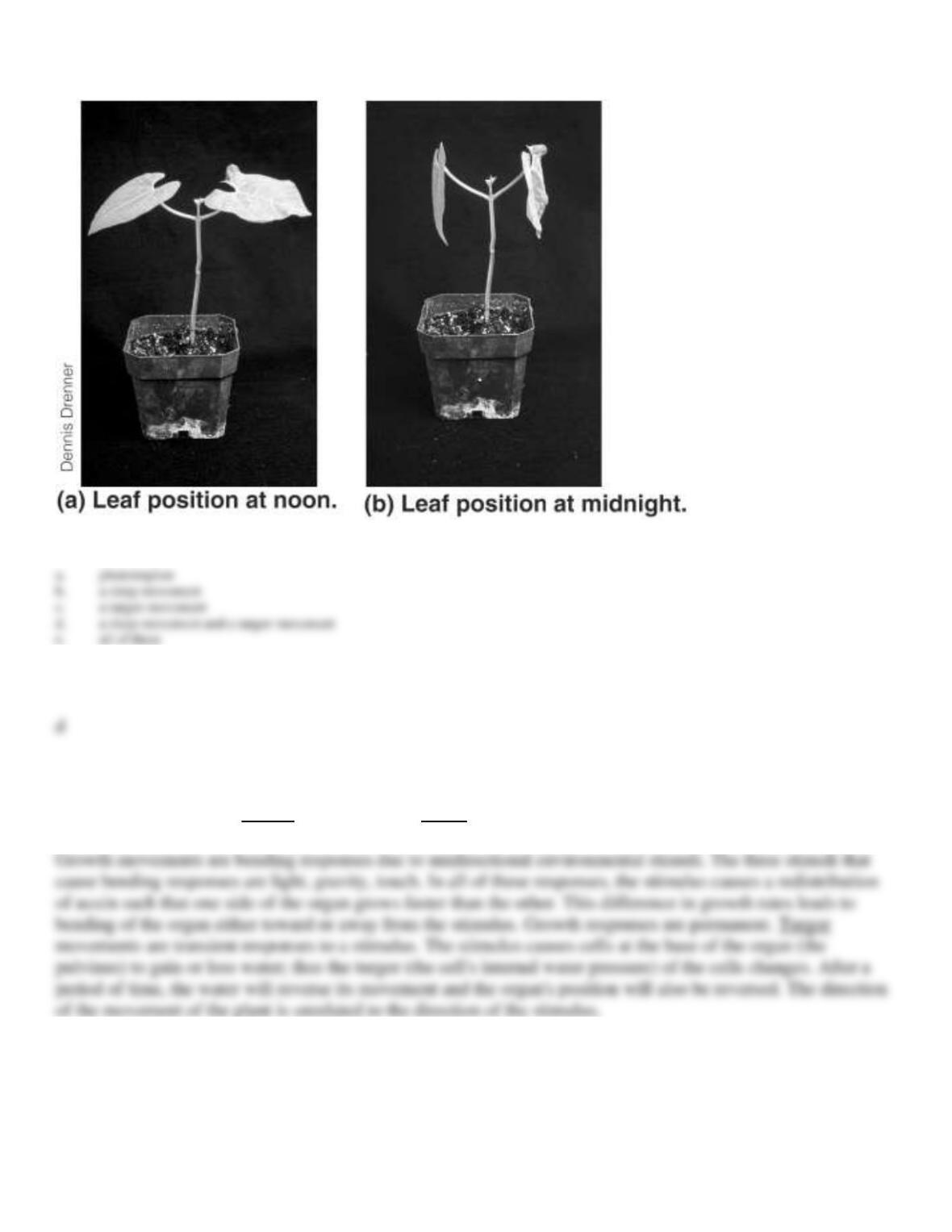
71. What phenomenon is illustrated in this figure?
72. Distinguish between growth movements and turgor movements.
73. How do changes in turgor produce temporary plant movements?
74. How do synthetic auxins (selective hormonal herbicides) cause plants to die?
75. Explain the hormonal interactions thought to be involved in leaf abscission.
76. In what way are circadian rhythms and photoperiodism both important in plant survival?