Chapter 11 Lipids
Matching Questions
Use the following to answer questions 1-10:
Choose the correct answer from the list below. Not all of the answers will be used.
a) ether-linked lipid
b) triacylglycerol
c) sterol
d) amphipathic
e) 16 or 18
f) organic solvent
g) cholesterol
h) cysteine
i) phospholipid
j) prokaryotes
k) glycolipid
l) 20 or 24
m) sphingosine
n) serine
1.
____________ The storage form of fatty acids.
2.
____________ This is the number of carbons in most common fatty acids.
Ans: e
Section: 11.1
3.
____________ In addition to phospholipids and glycolipids, this is a major type of membrane
lipid.
Ans: g
Section: 11.3
4.
____________ This is a term applied to molecules that have both hydrophilic and hydrophobic
moieties.
Ans: d
Section: 11.3
5.
____________ A lipid is defined as a compound soluble in ________________.
Ans: f
Section: Introduction
Ans: b
Section: Introduction
Chapter 10 Lipids
2
6.
____________ Lipids that are bound to carbohydrates.
7.
____________Type of lipid with two acyl chains, a glycerol backbone, and a polar head group.
Ans: i
Section: 11.3
8.
____________ Flat polycylic molecule absent in prokaryotic membranes.
Ans: g
Section: 11.3
9.
____________ These lipids are less resistant to hydrolysis, potentially due to the way the acyl
chain is linked to the glycerol backbone.
Ans: a
Section: 11.3
10.
____________ A complex amino alcohol backbone for membrane lipids.
Ans: m
Section: 11.3
Fill–in-the-Blank Questions
11.
is a membrane lipid composed of sphingosine, fatty acid, and a simple sugar.
Ans: Cerebroside Section: 11.3
12.
The common name of hexadecanoic acid is .
Ans: palmitic acid Section: 11.1
13.
In phosphoglycerides, the fatty acids are linked to the glycerol backbone by the linkages.
Ans: ester Section: 11.3
14.
The configuration of most fatty acids in biological systems is .
Ans: cis Section: 11.1
15.
Fatty acids are ionized at physiological pH and so are referred to in their form.
Ans: carboxylate Section: 11.1
16.
The short-hand notation indicating that there are two cis double bonds between carbons 9 and
10 and again between 12 and 13.
Ans: cis, cis-∆9,Δ12 Section: 11.1
17.
The presence of double bonds in fatty acids limits tight packaging and the number of
interactions.
Ans: k
Section: Introduction
Chapter 10 Lipids
3
18.
is the type of glycolipid that contains a branched chain of as many as seven sugar residues.
19.
The reduction in tight packing due to cis double bonds the melting temperature of a fatty
acid.
Ans: lowers Section: 11.1
20.
One important is EPA (eicosapentoenoate) and is found in fatty fish and shellfish.
Ans: ω-3 fatty acid Section: 11.1
Multiple-Choice Questions
21.
Membrane lipids are primarily comprised of:
A) phospholipids. B) glycolipids. C) cholesterol. D) A and B. E) A, B, and C.
Ans: E Section: 11.3
22.
Which of the following is NOT a main function of lipids?
A)
cell signaling
B)
fuel source
C)
structural rigidity of the cytoskeleton
D)
membrane component
E)
All of the above.
Ans: C Section: Introduction
23.
Octadecatrienoic acid has how many double bonds?
A)
0
B)
1
C)
2
D)
3
E)
4
Ans: D Section: 11.1
24.
An -3 fatty acid ____________.
A)
has a methyl group at the carboxyl end of the fatty acid
B)
has a methyl group on the third carbon of the chain
C)
has a double bond the third carbon in from the carboxyl group
D)
has a triple bond on the third carbon from the methyl end of the fatty acid
E)
None of the above.
Ans: E Section: 11.1
25.
The notation 12:2 indicates which of the following about a fatty acid?
A)
There are 12 carbons in the chain with two double bonds.
B)
There are two 12-carbon chains for this fatty acid.
C)
The second carbon has a fatty acid double bond.
D)
The 12th carbon has a double bond.
E)
There are two trans-double bonds on this 12-carbon fatty acid.
Ans: A Section: 11.1
Ans: Ganglioside Section: 11.3

Chapter 10 Lipids
4
26.
Which of the following is NOT correct concerning the structure given?
+
CH2
CH
CH2
O C(CH2)14CH3
O
CH3(CH2)7C C(CH2)7C
O
O
H H
OPOCH2CH2N(CH3)3
O
O–
A)
It is a component of biological membranes.
B)
It is amphipathic.
C)
It is a sphingolipid.
D)
It is a phosphoglyceride.
E)
It is phosphatidyl choline.
27.
The longer the fatty acid the ________ the fatty acid.
A)
more oxidized
B)
lower the melting point of
C)
higher the melting point of
D)
more reduced
E)
more double-bond containing
Ans: C Section: 11.1
28.
Palmitate has how many carbons in its chain?
A)
12
B)
14
C)
16
D)
20
E)
24
Ans: C Section: 11.1
29.
Unsaturations ________ melting points of fatty acids and their derivatives.
A)
maintain
B)
decrease
C)
increase
D)
are unrelated to
E)
None of the above.
Ans: B Section: 11.1
30.
Eating ____________ increases the -3 fatty acids decreasing ___________.
A)
arachidonic acid, cardiovascular disease
B)
a low fat diet, cardiovascular disease
C)
fatty fish, cardiovascular disease
D)
shellfish, lung cancer
E)
vegetable oils, blood pressure
Ans: C Section: 11.1
Ans: C Section: 11.3

Chapter 10 Lipids
5
31.
The backbone of a phospholipid is which of the following?
A)
glucose
B)
cholesterol
C)
fatty acid chain
D)
triacylglycerol
E)
glycerol
32.
The polar head group of phospholipids is found at which carbon of glycerol?
A)
C1
B)
C2
C)
C3
D)
C1–OH
E)
C2–OH
Ans: C Section: 11.3
33.
Polar-head groups of phospholipids are esterified to what functional group?
A)
methyl
B)
phosphate
C)
ketone
D)
thiol
E)
aldehyde
Ans: B Section: 11.3
34.
A phosphatidate lipid (phosphatidic acid) has which of the following components?
A)
phosphate
B)
glycerol
C)
ester linkage
D)
acyl chain
E)
All of the above.
Ans: E Section: 11.3
35.
Which phospholipid is enriched in neural sheath membranes?
A)
phosphatidic acid
B)
phosphatidylcholine
C)
sphingomyelin
D)
diphophatidylglycerol (cardiolipin)
E)
phosphatidylinositol
Ans: C Section: 11.3
Ans: E Section: 11.3
Chapter 10 Lipids
6
36.
Identify the differences in archaea membrane lipids compared to those of eukaryotes or bacteria
and how these differences help them withstand extreme environmental conditions.
A)
The ether linkages are more, readily hydrolyzed by enzymes allowing the membrane to
serve as an energy reserve.
B)
The glycerol moiety is esterified to multiple complex carbohydrate chains making them
more soluble in low pH environments.
C)
The fatty acid chains are branched, allowing them to pack more tightly, thereby
protecting membrane integrity.
D)
There are two phosphate esters instead of only one giving the archaea better solubility in
high salt environments.
E)
Omega ω-3 fatty acids are common in membranes and may act as important precursors as
they do in eukaryotes.
37.
You are studying a protein known to be localized to the membrane surface. What protein
modifications might you look for to determine how the protein is attached to the membrane?
A)
Determine whether a farnesyl group is attached to a carboxy terminal cysteine residue.
B)
Determine whether a fatty alcohol is attached to a serine residue on the surface of the
protein.
C)
Determine whether a glycosylphosphatidylinositol anchor is attached to the carbosy
terminus.
D)
A and C only.
E)
All of the above.
Ans: D Section: 11.3
38.
Cholesterol and other steroids are not soluble in blood, and therefore must be transported.
Predict what chemical modifications must occur for cholesterol to move through the circulatory
system.
A)
Cholesterol forms micells in blood, the surface of which is hydrophilic and the interior is
hydrophobic.
B)
Cholesterol cannot be transported in blood and so it broken down and resynthesized in all
cells.
C)
Cholesterol moves through cell membranes from tissue to tissue.
D)
Cholesterol forms glycolipids with large carbohydrate complexes in order to increase
solubility.
E)
Cholesterol is esterified to a fatty acid for transport by lipoprotein particles, the surface of
which is hydrophilic and the interior is hydrophobic.
Ans: E Section: 11.3
Short-Answer Questions
39.
What does the notation 18:2 for fatty acids imply?
Ans:
In this fatty acid there are 18 carbons, with two double bonds.
Section: 11.1
Ans: C Section: 11.3
Chapter 10 Lipids
7
40.
What are the two systems for naming the positions of the double bonds? Provide examples.
41.
What are some molecules that form the polar-head group of phospholipids? Provide several
examples.
Section: 11.3
42.
Explain the biochemical nature of why trans bonds do not have the same effect as cis bonds on
the melting point of fatty acids.
of energy needed to melt the fatty acid lattice.
43.
Explain why fats are an efficient way to store biochemical energy.
ATP production.
Section: 11.2
44.
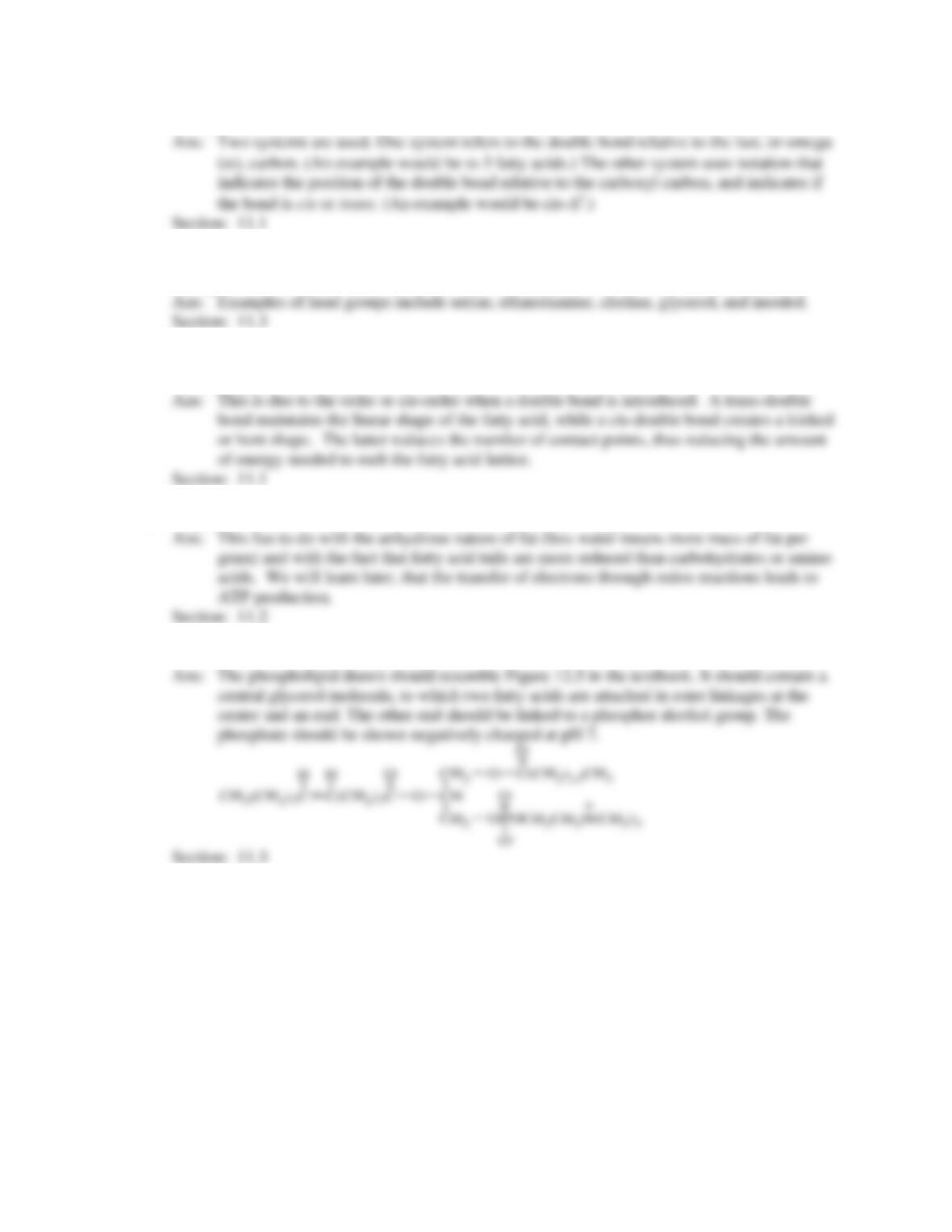
Draw and label a typical phospholipid.
the bond is cis or trans. (An example would be cis-9.)
Section: 11.1
Chapter 10 Lipids
8
45.
How are birds that migrate across the Gulf of Mexico able to sustain flight over long distances?
46.
What is the difference between a sphingolipid and a glycerolipid?
Ans:
A sphingolipid has an alcohol such as a serine for the backbone and only one fatty acid
tail, where as a glycerolipid uses glycerol as the backbone and has two acyl chains
esterified to the hydroxyl groups of the glycerol.
Section: 11.3
47.
Steroid hormones come from what lipid?
Ans:
Cholesterol is the main source of steroid hormones.
Section: 11.3
48.
Define the different chemical characteristics for the phospholipids, phosphatidylserine,
phosphatidylcholine, and phosphadidylinositol.
Ans:
See the figure for each phospholipid and focus on the head group. Look for charge and
hydrophobicity.
Section: 11.3
49.
How does the structure of cholesterol give it a unique structural quality among the lipids?
Ans:
The flat double-bonded fused ring creates a bulky hydrophobic moiety for several
potential modifications.
Section: 11.3
50.
Based on your knowledge of lipids, guess why some fats from plants are oils (liquid at room
temperature) and animal fats are solid at room temperature.
Ans:
Knowing that the longer the fatty acid chain the higher the melting point and that more
double bonds lead to lower melting points, plant fats are likely to be shorter and primarily
unsaturated or monounsaturated, while animal fats are more often polyunsaturated.
Section: 11.2
51.
Phosphoglycerides have common but varying structural features. Describe which structural
features are common to all phosphoglycerides and which ones vary. Draw correlations between
structural variability and membrane function.
saturation of the fatty acids, and the chemical nature of the alcohol attached to the
phosphate. Fatty acid differences affect the fluidity of the membrane and the chemical
nature of the alcohol provides multiple functional sites on the membrane surfaces.
Section: 11.2
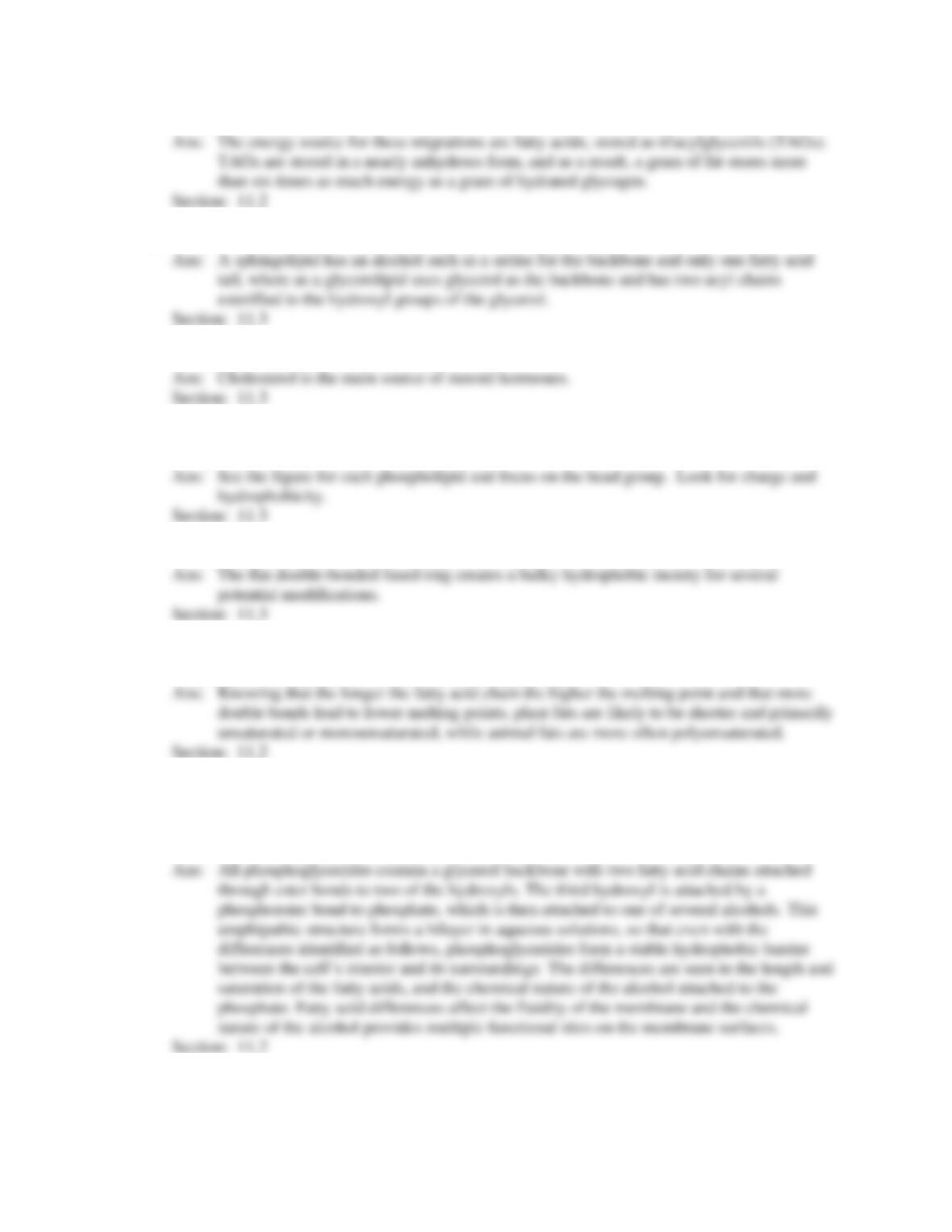
TAGs are stored in a nearly anhydrous form, and as a result, a gram of fat stores more
than six times as much energy as a gram of hydrated glycogen.
Section: 11.2
Chapter 10 Lipids
9
52.
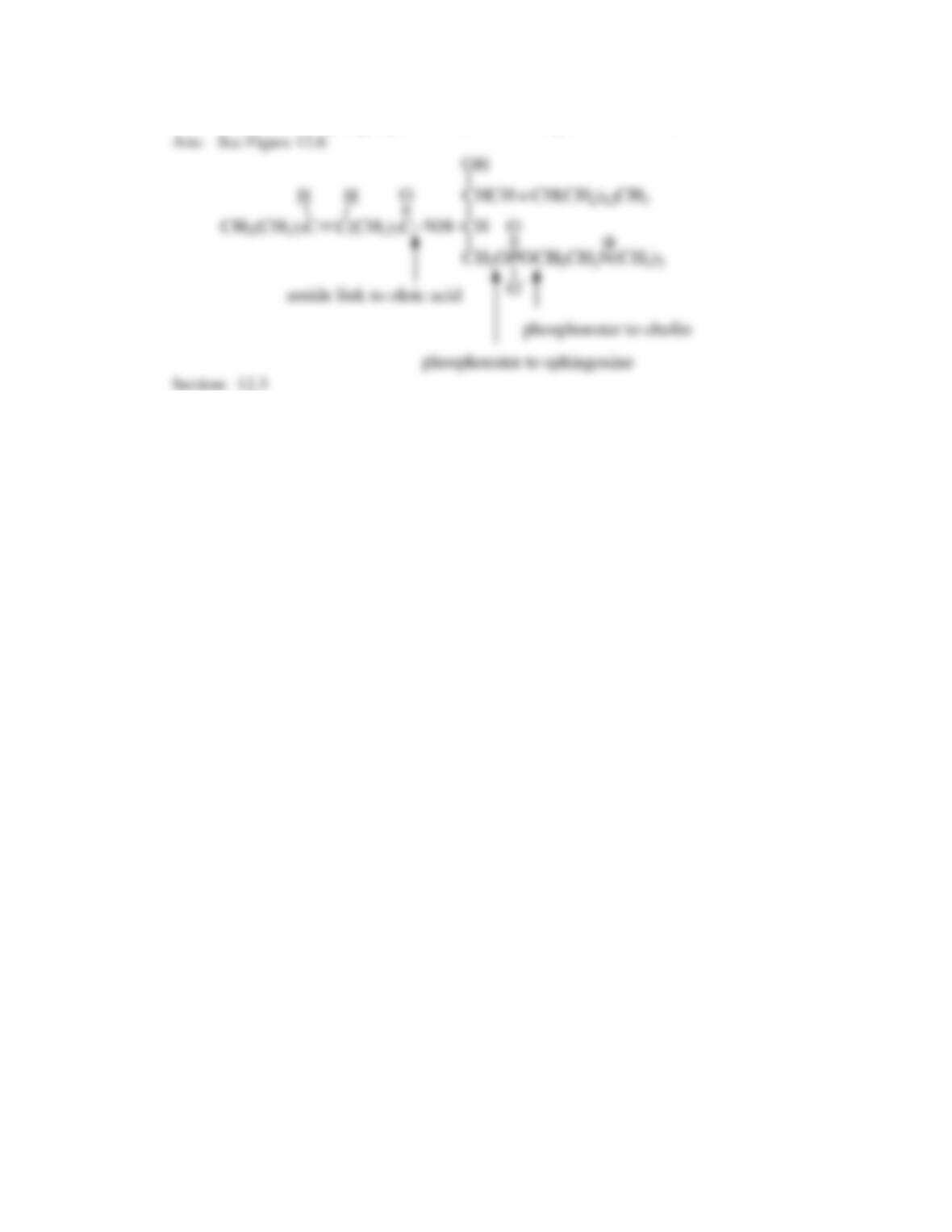
Draw the structure of sphingomyelin and label the linkages in this structure.