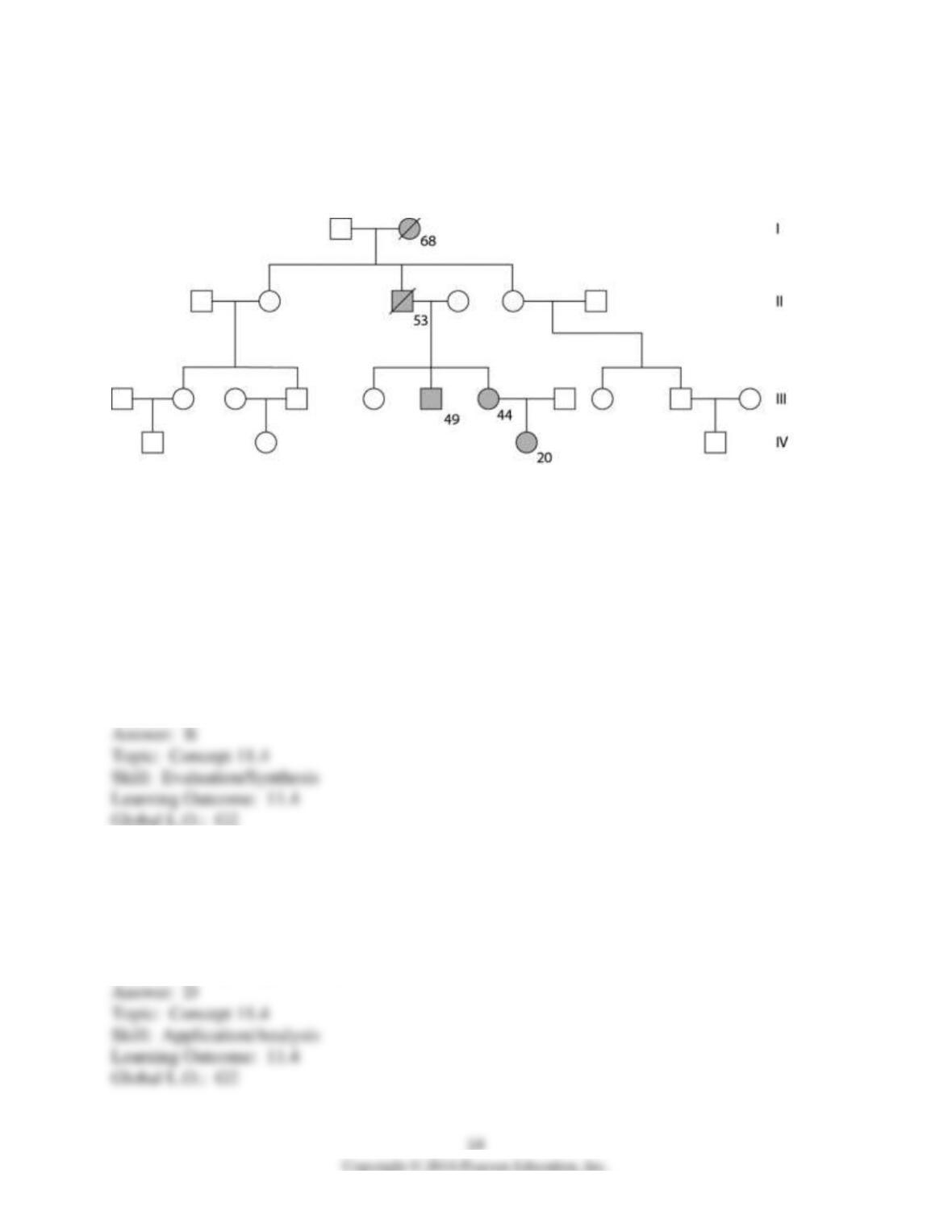
Use the following pedigree (Figure 11.3) for a family in which dark-shaded symbols represent
individuals with one of the two major types of colon cancer. Numbers under the symbols are the
individual’s age at the time of diagnosis. A slash through the symbol indicates that the individual
is deceased.
Figure 11.3
7) In each generation of this family after generation I, the age at diagnosis is significantly lower
than would be found in nonfamilial (sporadic) cases of this cancer (~63 years). What is the most
likely reason?
A) Members of this family know to be checked for colon cancer early in life.
B) Hereditary (or familial) cases of this cancer typically occur at earlier ages than do nonfamilial
forms.
C) This is pure chance; it would not be expected if you were to look at a different family.
D) This cancer requires mutations in more than this one gene.
E) Affected members of this family are born with colon cancer, and it can be detected whenever
they are first tested.
8) From this pedigree, how does this trait seem to be inherited?
A) from mothers
B) as a recessive trait
C) as a result of epistasis
D) as a dominant trait
E) as an incompletely dominant trait
9) The affected woman in generation IV is thinking about her future and asks her oncologist
(cancer specialist) whether she can know whether any or all of her children will have a high risk
of the same cancer. The doctor would be expected to advise which of the following: (I) genetic
counseling; (II) prenatal diagnosis when/if she becomes pregnant; (III) testing to see whether she
has the allele; (IV) testing to see whether her future spouse or partner has the allele?
A) I only
B) II only
C) I, II, and IV only
D) III only
E) III and IV only
11.3 Scenario Questions
Please use the following information to answer the question(s) below.
Two true-breeding stocks of pea plants are crossed. One parent has red axial flowers and the
other has white terminal flowers; all F1 individuals have red axial flowers. The genes for flower
color and location assort independently.
1) If 1,000 F2 offspring resulted from the cross, approximately how many of them would you
expect to have red terminal flowers?
A) 65
B) 190
C) 250
D) 565
E) 750
2) Among the F2 offspring, what is the probability of plants with white axial flowers?
A) 9/16
B) 1/16
C) 3/16
D) 1/8
E) 1/4
Please use the following information to answer the question(s) below.
Labrador retrievers are black, brown, or yellow. In a cross of a black female with a brown male,
results can be all black puppies, 1/2 black to 1/2 brown puppies, or 3/4 black to 1/4 yellow
puppies.
3) These results indicate which of the following?
A) Brown is dominant to black.
B) Black is dominant to brown and to yellow.
C) Yellow is dominant to black.
D) There is incomplete dominance.
E) Epistasis is involved.
4) How many genes must be responsible for these coat colors in Labrador retrievers?
A) 1
B) 2
C) 3
D) 4
E) 5
5) In one cross of black × black, the results were as follows:
9/16 black, 4/16 yellow, 3/16 brown
The genotype eebb must result in which of the following?
A) black
B) brown
C) yellow
D) a lethal result
E) white
Please use the following information to answer the question(s) below.
Radish flowers may be red, purple, or white. A cross between a red-flowered plant and a white-
flowered plant yields all-purple offspring. The part of the radish we eat may be oval or long, with
long being the dominant trait.
6) If true-breeding red long radishes are crossed with true-breeding white oval radishes, the F1
will be expected to be which of the following?
A) red and long
B) red and oval
C) white and long
D) purple and long
E) purple and oval
7) In the F2 generation of the above cross, which of the following phenotypic ratios would be
expected?
A) 9:3:3:1
B) 9:4:3
C) 1:1:1:1
D) 1:1:1:1:1:1
E) 6:3:3:2:1:1
8) The flower color trait in radishes is an example of which of the following?
A) a multiple allelic system
B) sex linkage
C) codominance
D) incomplete dominance
E) epistasis
Please use the following information to answer the question(s) below.
Drosophila (fruit flies) usually have long wings (+), but mutations in two different genes can
result in bent wings (bt) or vestigial wings (vg).
9) If a homozygous bent wing fly is mated with a homozygous vestigial wing fly, which of the
following offspring would you expect?
A) all +bt +vg heterozygotes
B) 1/2 bent and 1/2 vestigial flies
C) all homozygous + flies
D) 3/4 bent and 1/4 vestigial flies
E) 1/2 bent and vestigial and 1/2 normal flies
10) If flies that are heterozygous for both the bent wing gene and the vestigial wing gene are
mated, what is the probability of offspring with bent wings only?
A) 1/8
B) 3/8
C) 1/4
D) 9/16
E) 3/16
Please use the following information to answer the question(s) below.
Tallness (T) in snapdragons is dominant to dwarfness (t), and red (CR) flower color is not
dominant to white (Cr). The heterozygous condition results in pink (CRCr) flower color.
11) A dwarf red snapdragon is crossed with a plant homozygous for tallness and white flowers.
What are the genotype and phenotype of the F1 individuals?
A) ttCRCr–dwarf and pink
B) ttCrCr–dwarf and white
C) TtCRCr–tall and red
D) TtCRCr–tall and pink
E) TTCRCR–tall and red
12) If snapdragons are heterozygous for height as well as for flower color, a mating between
them will result in what ratio?
A) 9:3:3:1
B) 6:3:3:2:1:1
C) 1:2:1
D) 27:9:9:9:3:3:3:1
E) 9:4:3
Please use the following information to answer the question(s) below.
Skin color in a certain species of fish is inherited via a single gene with four different alleles.
13) How many different types of gametes would be possible in this system?
A) 1
B) 2
C) 4
D) 8
E) 16
14) One fish of this type has alleles 1 and 3 (S1S3) and its mate has alleles 2 and 4 (S2S4). If
each allele confers a unit of color darkness such that S1 has one unit, S2 has two units, and so on,
then what proportion of their offspring would be expected to have five units of color?
A) 1/4
B) 1/5
C) 1/8
D) 1/2
E) 0
Please use the following information to answer the question(s) below.
Gene S controls the sharpness of spines in a type of cactus. Cactuses with the dominant allele, S,
have sharp spines, whereas homozygous recessive ss cactuses have dull spines. At the same time,
a second gene, N, determines whether or not cactuses have spines. Homozygous recessive nn
cactuses have no spines at all.
15) The relationship between genes S and N is an example of
A) incomplete dominance.
B) epistasis.
C) complete dominance.
D) pleiotropy.
E) codominance.
16) A cross between a true-breeding sharp-spined cactus and a spineless cactus would produce
A) all sharp-spined progeny.
B) 50% sharp-spined, 50% dull-spined progeny.
C) 25% sharp-spined, 50% dull-spined, 25% spineless progeny.
D) all spineless progeny.
E) It is impossible to determine the phenotypes of the progeny.
17) If doubly heterozygous SsNn cactuses were allowed to self-pollinate, the F2 would segregate
in which of the following ratios?
A) 3 sharp-spined:1 spineless
B) 1 sharp-spined:2 dull-spined:1 spineless
C) 1 sharp-spined:1 dull-spined:1 spineless
D) 1 sharp-spined:1 dull-spined
E) 9 sharp-spined:3 dull-spined:4 spineless
Please use the following information to answer the question(s) below.
Feather color in budgies is determined by two different genes, Y and B, one for pigment on the
outside of the feather and one for the inside. YYBB, YyBB, or YYBb is green; yyBB or yyBb is
blue; YYbb or Yybb is yellow; and yybb is white.
18) A blue budgie is crossed with a white budgie. Which of the following results is possible?
A) green offspring only
B) yellow offspring only
C) blue offspring only
D) blue and white offspring
E) a 9:3:3:1 ratio
19) Two blue budgies were crossed. Over the years, they produced 22 offspring, 5 of which were
white. What are the most likely genotypes for the two blue budgies?
A) yyBB and yyBB
B) yyBB and yyBb
C) yyBb and yyBb
D) yyBB and yybb
E) yyBb and yybb
Please use the following information to answer the question(s) below.
A woman who has blood type A positive has a daughter who is type O positive and a son who is
type B negative. Rh positive is a trait that shows simple dominance over Rh negative and is
designated by the alleles R and r, respectively. A third gene for the MN blood group has
codominant alleles M and N.
20) Which of the following is a possible partial genotype for the son?
A) IBIB
B) IAIB
C) ii
D) IBi
E) IAIA
21) Which of the following is a possible genotype for the mother?
A) IAIA
B) IBIB
C) ii
D) IAi
E) IAIB
22) Which of the following is a possible phenotype for the father?
A) A negative
B) O negative
C) B positive
D) AB negative
E) impossible to determine
23) If both children are of blood type M, which of the following is possible?
A) Each parent is either M or MN.
B) Each parent must be type M.
C) Both children are heterozygous for this gene.
D) Neither parent can have the N allele.
E) The MN blood group is recessive to the ABO blood group.