Microbiology: An Introduction, 13e (Tortora et al.)
Chapter 10 Classification of Microorganisms
10.1 Multiple-Choice Questions
1) Which of the following statements about archaea is FALSE?
A) They are prokaryotes.
B) They lack peptidoglycan in their cell walls.
C) Some are thermoacidophiles; others are extreme halophiles.
D) They evolved before bacteria.
E) Some produce methane from carbon dioxide and hydrogen.
2) Which of the following characterizes the Domain Bacteria?
A) prokaryotic cells; ether linkages in phospholipids
B) eukaryotic cells; ester linkages in phospholipids
C) prokaryotic cells; ester linkages in phospholipids
D) complex cellular structures
E) multicellular
3) If two organisms have similar rRNA sequences, you can conclude that they
A) live in the same place.
B) evolved from a common ancestor.
C) will have different G-C ratios.
D) will both ferment lactose.
E) mated with each other.

4) What is the outstanding characteristic of the Kingdom Fungi?
A) All members are photosynthetic.
B) Members absorb dissolved organic matter.
C) Members absorb dissolved inorganic matter.
D) All members are microscopic.
E) All members are macroscopic.
5) Which of the following statements about members of the Kingdom Plantae is FALSE?
A) They are multicellular.
B) They are composed of eukaryotic cells.
C) They undergo photosynthesis.
D) They use organic carbon sources.
E) They synthesize organic molecules.
6) Which of the following statements about the members of the Kingdom Animalia is FALSE?
A) They are multicellular.
B) They are composed of eukaryotic cells.
C) They undergo photosynthesis.
D) They ingest nutrients through a mouth.
E) They are heterotrophs.
7) A genus can best be defined as
A) a taxon composed of families.
B) a taxon composed of one or more species and a classification level lying below family.
C) a taxon belonging to a species.
D) a taxon comprised of classes.
E) the most specific taxon.
8) A bacterial species differs from a species of eukaryotic organisms in that a bacterial species
A) does not breed with other species.
B) has a limited geographical distribution.
C) can be distinguished from other bacterial species.
D) is a population of cells with similar characteristics.
E) breeds with its own species.
9) Which of the following is the best evidence for a three-domain system?
A) Nucleotide sequences in ribosomal RNA vary between all three domains.
B) There are three distinctly different sets of metabolic reactions.
C) There are three distinctly different Gram reactions.
D) Some bacteria live in extreme environments.
E) There are three distinctly different types of nuclei.
10) A biochemical test, in the microbiology world, is used to determine
A) staining characteristics.
B) amino acid sequences of enzymes.
C) nucleic acid-base composition of DNA sequences.
D) capability of a microbe to perform a specific enzymatic activity.
E) All of the answers are correct.
11) Which of the following is NOT based on nucleic-acid hybridization?
A) DNA chip
B) FISH
C) PCR
D) Southern blotting
E) Western blotting
12) The phylogenetic classification of bacteria is based on
A) cell morphology.
B) Gram reaction.
C) rRNA sequences.
D) habitat.
E) diseases.
13) Which one of the following statements is a reason for NOT classifying viruses in one of the
threedomains of life (Bacteria, Archaea, Eukarya) rather than in a fourth separate domain?
A) Some viruses can incorporate their genome into a host’s genome.
B) Viruses direct anabolic pathways of host cells.
C) Viruses are obligate parasites.
D) Viruses are not composed of cells.
14) Which one of the following provides taxonomic information that includes the information
obtained in each of the other options listed?
A) nucleic acid hybridization
B) nucleic acid-base composition
C) amino acid sequencing
D) biochemical tests
E) cladogram
15) Fossil evidence indicates that prokaryotic cells first existed on the Earth at least
A) 350 years ago.
B) 3500 years ago.
C) 35000 years ago.
D) 3.5 billion years ago.
E) 3.5 × 10¹² years ago.
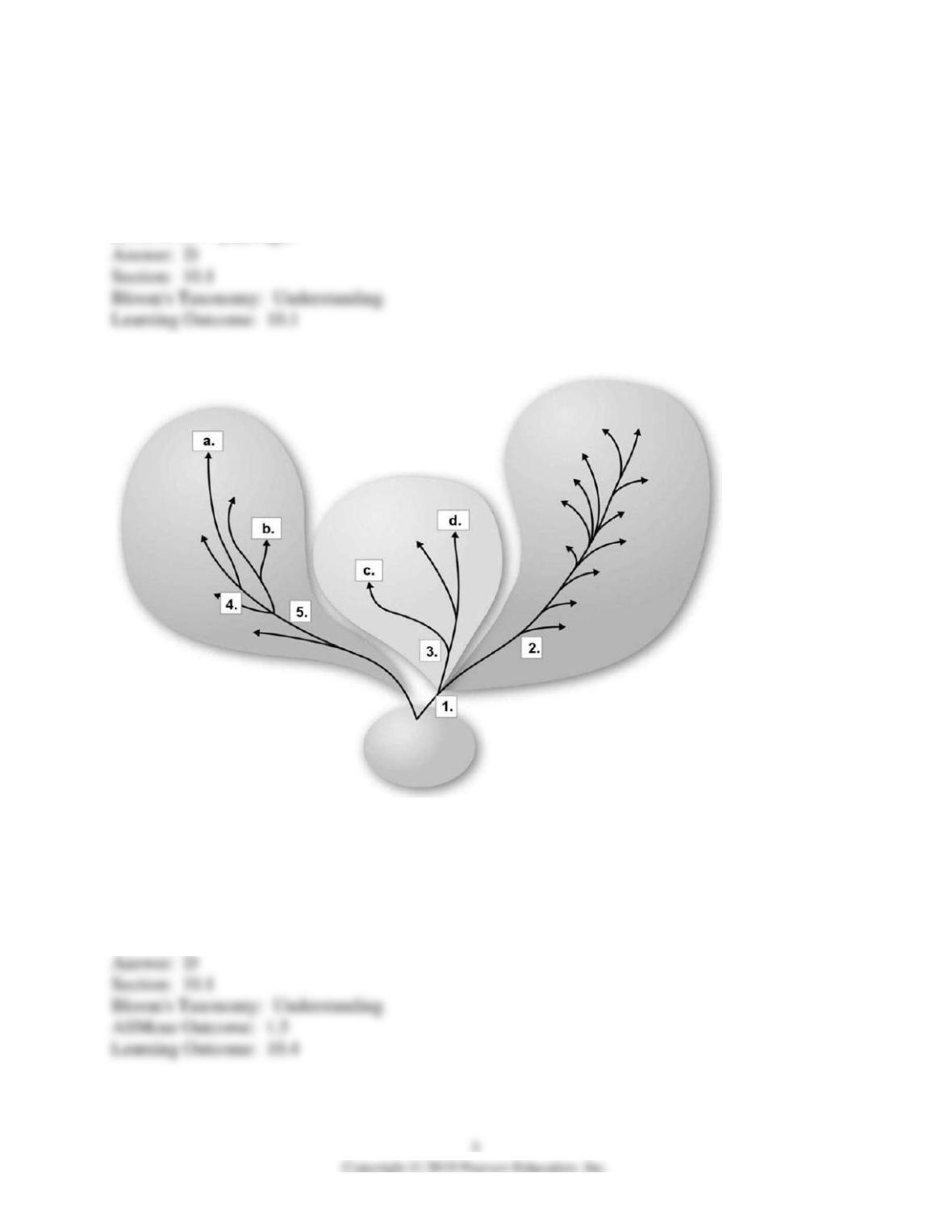
Figure 10.1
16) In Figure 10.1, species “c.” is most closely related to which of the following?
A) a
B) b
C) c
D) d
E) e

17) In Figure 10.1, the closest ancestor for both species “a.” and species “b.” would be which of
the following?
A) 1
B) 2
C) 3
D) 4
E) 5
18) ________ are a diverse group of eukaryotic organisms that are similar in rRNA sequences,
but quite different from each other in motility types and ecology. They have been used
previously as a “catch-all” for organisms that couldn’t be easily classified into other groups.
A) Protists
B) Fungi
C) Plants
D) Methanogens
19) In the scientific name Enterobacter aerogenes, Enterobacter is the
A) specific epithet.
B) genus.
C) family.
D) order.
E) kingdom.
20) The arrangement of organisms into taxa
A) shows degrees of relatedness between organisms.
B) shows relationships to common ancestors.
C) was designed by Charles Darwin.
D) is arbitrary.
E) is based on evolution.
21) Bacteria and Archaea are similar in which of the following?
A) peptidoglycan cell walls
B) methionine as the start signal for protein synthesis
C) sensitivity to antibiotics
D) considered prokaryotic cells
E) plasma membrane ester linkage
22) Which of the following best defines a strain in microbiological terms?
A) a pure culture that is not totally identical to other cultures of the same species
B) a group of organisms with a limited geographical distribution
C) a mixed population of cells, which are genetically distinct, but with highly similar phenotypic
characteristics
D) groups of cells all derived from and identical to a single parent species
E) same as a species
23) Serological testing is based on the fact that
A) all bacteria have the same antigens.
B) antibodies react specifically with an antigen.
C) the human body makes antibodies against bacteria.
D) antibodies cause the formation of antigens.
E) bacteria clump together when mixed with any antibodies.
24) Phage typing is based on the fact that
A) bacteria are destroyed by viruses.
B) viruses cause disease.
C) bacterial viruses attack only members of a specific species.
D) Staphylococcus causes infections.
E) phages and bacteria are related.
25) Organism A has 70 moles % G+C, and organism B has 40 moles % G+C. Which of the
following can be concluded from these data?
A) The two organisms are related.
B) The two organisms are unrelated.
C) The organisms make entirely different enzymes.
D) Their nucleic acids will completely hybridize.
26) Nucleic acid hybridization is based on the fact that
A) the strands of DNA can be separated.
B) a chromosome is composed of complementary strands.
C) pairing between complementary bases occurs.
D) DNA is composed of genes.
E) all cells have DNA.
27) One of the most popular taxonomic tools is DNA fingerprinting to develop profiles of
organisms. These profiles provide direct information about
A) enzymatic activities.
B) protein composition.
C) the presence of specific genes.
D) antigenic composition.
E) the similarities between nucleotide sequences.
28) All of the following statements are reasons why fluorescent in situ hybridization (FISH) has
become a valuable tool for environmental microbiologists EXCEPT
A) it allows for detection of uncultured microbes.
B) it demonstrates the diversity of microbes in an environment.
C) it allows observation of microbes in their natural environment in association with other
microbes.
D) it allows one to obtain pure cultures of microbes.
29) Which of the following criteria is most useful in determining whether two organisms are
related?
A) Both ferment lactose.
B) Both are gram-positive.
C) Both are motile.
D) Both are aerobic.
30) A clone is
A) genetically identical cells derived from a single cell.
B) a genetically engineered cell.
C) a taxon composed of species.
D) a mound of cells on an agar medium.
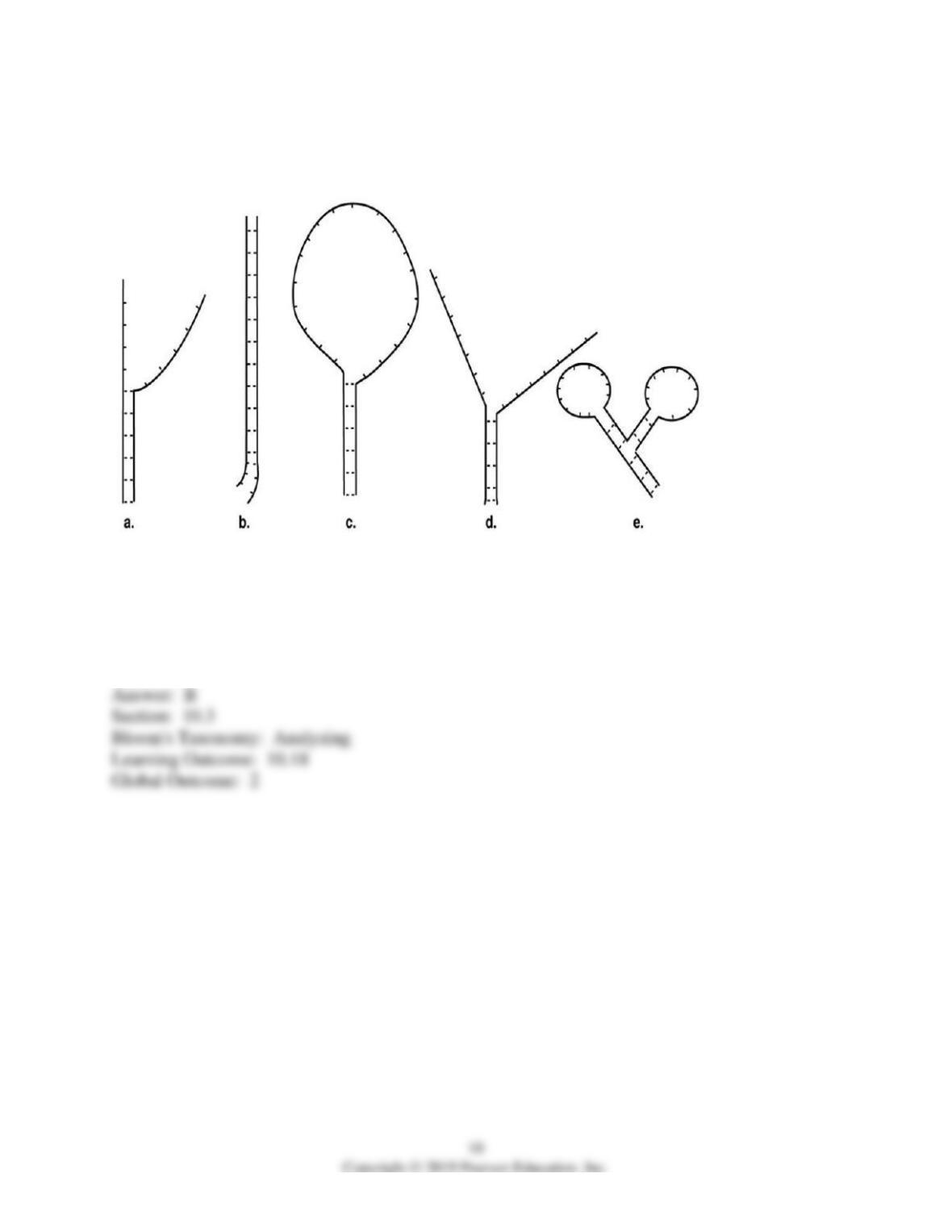
31) Figure 10.2
A nucleic acid hybridization experiment produced the following results.
In Figure 10.2, which figure shows the most closely related organisms?
A) a
B) b
C) c
D) d
E) e

Table 10.1
1. 9+2 flagella
2. Nucleus
3. Plasma membrane
4. Peptidoglycan
5. Mitochondrion
6. Fimbriae
32) In Table 10.1, which features are found in nearly all eukarya?
A) 2, 3, 5
B) 1, 4, 6
C) 3, 5
D) 2, 3
E) 1, 2, 5
33) In Table 10.1, which feature(s) is (are) found only in prokaryotes?
A) 1, 2, 3
B) 4, 6
C) 2
D) 1
E) 2, 4, 5
34) Into which group would you place a multicellular heterotroph with chitin cell walls?
A) Animalia
B) Archaea
C) Bacteria
D) Fungi
E) Plantae