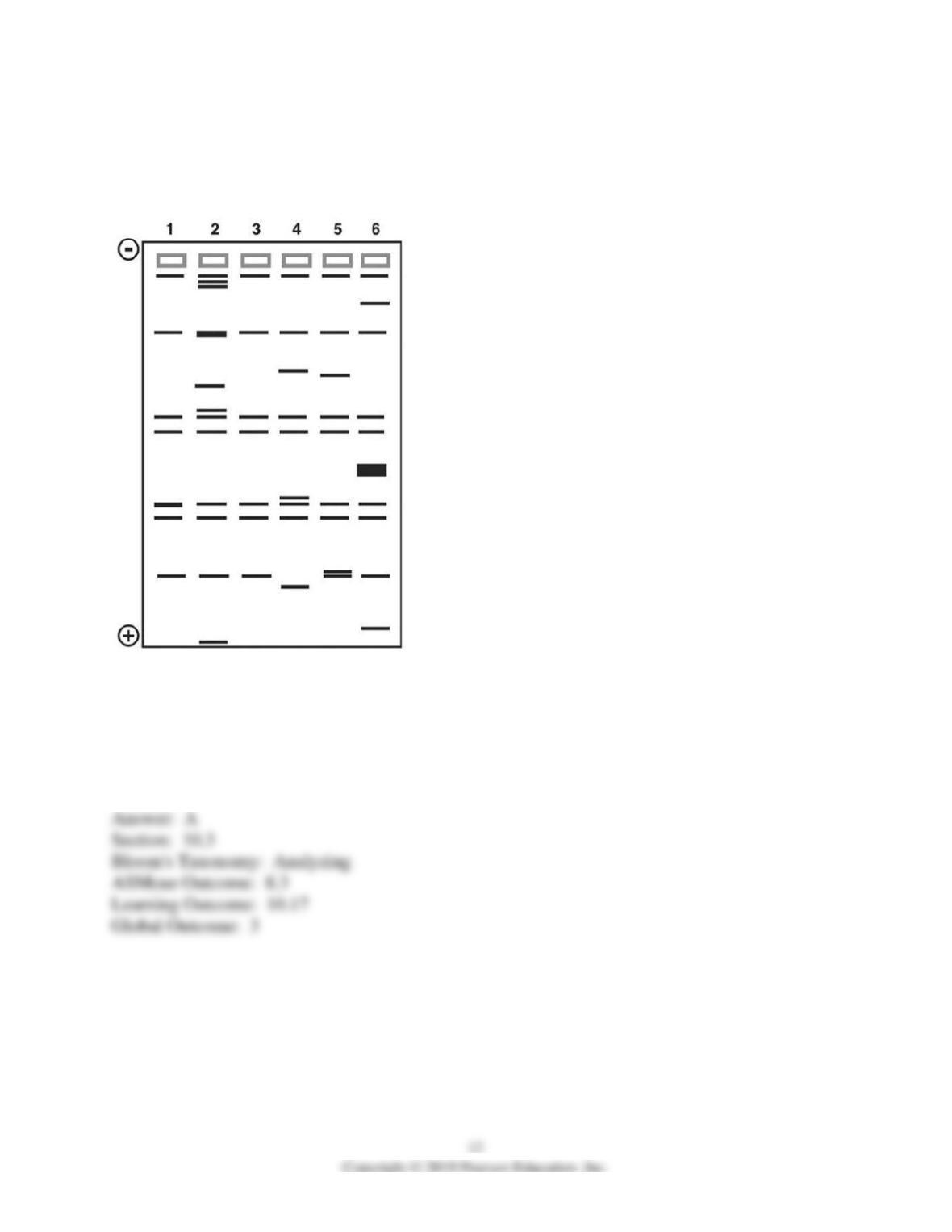
35) Figure 10.3
This figure shows the results of a gel electrophoresis separation of restriction fragments of the
DNA of different organisms.
In Figure 10.3, which two are most closely related?
A) 1 and 3
B) 2 and 4
C) 3 and 5
D) 2 and 5
E) 4 and 5

36) Into which group would you place a photosynthetic cell that lacks a nucleus?
A) Animalia
B) Bacteria
C) Fungi
D) Plantae
E) Protista
37) You discovered a unicellular organism that lacks a nucleus and peptidoglycan. You suspect
the organism is in the group
A) Animalia.
B) Archaea.
C) Bacteria.
D) Fungi.
E) Plantae.
38) Into which group would you place a unicellular organism that has 70S ribosomes and a
peptidoglycan cell wall?
A) Animalia
B) Bacteria
C) Fungi
D) Plantae
E) Protist

Table 10.2
I. Gram-positive
A. Catalase+
1. Acid from glucose……………….. Staphylococcus
2. Glucose-…………………………… Micrococcus
B. Catalase–
1. Coccus……………………………. Streptococcus
2. Rod………………………………… Lactobacillus
II. Gram-negative
A. Oxidase-
1. Acid from lactose
a. Uses citric acid…………………… Citrobacter
b. Citric acid-……………………….. Escherichia
2. Lactose-
a. H2S produced
(1) Urease positive………………… Proteus
(2) Urease negative………………… Salmonella
B. Oxidase+
1. Rod……………………………….……. Pseudomonas
2. Coccus……………………………….… Neisseria
39) Use the dichotomous key in Table 10.2 to identify a gram-negative cell that ferments lactose
and uses citric acid as its sole carbon source.
A) Citrobacter
B) Escherichia
C) Lactobacillus
D) Pseudomonas
E) Staphylococcus
40) Use the dichotomous key in Table 10.2 to identify a gram-negative coccus.
A) Neisseria
B) Pseudomonas
C) Staphylococcus
D) Streptococcus
E) Micrococcus

41) Into which group would you place a multicellular organism that has a mouth and lives inside
the human liver?
A) Animalia
B) Fungi
C) Plantae
D) Firmicutes (gram-positive bacteria)
E) Proteobacteria (gram-negative bacteria)
42) Into which group would you place a photosynthetic organism that lacks a nucleus and has a
thin peptidoglycan wall surrounded by an outer membrane?
A) Animalia
B) Fungi
C) Plantae
D) Firmicutes (gram-positive bacteria)
E) Proteobacteria (gram-negative bacteria)
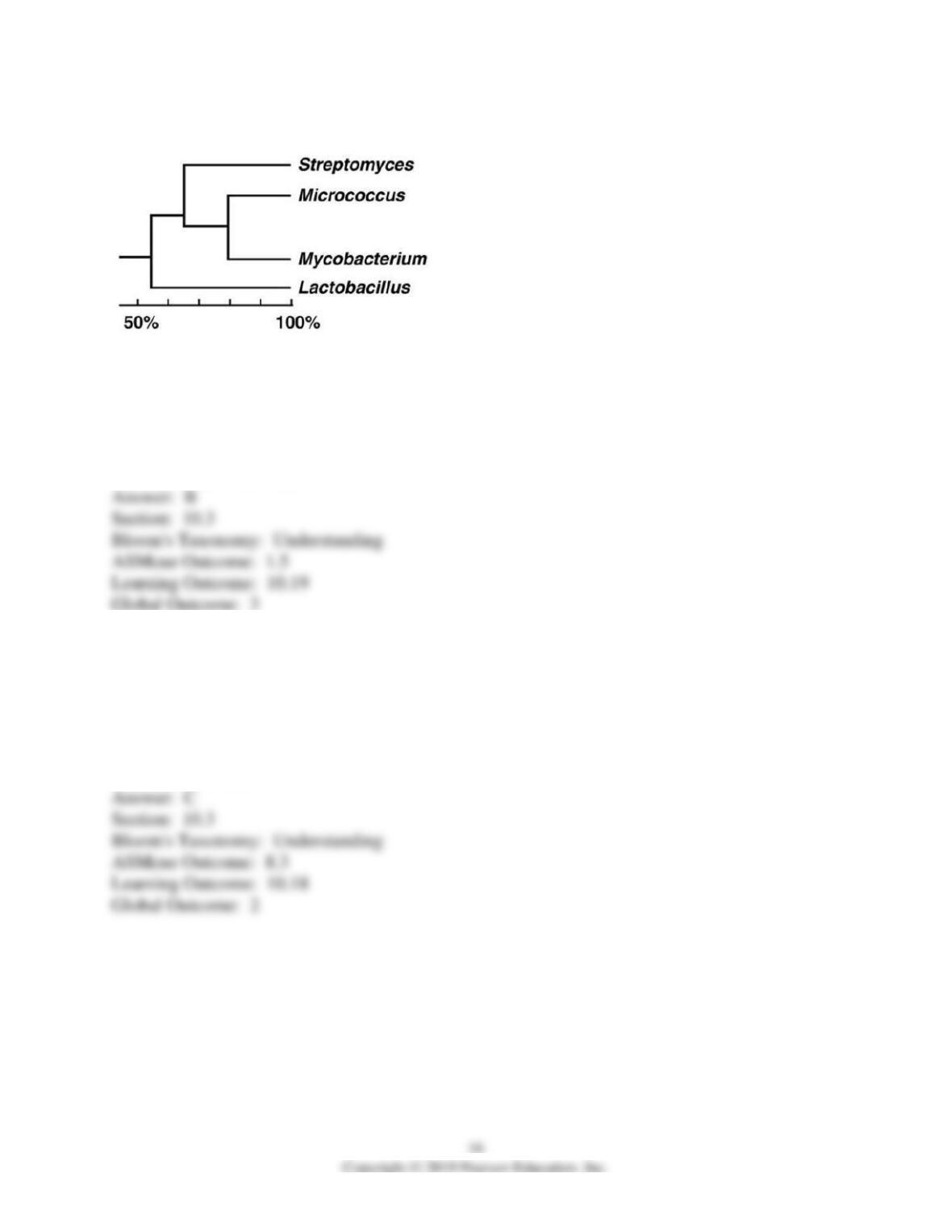
43) Figure 10.4
In the cladogram shown in Figure 10.4, which two organisms are most closely related?
A) Streptomyces and Micrococcus
B) Micrococcus and Mycobacterium
C) Mycobacterium and Lactobacillus
D) Streptomyces and Lactobacillus
E) Streptomyces and Mycobacterium
44) Which one of the following characteristics most reasonably indicates that two
microorganisms are closely related?
A) Both are cocci.
B) Both ferment lactose.
C) Their DNA can hybridize together.
D) Both normally live in clams.
E) Both are motile.

45) Data collected to date indicate that
A) humans and marine mammals cannot be infected by the same pathogens.
B) marine mammals do not get infectious diseases.
C) new species of bacteria will not be discovered in wild animals.
D) marine mammals don’t have an immune system.
E) None of the answers is correct.
46) For a serological bacterial identification test to be performed, you must have ________ in
your possession.
A) DNA that will hybridize to the DNA of the bacterium to be identified
B) RNA that will hybridize to the RNA of the bacterium to be identified
C) antiserum containing antibodies that will bind to the bacterium to be identified
D) fluorescent molecules that will light up when bound to the DNA of the bacterium
E) viruses that will specifically infect the bacterium you’re trying to identify
47) When performing phage typing to identify an unknown bacterium, you must have ________
in your possession.
A) DNA that will hybridize to the DNA of the bacterium to be identified
B) RNA that will hybridize to the RNA of the bacterium to be identified
C) antiserum containing antibodies that will bind to the bacterium to be identified
D) fluorescent molecules that will light up when bound to the DNA of the bacterium
E) viruses that will specifically infect the bacterium you’re trying to identify

48) In a direct ELISA test, the method is determining if ________ is/are present in the patient’s
sample by attempting to bind a labeled antibody to it.
A) antibodies against a pathogen found in a patient’s blood
B) an antigen from a particular pathogen
C) a bacteriophage that can infect a particular bacterial strain
D) a known sequence of DNA from a pathogen
49) Fatty acid methyl ester analysis is commonly used
A) in bacterial identification.
B) in DNA sequencing reactions.
C) in serological identification methods.
D) in DNA fingerprinting.
50) Flow cytometry, where a cell is passed through a light source such as a laser beam, can
directly indicate all EXCEPT which one of the following about a cell?
A) size
B) shape
C) density
D) identity
10.2 True/False Questions
1) The cell membranes of all three domains are composed of straight carbon chains attached to
glycerol by ester linkage.

2) Chloroplasts possess circular DNA and reproduce by binary fission.
3) As molecular techniques improve, scientists are finding it necessary to reclassify some genera.
4) The highest level in the current taxonomic hierarchy is “Kingdom.”
5) Pure cultures of the same species are not always identical in all ways.
6) At this point in time, scientists believe the vast majority of the domain Bacteria have been
discovered.
7) Once a culture is purified, the next logical step in the process of identifying bacteria is
biochemical testing.
8) Serological testing is used for screening bacterial isolates for similarities.
9) Western blotting is an immunological test used to identify the antibodies in the serum of an
individual suspected of having Lyme disease.
10) When building a cladogram, the length of the horizontal branch is based on the calculated
percent similarity between organisms.
10.3 Essay Questions
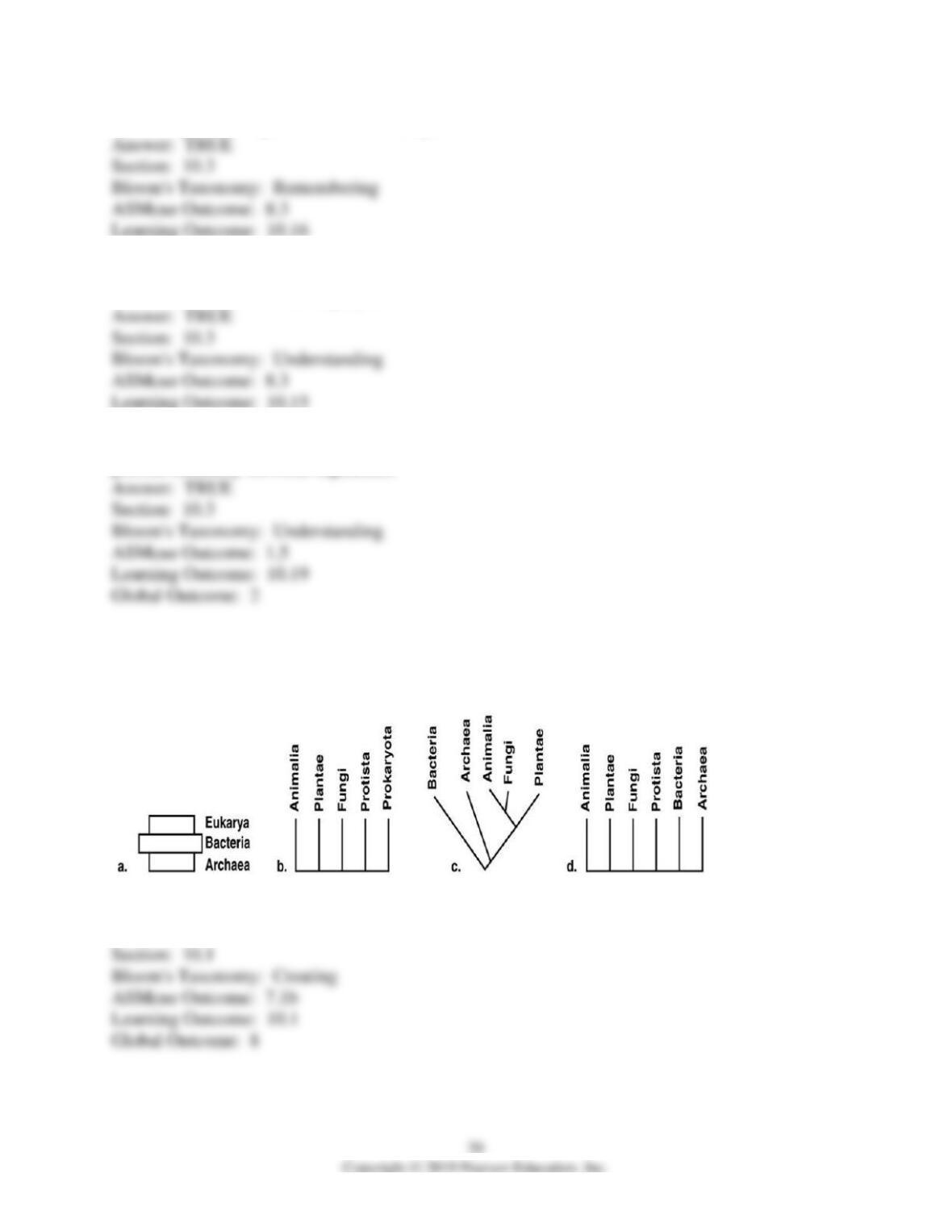
1) Figure 10.5
Choose one of the phylogenetic schemes in Figure 10.5 and explain why you feel it is preferable
to the others.
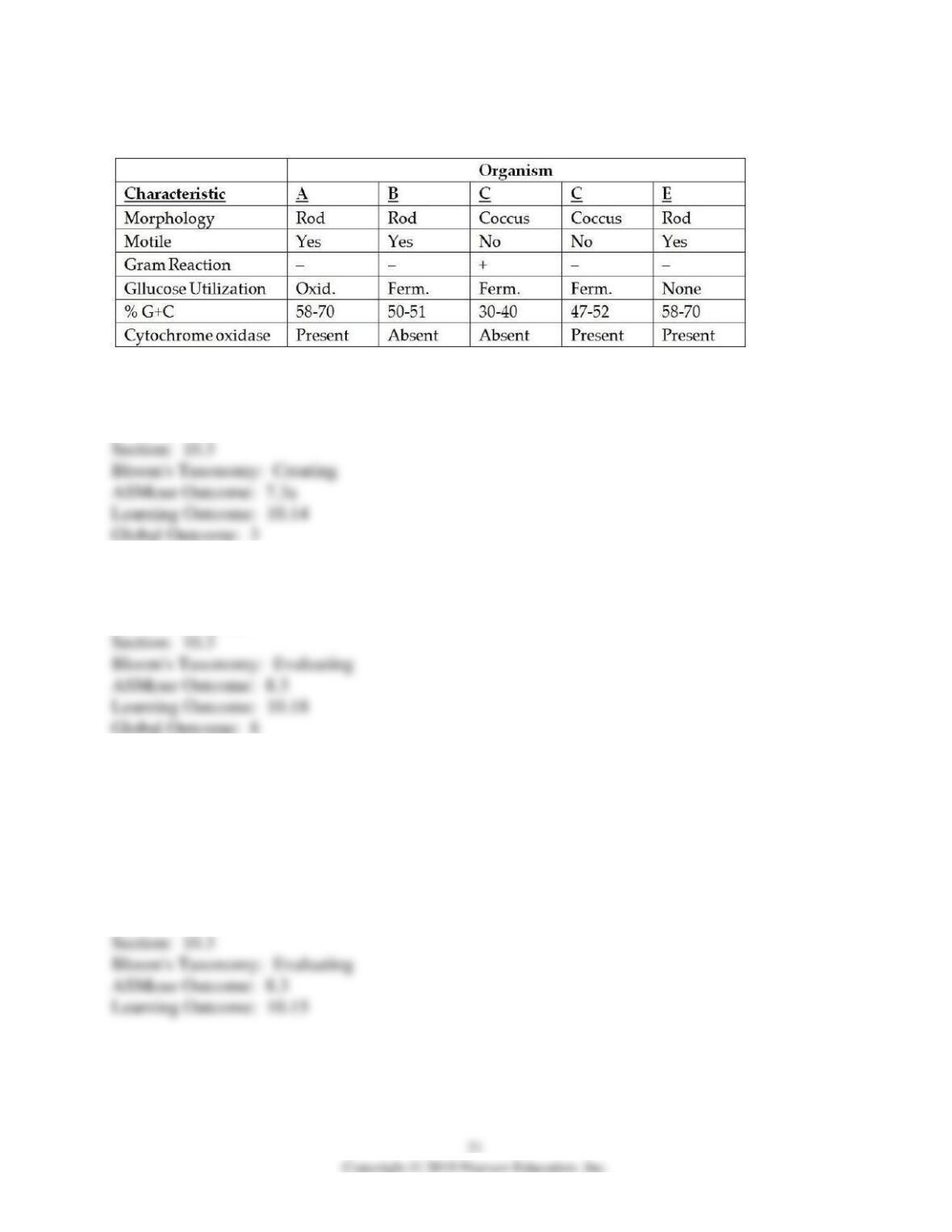
2) Table 10.3
Use the information given in Table 10.3 to answer the following questions. Which organisms are
most closely related? On what did you base your answer? DNA from which organisms will
probably hybridize?
3) One of the advantages of some newly developed rapid identification tools is that pure cultures
are not needed. Why is a pure culture necessary for biochemical tests such as the Enterotube, but
not for DNA probes?
4) You are studying a type of bacteria isolated from the acidic water runoff of a mining
operation. You subject two batches of the same bacteria type to different environmental growth
conditions. One batch is grown at pH 2, while the other is grown at pH 7. All other
environmental parameters are kept identical between the two batches. You then collect their
proteins and run a Western blot using an antibody that binds to a proton efflux pump protein
(which actively expends energy to pump protons out of a cell). How would you characterize the
information obtained in this experiment? What does it tell you, and why is that potentially
valuable information?

5) How are a Southern blot and fluorescent in situ hybridization similar and different from each
other? What are the pros and cons of each method for identification of microorganisms?