Chapter 10 Carbohydrates
Matching Questions
Use the following to answer questions 1-10:
Choose the correct answer from the list below. Not all of the answers will be used.
a) Fehling’s
b) enantiomers
c) UDP
d) glycogen
e) monosaccharides
f) cellulose
g) lectins
h) heparin
i) axial
j) glycoproteins
k) epimers
l) glycosyltransferases
1.
____________ This class of compounds has the molecular formula CH2On.
2.
____________ These are stereoisomers that are mirror images of one other.
Ans:
b
3.
____________ These monosaccharides differ at a single asymmetric carbon.
Section: 10.1
4.
____________ This is one of the most abundant organic molecule in the biosphere.
Section: 10.2
5.
____________ This is a test solution used to identify reducing and nonreducing sugars.
Section: 10.1
6.
____________ This is the storage form of glucose in animals.
Section: 10.2
Ans:
Chapter 10 Carbohydrates
2
7.
____________ This is an example of a glycosaminoglycan.
8.
____________ These are the enzymes that synthesize oligosaccharides.
Ans:
Section: 10.2
9.
____________ These are molecules to which most sugars are attached prior to transfer.
Ans:
Section: 10.2
10.
____________ These proteins bind to specific carbohydrate structures.
Ans:
g
Section: 10.4
Fill–in-the Blank Questions
11.
A is a stereoisomer that is not a mirror image.
Ans: diastereoisomer Section: 10.1
12.
A is a five-membered ring formed from a monosaccharide.
Ans: furanose Section: 10.1
13.
A is formed when two monosaccharides are linked together via a glycosidic bond.
Ans: disaccharide Section: 10.2
14.
Plant starch is composed of amylose, a linear polymer of glucose, and a branched polymer of
glucose referred to as .
Ans: amylopectin Section: 10.2
15.
Maltose is composed of two molecules of glucose linked together by a glycosidic bond.
16.
is a galactose joined to a glucose by a β-1,4 glycosidic bond.
Ans: Lactose Section: 10.2
17.
In N-linked glycoproteins, the carbohydrate portion is attached to a(n) residue in the protein.
Ans: asparagine Section: 10.3
18.
When the carbohydrate portion is attached to a serine or threonine residue in a glycoprotein, it is
referred to as a(n) glycoprotein.
Ans: O-linked Section: 10.3
Ans:
h
Section: 10.3
Chapter 10 Carbohydrates
3
19.
The influenza virus recognizes residues of glycoproteins present on cell surfaces.
20.
Repeating units in have a least one negatively charged carboxylate or sulfate group.
Ans: glycosaminoglycan Section: 10.3
Multiple-Choice Questions
21.
Carbohydrates are:
A)
aldehydes with two or more hydroxyl groups.
B)
ketones with two or more hydroxyl groups.
C)
acids with two or more hydroxyl groups.
D)
alcohols with two or more hydroxyl groups.
E)
A and B.
Ans: E Section: 10.1
22.
The simplest carbohydrates are:
A)
D– and L-glyceraldehyde.
B)
dihydroxyacetone and D– and L-glyceraldehyde.
C)
dihydroxyacetone and glycerate.
D)
All of the above.
E)
None of the above.
Ans: B Section: 10.1
23.
An aldehyde and alcohol can react to form a:
A)
hemialkyl.
D)
All of the above.
B)
hemiketal.
E)
None of the above.
C)
hemiacetal.
Ans: C Section: 10.1
24.
Fructose can cyclize to (a):
A)
pyranose ring.
B)
furanose ring.
C)
both pyranose and furanose ring forms.
D)
All of the above.
E)
None of the above.
Ans: C Section: 10.1
25.
The nutritional storage form(s) of glucose in plants.
A) glycogen B) amylose C) amylopectin D) B and C. E) All of the above.
Ans: D Section: 10.2
26.
Which enzyme digests amylopectin?
A)
-amylase
D)
All of the above.
B)
amylose
E)
None of the above.
C)
cellulose
Ans: A Section: 10.2
Ans: sialic acid Section: 10.4
Chapter 10 Carbohydrates
4
27.
To which amino acid residues in glycoproteins are the sugars commonly linked?
A)
tyrosine and asparagine
D)
serine and threonine
B)
serine, threonine, and asparagine
E)
A and D.
C)
serine, tyrosine, and asparagine
28.
Glycoproteins are normally:
A)
found on membranes.
D)
A and B.
B)
secreted as extracellular proteins.
E)
All of the above.
C)
found inside organelles.
Ans: D Section: 10.3
29.
All of the following are repeating units of glycosaminoglycans except:
A)
chondroitin 6-sulfate.
D)
heparin.
B)
keratin sulfate.
E)
All of these form glycosaminoglycans.
C)
hyaluronate.
Ans: E Section: 10.3
30.
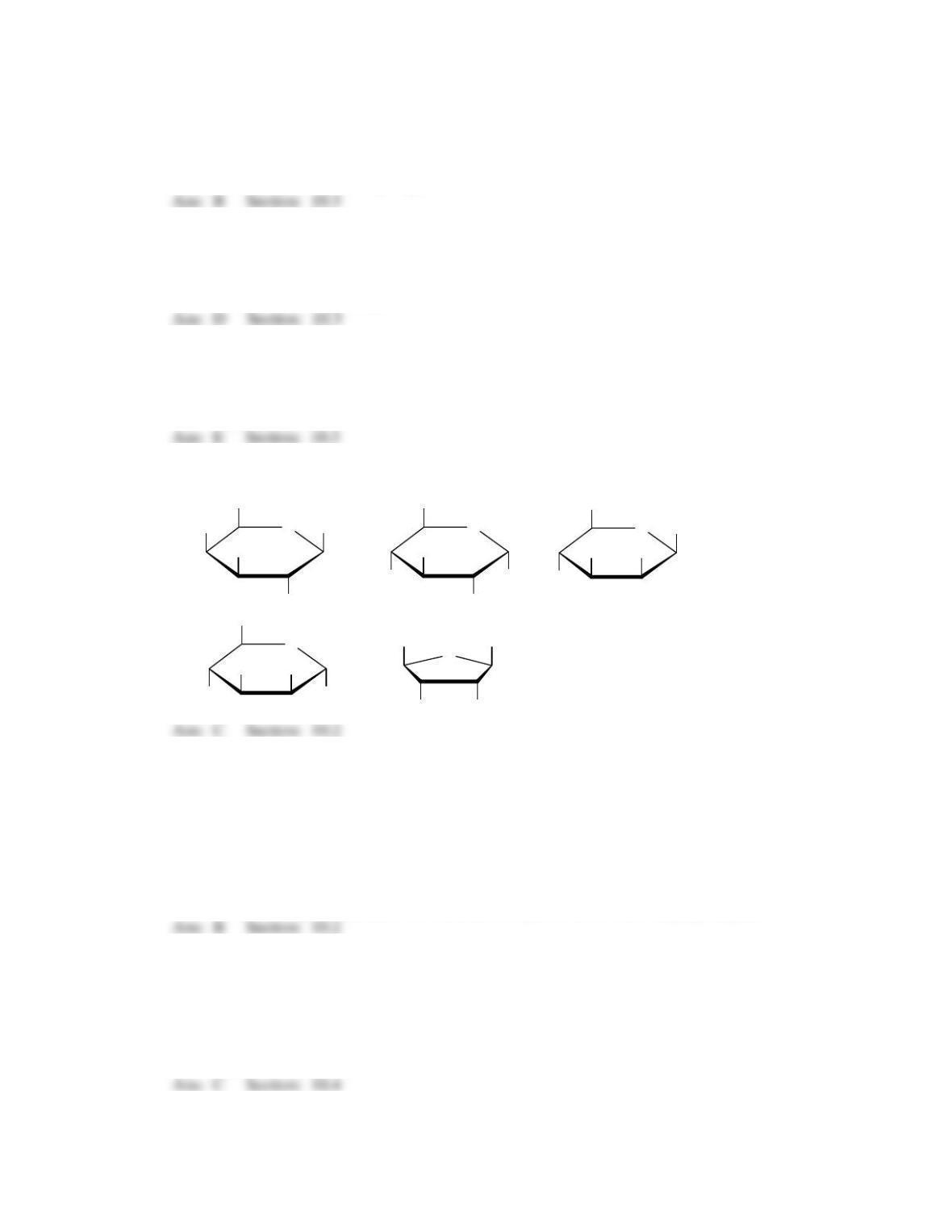
Which of the following is the anomer of β–D-glucopyranose?
E)
D)
C)
B)
A)
O
OHOH
OH
CH2OH
O
OH
CH2OH
OH
OH
OH
O
OH
CH2OH
OH OH
OH
O
OH
CH2OH
OH
OH
OH
O
OH
OH
CH2OH
OH
OH
Ans: C Section: 10.2
31.
All of the following are thought to play a role in cancer prevention except:
A)
glucosinolates that are formed by the condensation of glucose with an organic
isothiocyanate.
B)
plants of the order Brassicales hydrolyze glucosinolates and that store organic
isothiocyanates as a defense against herbivory.
C)
organic isothiocyanates that have a mustard-oil flavor.
D)
Brassicales, which include mustard, relish, kale, and broccoli.
E)
in humans, glucosinolates that stimulate the production of detoxifying enzymes.
Ans: B Section: 10.2
32.
Selectins are proteins that:
A)
selectively bind proteins destined for lysozomes.
B)
aid in selection of proteins bound for the Golgi complex.
C)
bind immune-system cells as part of the inflammatory response.
D)
All of the above.
E)
None of the above.
Ans: C Section: 10.4
Ans: B Section: 10.3
Chapter 10 Carbohydrates
5
33.
What are lectins?
A)
proteins that bind the carbohydrates on glycoproteins and other macromolecules
B)
proteins that promote cell-cell interaction
C)
proteins found in animals, plants, and microorganisms
D)
All of the above.
E)
None of the above.
34.
How do some viruses gain entry into specific cells?
A)
by attaching to ion channels
B)
by cleaving the glycosidic bonds and altering protein shapes
C)
by binding to glycoproteins on the cell surface that are unique to specific cells
D)
All of the above.
E)
None of the above.
Ans: C Section: 10.4
35.
Inhibitors against which viral enzyme have potential as anti-influenza agents?
A)
calnexin
D)
All of the above.
B)
neuramidase
E)
None of the above.
C)
selectin
Ans: B Section: 10.4
36.
How do some viruses gain entry into specific cells?
A)
by attaching to ion channels
B)
by cleaving the glycosidic bonds and altering protein shapes
C)
by binding to glycoproteins on the cell surface that are unique to specific cells
D)
All of the above.
E)
None of the above.
Ans: C Section: 10.4
37.
Biochemists organize proteins with carbohydrates attached into three classes. Below is a list of
structural differences in these three classes, one of which is assigned to the wrong class. Identify
the incorrect structural correlation.
A)
Unlike glycoproteins and proteoglycans, in mucopolysaccharides carbohydrates are
attached via ester bonds to Asp and Glu.
B)
The glycosaminoglycan component of proteoglycans determines their properties.
C)
The defining feature of the mucopolysaccharide is a region of the protein backbone called
the variable number of tandem repeats region.
D)
The carbohydrate portion of glycoproteins such as erythropoietin are thought to make it
more soluble in blood.
E)
Glycosaminoglycans often have repeating units of disaccharides containing a negatively
charged carboxylate or sulfate group.
Ans: A Section: 10.3
Short-Answer Questions
38.
List some of the reasons carbohydrates are considered important molecules.
Carbohydrates serve as the structural framework or building blocks for DNA, RNA, and
polysaccharides. They are also linked to other molecules, such as proteins and lipids, and
Ans: D Section: 10.4.
Chapter 10 Carbohydrates
6
39.
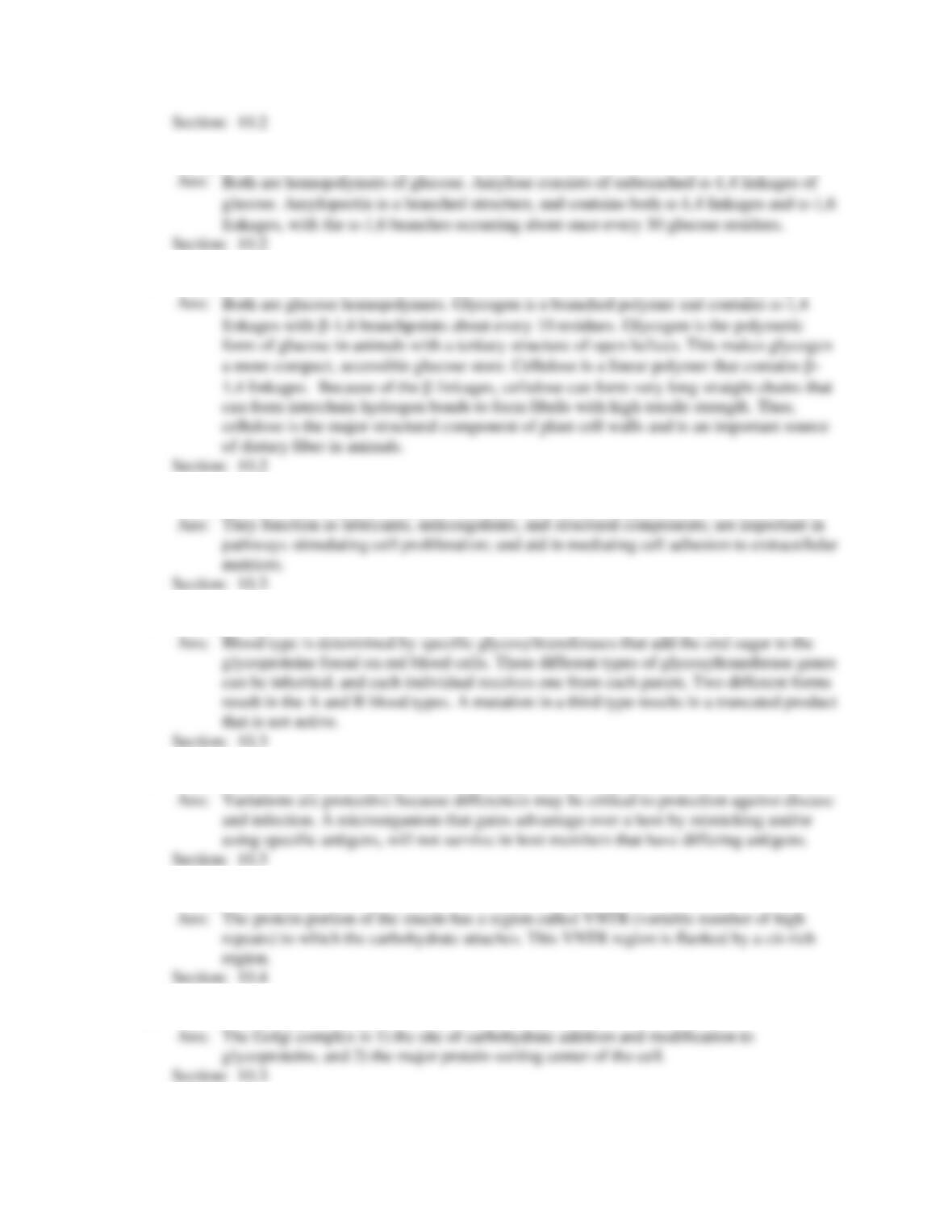
Draw the Fischer projection structures of all of the trioses.
Structures shown on page 168.
Section: 10.1
40.
What is the difference between an enantiomer and a diastereoisomer?
stereoisomers that are not mirror images of each other are called diastereoisomers.
Section: 10.1
41.
How is the D or L configuration determined in carbohydrates?
or aldehyde group, and is related to the glyceraldehyde D and L structures.
Section: 10.1
42.
Draw the Haworth projections of the two pyranose forms of D-glucose.
Shown in Figure 10.3 of the text.
Section: 10.1
43.
Draw the structure of lactose. Identify the monosaccharides involved and identify the type of
linkage in lactose?
OH
Section: Introduction
Chapter 10 Carbohydrates
7
44.
Compare the structures of amylopectin and amylose.
linkages, with the -1,6 branches occurring about once every 30 glucose residues.
Section: 10.2
45.
What are the chemical, structural, and functional differences between cellulose and glycogen?
of dietary fiber in animals.
Section: 10.2
46.
Describe some of the functions of glycosaminoglycans and proteoglycans.
matrices.
Section: 10.3
47.
How does a genetic mutation account for some of the different human blood types?
that is not active.
Section: 10.3
48.
What is the advantage of having different blood types within a species?
using specific antigens, will not survive in host members that have differing antigens.
Section: 10.3
49.
What are some of the defining characteristics of mucins?
region.
Section: 10.4
50.
What are the two primary functions of the Golgi complex?
glycoproteins, and 2) the major protein-sorting center of the cell.
Section: 10.3
Chapter 10 Carbohydrates
8
51.
What are selectins and how do they facilitate development?
52.
Which tissues synthesize mucins and why?
particles through these systems.
Section: 10.3
53.
Your grandfather tells you that his doctor is now measuring A1c (a form of hemoglobin) levels
to check his diabetes. Your grandfather is confused as to why his doctor would check levels of a
protein (hemoglobin) to monitor blood carbohydrate (glucose) levels. What do you tell him?
hemoglobin, the worse the blood sugar control.
Section: 10.1
Section: 10.4