Chapter 1 Biochemistry and the Unity of Life
Matching Questions
Use the following to answer questions 1–10:
Choose the correct answer from the list below. Not all of the answers will be used.
a) uracil
b) cytoplasm
c) protein
d) thymine
e) carbohydrate
f) sugar–phosphate units
g) cell wall
h) transcription
i) glycogen
j) lipid
k) central dogma
l) phagocytosis
m) endoplasmic reticulum
n) translation
o) prokaryotes
p) eukaryotes
q) lysosome
1.
DNA is made from the building blocks adenine, guanine, cytosine, and
____________.
2.
____________: Unbranched polymer that, when folded into its three-
dimensional shape, performs much of the work of the cell.
Ans:
c
Section: 1.2
3.
____________: Scheme that describes the flow of information from
one strand of DNA to a new strand of DNA.
Ans:
k
Section: 1.3
Ans:
Chapter 1 Biochemistry and the Unity of Life
2
4.
____________: Process where large amounts of material are taken into
the cell.
5.
The transfer of information from DNA to RNA is called
____________.
Ans:
h
Section: 1.3
6.
____________ are cells that are composed of multiple specialized
compartments.
Ans:
p
Section: 1.4
7.
____________: Class of biological macromolecules with many
functions, such as forming barriers between cell organelles, serving as a
metabolic fuel, and cell-to-cell signaling.
Ans:
j
Section: 1.2
8.
____________: Highly organized region of the cell where glycolytic
metabolism occurs.
Ans:
Section: 1.4
9.
____________: Responsible for protein processing and xenobiotic
metabolism.
Ans:
Section: 1.4
10..
____________: Filled with proteases and other digestive enzymes.
Ans:
Section: 1.4
Fill-in-the-Blank Questions
11.
Organisms are known to be highly uniform at the level.
Ans: molecular Section: Introduction
Ans:
l
Section: 1.3
Chapter 1 Biochemistry and the Unity of Life
3
12.
After hydrogen and oxygen, the next most common element in living
systems is .
13.
A chemical that can dissolve in water is said to be .
Ans: hydrophilic Section: 1.2
14.
A nucleotide consists of one or more groups, a 5-carbon ribose
sugar, and a nitrogen-containing aromatic ring group.
Ans: phosphoryl Section: 1.2
15.
The most common carbohydrate fuel is .
Ans: glucose Section: 1.2
16.
Heritable information is packaged into discrete units called .
Ans: genes Section: 1.3
17.
A group of enzymes called catalyze replication.
Ans: DNA polymerase Section: 1.3
18.
Although all cells in an organism have the same DNA, tissues differ
due to selective .
Ans: expression Section: 1.3
19.
The basic unit of life is considered the .
20.
Secretory vesicles fuse with the plasma membrane to release material
outside of the cell via .
Ans: exocytosis Section: 1.4
Multiple-Choice Questions
Ans: carbon Section: 1.1
Chapter 1 Biochemistry and the Unity of Life
4
22.
In higher organisms, which of the following is composed of a polymer
with double-stranded phosphodiester-linked monomers?
A) RNA
B) DNA
C) protein
D) carbohydrate
E) None of the above.
23.
What gives proteins such a dominant role in biochemistry?
A) the variation in protein sizes
B) the ability to act as a blueprint
C) their ability to self-replicate
D) their ability to spontaneously fold into complex three-dimensional
structures
E) All of the above.
Ans: D Section: 1.2
21.
The structure of DNA described by Watson and Crick
included:
A) a double helix.
B) the sugar–phosphate backbone aligned in the
center of the helix.
C) the base pairs that are stacked on the inside of the
double helix.
D) A and B.
E) A and C.
Ans: E Section: 1.2
Ans: B Section 1.2
Chapter 1 Biochemistry and the Unity of Life
5
24.
Proteins are chiefly composed of which of the following?
A) carbohydrate and amino acids
B) long unbranched amino acid polymers
C) peptide bonds formed between lipid moieties
D) aggregated amino acids
E) A and B
25.
How a protein folds is determined by:
A) whether the environment is hydrophobic or hydrophilic.
B) the location in the cell in which the protein is located.
C) the pH of the cytoplasm.
D) the order of the amino acids found in the sequence.
E) All of the above.
Ans: D Section: 1.2
Chapter 1 Biochemistry and the Unity of Life
6
26.
The half-life of which of the following is likely to be shortest?
A) protein
B) lipid
C) carbohydrate
D) DNA
E) RNA
27.
The central dogma describes:
A) the formation of cells from individual components.
B) the selective expression of genes.
C) the flow of information between DNA, RNA, and protein.
D) the work of polymerases on RNA and DNA.
E) All of the above.
Ans: C Section: 1.3
28.
Translation takes place on/in the:
A) ribosomes.
B) smooth endoplasmic reticulum.
C) nucleus.
D) DNA polymerases.
E) DNA parent strand.
Ans: A Section: 1.3
29.
Which of the following organelles has a double membrane?
A) nucleus
B) endoplasmic reticulum
C) mitochondria
D) plasma membrane
E) A and C
F) All of the above.
Ans: E Section: 1.4
Ans: E Section: 1.2

Chapter 1 Biochemistry and the Unity of Life
7
30.
The main function of the plasma membrane is to:
A) provide the interior of the cell an enclosed environment that no
molecules may cross.
B) provide a selectively permeable barrier with the aid of transport
proteins.
C) give eukaryote and prokaryote cells structural strength.
D) allow only the free passage of water in and out of the cell.
E) None of the above.
31.
Filaments and microtubules are components of a network called the:
A) chloroplast.
B) cytoplasm.
C) cytoskeleton.
D) cell wall.
E) B and D.
Ans: C Section: 1.4
32.
Poisons that kill an organism as a result of a loss of high-energy ATP
molecules are most likely to target which organelle?
A) mitochondria
B) cytoskeleton
C) cytoplasm
D) endoplasmic reticulum
E) nucleus
Ans: A Section: 1.4
33.
A secreted protein would be processed through organelles in the
following order:
A) nucleus; secretory vesicle; Golgi complex.
B) cytoplasm; Golgi complex; cytosol; secretory vesicle.
C) endoplasmic reticulum; cytoplasmic reticulum; Golgi complex.
D) nucleus; cytoplasm; endoplasmic reticulum; Golgi complex;
secretory vesicle.
E) None of the above.
Ans: E Section: 1.4
34.
Extracellular material is taken into the cell via which process?
A) exocytosis
B) phagocytosis
Ans: B Section: 1.4
Chapter 1 Biochemistry and the Unity of Life
8
C) lysosome-mediated endocytosis
D) reverse secretory mechanism
E) phago-cytosolic internalization
35.
The rigid material that provides structural support to a plant cell is/are
called the:
A) plant cytoskeleton.
B) plasma membrane.
C) cell wall.
D) chloroplast anchor proteins.
E) microfilaments and microtubules.
Ans: C Section: 1.4
36. In studying secreted proteins, you find that Substance X inhibits the secretion
of a labeled protein. However, you do find a fully synthesized, folded, and
glycosylated proteins in the cell. Where is the most likely site in the synthesis and
secretion of proteins for Substance X to act?
A) nucleus during translation
B) budding of the secretory granule
C) translation on the ribosome
D) enzyme modification in the Golgi
E) All of the above.
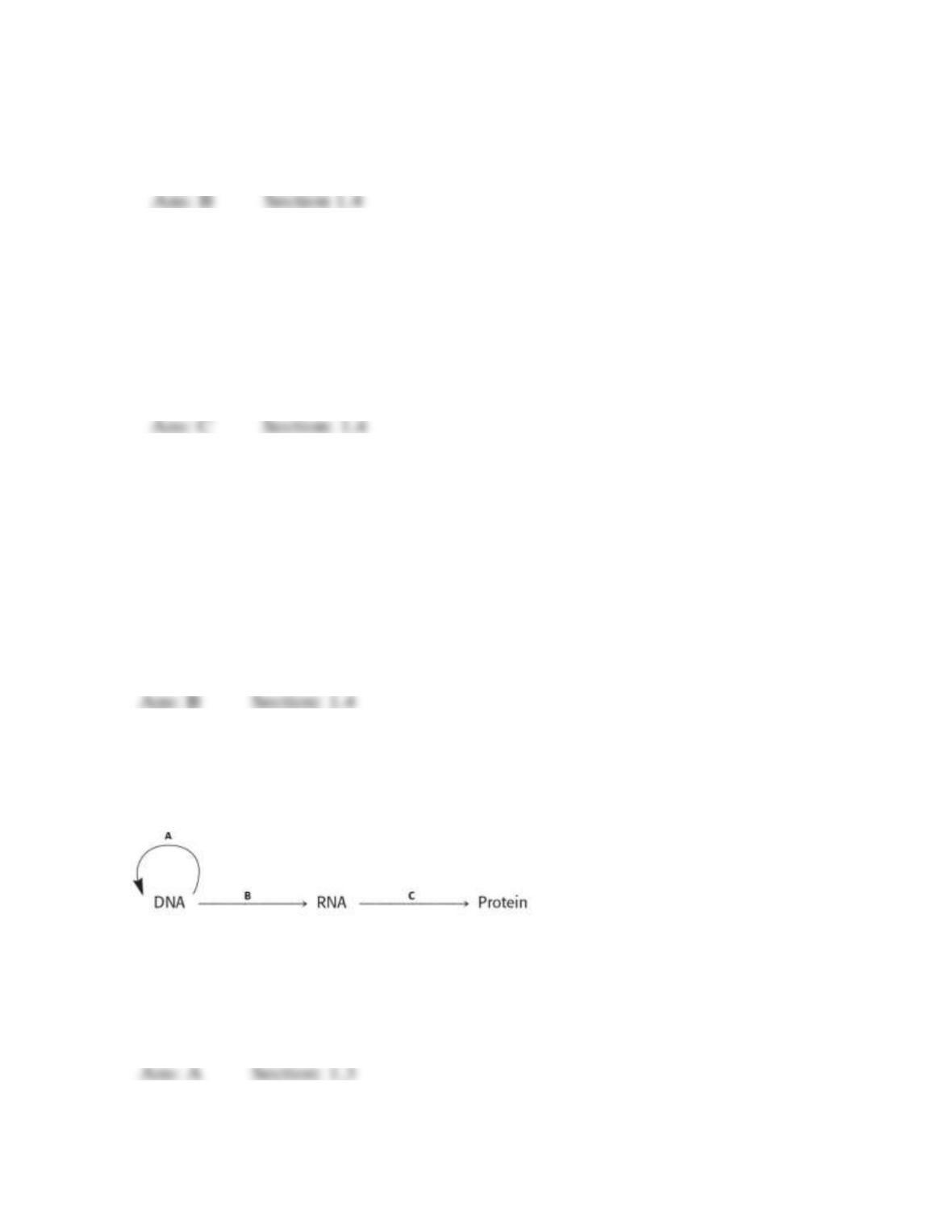
37. Below is the scheme known as the central dogma. Each of the arrows (A, B, C)
represents a particular process in gene expression. A, B, and C, respectively, are:
A) replication, transcription, translation.
B) reverse transcription, transcription, translation.
C) transcription, translation, replication.
D) replication translation, expression.
E) None of the above.
Ans: B Section 1.4
Chapter 1 Biochemistry and the Unity of Life
9
38. Match the loss of a particular organelle with the associated disease.
A) Hypercholesterolemia – smooth endoplasmic reticulum
B) Diabetes – endosome
C) Tay-Sachs disease – lysosome
D) Muscle degeneration – mitochondria
E) Stroke – Golgi body
39. In a biochemistry lab course, you are asked to design an experiment to identify
a strain of bacteria. Your lab partner claims that she thinks the bacterium contains
a rough endoplasmic reticulum. To verify her claim, which of the following
experiments would you preform?
A) determine whether the bacterium can synthesize ATP in the presence of fuel
molecules and O2
B) determine whether the bacterium can synthesize proteins
C) determine whether the bacterium generates CO2 in the presence of fuel
molecules
D) determine whether the bacterium has an internal membrane-enclosed
compartment
E) All of these experiments will work.
Short-Answer Questions
40.
What are the four key classes of biomolecules?
Section: 1.2
41.
How do eukaryotic cells differ from prokaryotic cells?
prokaryotic cells do not have such compartments.
Chapter 1 Biochemistry and the Unity of Life
10
42.
Describe the central dogma and why it is important for cell life.
43.
Define an organelle.
that area surrounded by the plasma membrane, excluding the
organelles.
Section: 1.4
44.
What is the role of the endoplasmic reticulum (ER)?
responsible for xenophobic metabolism of foreign compounds.
Section: 1.4
45.
Of the biochemical macromolecules, which class is chiefly responsible for
catalysis of cellular processes?
Ans:
Proteins.
Section: 1.2
46.
DNA and RNA are composed of what basic biochemical compounds?
phosphate groups are also bonded to the ribose or deoxyribose.
Section: 1.2
central dogma. Which genes are transcribed and translated defines the
function of a cell.
Section: 1.3
47.
What are the important functions of carbohydrates?
Ans:
Structural, energy storage, modify proteins, cell–cell recognition..
Section: 1.2
48.
What is significant about the DNA process of replication?
the next.
Section: 1.4
49.
Which property of lipids drives the formation of membranes?
membranes.
Section: 1.2
50. What data might Monod cite to justify the phrase “Anything found to be true of
E. coli must also be true of elephants”?