
1
Campbell Essential Biology, 6e (Simon/Dickey/Hogan/Reece)
Chapter 9 Patterns of Inheritance
Chapter 9 Learning Outcomes
9 Biology and Society: Our Longest-Running Genetic Experiment
9.1. Explain how human experiences of breeding dogs and food crops can provide insights
into principles of genetics.
9.1 Genetics and Heredity
9.2. Apply through examples and working problems, genetics terms and concepts including:
1) genetics and heredity; 2) characters and traits; 3) self-fertilization and cross-
fertilization; 4) purebred organisms and hybrids; 5) the P, the F1, and the F2 generations;
6) heterozygous and homozygous conditions; 7) dominant and recessive alleles; 8) a
genotype and a phenotype; 9) phenotypic and genotypic ratios; and 10) Mendel’s law of
segregation and law of independent assortment.
9.3. Set up and complete genetic analysis (problems) involving a testcross to determine an
organism’s genotype, the use of the rule of multiplication to determine probable
outcomes, and the use of pedigrees to determine how a particular human trait is inherited.
9.4. Compare the frequency and method of inheritance of recessive and dominant disorders.
9.5. Describe and compare methods that can be used to detect the presence of disease-causing
alleles in a baby before birth.
9.2 Variations on Mendel’s Laws
9.6. Identify situations involving variations on Mendel’s laws including incomplete
dominance, codominance, pleiotropy, and polygenic inheritance.
9.7. Describe the process of epigenetics and the environment in inheritance.
9.3 The Chromosomal Basis of Inheritance
9.8. Describe how the chromosome theory of inheritance explains linked genes.
9.9. Explain and describe examples of sex-linked inheritance.
9 Evolution Connection: Barking Up the Evolutionary Tree
9.10. Describe the relationships between the many breeds of dogs.
Global Learning Outcomes:
1. Demonstrate an understanding of the principles of scientific inquiry.
2. Demonstrate the ability to think critically and employ critical-thinking skills.
3. Read and interpret models, graphs, and data.
4. Demonstrate the quantitative skills needed to succeed in biology.
5. Demonstrate an understanding of the impact of science on society.
6. Evaluate the credibility of scientific information from various sources.
7. Demonstrate the ability to make connections between concepts across biology.
8. Communicate effectively in writing.
9. Apply the scientific method to interpret information and draw conclusions.
9.1 Multiple Choice Questions
1) The best definition of a purebred plant is one that ________.
A) cannot be cross-fertilized
B) self-fertilizes to produce offspring identical to the parent
C) produces sterile offspring when cross-fertilized
D) self-fertilizes to produce hybrid offspring
2) A mating between a purebred purple-flowered pea plant and a purebred white-flowered pea
plant would produce a(n) ________.
A) purebred variety
B) hybrid
C) P generation
D) F2 generation
3) Alleles are described as ________.
A) homologous chromosomes
B) environmental factors that affect gene expression
C) alternate versions of a gene
D) alternate phenotypes
4) A purebred plant that produces yellow seeds is crossed with a purebred plant that produces
green seeds. The seeds of all of the offspring are yellow. Why?
A) The yellow allele is recessive to the green allele.
B) All of the offspring are homozygous yellow.
C) The yellow allele is dominant to the green allele.
D) The alleles are codominant.
5) A purebred plant that produces yellow seeds is crossed with a purebred plant that produces
green seeds. The F1 plants have yellow seeds. What is the expected phenotypic ratio of seed
color of the offspring of an F1 × F1 cross?
A) 1:2:1
B) 2:1
C) 3:1
D) 9:3:3:1
6) According to Mendel’s law of segregation, ________.
A) two alleles segregate into each gamete
B) more gametes carrying the dominant allele are produced than gametes carrying the recessive
allele
C) gametes have one allele copy for each gene
D) gametes are diploid
7) Attached earlobes are recessive to free earlobes. What genotypic ratio is expected when an
individual with attached earlobes mates with an individual heterozygous for free earlobes?
A) 2:1
B) 1:1
C) 1:2:1
D) 3:1
8) Mendel crossed purebred purple-flowered plants with purebred white-flowered plants, and all
of the resulting offspring produced purple flowers. The offspring are all ________, and the allele
for purple flowers is ________.
A) heterozygotes… recessive
B) heterozygotes… dominant
C) homozygotes… recessive
D) homozygotes… dominant
9) Attached earlobes are recessive to free earlobes. What is the probability of having a child with
attached earlobes when an individual with attached earlobes mates with an individual
heterozygous for free earlobes?
A) 0%
B) 25%
C) 50%
D) 75%
10) In humans, the presence or absence of dimples is a trait controlled by a single gene. What is
the genotype of an individual who is heterozygous for dimples?
A) DD
B) Dd
C) dd
D) DI
11) An individual who is homozygous ________.
A) expresses the dominant trait
B) carries two different alleles for a gene
C) carries two copies of the same allele for a gene
D) expresses the recessive trait
12) Which of these crosses will produce only heterozygous offspring?
A) AA × aa
B) AA × Aa
C) Aa × Aa
D) Aa × aa
13) What name is given to the specific location of a gene on a chromosome?
A) locus
B) phenotype
C) genotype
D) allele
14) Round seeds (R) are dominant to wrinkled seeds (r), and yellow seeds (Y) are dominant to
green seeds (y). What is the expected phenotypic ratio of a cross between an RrYy and an rryy
individual?
A) 1:2:1
B) 9:3:3:1
C) 3:1
D) 1:1:1:1
15) An individual with the genotype AaBb produces four different gametes in equal proportions.
This is a demonstration of ________.
A) the chromosomal theory of inheritance
B) Mendel’s law of independent assortment
C) linkage
D) Mendel’s principle of segregation
16) To determine the phenotype of an individual who expresses a dominant trait, you would
cross that individual with an individual who ________.
A) expresses the dominant trait
B) is homozygous recessive for that trait
C) is homozygous dominant for that trait
D) is heterozygous for that trait
17) A couple has two female children. What is the probability that their next child will be male?
A) 25%
B) 50%
C) 33%
D) 67%
18) In humans, free earlobes (E) are dominant to attached earlobes (e) and the presence of
freckles (F) is dominant to the absence of freckles (f). If an individual heterozygous for both of
these traits were to mate with an individual with attached earlobes and no freckles, what is the
probability of having a child with attached earlobes and freckles?
A) 0%
B) 25%
C) 50%
D) 100%
19) What data or test would you seek to determine whether or not a trait is sex linked?
A) karyotype
B) pedigree
C) DNA sequence
D) blood test
20) The ________ is most commonly found in nature.
A) recessive trait
B) wild-type trait
C) parental type
D) dominant trait
21) An individual heterozygous for cystic fibrosis ________.
A) cannot have children with cystic fibrosis
B) is a carrier
C) will have children who are all carriers of cystic fibrosis
D) has cystic fibrosis
22) Achondroplasia is a form of dwarfism caused by a dominant allele. The homozygous
dominant genotype causes death, so individuals who have this condition are all heterozygotes. If
a person with achondroplasia mates with a person who does not have achondroplasia, what
percentage of their children would be expected to have achondroplasia?
A) 0%
B) 50%
C) 75%
D) 100%
23) Which of the following techniques is used to collect fetal cells during pregnancy for genetic
testing?
A) testcross
B) dihybrid cross
C) amniocentesis
D) pedigree analysis
24) What is the key to the recognition of incomplete dominance?
A) The phenotype of the heterozygote falls between the phenotypes of the homozygotes.
B) The trait exhibits a continuous distribution.
C) The alleles affect more than one trait.
D) The heterozygote expresses the phenotype of both homozygotes.
25) An individual with (naturally) curly hair and an individual with (naturally) straight hair mate;
all of their offspring have (naturally) wavy hair. What is the relationship between the alleles for
hair texture?
A) pleiotropy
B) incomplete dominance
C) wavy hair dominant to both straight and curly hair
D) codominance
26) An individual with (naturally) curly hair and an individual with (naturally) straight hair mate;
all of their offspring have (naturally) wavy hair. If an individual with wavy hair mates with an
individual with straight hair, what is the probability that their child will have curly hair?
A) 0%
B) 25%
C) 50%
D) 75%
27) What is the key to the recognition of codominance?
A) The phenotype of the heterozygote is intermediate between the phenotypes of the
homozygotes.
B) The trait exhibits a continuous distribution.
C) The alleles affect more than one trait.
D) The heterozygote expresses the phenotype of both homozygotes.
28) An individual with the blood group genotype LMLN has the phenotype MN. What is the
relationship between the LM and LN alleles?
A) codominance
B) pleiotropy
C) LN is dominant
D) incomplete dominance
29) Marfan syndrome is the result of inheriting a single allele. Individuals with Marfan syndrome
are tall and long-limbed, and have both cardiovascular and eye defects. Of what type of
inheritance is the phenotype of Marfan syndrome an example?
A) codominance
B) homozygous recessive
C) pleiotropy
D) incomplete dominance
30) What is key to recognition of a trait whose expression is determined by the effects of two or
more genes (polygenic inheritance)?
A) A mating between a homozygous and a heterozygous individual produces more than the
expected number of offspring expressing the dominant trait.
B) All of the alleles of the gene for that trait are equally expressed.
C) Pleiotropy occurs.
D) The trait varies along a continuum in the population.
31) In humans, the inheritance of ________ is best explained as being polygenic.
A) cystic fibrosis
B) height
C) blood type
D) sickle-cell disease
32) Many human traits, such as our performance on intelligence tests or our susceptibility to
heart disease, are ________.
A) determined only by our genes
B) influenced by both genes and the environment
C) determined by genes in some people and by the environment in other people
D) not affected by our genes
33) What is the basis of Mendel’s laws?
A) the behavior of chromosomes during prophase I of meiosis only
B) the behavior of chromosomes during mitotic anaphase
C) the behavior of chromosomes during prophase I and prophase II of meiosis
D) the behavior of chromosomes during metaphase I and anaphase I of meiosis
34) ________ genes violate Mendel’s principle of independent assortment.
A) Codominant
B) Linked
C) Recessive
D) Pleiotropic
35) What is the best explanation for a BbCc × bbcc cross producing offspring in a 5:5:1:1
phenotypic ratio?
A) linked genes
B) polygenic inheritance
C) incomplete dominance
D) codominance
36) A dihybrid cross produces 30 recombinant offspring out of a total of 1,000 offspring. What is
the recombination frequency of the two gene pairs?
A) 6%
B) 3%
C) 30%
D) 1.5%
37) The recombination frequency between gene B and gene C is 11%. The recombination
frequency between gene B and gene D is 5%. The recombination frequency between gene C and
gene D is 15%. What would be the arrangement of these genes on a linkage map?
A) CDB
B) DBC
C) BCD
D) More information is needed.
38) Linked genes are usually ________.
A) found on the X chromosome
B) found on the Y chromosome
C) codominant
D) located close together on a chromosome
39) Assume that having three nostrils is inherited as a sex-linked trait on the Y chromosome. A
man with three nostrils has a daughter who has a son with a man who has only two nostrils. What
is the probability that the three-nostriled man’s grandson has three nostrils?
A) 0%
B) 25%
C) 50%
D) 100%
40) Red-green color blindness is inherited as a sex-linked recessive trait. The gene is found on
the X chromosome. Can a man with normal color vision father a daughter who is red-green
color-blind?
A) Yes, if the woman with whom he mates is red-green color-blind.
B) Yes, if the man is heterozygous for red-green color blindness.
C) No, he can’t (unless there is a mutation).
D) No, the expression of the trait skips a generation.
41) Hypophosphatemia (vitamin D—resistant rickets) is inherited as a sex-linked dominant trait.
The relevant gene is found on the X chromosome. What is the expected outcome of a cross
between a homozygous recessive woman and a man with hypophosphatemia?
A) All of their daughters and none of their sons exhibit hypophosphatemia.
B) Fifty percent of their daughters and fifty percent of their sons exhibit hypophosphatemia.
C) All of their sons and none of their daughters exhibit hypophosphatemia.
D) Twenty-five percent of their offspring exhibit hypophosphatemia.
42) Experience with dog breeding has taught geneticists ________.
A) that, given enough time, any desired trait can be bred into dogs
B) that purebred dogs have offspring with qualities identical to the parents, because all purebred
dogs are alike genetically
C) that, while physical traits can be molded through artificial selection, behavioral traits cannot
D) that geographically isolated groups of dogs may be selected for quite different traits, resulting
in a different dog breed
9.2 Art Questions
Please refer to the following art to answer the following questions.
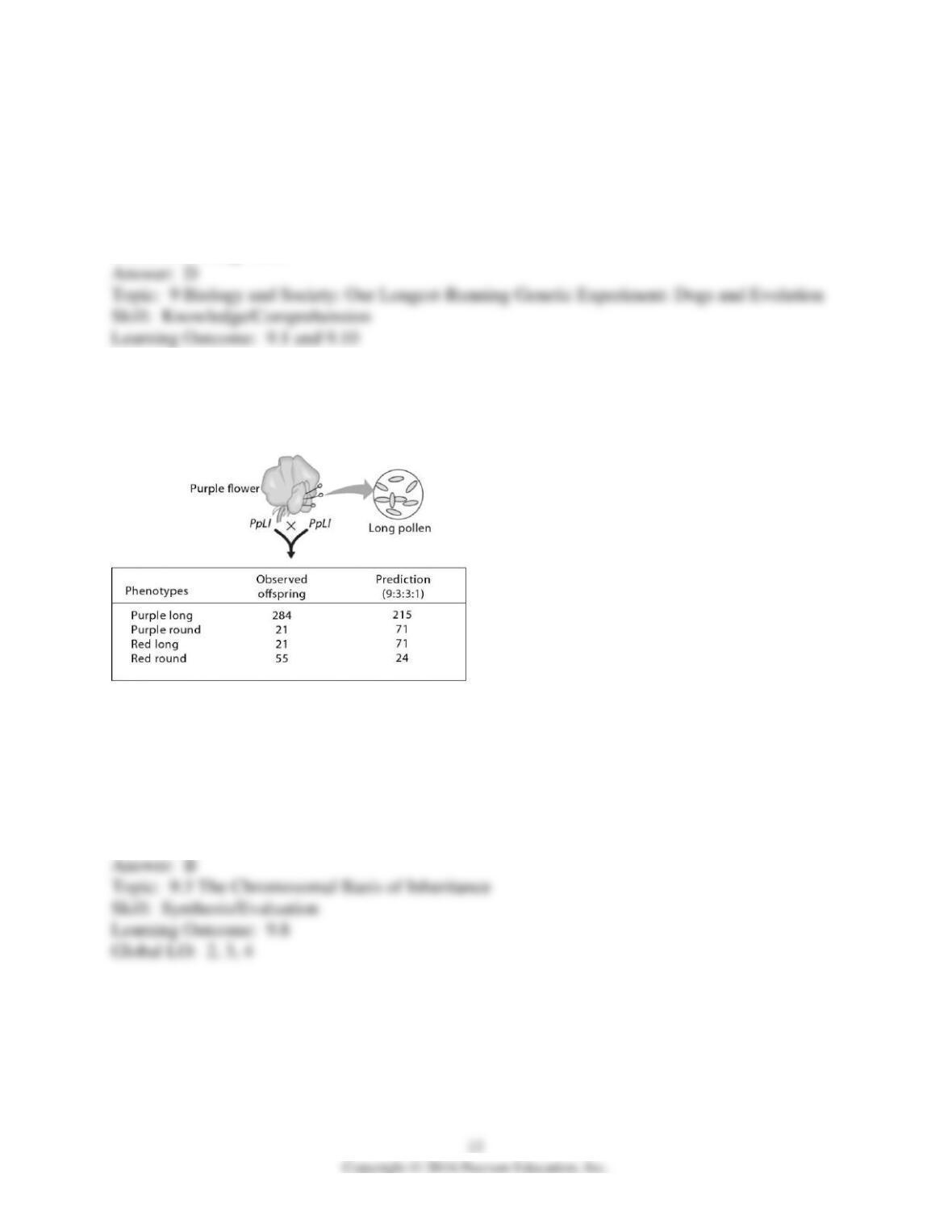
1) In the accompanying art, you see a table with the actual number of offspring that resulted from
a dihybrid cross. The numbers do not show the 9:3:3:1 ratio predicted. One phenotype occurred
more than predicted; another occurred less. The reason could be because ________.
A) of errors in mitosis
B) some of the alleles were linked
C) some of the alleles were sex-linked
D) of polygenic inheritance
2) Recombinant offspring were produced by the mating shown in the accompanying art. What is
the recombination frequency of purple round and red long offspring?
A) 21%
B) 381
C) 21 + 21
D) 11%
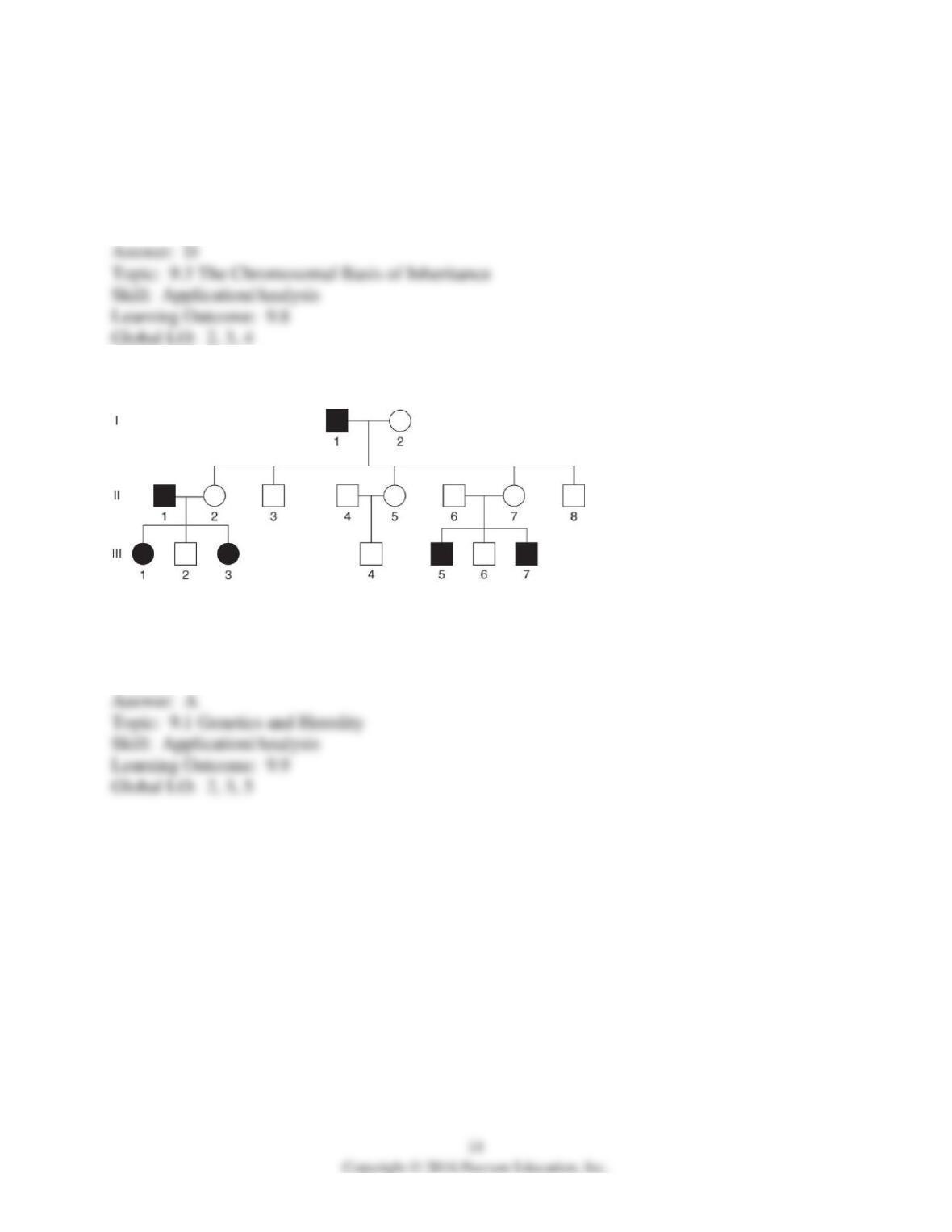
3) This hypothetical pedigree for a disease in humans illustrated inheritance that is
A) autosomal recessive.
B) autosomal dominant.
C) sex-linked dominant.
D) carried on the Y chromosome.
9.3 Scenario Questions
Please read the following scenario to answer the following questions.
Widow’s peak, a pointed hairline on the forehead, is a genetic trait caused by a dominant allele. It
can be traced back through a family’s history using pedigree analysis.
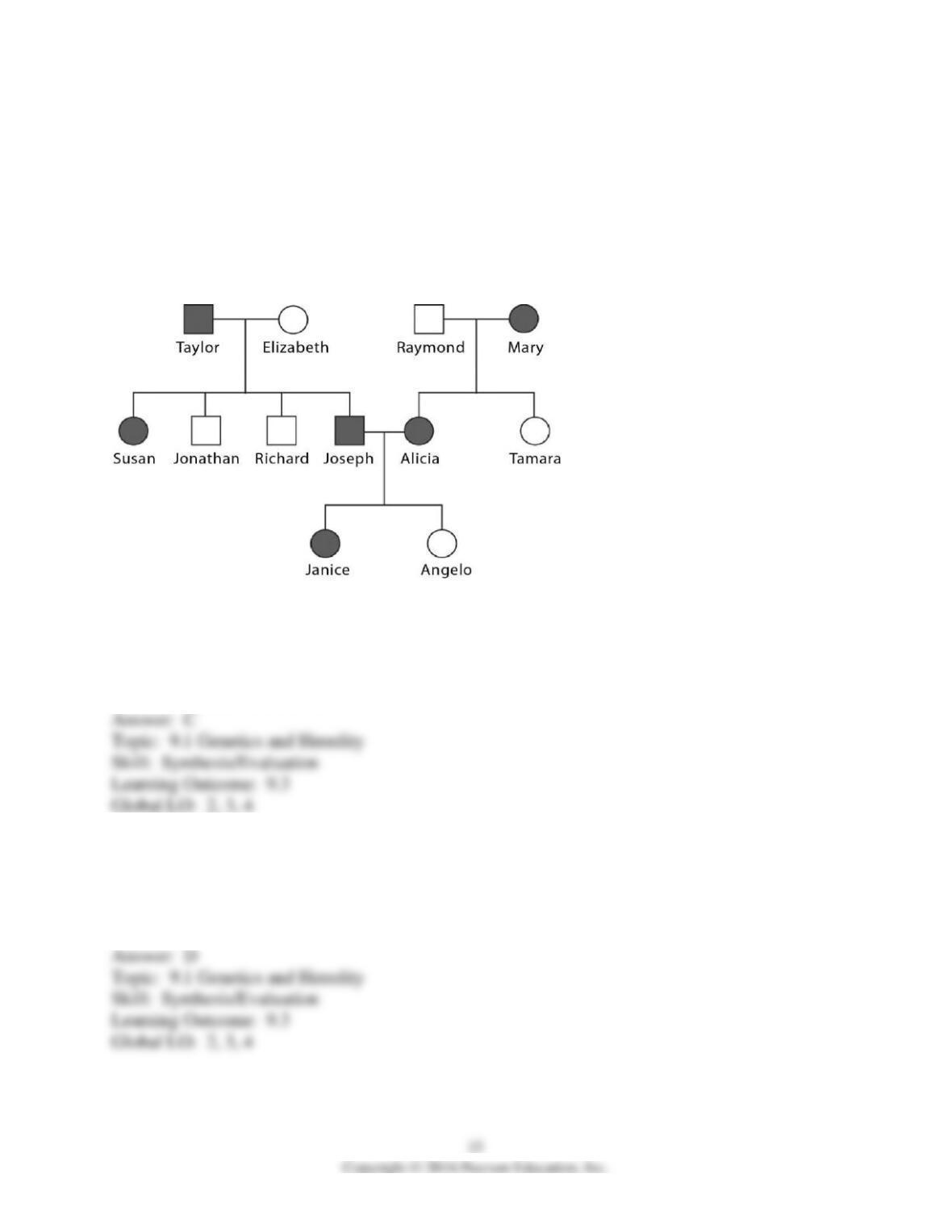
The pedigree shown here is of three generations of a family. Notice that some individuals (shown
in gray) have a widow’s peak (W = dominant allele and w = recessive allele).
1) Mary has the genotype ________.
A) WW
B) ww
C) Ww
D) More information is needed.
2) Janice’s genotype is ________.
A) Ww
B) WW
C) ww
D) WW or Ww
3) This pedigree supports the fact that widow’s peak is due to a dominant allele, because if it
were due to a recessive allele and both parents show the recessive phenotype, then ________.
A) half of the sons would have a widow’s peak
B) all of the offspring would have a widow’s peak
C) none of the daughters would have a widow’s peak
D) all of the daughters and none of the sons would have a widow’s peak
Please read the following scenario to answer the following question.
The parents of a child with unusual disease symptoms take the child to a doctor for help. The
doctor suspects that the condition might have a genetic basis. She recommends that the child be
taken to a specialty clinic where physicians and staff members are trained to diagnose genetic
diseases and counsel parents. Ultimately, the child is diagnosed with a rare recessively inherited
disease. The parents are tested for the gene, and both are found to be heterozygous. The parents
want to have another child but are afraid this child will also be affected.
4) What would genetic counselors say is the probability that the second child will have the
disease?
A) 1/2
B) 1/4
C) 1/8
D) 1/16