
Campbell Essential Biology, 6e (Simon/Dickey/Hogan/Reece)
Chapter 8 Cellular Reproduction: Cells from Cells
Chapter 8 Learning Outcomes
8 Biology and Society: Virgin Birth of a Dragon
8.1. Define parthenogenesis and explain how it occurs in the Komodo dragon.
8.1 What Cell Reproduction Accomplishes
8.2. Compare the functions, cellular processes, and cellular products of asexual and sexual
reproduction.
8.2 The Cell Cycle and Mitosis
8.3. Describe the basic structure of a chromosome including how it is packaged into an
elaborate, multilevel system of coiling and folding.
8.4. Describe key events of each phase of the cell cycle including when chromosomes are
duplicated.
8.5. Describe key events of each phase of mitosis, explaining how cytokinesis differs in
animal and plant cells.
8.6. Predict consequences of errors in the cell cycle control system including how such errors
cause cancer cells to be different from healthy cells, how benign and malignant tumors
differ, and what is meant by the “slash, burn, and poison” approach to cancer treatment.
8.7. Explain how you can reduce your risks of developing cancer or increase your chances of
surviving it.
8.3 Meiosis, the Basis of Sexual Reproduction
8.8. Distinguish between the following pairs of terms including structure and function of
each: sex chromosomes versus autosomes, somatic cells versus gametes, and diploid
versus haploid cells.
8.9. Compare the processes and products of meiosis I, meiosis II, and mitosis, explaining how
the independent assortment of chromosomes during meiosis, random fertilization, and
crossing over contribute to genetic diversity in offspring.
8.10. Describe the consequences of nondisjunction in autosomes and sex chromosomes.
8 The Process of Science: Do All animals Have Sex?
8.11. Describe evidence that might be used to determine whether a species has historically
reproduced sexually or asexually.
8 Evolution Connection: The Advantages of Sex
8.12. Explain why asexual and sexual reproduction are adaptive.
Global Learning Outcomes
1. Demonstrate an understanding of the principles of scientific inquiry.
2. Demonstrate the ability to think critically and employ critical-thinking skills.
3. Read and interpret models, graphs, and data.
4. Demonstrate the quantitative skills needed to succeed in biology.
5. Demonstrate an understanding of the impact of science on society.
6. Evaluate the credibility of scientific information from various sources.
7. Demonstrate the ability to make connections between concepts across biology.
8. Communicate effectively in writing.
9. Apply the scientific method to interpret information and draw conclusions.

8.1 Multiple Choice Questions
1) A(n) ________ is an example of an organism that can sometimes reproduce asexually by
parthenogenesis.
A) cat
B) human
C) Komodo dragon
D) mouse
2) Ordinary cell division produces two daughter cells that are genetically identical. This type of
cell division is important for all of the following functions EXCEPT ________.
A) growth of a multicellular organism
B) cell replacement
C) production of sperm and eggs
D) asexual reproduction
3) The chromosomes of eukaryotic cells are found in the ________.
A) nucleus
B) centriole
C) Golgi apparatus
D) nucleolus
4) Chromatin consists of ________.
A) DNA and protein
B) RNA and protein
C) protein only
D) DNA only
5) A duplicated chromosome consists of two ________.
A) centromeres
B) centrosomes
C) genomes
D) sister chromatids
6) Sister chromatids are joined at the ________.
A) centromere
B) spindle
C) centrosome
D) centriole
7) Which of the following occurs during interphase?
A) Chromatin becomes tightly coiled.
B) Chromosome duplication occurs.
C) Sister chromatids separate.
D) The mitotic spindle forms.
8) The mitotic cell cycle results in the production of ________.
A) four cells, each with the same amount of genetic material and the same genetic information
B) two cells, each with the same amount of genetic material but with different genetic
information
C) two cells, each with the same amount of genetic material and the same genetic information
D) four cells, each with the same amount of genetic material but with different genetic
information
9) Which of the following occurs during prophase?
A) Chromosomes line up on the midline of the cell.
B) The nuclear envelope forms.
C) Sister chromatids separate.
D) The mitotic spindle begins to form.
10) Which of the following is a stage of mitosis?
A) cytokinesis
B) telophase
C) interphase
D) DNA synthesis
11) The CORRECT sequence of stages of mitosis is ________.
A) prophase, metaphase, anaphase, telophase
B) telophase, prophase, anaphase, metaphase
C) anaphase, interphase, prophase, metaphase, telophase
D) interphase, prophase, metaphase, anaphase, telophase
12) During metaphase, ________.
A) the nuclear envelope breaks up
B) sister chromatids separate
C) centromeres divide
D) chromosomes line up in the middle of the cell
13) Which of these events occurs during anaphase?
A) Sister chromatids become separate chromosomes.
B) Chromosomes line up in the middle of the cell.
C) The nuclear envelope reappears.
D) The nuclear envelope breaks up.
14) During telophase, ________.
A) the events of prophase are reversed
B) chromosomes line up in the middle of the cell
C) sister chromatids become separate chromosomes
D) the nuclear envelope breaks up
15) A cell that completed the cell cycle without undergoing cytokinesis would ________.
A) have less genetic material than it started with
B) not have completed anaphase
C) have its chromosomes lined up in the middle of the cell
D) have two nuclei
16) Cytokinesis typically begins during the ________ stage of mitosis.
A) telophase
B) prophase
C) metaphase
D) anaphase
17) What is the difference between a benign and a malignant tumor?
A) Benign tumors are composed of cancer cells; malignant tumors are not.
B) Benign tumors are not the result of a failure of a cell cycle control system; malignant tumors
are.
C) Benign tumors do not metastasize; malignant tumors do.
D) Benign tumors do not form lumps; malignant tumors do form lumps.
18) Which of the following will help prevent cancer and increase survival?
A) Eat a low-fiber, low-fat diet.
B) Limit exercise.
C) Seek early detection of tumors.
D) Smoke only cigarettes.
19) Homologous chromosomes ________.
A) carry genes controlling the same inherited characteristics
B) include only the autosomes
C) are a set of chromosomes that the cell received from one parent
D) carry the same versions of all genes
20) What chromosomes belong to a normal human male?
A) 22 autosomes and two Y chromosomes
B) 44 autosomes and two Y chromosomes
C) 44 autosomes, one X chromosome, and one Y chromosome
D) 46 autosomes, one X chromosome, and one Y chromosome
21) What chromosomes belong to a normal human female?
A) 22 autosomes and 2 X chromosomes
B) 44 autosomes and 2 X chromosomes
C) 44 autosomes, one X chromosome, and one Y chromosome
D) 46 autosomes and two X chromosomes
22) Chromosomes that do NOT determine the sex of an individual are called ________.
A) homologous chromosomes
B) nonhomologous chromosomes
C) sex chromosomes
D) autosomes
23) Sexual reproduction in humans ________.
A) allows a haploid sperm cell to fertilize a haploid egg cell
B) produces a haploid individual
C) produces an individual with 23 chromosomes
D) combines two diploid gametes, producing a zygote
24) In meiosis, how does prophase I differ from prophase II?
A) During prophase I there is one diploid cell; during prophase II there are two haploid cells.
B) During prophase I chromosomes line up single file in the middle of the cell; during prophase
II the chromosomes line up in double file in the middle of the cell.
C) During prophase I the chromosomes coil up; the chromosomes are not coiled up during
prophase II.
D) In prophase I the sister chromatids are attached; in prophase II the sister chromatids are
separated.
25) How much genetic material is present in a cell during prophase I compared to a cell that has
completed meiosis II?
A) one-quarter as much
B) four times as much
C) one-half as much
D) twice as much
26) During metaphase I, ________.
A) crossing over occurs
B) homologous chromosomes line up in the middle of the cell
C) the nuclear envelope breaks up
D) sister chromatids separate and migrate to opposite poles
27) Upon completion of telophase I and cytokinesis, there is(are) ________ cell(s).
A) four haploid
B) two diploid
C) two haploid
D) one diploid
28) Which of the following is a characteristic seen in prophase I that does NOT occur in
prophase II?
A) Chromosomes move to the middle of the cell.
B) Spindle formation occurs.
C) The number of chromosomes doubles.
D) Crossing over occurs.
29) Anaphase II is essentially the same as mitotic anaphase except that in anaphase II ________
and in mitotic anaphase ________.
A) the cells are diploid… the cells are haploid
B) chromosomes line up double file in the middle of the cell… chromosomes line up single file in
the middle of the cell
C) crossing over occurs… crossing over does not occur
D) the cells are haploid and sister chromatids separate… the cells have the same number of
chromosomes as the original cell and sister chromatids separate
30) One difference between mitosis and meiosis is ________.
A) mitosis produces cells genetically identical to the parent cell, but meiosis does not
B) mitosis produces more daughter cells for each division than meiosis
C) mitosis produces haploid cells, but meiosis produces diploid cells
D) mitosis requires only one parent cell, but meiosis requires two parent cells
31) Genetic variation is accomplished by all but one of the following. Choose the exception.
A) the events of meiosis I
B) crossing over
C) independent assortment
D) the events of meiosis II
32) Which of the following is the best description of the events of anaphase I?
A) Half of the chromosomes inherited from the mother go to one pole along with half of the
chromosomes inherited from the father.
B) Sister chromatids separate and the daughter chromosomes migrate to opposite poles.
C) Homologous chromosomes randomly separate and migrate to opposite poles.
D) All of the chromosomes inherited from the mother go to one pole of the cell, and all of the
chromosomes inherited from the father go to the other pole.
33) For a species with four pairs of chromosomes, ________ chromosome combinations are
possible.
A) 4
B) 8
C) 16
D) 20
34) Crossing over during prophase I results in ________.
A) nondisjunction
B) reciprocal translocation
C) duplication
D) genetic recombination
35) A karyotype (a chromosome display) would be unable to determine ________.
A) sex
B) Down syndrome
C) Turner syndrome
D) eye color
36) How many chromosomes can a gamete possess as a result of nondisjunction?
A) n + 1 or n – 1
B) 2n + 1 or 2n – 1
C) 2n – 1 only
D) 2n + 1 or n – 1
37) How many chromosomes does an individual with Turner syndrome have?
A) 2n + 1
B) n + 1
C) 2n − 1
D) n − 1
38) Sexual reproduction appears to be absent in bdelloid rotifers. Which of these, if found in this
group, would bring into question the idea that they reproduce ONLY asexually?
A) female rotifers with eggs
B) significant differences of two different alleles among different populations (one population
having mostly allele A and one having mostly a).
C) cells in which meiosis occurs
D) related groups (not bdelloid rotifers) which reproduce both sexually and asexually.
39) Which of these describes the type of reproduction that is most adaptive in a rapidly changing
environment with many different parasitic diseases present?
A) asexual reproduction because the currently successful genotypes can reproduce quickly
B) asexual reproduction, because asexual reproduction uses less energy, which leaves more for
each individual to adapt to the changing environment
C) sexual reproduction because the diversity of genotypes increases the likelihood that there is
one which can survive in a new environment
D) sexual reproduction because this type of reproduction allows the production of a greater
number of offspring thus providing more individuals to take advantage of any environmental
challenges presented
12
8.2 Art Questions
1) Examine the figure below. Nucleosomes are made of ________.
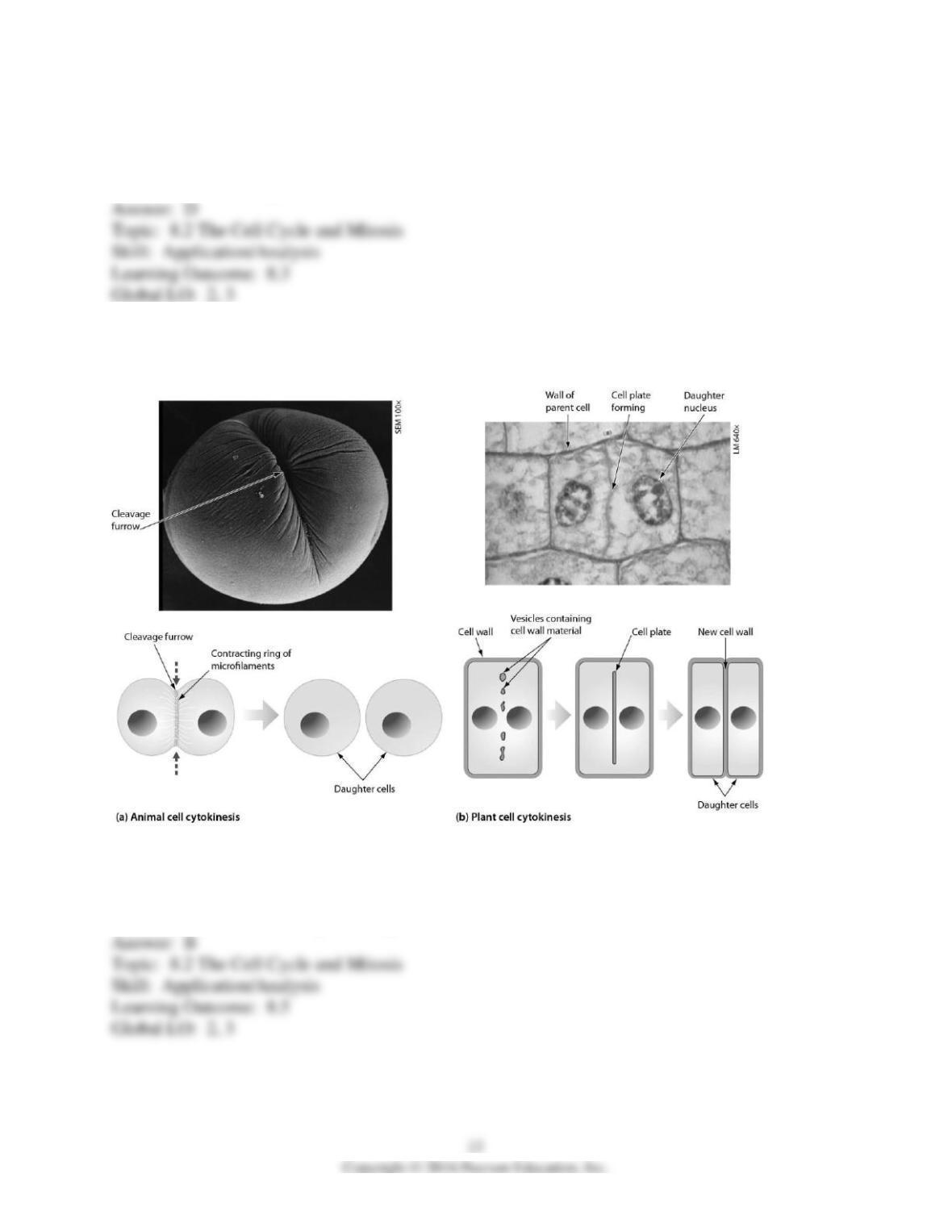
A) RNA and protein
B) DNA
C) proteins
D) DNA and histone proteins
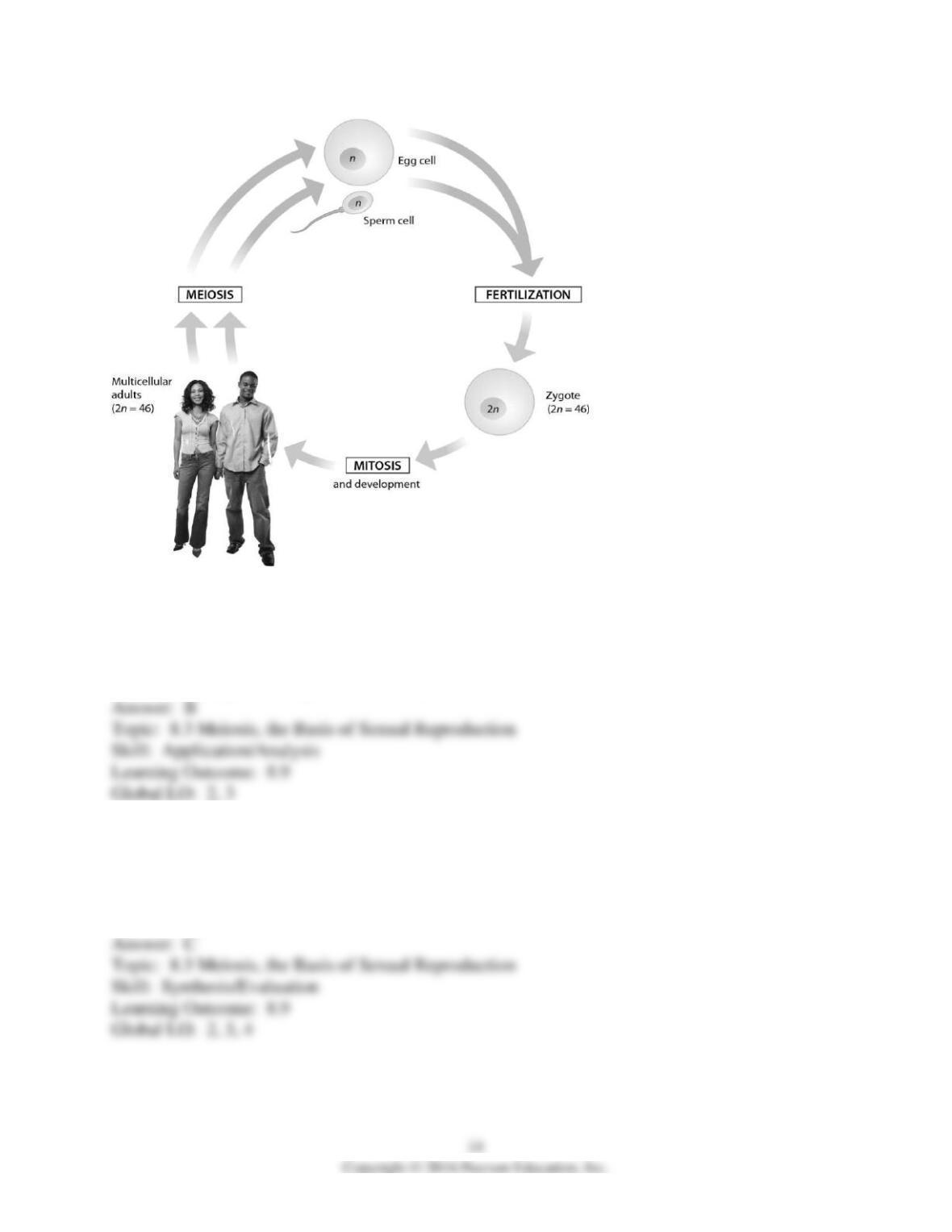
2) As shown in the following figure, plant cell cytokinesis differs from animal cell cytokinesis
because ________.
A) plant cells produce more daughter cells
B) plant cells form a cell plate and animal cells do not
C) animal cells produce more daughter cells
D) animal cells form a cell plate and plant cells do not
3) This diagram of the human life cycle shows that ________.
A) meiosis produces a diploid zygote
B) meiosis produces haploid sperm and egg cells
C) fertilization produces a haploid zygote
D) a diploid zygote undergoes meiosis to produce an adult human
4) What is the chromosome number found in humans cells after meiosis I is completed?
A) 46 autosomes
B) 43 autosomes and 2 sex chromosomes
C) 22 autosomes and a sex chromosome
D) 44 autosomes and 2 sex chromosomes
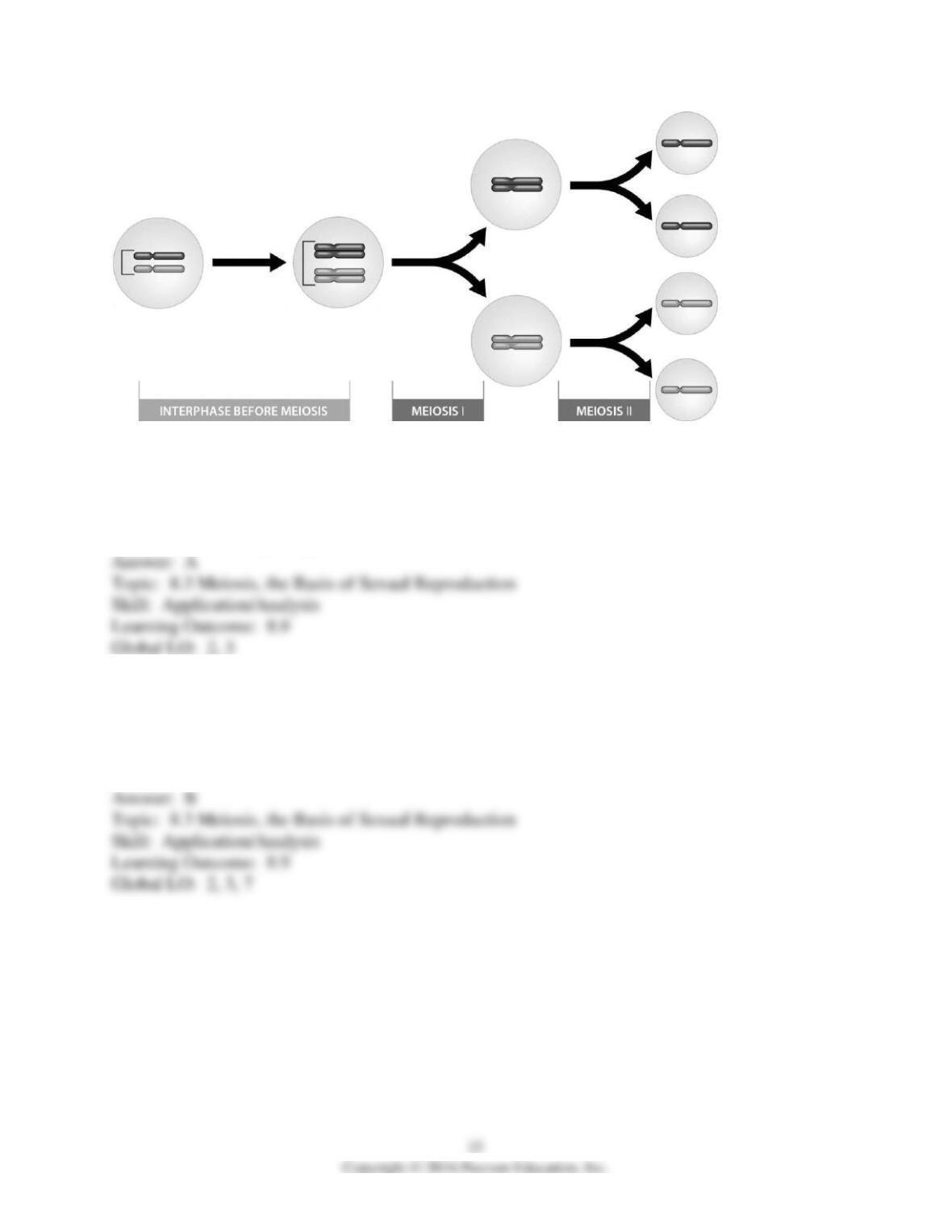
5) The above figure shows that ________.
A) meiosis results in the formation of four haploid daughter cells
B) fertilization results in four haploid daughter cells
C) the human 2n number is 4
D) meiosis forms diploid gametes
6) The 2n number for the cell depicted here is ________.
A) one
B) two
C) four
D) eight
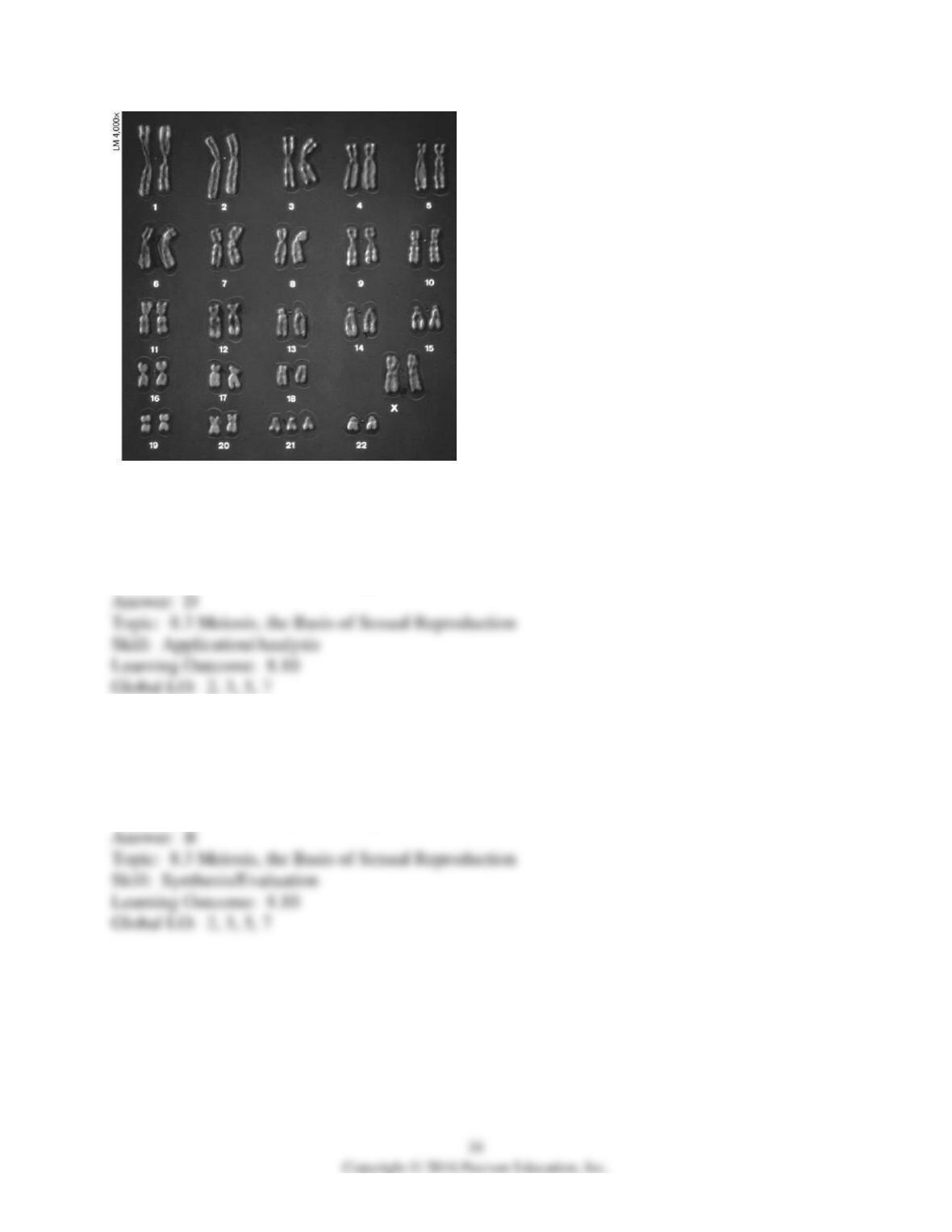
7) The karyotype above shows ________.
A) abnormal sex chromosomes
B) trisomy 21, a cause of Klinefelter syndrome
C) Turner syndrome
D) trisomy 21, a cause of Down syndrome
8) Which of these could lead to the mistake evident in the karyotype?
A) a failure of cytokinesis after meiosis I in gamete formation
B) a nondisjunction in meiosis II in gamete formation
C) crossing over in meiosis I in gamete formation
D) fertilization by two sperm in zygote formation
8.3 Scenario Questions
Please read the following paragraph and answer the following questions.
Amanda’s parents realized that her body was not developing properly about the time she was 12
years old. She was shorter than most of her friends and was not going through changes normally
associated with female puberty. They took her to a doctor who initially diagnosed Amanda with
Turner Syndrome because of her physical features. He ordered a karyotype that confirmed his
diagnosis. Amanda was born with only one X chromosome. Although there is no specific cure,
the doctor was able to treat her and correct some of the problems associated with the condition.
For example, she received growth hormone to improve her growth and estrogen to help her
develop the physical changes of puberty.
1) Amanda’s abnormal number of sex chromosomes resulted from ________.
A) independent assortment of chromosomes
B) crossing over
C) nondisjunction
D) random fertilization
2) With respect to her sex chromosomes, Amanda would be designated as ________.
A) XYY
B) XO
C) XOY
D) XX
3) What percentage of Amanda’s gametes would likely have the normal number of
chromosomes?
A) zero
B) 100 percent
C) 50 percent
D) 25 percent

4) If only some, but not all, of Amanda’s somatic (body) cells had only one X chromosome, this
could indicate that an error occurred ________.
A) during mitosis leading to the sperm or egg that came together to form Amanda
B) during meiosis in the first cell division of the original cell that was Amanda (the zygote)
C) during meiosis which occurred in Amanda’s ovaries
D) during mitosis which occurred at a multicellular stage of Amanda’s development