2) In the accompanying figure, the molecule that makes up the bulk of the mass of the plant
comes in mostly ________.
A) through the veins, which bring materials from the roots
B) through the transparent covering of the leaf into the photosynthetic cells
C) through the stomata
D) from the roots where they are stored during the night
3) Refer to the accompanying figure. Which of the following is TRUE regarding the behavior of
a chlorophyll molecule as it absorbs a photon?
A) An electron goes from the excited state to the ground state.
B) Light is released.
C) The energy of a photon raises an electron to the excited state.
D) ATP is broken down.
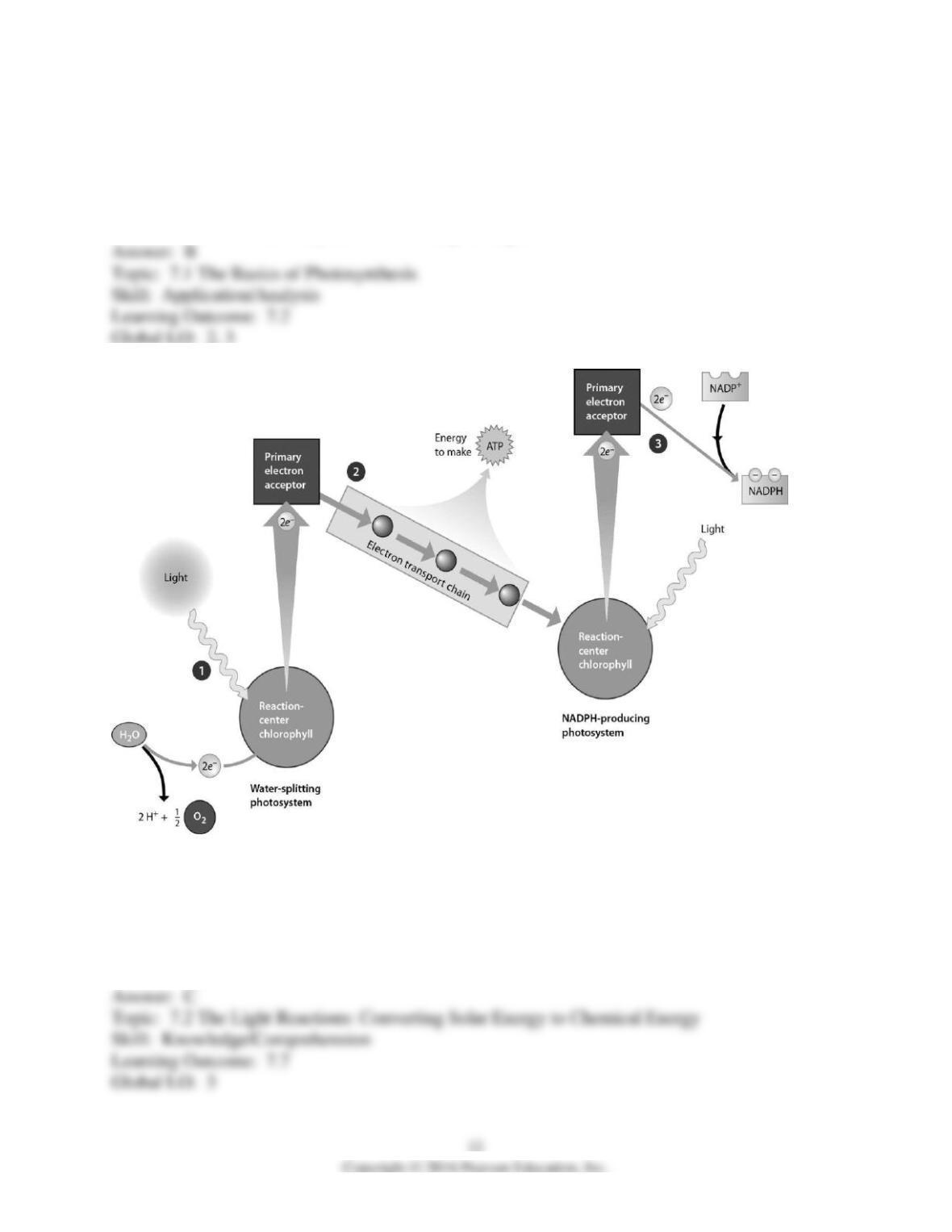
4) The light reactions are generally presented in zig-zag patterns, as shown in the accompanying
figure. What is the significance of the primary electron receptor shown at position 2 being
slightly higher than the primary electron receptor shown at position 3?
A) The electron that has been accepted gains energy as it leaves the primary electron receptor at
2 and heads to the primary electron receptor at position 3.
B) The primary electron receptor at 2 has slightly less energy than the primary electron receptor
at position 3.
C) The primary electron receptor at position 2 comes before the primary electron receptor at
position 3.
D) Since electrons have given off energy in the electron transport chain, they can be boosted
higher by the second photosystem.
Answer B
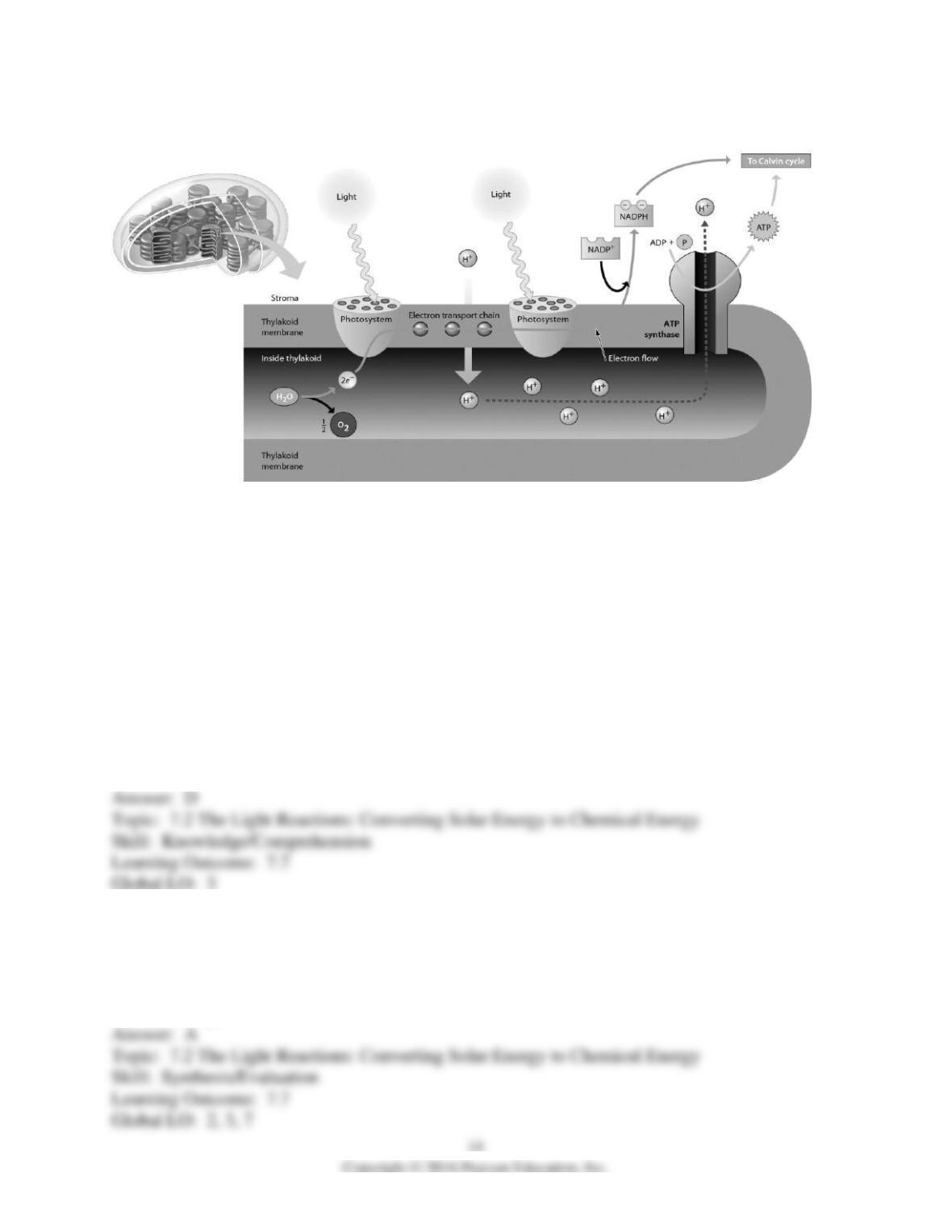
Please refer to the following art to answer the following questions.
5) Which of the following BEST describes the direct mechanism of ATP production during
photosynthesis?
A) use of the energy generated as hydrogen ions (H+) move up a proton gradient; this energy is
used to make ATP
B) use of the energy released as excited electrons are passed from one molecule to another in the
electron transport system; the energy is converted to the chemical bond energy of ATP
C) use of the energy stored in excited electrons; as the electrons move from the excited state to
the ground state, the energy released is converted to the energy stored in the third phosphate
bond in ATP
D) use of the energy stored in hydrogen ion (H+) gradients; the potential energy of the proton
gradient is released as the protons move down their gradient through special membrane protein
channels; this energy is converted to chemical bond energy in the ATP molecule
6) The energy in the proton gradient above is ________.
A) potential energy
B) sunlight light energy
C) sugar energy
D) heat energy
7) If the interior of the thylakoid were not a sealed compartment ________.
A) There would be no location for the electron transport chain
B) Light would not be able to reach the photosystems
C) Water could not be split
D) The proton gradient could not be maintained
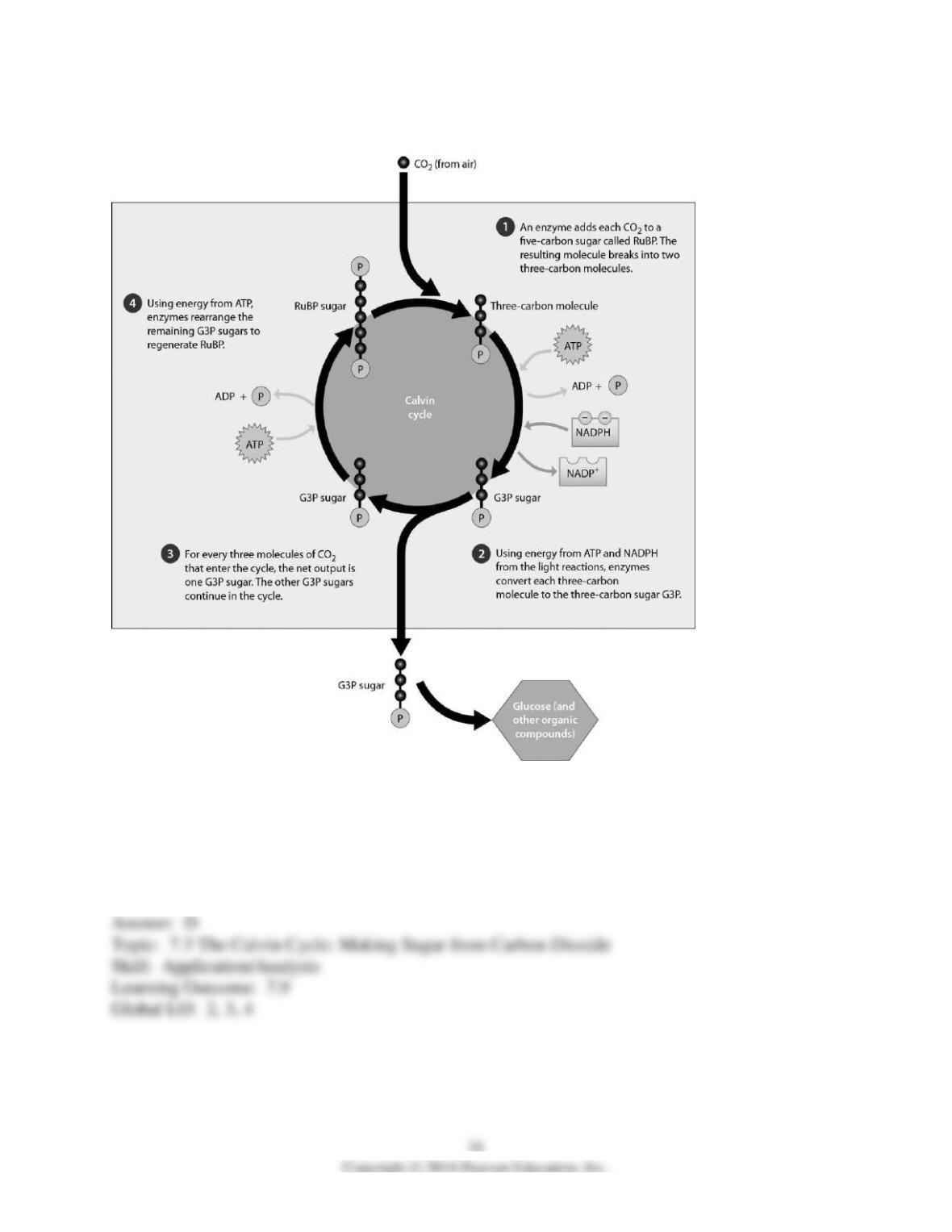
Please refer to the following art to answer the following questions.
8) How many times must the Calvin cycle turn for the plant cell to be able to produce one
molecule of glucose?
A) one
B) two
C) three
D) six
9) One of the compounds that is a direct output of the Calvin cycle is ________.
A) C6H12O6
B) NADPH
C) G3P
D) ATP
10) The first step of the Calvin cycle is the incorporation of ________ into ________.
A) O2… G3P
B) RuBP… O2
C) CO2… RuBP
D) G3P… RuBP
11) The last stage of one complete turn of the Calvin cycle involves ________.
A) G3P production
B) oxidation of CO2
C) regeneration of RuBP
D) sugar production
12) If an herbicide blocked the Calvin cycle before the generation of glyceraldehyde 3-phosphate
(G3P), which of the following statements would be TRUE?
A) The plant would still be able to make sugar, just a lot less.
B) No oxygen would be released by the plant.
C) No sugar would be made by the plant.
D) Only RuBP would be recycled.
13) The Calvin cycle is sometimes called the “dark reactions.” Could it take place if a plant were
grown in the dark continuously?
A) No, because plants cannot take in CO2 without sunlight.
B) No, because sunlight is needed to split water to provide NADH.
C) Yes, because taking in carbon dioxide, the only outside input to the Calvin cycle, does not
need sunlight.
D) Yes, because plants have stored materials in their roots which can provide what the Calvin
cycle needs.

7.3 Scenario Questions
Please use the following information to answer the following questions.
You work for a company selling tropical rain forest plants commonly found in the understory of
the forest. These plants are shade tolerant and can be grown indoors because they require low
light. Your employer wants you to find out what is the best type of light to maximize growth of
these understory plants. Using a full spectrum of natural light would cause these plants to die
because they are a shade-tolerant plant species.
From your biology class, you recall that the light-dependent reactions of photosynthesis involve
pigment molecules that absorb light of specific wavelengths. You also remember the
experiments done by the German biologist Theodor Engelmann, in which he separated light
using a prism into different wavelengths and then determined which wavelengths were best for
promoting photosynthesis in the algae species he was examining. Your goal is to determine
which wavelengths (colors) of light are best for promoting photosynthesis to enhance growth in
your species of plant. To achieve this, you grew your plants under different wavelengths of light
and measured their growth rates. The wavelengths were measured in nanometers (nm), and the
growth rate was measured in millimeters per day (mm/day). The data you collected are as
follows:
Wavelengths Growth
400 nm 0.33 mm/day
450 nm 0.46 mm/day
500 nm 0.88 mm/day
550 nm 0.12 mm/day
600 nm 0.54 mm/day
650 nm 0.28 mm/day
700 nm 0.08 mm/day
750 nm 0.00 mm/day
Make a bar graph plotting growth rates on the y-axis and wavelengths of light on the x-axis.
Referring to your graph, answer the following questions:
1) Which wavelength is best for your plants’ growth?
A) 650 nm
B) 550 nm
C) 500 nm
D) 400 nm
2) Of the following, which wavelength is LEAST useful to your plants?
A) 650 nm
B) 450 nm
C) 550 nm
D) 400 nm
3) Which wavelength of light is the LEAST useful to your plant’s growth?
A) 750 nm
B) 650 nm
C) 550 nm
D) 500 nm
4) Some plant species require shaded conditions while other plant species require bright sunlight.
Shade tolerance is best related to which of these characteristics?
A) Different species of plants have different ratios of pigment molecules that utilize different
wavelengths of light.
B) Plant leaves without a protective coating are subject to sunburn.
C) Some species of plants are able to produce sugar without ever having been exposed to
sunlight.
D) Some species of plants are consumers and do not need sunlight.
5) Shade-tolerant plants have many adaptations for living in areas of low light. Predict whether
each of the following processes would be high or low in comparison with other plants and
choose the answer that is most CORRECT.
Net photosynthetic rate
Chlorophyll per area of the leaf
Electron transport chain rate
A) high, high, high
B) high, high low
C) low, high, high
D) low, high, low
6) Shade-tolerant plants have many adaptations for living in areas of low light. Predict whether
each of the following processes would be high or low in comparison with other plants and
choose the answer that is most CORRECT.
Density of stomata on leaves
Leaf size
Carbohydrate storage
A) High, high, high
B) High, high, low
C) Low, high, high
D) Low, high, low