
1
Campbell Essential Biology, 6e (Simon/Dickey/Hogan/Reece)
Chapter 7 Photosynthesis: Using Light to Make Food
Chapter 7 Learning Outcomes
7 Biology and Society: A Greasy Crime Wave
7.1. Explain how biofuels are produced and used.
7.1 The Basics of Photosynthesis
7.2. Relate the structure of leaves and chloroplasts within them to the functions of bringing in
light, water, oxygen, and carbon dioxide and releasing carbon dioxide and oxygen.
7.3. Explain how the process of photosynthesis is complementary to cellular respiration.
7.4. Compare the reactants and products of the light reactions and the Calvin cycle.
7.2 The Light Reactions: Converting Solar Energy to Chemical Energy
7.5. Identify the wavelengths that are absorbed by and reflected from an object that appears
green and describe green in terms of its wavelength and its place on the electromagnetic
spectrum.
7.6. Describe the properties of chlorophyll a, chlorophyll b, and carotenoids including how
they assist in transferring the energy of photons within a photosystem driving reactions
that generate ATP and NADPH.
7.7. Describe the light reactions and compare the process of ATP production in the thylakoid
membrane of chloroplasts to that in the inner mitochondrial membrane.
7 The Process of Science: What Colors of Light Drive Photosynthesis?
7.8. Explain how Theodor Engelmann was able to determine that only certain wavelengths of
light are used in photosynthesis.
7.3 The Calvin Cycle: Making Sugar from Carbon Dioxide
7.9. Describe the reactants and products of the Calvin cycle, explaining where each reactant
comes from and where each product goes.
7 Evolution Connection: Creating a Better Biofuel Factory
7.10. Explain how directed evolution can help to produce algae that efficiently produce
biofuels.
Global Learning Outcomes
1. Demonstrate an understanding of the principles of scientific inquiry.
2. Demonstrate the ability to think critically and employ critical-thinking skills.
3. Read and interpret models, graphs, and data.
4. Demonstrate the quantitative skills needed to succeed in biology.
5. Demonstrate an understanding of the impact of science on society.
6. Evaluate the credibility of scientific information from various sources.
7. Demonstrate the ability to make connections between concepts across biology.
8. Communicate effectively in writing.
9. Apply the scientific method to interpret information and draw conclusions.

2
7.1 Multiple Choice Questions
1) Which of these is NOT considered an advantage of biofuels from food crops?
A) reduced carbon emissions
B) a renewable resource
C) increased fuel efficiency
D) increased crop prices
2) Which of the following is an autotroph?
A) human
B) mushroom
C) pine tree
D) fish
3) Photosynthesis contributes to plant growth by ________.
A) taking in oxygen and making wood
B) taking in carbon dioxide and making sugars (carbohydrates)
C) synthesizing carbon dioxide and making cellulose
D) converting sugar to oxygen and water
4) Within the inner membrane of a chloroplast, interconnected sacs of membrane called
________ are suspended in a thick fluid called the ________.
A) chlorophyll… thylakoid
B) thylakoids… grana
C) thylakoids… stroma
D) grana… thylakoid
5) What is the function of stomata?
A) water absorption

B) Calvin cycle
C) location of photosystems
D) gas exchange
6) Through what structure(s) do plants obtain most of their water?
A) roots
B) interior cells
C) stomata
D) leaves
7) What name is given to the membranous sacs found within a chloroplast?
A) stroma
B) mitochondria
C) thylakoids
D) vesicles
8) What are grana?
A) thick fluids inside chloroplasts
B) convolutions of the inner chloroplast membrane
C) stacks of membranous sacs
D) pigments found in chloroplasts

9) If you provided your shade-tolerant plants with their preferred wavelength of light, but only
minimal amounts of water, which of the following would you expect to occur?
A) increased plant growth
B) increased amounts of oxygen released by the plants
C) decreased amounts of ATP being produced by the plants
D) increased growth of the plants’ leaves
10) Which of the following equations best summarizes photosynthesis?
A) 6 CO2 + 6 H2O + 6 O2 → C6H12O6
B) 6 CO2 + 6 H2O → C6H12O6 + 6 O2
C) 6 CO2 + 6 O2 → C6H12O6 + 6 H2O
D) C6H12O6 + 6 O2 → 6 CO2 + 6 H2O
11) In photosynthesis, redox reactions ultimately transfer electrons from ________ to ________.
A) O2… CO2
B) C6H12O6… O2
C) H2O… C6H12O6
D) H2O… CO2
12) Which of the following is produced during the light reactions of photosynthesis?
A) O2
B) CO2
C) C6H12O6
D) ADP
13) The Calvin cycle requires ________ and ________ from the light reactions in order to
operate.
A) glucose… carbon dioxide
B) electrons… NADH
C) ATP… NADPH
D) RuBP… NADP+
14) The products of the light reactions of photosynthesis are ________.
A) ATP and NADH
B) ATP and NADPH
C) RuBP and O2
D) ATP and NADP+
15) The color that we see when looking at a pigmented object is ________.
A) the wavelengths that are absorbed by the pigmented object
B) the wavelengths that are reflected or transmitted by the pigmented object
C) the wavelengths that have been raised to an excited state by the pigmented object
D) the wavelengths that the pigmented object created after interacting with sunlight
16) If a plant appears blue to us, what wavelength of light is being reflected?
A) blue
B) green
C) red
D) yellow
17) The energy of wavelengths that appear ________ is LEAST useful to photosynthesis.
A) red
B) green
C) blue
D) orange
18) What is responsible for the yellow-orange coloration of leaves in the fall?
A) RuBP
B) chlorophyll a
C) carotenoids
D) chlorophyll b
19) What is one reason why plants have accessory pigment molecules, like chlorophyll b and
carotenoids?
A) to reflect more energy
B) to absorb energy in parts of the electromagnetic spectrum that chlorophyll a cannot
C) to give them different colors
D) because plants cannot make enough chlorophyll a for all of their energy needs
20) What name is given to a discrete packet of light?
A) phaser
B) wavelength
C) photon
D) quantum
21) The shorter the wavelength of visible light, the ________.
A) less energy absorbed by photosynthetic pigments
B) redder the color
C) more photons it contains
D) greater the energy
22) When a molecule absorbs a photon, one of its electrons is raised to the ________ state.
A) energetic
B) quantum
C) positive
D) excited
23) Which of the following is a way that a molecule releases energy gained by absorption of a
photon?
A) heat
B) fluorescence
C) light
D) all of the above
24) Where are photosystems located?
A) chlorophyll
B) thylakoid membrane
C) mitochondria
D) stroma
25) What compound is found at the reaction center of a photosystem?
A) chlorophyll b
B) carotenoids
C) phycobilins
D) chlorophyll a
26) The light reactions of photosynthesis take place ________.
A) in the stroma
B) in the mitochondria
C) in the thylakoid membrane
D) in the cytosol
27) ________ is the source of the oxygen gas released by a photosystem.
A) H2O
B) Chlorophyll a
C) CO2
D) C6H12O6
28) Which of the following is the source of electrons for the light reactions?
A) C6H12O6
B) CO2
C) NADPH
D) H2O
29) Which of the following is found in both cellular respiration and in the light reactions of
photosynthesis?
A) citric acid cycle
B) glycolysis
C) Calvin cycle
D) electron transport chain
30) In photosynthesis, an H+ ion gradient forms across the ________.
A) thylakoid membrane
B) outer chloroplast membrane
C) endomembrane
D) inner chloroplast membrane
31) The Calvin cycle makes direct use of ________ to make ________.
A) light energy and CO2… sugar
B) CO2, ATP, and NADPH… sugar and O2
C) light energy, CO2, and water… sugar and O2
D) CO2, ATP, and NADPH… sugar
32) C4 plants conserve water by ________.
A) shuttling CO2 from the Calvin cycle to the water-splitting photosystem
B) keeping their stomata closed when the weather is hot and dry
C) growing very deep roots
D) running the Calvin cycle at night

33) CAM plants conserve water by ________.
A) opening their stomata only at night
B) incorporating CO2 into RuBP
C) keeping their stomata closed at night
D) running the Calvin cycle at night
34) Scientists are working to create a better biofuel factory through which of the following
processes?
A) increasing the rate at which certain algae reproduce
B) developing strains of algae that can clean up oil spills
C) increasing the genetic diversity of groups of algae
D) restricting hydrocarbon production
7.2 Art Questions
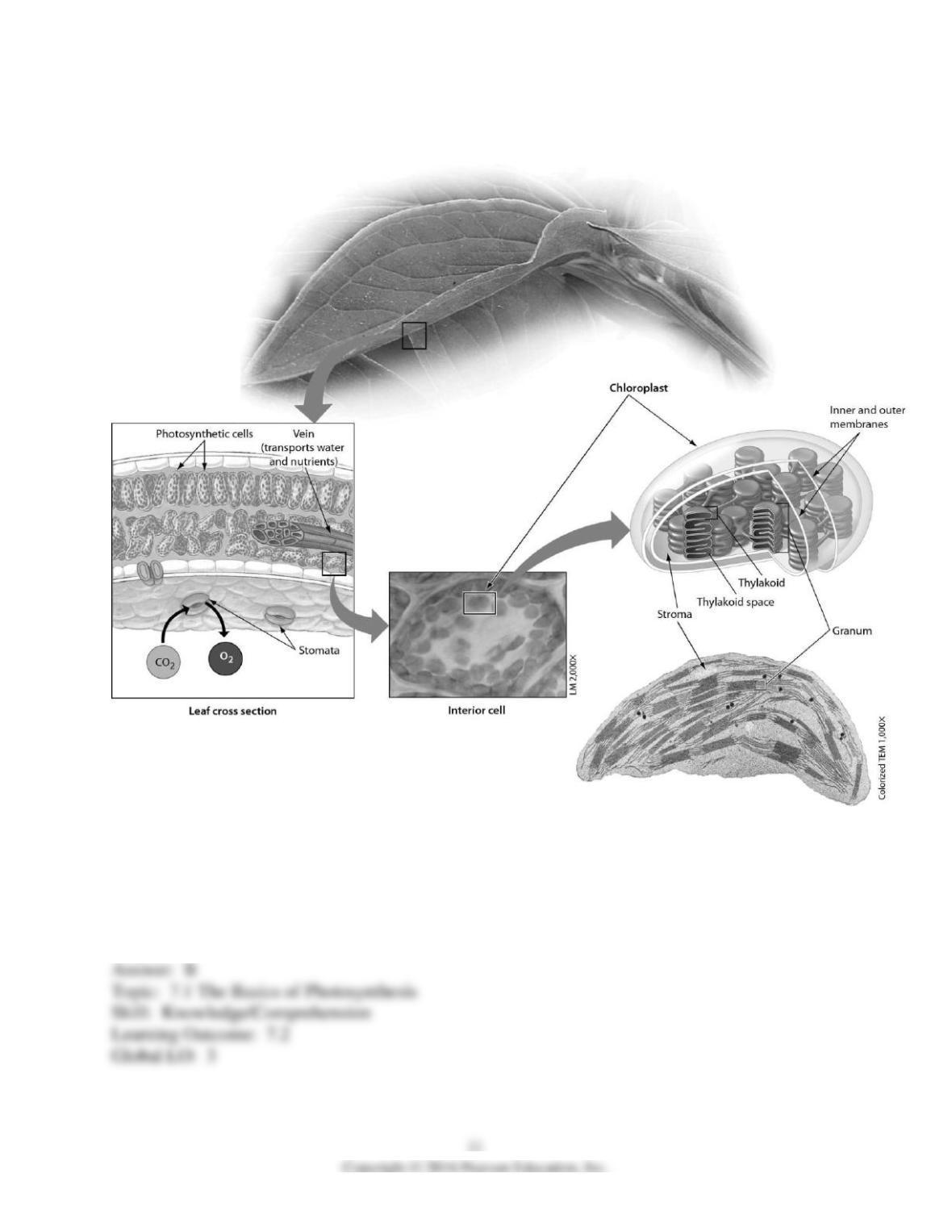
1) Refer to the accompanying figure. Plant cells that contain the organelle responsible for
photosynthesis are concentrated in cells of the ________.
A) roots
B) leaves
C) stomata
D) grana