
1
Campbell Essential Biology, 6e (Simon/Dickey/Hogan/Reece)
Chapter 5 The Working Cell
Chapter 5 Learning Outcomes
5 Biology and Society: Harnessing Cellular Structures
5.1. Explain how nanotechnology might be used to power microscopic robots.
5.1 Some Basic Energy Concepts
5.2. Define the terms energy, kinetic energy, potential energy, and the principle of
conservation of energy.
5.3. Explain the relationship between heat and entropy.
5.4. Compare the processes by which a car and a human use “fuel” to perform work.
5.5. Compare the amount of energy in a calorie, kilocalorie, and Calorie.
5.2 Energy Transformation: ATP and Cellular Work
5.6. Explain how ATP powers cellular work and how ATP is recycled.
5.3 Enzymes
5.7. Explain why enzymes are needed in living organisms and how they speed up specific
chemical reactions.
5.8. Explain how inhibitors and poisons can affect enzyme activity.
5.4. Membrane Function
5.9. Define and distinguish between the following pairs of terms: diffusion versus osmosis,
passive transport versus active transport, hypertonic versus hypotonic, and endocytosis
versus exocytosis.
5 Evolution Connection: The Origin of Membranes
5.10. Explain why phospholipids were probably some of the first organic compounds to form
as life emerged on Earth.
Global Learning Outcomes
1. Demonstrate an understanding of the principles of scientific inquiry.
2. Demonstrate the ability to think critically and employ critical-thinking skills.
3. Read and interpret models, graphs, and data.
4. Demonstrate the quantitative skills needed to succeed in biology.
5. Demonstrate an understanding of the impact of science on society.
6. Evaluate the credibility of scientific information from various sources.
7. Demonstrate the ability to make connections between concepts across biology.
8. Communicate effectively in writing.
9. Apply the scientific method to interpret information and draw conclusions.
2
5.1 Multiple Choice Questions
1) What molecules are scientists currently trying to use to power nanotechnology devices, such
as microscopic robots?
A) DNA
B) Enzymes
C) Lipids
D) Cell membranes
2) What is energy?
A) the capacity to cause movement
B) the capacity to cause change
C) a measure of calories
D) a measure of disorder
3) An object at rest has no ________ energy, but it may have ________ energy resulting from its
location or structure.
A) kinetic… potential
B) kinetic… conserved
C) potential… kinetic
D) stored… potential
4) The principle that energy cannot be created or destroyed is known as ________.
A) cellular respiration
B) conservation of energy
C) conservation of heat
D) entropy
5) A rock on the top of a mountain contains ________ energy.
A) potential
B) no
C) kinetic
D) conserved
6) You are riding on your bike and stop pedaling, coasting along the road. Eventually, your bike
slows down and stops. What happened to the energy of your motion when your bike stopped?
A) It was returned to the bicycle.
B) It was converted back to chemical energy.
C) It was released as heat.
D) It was used to chemically break down the tires.
7) Which of the following is a measure of randomness in a system?
A) entropy
B) kinetic energy
C) potential energy
D) chemical energy
8) Glucose molecules provide energy to power the swimming motion of sperm. In this example,
the sperm are changing ________.
A) chemical energy into kinetic energy
B) chemical energy into potential energy
C) kinetic energy into potential energy
D) kinetic energy into chemical energy
9) Humans convert approximately ________ of the energy stored in food to useful work.
A) 22%
B) 34%
C) 55%
D) 99.9%
10) Ten kilocalories are equivalent to ________ calories.
A) 1,000
B) 10,000
C) 0.1
D) 100
11) You have a 2-kg bottle of liquid water at 0°C. About how many Calories are needed to heat
up the water to 100°C?
A) 100 Calories
B) 200 Calories
C) 2,000 Calories
D) 10,000 Calories
12) What compound directly provides energy for cellular work?
A) sugar
B) ATP
C) DNA
D) fat
13) Energy is transferred from ATP to other molecules by transferring a(n) ________.
A) adenosine
B) heat unit
C) ADP
D) phosphate group
14) Anything that prevents ATP formation will most likely ________.
A) result in cell death
B) force the cell to rely on lipids for energy
C) force the cell to rely on ADP for energy
D) have no effect on the cell
15) Usually, enzymes are ________.
A) fats
B) steroids
C) chemical reactions
D) proteins
16) The sum total of all the chemical reactions that occur in organisms is called ________.
A) hydrolysis
B) cellular synthesis
C) conservation of energy
D) metabolism
17) Enzymes increase the rate of a reaction by ________.
A) increasing the temperature of the substrates
B) contributing electrons to the reaction
C) decreasing activation energy
D) changing the pH of the environment
18) Which one of the following is TRUE?
A) Enzymes are the products in a chemical reaction.
B) Enzymes are the reactants in a chemical reaction.
C) Enzymes catalyze specific reactions.
D) Enzymes’ functions require inhibitors.
19) An enzyme’s function is most dependent on its ________.
A) pH
B) temperature
C) shape
D) size
20) Which component of the following reaction is the enzyme?
sucrose + sucrase + water → sucrase + glucose + fructose
A) sucrose
B) sucrase
C) glucose
D) fructose
21) The region of an enzyme to which a substrate binds is called the ________ site.
A) active
B) substrate
C) enzymatic
D) inactive
22) Which component of the following reaction is the substrate?
sucrose + sucrase + water → sucrase + glucose + fructose
A) sucrose
B) sucrase
C) glucose
D) fructose
23) Which one of the following is TRUE?
A) An enzyme’s function depends on its three-dimensional shape.
B) Enzymes work generally on a broad range of substrates.
C) Enzymes are used up in chemical reactions.
D) Enzymes emerge changed from the reactions they catalyze.
24) Substances that plug up an enzyme’s active site are ________.
A) enzyme substrates
B) enzyme inhibitors
C) enzyme catalysts
D) enzyme products
25) Which one of the following is most similar to the mechanism of an enzyme inhibitor?
A) keeping someone from parking by parking in their designated spot
B) driving the wrong way on a one-way street
C) forgetting to put a cap back on a pen
D) changing the tires on a car
26) Diffusion is an example of ________.
A) phagocytosis
B) active transport
C) endocytosis
D) passive transport
27) Diffusion ________.
A) is the result of the potential energy of atoms
B) requires an input of cellular energy
C) occurs when particles spread from areas where they are less concentrated to areas where they
are more concentrated
D) proceeds until equilibrium is reached
28) Facilitated diffusion across a biological membrane requires ________ and moves a substance
________ its concentration gradient.
A) energy… down
B) transport proteins… down
C) energy and transport proteins… against
D) transport proteins… against
29) Osmosis can be defined as ________.
A) the diffusion of water across a selectively permeable membrane
B) the diffusion of nonpolar molecules across a selectively permeable membrane
C) active transport across a selectively permeable membrane
D) the diffusion of a solute across a selectively permeable membrane
30) A balloon permeable to water but not to glucose contains a 10% glucose solution. A beaker
contains a 5% glucose solution. Which of the following is TRUE?
A) The solution in the beaker is hypertonic relative to the solution in the balloon.
B) The solution in the balloon is isotonic; the solution in the beaker is hypertonic.
C) The solution in the balloon is hypotonic relative to the solution in the beaker.
D) The solution in the balloon is hypertonic relative to the solution in the beaker.
31) When two solutions that differ in solute concentration are placed on either side of a
selectively permeable membrane, and osmosis is allowed to take place, the water will ________.
A) exhibit a net movement to the side with lower water concentration
B) exhibit a net movement to the side with higher water concentration
C) exhibit a net movement to the side with lower solute concentration
D) exhibit an equal movement in both directions across the membrane
32) A cell that neither gains nor loses a net amount of water at equilibrium when it is immersed
in a solution is ________.
A) isotonic to its environment
B) hypertonic to its environment
C) hypotonic to its environment
D) metabolically inactive
33) Some protozoans have special organelles called contractile vacuoles that continually
eliminate excess water from the cell. The presence of these organelles tells you that the
environment ________.
A) is isotonic to the protozoan
B) is hypotonic to the protozoan
C) is hypertonic to the protozoan
D) contains a higher concentration of solutes than the protozoan
34) If placed in tap water, an animal cell will undergo lysis, whereas a plant cell will not. What
accounts for this difference?
A) expulsion of water by the plant cell’s central vacuole
B) the relative impermeability of the plant cell membrane to water
C) the relative impermeability of the plant cell wall to water
D) the relative inelasticity and strength of the plant cell wall
35) In a hypotonic solution, a plant cell will ________.
A) undergo plasmolysis
B) become flaccid
C) burst
D) become turgid
36) Which of the following processes could result in the net movement of a substance into a cell,
if the substance is more concentrated in the cell than in the surroundings?
A) active transport
B) facilitated diffusion
C) diffusion
D) osmosis
37) Active transport ________.
A) uses ATP as an energy source
B) can move solutes against their concentration gradient
C) can involve the transport of ions
D) all of the answer options
38) When a person cries, tears are exported from cells through the process of ________.
A) facilitated diffusion
B) active transport
C) endocytosis
D) exocytosis
39) Certain cells that line the stomach synthesize a digestive enzyme and secrete it into the
stomach. Which of the following processes could be responsible for its secretion?
A) endocytosis
B) exocytosis
C) phagocytosis
D) passive transport
40) The act of a white blood cell engulfing a bacterium is ________.
A) osmosis
B) diffusion
C) exocytosis
D) phagocytosis
41) A balloon permeable to water but not to glucose contains a 10% glucose solution. A beaker
contains a 5% glucose solution. What will happen when the balloon is submerged in the beaker?
A) The volume of water in the beaker will decrease.
B) The volume of water in the beaker will increase.
C) The amount of glucose in the beaker will increase.
D) The amount of glucose in the beaker will decrease.
42) On a lab bench, there are four balloons filled with identical volumes of different salt
solutions: 0% (balloon A), 5% (balloon B), 10% (balloon C), and 15% (balloon D). There are
also four beakers each filled with identical volumes of a 10% salt solution. The balloons are
semi-permeable; that is, only water can enter and exit the balloon. All four balloons are placed in
separate beakers at the same time and are allowed to come to equilibrium. Which is the correct
order of balloon volumes at equilibrium, from largest to smallest?
A) A < B < C < D
B) D < C < B < A
C) D < B < A < C
D) All balloons will be of equal volume at equilibrium.
43) Which of the following molecules spontaneously form membranes when mixed in water and
most likely were one of the first organic compounds formed on Earth?
A) DNA
B) Enzymes
C) Phospholipids
D) RNA
5.2 Art Questions
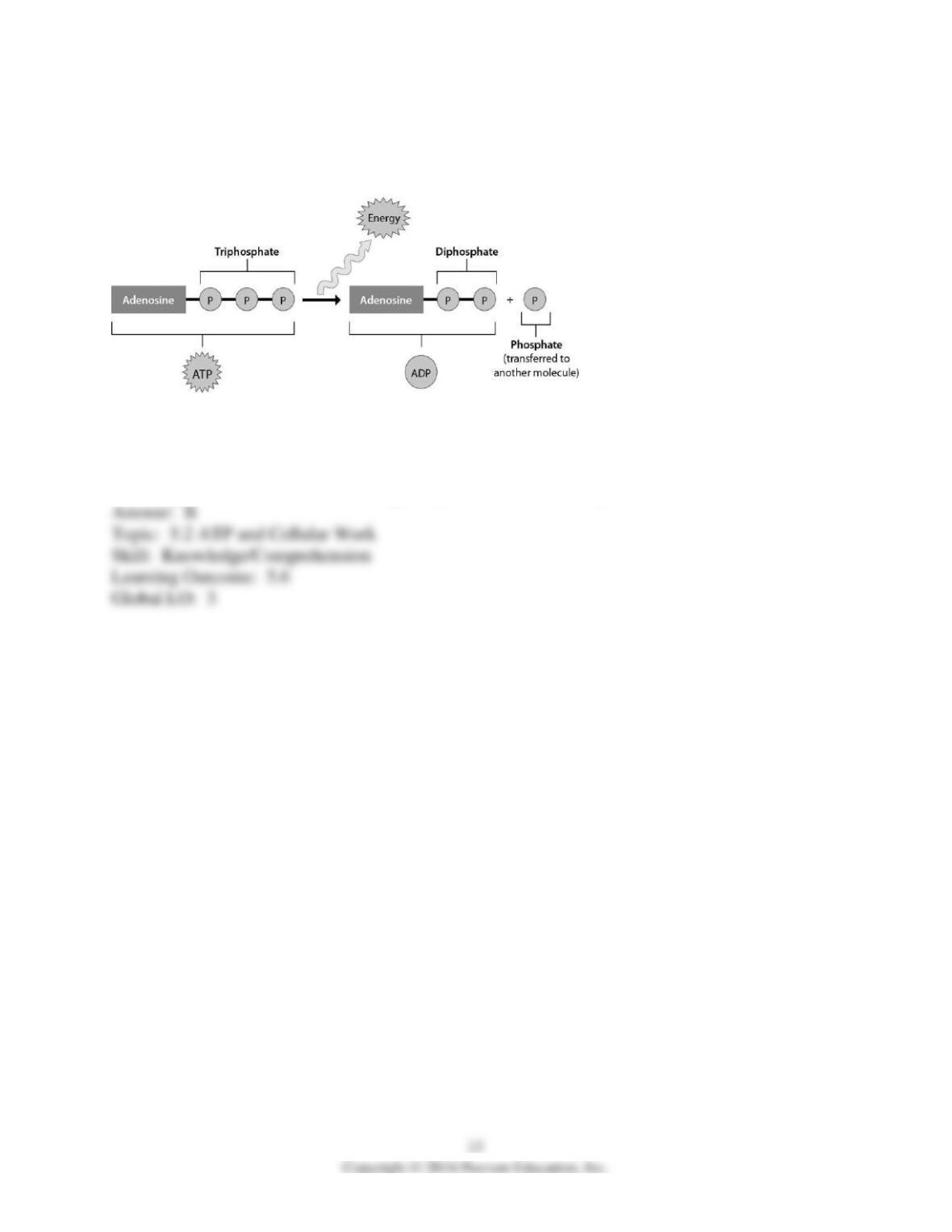
1) The figure below shows that ________.
A) ADP can perform cellular work when it binds to an additional phosphate group
B) ATP can perform cellular work when it releases a phosphate group
C) ATP can be converted to ADP by adding a phosphate group
D) energy is released from ATP during the process of cellular respiration
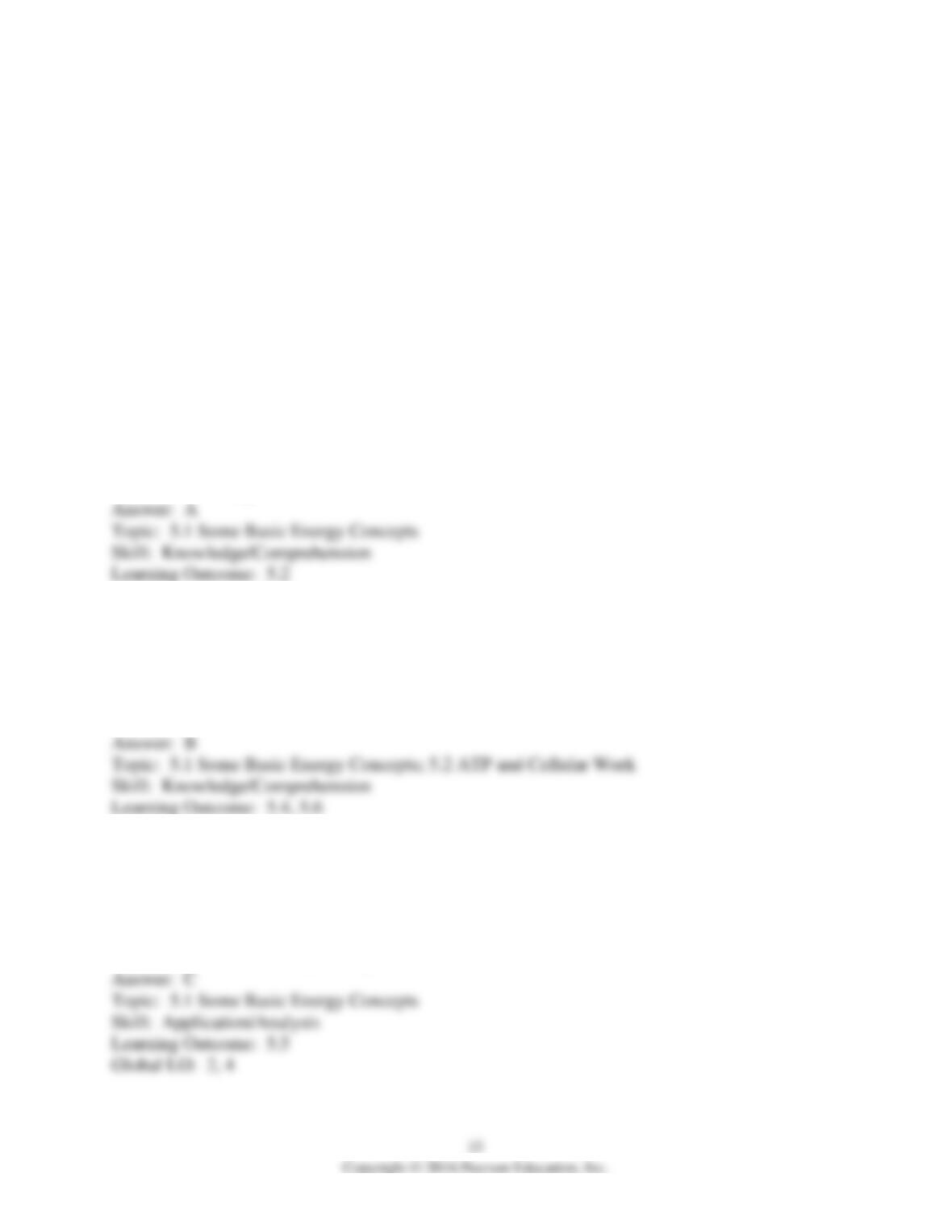
2) Examine the cells below. Cells with a higher concentration of ions than the surrounding
medium tend to ________.
A) stay about the same size and shape
B) expand
C) shrink
D) divide
5.3 Scenario Questions
Read the following scenario to answer the following question(s).
Cellular respiration converts the energy of fuel molecules to a form of energy that a cell can use
to perform work. In an average day, most adult humans need to consume about 2,000 Calories to
maintain their health. However, the exact amount of dietary Calories a person needs depends
upon many factors, including the person’s age, physical activity, size, and health. Foods that we
consume vary greatly in their nutritional content and quality. A large hard-boiled egg, for
example, has about 75 dietary Calories and contains about 70% of our recommended daily intake
of cholesterol.
1) Molecules that come from the food we eat provide energy for the amazing work that goes on
inside of our cells. This energy, stored inside of our food, is a form of ________.
A) potential energy called chemical energy
B) potential energy called entropy
C) kinetic energy called heat
D) electrical energy called heat
2) If a person eats one hard-boiled egg and digests the egg fully, cellular respiration will convert
most of this energy into ________.
A) ATP
B) heat
C) carbon dioxide
D) sugars
3) The amount of dietary Calories in one hard-boiled egg could raise the temperature of
________.
A) 75 grams of water by 1 degree Celsius
B) 750 grams of water by 1 degree Celsius
C) 1,000 grams of water by 75 degrees Celsius
D) 7,500 grams of water by 50 degrees Celsius
4) Running burns approximately 600 Calories per hour. If you ate four hard-boiled eggs, how
long would you have to run to burn them off?
A) 10 minutes
B) 30 minutes
C) 60 minutes
D) 120 minutes
Read the following scenario to answer the following question(s).
Biomedical scientists have recently developed an anticancer drug delivery system that sneaks the
anticancer drug into cancer cells before releasing it. They were able to do this by using two sets
of liposomes. An anticancer drug (Doxorubicin (Dox)) bound to DNA molecules was added into
one set of liposomes (type A), and a high concentration of ATP molecules were added to the
other set of liposomes (type B). The drug is inactive when bound to DNA molecules.
Researchers inject both types of liposomes (A and B) into cancer cells, and upon doing so their
contents are released. The ATP molecules (from liposome type A) bind to the DNA molecules
(from liposome type B) and activate the drug, thus inducing cell death and decreasing tumor size.
Mice with breast cancer tumors were treated with this liposome system to test the effectiveness
of the drug. The scientists performed three trials one with both types of liposomes (Dox + ATP),
one with just the drug (Dox only), and one with a salt solution (control). Examine the figure
below and answer the following questions.
5) What statement regarding this data is TRUE?
A) The weight of the tumors will not change if not treated with Dox or Dox + ATP.
B) Tumor weight decreases when you add Dox only to cancer cells.
C) Adding Dox only or Dox + ATP result in similar decreases in tumor weight.
D) Dox is entering the cancer cells via endocytosis to induce cell death.
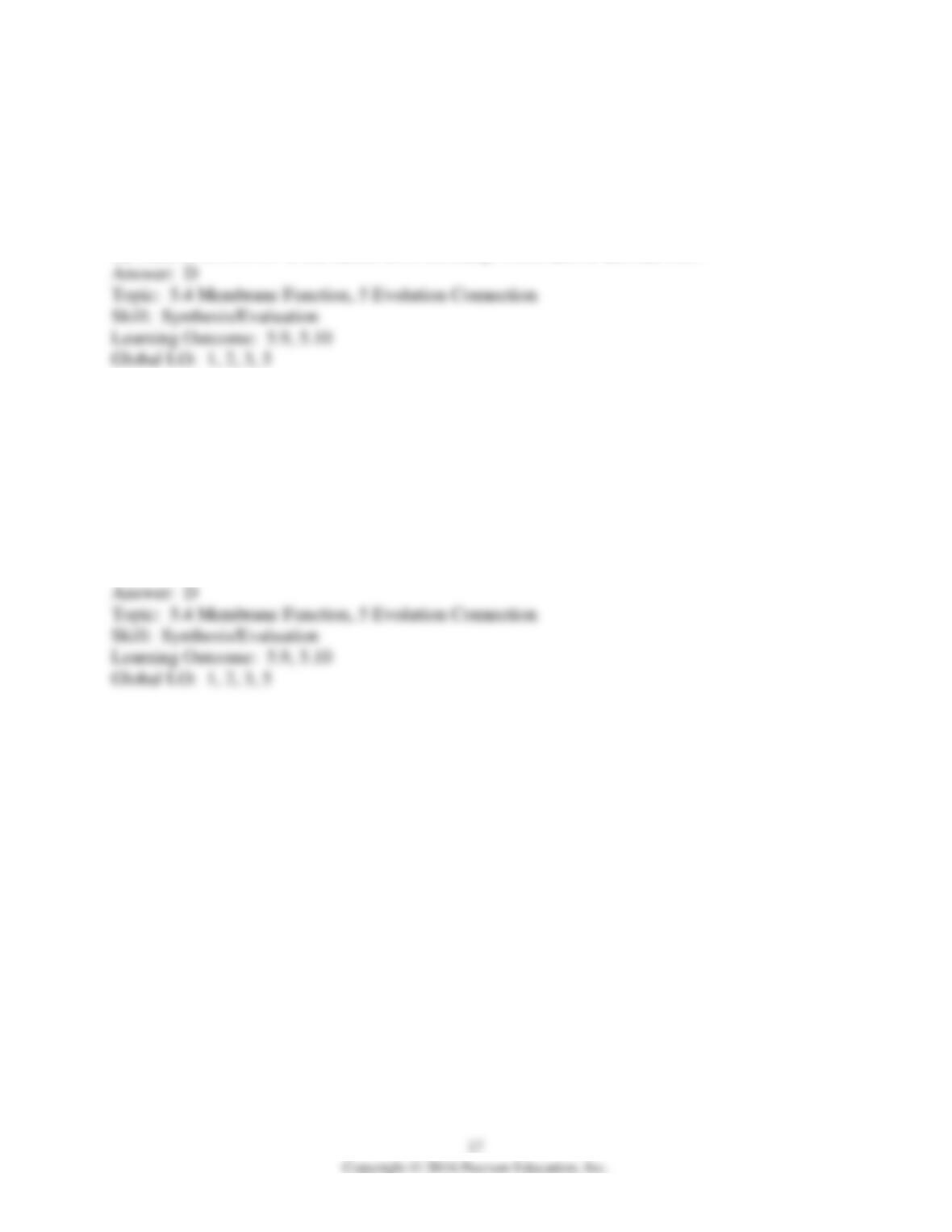
6) Why did tumor size decrease in the Dox only experiment to a lesser extent than the Dox +
ATP experiment?
A) ATP is actually the drug that is killing the cancer cells, not Dox.
B) Dox is always active in cancer cells, so it should be able to kill some cells without ATP.
C) When ATP is lacking, not as much Dox can enter the cell via facilitated diffusion.
D) There is some ATP in the cancer cells normally, which acts to activate Dox.
7) What would be the best experiment to test the effectiveness of this anticancer drug system?
A) Inject both sets of liposomes into a single healthy mouse and measure what happens to its
blood ATP levels.
B) Inject both sets of liposomes into a single mouse that has tumors and measure what happens
to the size of the tumors.
C) Inject both sets of liposomes into multiple healthy mice and measure what happens to their
blood ATP levels.
D) Inject both sets of liposomes into multiple mice that have tumors and measure what happens
to the size of the tumors.