
1
Campbell Essential Biology, 6e (Simon/Dickey/Hogan/Reece)
Chapter 4 A Tour of the Cell
Chapter 4 Learning Outcomes
4 Biology and Society: Antibiotics: Drugs that Target Bacterial Cells
4.1. Explain how antibiotics specifically target bacteria while minimally harming the human
host.
4.1 The Microscopic World of Cells
4.2. Compare the following pairs of terms, noting similarities and differences: 1) prokaryotic
cells versus eukaryotic cells and 2) plant cells versus animal cells.
4.2 Membrane Structure
4.3. Describe the structure of cell membranes, and explain why the plasma membrane is
called a “fluid mosaic.”
4.4. Compare the structures and functions of a plant cell wall with the extracellular matrix of
an animal cell.
4.3 The Nucleus and Ribosomes: Genetic Control of the Cell
4.5. Explain how the genetic information in the nucleus is used to direct the production of
proteins in the cytoplasm.
4.4 The Endomembrane System: Manufacturing and Distributing Cellular Products
4.6. Compare the structures and functions of the following components of the endomembrane
system: nuclear envelope, rough endoplasmic reticulum, smooth endoplasmic reticulum,
Golgi apparatus, lysosomes, and vacuoles.
4.5 Energy Transformation: Chloroplasts and Mitochondria
4.7. Compare the structure and function of chloroplasts and mitochondria, and explain what
structures in chloroplasts and mitochondria result in adaptive advantages.
4.8. Describe the evidence that suggests that mitochondria and chloroplasts evolved by
endosymbiosis.
4.6 The Cytoskeleton: Cell Shape and Movement
4.9. Describe the functions of the cytoskeleton and compare the structures and functions of
cilia and flagella.
4 Evolution Connection: The Evolution of Antibiotic Resistance in Humans
4.10. Explain how and why antibiotic-resistant bacteria have evolved.
Global Learning Outcomes
1. Demonstrate an understanding of the principles of scientific inquiry.
2. Demonstrate the ability to think critically and employ critical-thinking skills.
3. Read and interpret models, graphs, and data.
4. Demonstrate the quantitative skills needed to succeed in biology.
5. Demonstrate an understanding of the impact of science on society.
6. Evaluate the credibility of scientific information from various sources.
7. Demonstrate the ability to make connections between concepts across biology.
8. Communicate effectively in writing.
9. Apply the scientific method to interpret information and draw conclusions.
4.1 Multiple Choice Questions
1) Plants are susceptible to bacterial infections, which can damage their structure or even kill
them. Which of the following would be the best antibiotic to treat a plant that is infected with
bacteria?
A) a drug that interferes with mitochondria function
B) a drug that disrupts cell wall structure and function
C) a drug that destroys the central vacuole
D) a drug that blocks gene expression in circular chromosomes
2) Which theory states that all living things are composed of cells?
A) cell theory
B) Hooke’s rule
C) evolutionary theory
D) Mendel’s law
3) Which of the following is a feature of prokaryotic cells but NOT eukaryotic cells?
A) pili
B) cell wall
C) flagella
D) DNA
4) When using a microscope to view cells you obtained from scraping under your fingernails,
you notice that the cells lack nuclei; therefore, you conclude that the cells must be a type of
________ cell.
A) plant
B) eukaryotic
C) fungal
D) prokaryotic
5) One difference between eukaryotic and prokaryotic cells is that eukaryotic cells ________
prokaryotic cells.
A) have DNA, which is lacking in
B) have membrane-enclosed structures called organelles, which are lacking in
C) have a plasma membrane, which is lacking in
D) have a nucleoid region, which is lacking in
6) In eukaryotic cells, what name is given to the region between the nucleus and the plasma
membrane?
A) cytoplasm
B) phospholipid bilayer
C) nucleoid
D) chloroplast
7) You find a cell of a type you have never seen before. The cell has both a nucleus and a cell
wall. Therefore, you conclude that it is likely to be a(n) ________ cell.
A) prokaryotic
B) animal
C) bacterial
D) plant
8) Which of the following is a function of the plasma membrane?
A) regulate the traffic of chemicals in and out of the cell
B) regulate the production of lipids in the cell
C) regulate the production of DNA in and out of the nucleus
D) regulate the production of proteins in the cell
9) ________ are the major lipids of plasma membranes.
A) Steroids
B) Fatty acids
C) Starches
D) Phospholipids
10) When mixed with water, phospholipids spontaneously form membranes because they
________.
A) have hydrophilic phosphate groups that are attracted to water and hydrophobic fatty acid tails
that avoid water
B) have hydrophilic fatty acid tails that are attracted to water and hydrophobic phosphate groups
that avoid water
C) have hydrophilic heads that are attracted to their hydrophobic tails
D) are both fluid and mosaic
11) The concept of a membrane as a fluid mosaic reflects the ability of ________.
A) phospholipids and most proteins to drift about in the plane of the membrane
B) phospholipids but not proteins to drift about in the plane of the membrane
C) most proteins but not phospholipids to drift about in the plane of the membrane
D) carbohydrates to drift into and out of the membrane structure
12) The extracellular matrix of animal cells ________.
A) protects and support cells
B) provides avenues for the exchange of DNA
C) is a warehouse for the storage of extra lipids and carbohydrates
D) is primarily a site of dead matter and waste materials
13) ________ store the information necessary to produce proteins.
A) Lysosomes
B) Genes
C) Ribosomes
D) Carbohydrates
14) The nuclear envelope is composed of ________.
A) chromatin
B) DNA
C) a double membrane
D) carbohydrates
15) The structural combination of DNA and protein forms ________.
A) nucleoli
B) RNA
C) chromatin
D) ribosomes
16) Most human cells contain ________ chromosomes.
A) 36
B) 46
C) 2
D) 23
17) Which of the following structures manufactures the components of ribosomes?
A) nucleus
B) cytoplasm
C) endoplasmic reticulum
D) nucleolus
18) Some ribosomes are suspended in the cytosol of a cell, whereas other ribosomes ________.
A) make proteins inside the nucleus
B) are found on the plasma membrane
C) are attached to the smooth endoplasmic reticulum
D) are attached to the outside of the nucleus
19) Where does protein synthesis take place?
A) in the nucleolus
B) on smooth endoplasmic reticulum
C) on ribosomes
D) in the nucleus
20) Information is transferred from the nucleus to ribosomes via ________.
A) mRNA
B) rough endoplasmic reticulum
C) DNA
D) smooth endoplasmic reticulum
21) The endomembrane system includes ________.
A) ribosomes, lysosomes, vacuoles, and the endoplasmic reticulum
B) Golgi apparatus, nucleolus, vacuoles, and the endoplasmic reticulum
C) Golgi apparatus, lysosomes, ribosomes, and the endoplasmic reticulum
D) Golgi apparatus, lysosomes, vacuoles, and the endoplasmic reticulum
22) A hormone that will be secreted from a cell is manufactured by ribosomes ________.
A) attached to the endoplasmic reticulum
B) attached to the Golgi apparatus
C) attached to the plasma membrane
D) inside the nucleus
23) Based on its function in detoxifying drugs, you would expect to find a large amount of
smooth ER in ________ cells.
A) brain
B) liver
C) intestinal
D) muscle
24) Functions of the smooth endoplasmic reticulum include ________.
A) steroid synthesis, protein synthesis, and drug detoxification
B) lipid synthesis, protein synthesis, and drug detoxification
C) lipid synthesis, steroid synthesis, and drug detoxification
D) lipid synthesis, steroid synthesis, and storage of genetic information
25) What structures move proteins from the ER to the Golgi apparatus?
A) transport proteins
B) central vacuole
C) transport vesicles
D) nucleolus
26) Which of the following is a function of the Golgi apparatus?
A) digestion of organic matter inside the cell
B) protein modification
C) drug detoxification
D) cell respiration
27) Which of the following parts of a cell is (are) most like the shipping center of a company?
A) the Golgi apparatus
B) mitochondria
C) chloroplasts
D) the nucleolus
28) Lysosomes are responsible for ________.
A) lipid synthesis
B) cellular respiration
C) digestion of organic matter inside the cell
D) protein synthesis
29) If a cell’s lysosomes burst, the cell would ________.
A) shrivel
B) divide into two cells
C) digest itself
D) need to manufacture more lysosomes
30) Tay-Sachs disease results from ________ lacking a specific type of lipid-digesting enzyme.
A) the Golgi apparatus
B) lysosomes
C) mitochondria
D) the endoplasmic reticulum
31) Vacuoles are ________.
A) membranous sacs
B) manufactured by ribosomes
C) composed of microtubules
D) found only in plant cells
32) A protist that contains contractile vacuoles most likely lives ________.
A) in a marine environment
B) within the cells of another organism
C) in fresh water
D) in ice
33) In plant cells, ________ may contain organic nutrients, pigments, and poisons.
A) mitochondria
B) chloroplasts
C) lysosomes
D) central vacuoles
34) Plant cells, unlike animal cells, are characterized by the presence of a ________.
A) cell wall and a contractile vacuole
B) cell wall and a central vacuole
C) nucleus and a cell wall
D) nucleus and a contractile vacuole
35) Cells in the thyroid gland produce and secrete thyroid hormone (a polymer of amino acids)
that helps to regulate metabolism. What organelle is most likely abundant in cells of the thyroid
gland?
A) mitochondria
B) rough endoplasmic reticulum
C) free ribosomes
D) lysosomes
36) During a race such as a marathon, the skeletal muscle cells in your legs use a lot of energy to
continually contract and power your muscles. What organelle is most likely abundant in skeletal
muscle cells?
A) mitochondria
B) Golgi apparatus
C) smooth endoplasmic reticulum
D) rough endoplasmic reticulum
37) Similar to the nucleus, chloroplasts and mitochondria are ________.
A) surrounded by two membranes
B) able to synthesize carbohydrates
C) manufactured by the nucleolus
D) able to synthesize lipids
38) Which plant organelle is responsible for photosynthesis?
A) smooth endoplasmic reticulum
B) mitochondrion
C) ribosome
D) chloroplast
39) Cellular respiration can be described as the conversion of the energy ________.
A) of sunlight to energy stored in organic compounds
B) stored in food molecules to energy stored in ATP
C) stored in ATP to energy stored in food molecules
D) stored in ATP to energy used to do work
40) Which of the following is an adaptation to increase the surface area of a part of a cell that is
involved in cellular respiration?
A) the cristae of a mitochondrion
B) the outer membrane of a chloroplast
C) the grana of a chloroplast
D) the endoplasmic reticulum
41) Microtubules are associated with ________.
A) cilia
B) flagella
C) cell shape
D) all of the answer choices
42) Tobacco smokers (and those exposed to tobacco smoke) are at greater risk of an ectopic
(tubal) pregnancy. Based on your understanding of the structures of the cytoskeleton, what is the
BEST explanation?
A) Tobacco interferes with the microtubule network of eggs thus weakening their structure.
B) Tobacco interferes with the functioning of the flagella propelling sperm.
C) Tobacco interferes with microfilament formation in sperm, thereby forcing the zygote to
implant in a fallopian tube.
D) Tobacco interferes with the sweeping motion of cilia that aids in the movement of the egg
toward the uterus.
4.2 Art Questions
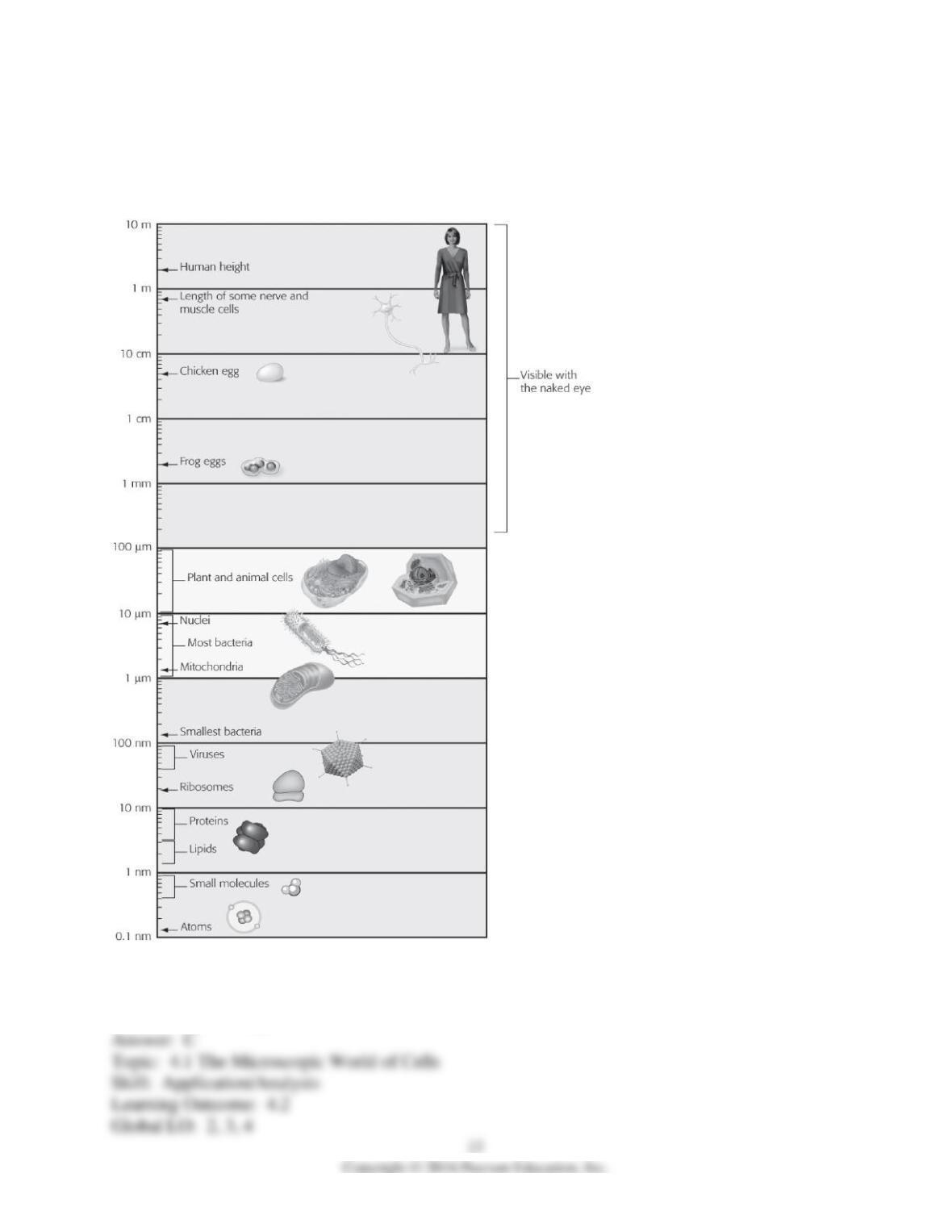
1) Using the figure below for a reference, approximately how many times larger is a nucleus
compared to a protein?
A) 10 times larger
B) 100 times larger
C) 1,000 times larger
D) 10,000 times larger
14
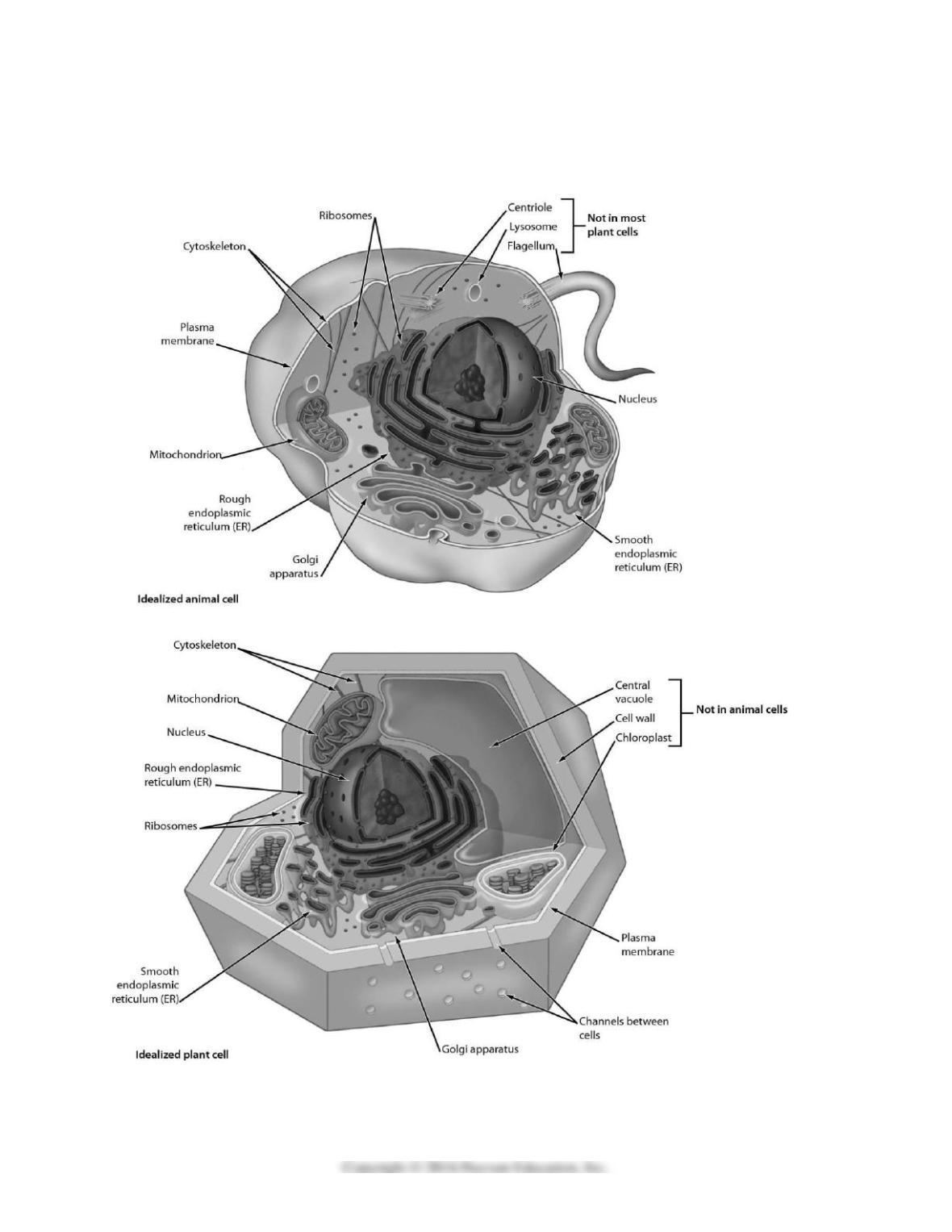
2) Examine the structures of the plant and animal cells below. Which of the following organelles
connect(s) to the nuclear envelope?
A) the Golgi apparatus
B) lysosomes
C) mitochondria
D) the endoplasmic reticulum
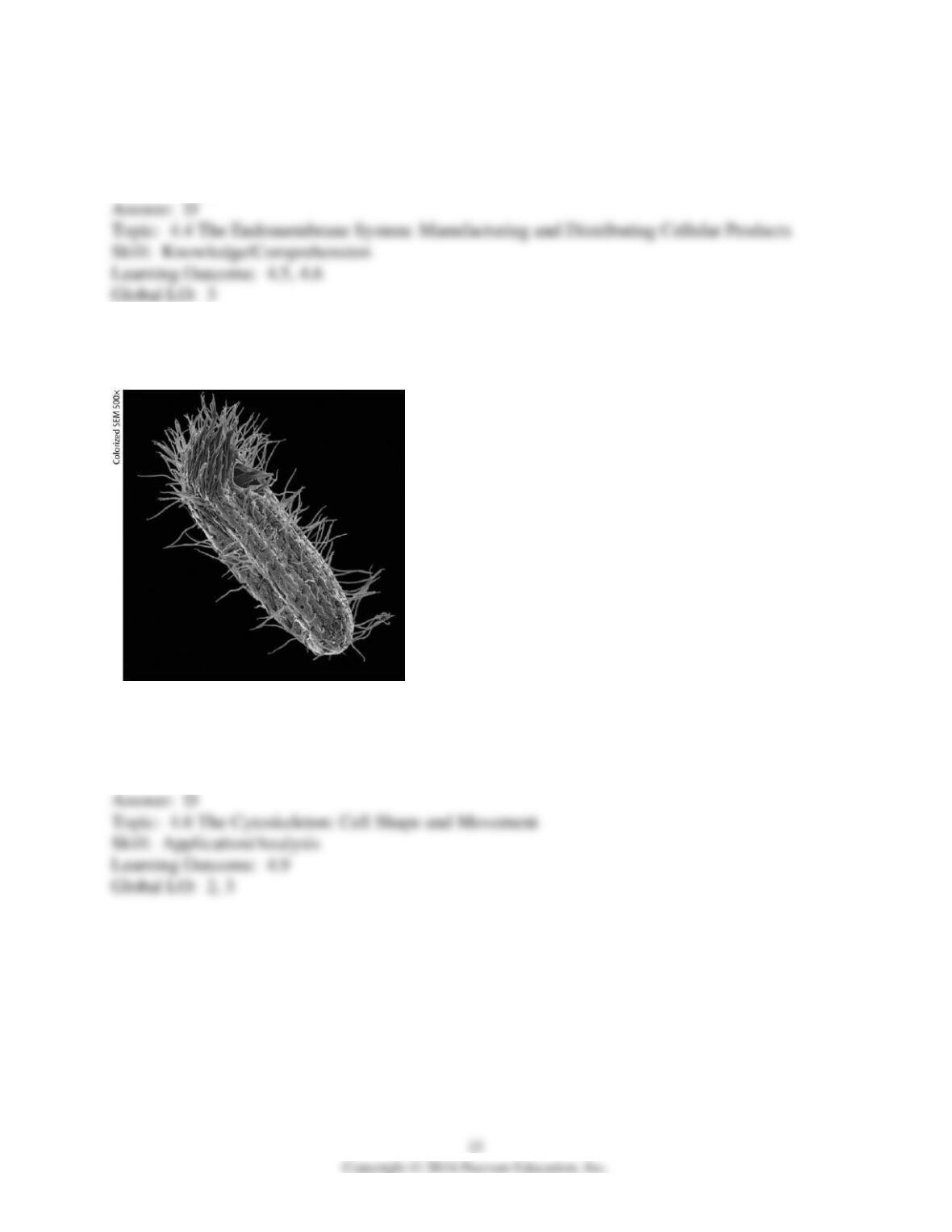
3) The figure below shows a Paramecium, a single-celled freshwater protist. The hairlike
structures visible on the Paramecium allow it to move. These structures are ________.
A) microfilaments
B) intermediate filaments
C) flagella
D) cilia
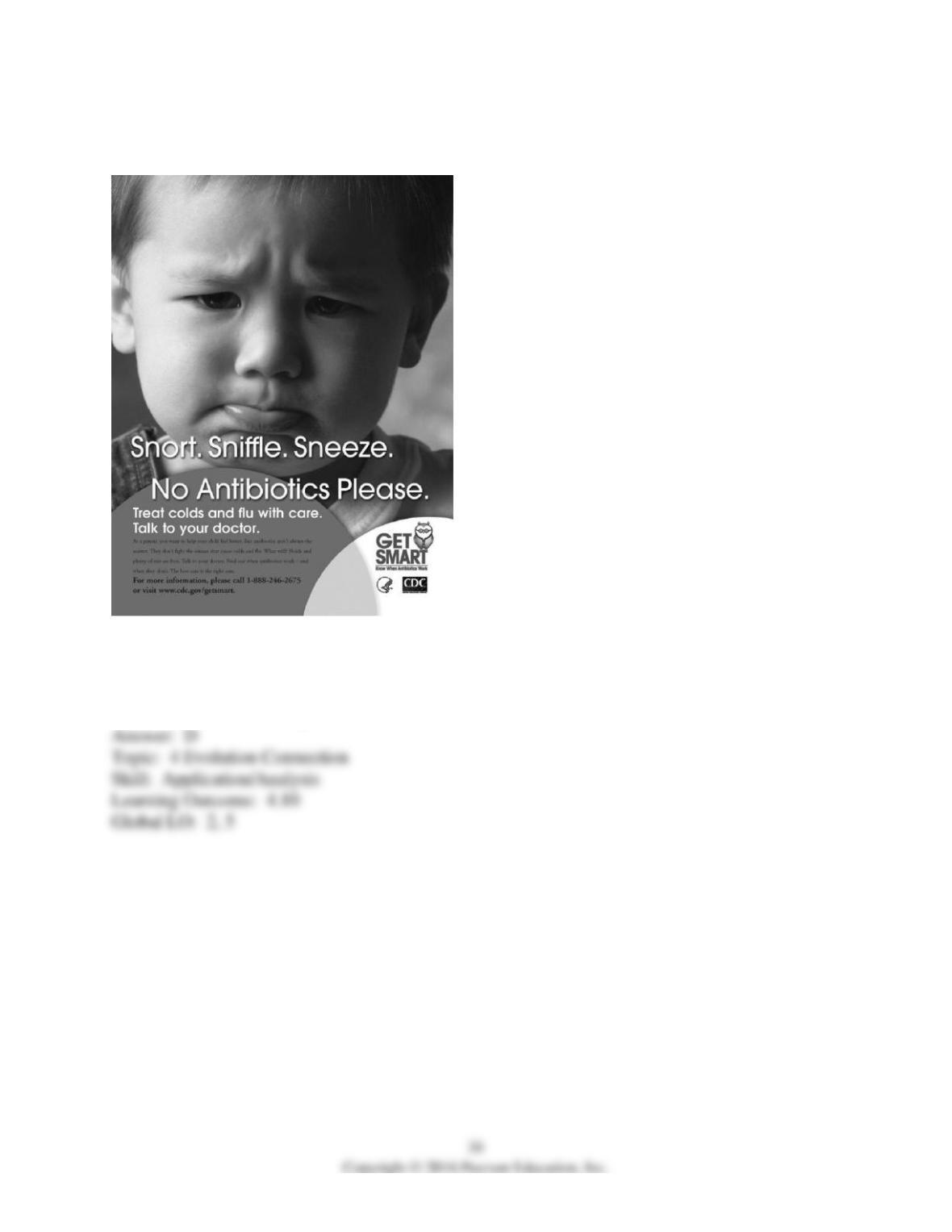
4) The child shown in the figure below is not feeling well. Why does the poster say “No
Antibiotics Please”?
A) His illness may be caused by an allergy to penicillin.
B) Antibiotics should be taken only to promote growth.
C) His illness is caused by bacteria.
D) His illness is caused by a virus.
4.3 Scenario Questions
Read the following scenario to answer the following questions.
The earliest cells detectable in fossils were different from the cells in animals, plants, fungi, and
protists living today. These first prokaryotic cells gave rise to eukaryotic cells approximately 1.7
billion years ago. The structure of eukaryotic cells today suggests how they might have evolved
from their prokaryotic ancestors. Scientists examining mitochondria and chloroplasts now think
that these organelles were probably free-living prokaryotes before becoming a part of eukaryotic
cells long ago.
1) What evidence suggests that mitochondria might have evolved before chloroplasts?
A) Mitochondria can sometimes divide to produce chloroplasts.
B) Only mitochondria have their own DNA.
C) Some mitochondria have chloroplasts inside of them.
D) Almost all eukaryotes have mitochondria but only some cells have chloroplasts.
2) Which of the following is a characteristic of chloroplasts that suggests that they might have
evolved from free-living bacteria?
A) Chloroplasts have cell walls.
B) Chloroplasts contain pigments.
C) Chloroplasts have their own DNA.
D) A single, highly folded plasma membrane surrounds chloroplasts.
3) Which of the following is a characteristic of mitochondria that suggests that they might have
evolved from free-living bacteria?
A) Mitochondria have cell walls.
B) The plasma membrane of a mitochondrion, forming the surface of this organelle, is the site of
many important steps of cellular respiration.
C) Mitochondria have their own DNA.
D) Mitochondria rely upon proteins as their source of energy.
Read the following scenario to answer the following questions.
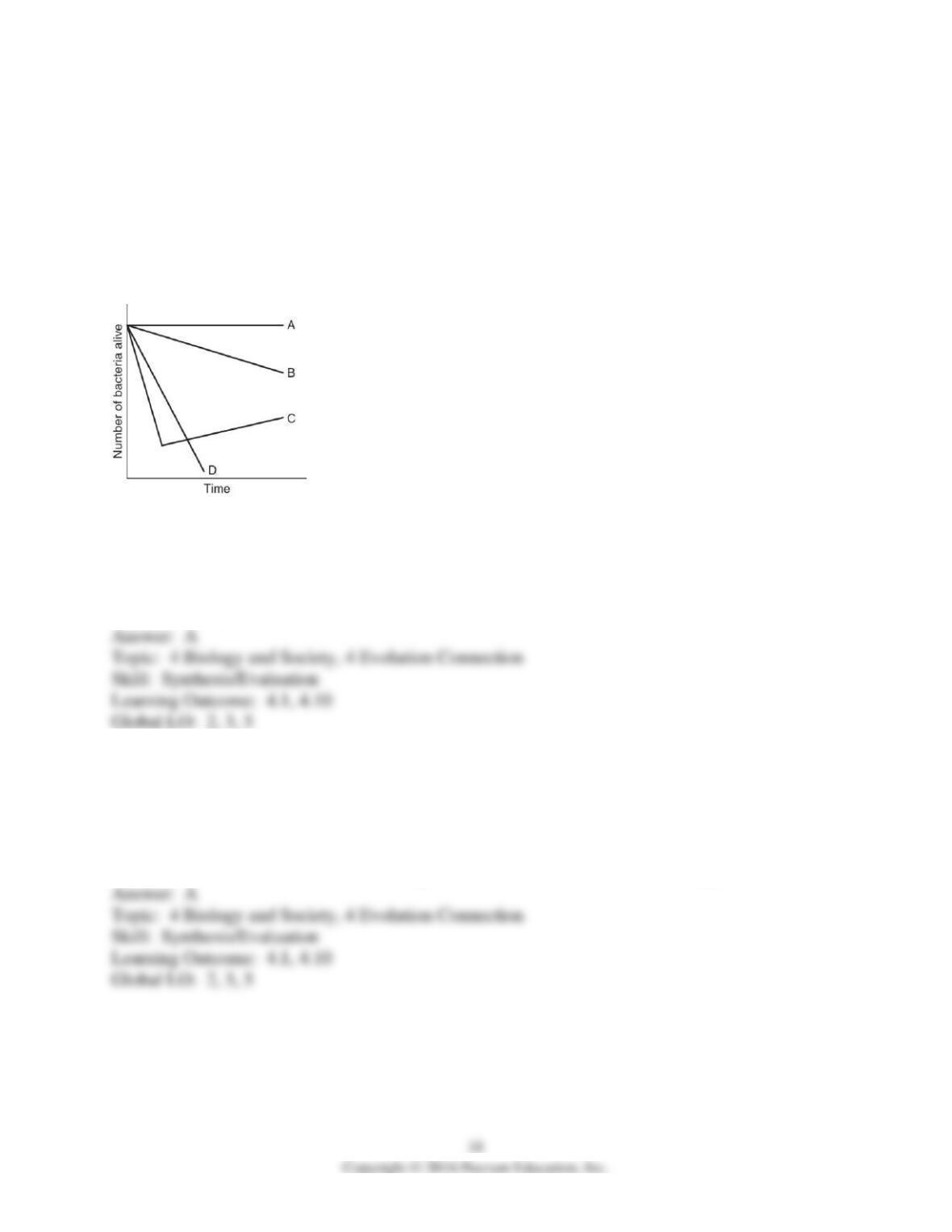
Different species of bacteria are resistant to different types of antibiotics. For example, one
species of bacteria may be resistant to an antibiotic that targets bacterial ribosomes but may not
be resistant to a different antibiotic that targets bacterial cell walls. In order to figure out what
type of antibiotic(s) to which a species of bacteria was resistant, a researcher treated the bacteria
with four different antibiotics (A, B, C, and D) and measured how many bacteria were alive over
the course of a few weeks. The data that she collected are summarized below.
4) The bacteria show the greatest resistance to which antibiotic?
A) Antibiotic A
B) Antibiotic B
C) Antibiotic C
D) Antibiotic D
5) Why do you think the bacteria start to decline when treated with antibiotic C but then begin to
grow as time goes on?
A) Some bacteria with resistance to antibiotic C were selected for over time.
B) Additional bacteria were added to the experimental group.
C) Antibiotic C degraded and thus was no longer effective.
D) This is the normal course of bacterial growth no matter which antibiotic is applied.
6) If you were treating a patient infected with this species of bacteria, which antibiotic would you
prescribe the person such that the bacteria were killed most effectively?
A) Antibiotic A
B) Antibiotic B
C) Antibiotic C
D) Antibiotic D