
1
Campbell Essential Biology, 6e (Simon/Dickey/Hogan/Reece)
Chapter 3 The Molecules of Life
Chapter 3 Learning Outcomes
3 Biology and Society: Got Lactose?
3.1. Describe the causes and consequences of lactose intolerance.
3.1 Organic Compound
3.2. Describe the special bonding properties of carbon that allow it to form an endless variety
of organic molecules.
3.3. Compare a dehydration reaction to a hydrolysis reaction.
3.2 Large Biological Molecules
3.4. Compare the structures and roles of monosaccharides, disaccharides, and polysaccharides
in living organisms. Give examples of each.
3.5. Describe the unique properties of lipids.
3.6. Compare the structure and properties of saturated and unsaturated fatty acids.
3.7. Distinguish between steroids and anabolic steroids, and explain how the use of anabolic
steroids can be dangerous to a person’s health.
3.8. Describe the structure of proteins, and explain how the structure of a protein relates to its
function.
3.9. Describe and compare the structures of DNA and RNA.
3 Evolution Connection: The Evolution of Lactose Intolerance in Humans
3.10. Explain why we think that lactose intolerance has a genetic basis and why it has evolved
differently in humans spread throughout the world.
Global Learning Outcomes
1. Demonstrate an understanding of the principles of scientific inquiry.
2. Demonstrate the ability to think critically and employ critical-thinking skills.
3. Read and interpret models, graphs, and data.
4. Demonstrate the quantitative skills needed to succeed in biology.
5. Demonstrate an understanding of the impact of science on society.
6. Evaluate the credibility of scientific information from various sources.
7. Demonstrate the ability to make connections between concepts across biology.
8. Communicate effectively in writing.
9. Apply the scientific method to interpret information and draw conclusions.
2
3.1 Multiple Choice Questions
1) People with lactose intolerance do not have enough ________.
A) lactose
B) lactase
C) glucose
D) fructose
2) A single carbon atom can form a maximum of ________ covalent bond(s).
A) 0
B) 1
C) 2
D) 4
3) The following molecule is best described as a(n) ________.
CH3–CH2–CH2–CH2
A) protein
B) carbohydrate
C) organic compound
D) inorganic compound
4) ________ is a hydroxyl group.
A) –NH2
B) –OH
C) –COOH
D) –H
5) In the following reaction, galactose is a ________.
galactose + glucose → lactose + water
A) polysaccharide
B) monomer
C) polymer
D) protein
6) What name is given to the following reaction?
galactose + glucose → lactose + water
A) hydrolysis
B) hydrogenation
C) glycolysis
D) dehydration
7) What name is given to the following reaction?
sucrose + water → glucose + fructose
A) hydrogenation
B) hydrolysis
C) glycolysis
D) dehydration
8) Carbohydrates typically include ________.
A) an NH2 group
B) C, H, and O atoms
C) N and S atoms
D) a PO4 group
9) Which of the following are isomers?
A) glucose and fructose
B) glucose and sucrose
C) sucrose and glucose
D) lactose and maltose
10) Complete the equation:
monosaccharide + monosaccharide → ________ + water
A) disaccharide
B) polypeptide
C) polysaccharide
D) fat
11) In the following equation, lactose is a ________.
galactose + glucose → lactose + water
A) nucleic acid
B) fatty acid
C) disaccharide
D) dipeptide
12) Table sugar is ________.
A) glucose, a monosaccharide
B) glucose, a disaccharide
C) sucrose, a monosaccharide
D) sucrose, a disaccharide
13) For good health, it is important to include ________ in our diets.
A) fructose
B) monosaccharides
C) disaccharides
D) polysaccharides
14) Which of the following is an example of a polysaccharide?
A) glucose
B) starch
C) maltose
D) sucrose
15) Animals store carbohydrates as ________.
A) cellulose
B) glycogen
C) starch
D) maltose
16) Cellulose is an example of ________.
A) a polypeptide
B) a steroid
C) fiber
D) fat
17) Which of the following is hydrophilic?
A) cellulose
B) testosterone
C) butter
D) cholesterol
18) Sometimes when I have my morning coffee, which I drink black with no cream or sugar, I
notice a thin film floating on top of the coffee. Since I have just read Chapter 3 of the text, I now
realize the nature of this substance and so I run to my friend screaming, “Look at this ________
in my coffee!”
A) hydrophilic substance
B) hydrophobic substance
C) disaccharide
D) polysaccharide
19) A glycerol with three fatty acids attached is referred to as a ________.
A) prostaglandin
B) nucleic acid
C) steroid
D) fat
20) What name is given to the following reaction?
glycerol + 3 fatty acids → triglyceride + 3 water molecules
A) glycolysis
B) hydrolysis
C) hydrogenation
D) dehydration
21) Saturated fats are saturated with ________.
A) carbon
B) nitrogen
C) hydrogen
D) oxygen
22) By definition, what type of fatty acid has double bonds?
A) steroid
B) triglyceride
C) unsaturated
D) saturated
23) Which of the following is lowest in unsaturated fats?
A) beef
B) salmon
C) corn oil
D) canola oil
24) A fat that is hydrogenated is ________.
A) more unsaturated
B) easier to digest
C) more solid
D) less likely to cause strokes
25) Which of the following is a health effect of a diet high in saturated fats?
A) increased risk of infectious disease
B) decreased risk of atherosclerosis
C) increased risk of heart attack
D) decreased risk of stroke
26) ________ is a steroid.
A) Butter
B) Sucrose
C) Amino acid
D) Estrogen
27) A friend of yours appears to have put on a lot of muscle very quickly. At the same time, you
notice that your friend seems to have a lot of mood swings and appears depressed. It is
reasonable for you to suspect that your friend has begun to take ________.
A) amino acid supplements
B) creatine
C) protein powder
D) an anabolic steroid
28) Enzymes are ________.
A) amino acids
B) monosaccharides
C) phospholipids
D) proteins
29) Proteins are polymers constructed from ________ monomers.
A) hydrocarbon
B) amino acid
C) nucleotide
D) fatty acid
30) Amino acids include a side group as well as ________.
A) a central carbon, a hydrogen atom, an amino group, and a carboxyl group
B) a central carbon, a hydrogen atom, a hydroxyl group, and a carbonyl group
C) a central nitrogen, a carbon atom, a hydroxyl group, and a carbonyl group
D) a central nitrogen, a carbon atom, an amino group, and a carbonyl group
31) What is the name given to the reaction that breaks peptide bonds?
A) dehydration
B) hydrogenation
C) hydrolysis
D) glycolysis
32) A protein’s function is most dependent on its ________.
A) pH
B) shape
C) size
D) weight
33) Extremophilic bacteria are able to survive in hostile environments, including scalding hot
water as well as springs and vents that reach temperatures over 100°C. Researchers studying
these bacteria measured the function of a protein from an extremophile bacterium at 100°C, and
they also measured the function of a similar protein from a human cell at 100°C. Which of the
following results do you think the researchers obtained?
A) The bacterial protein functioned normally, whereas the human protein did not.
B) The human protein functioned normally, whereas the bacterial protein did not.
C) The bacterial protein and the human protein both functioned normally.
D) Neither the human protein nor the bacterial protein functioned normally.
34) Nucleic acids are polymers of ________ monomers.
A) monosaccharide
B) fatty acid
C) DNA
D) nucleotide
35) A specific stretch of DNA that programs the amino acid sequence of a polypeptide is a
________.
A) gene
B) protein
C) nucleic acid
D) enzyme
36) DNA nucleotides include ________.
A) uracil, guanine, adenine, and cytosine
B) thymine, guanine, adenine, and cytosine
C) thymine, uracil, adenine, and cytosine
D) thymine, guanine, adenine, and uracil
37) Which of the following is TRUE with regard to a DNA molecule?
A) The amount of adenine is equal to the amount of guanine, and the amount of thymine is equal
to the amount of cytosine.
B) The amount of adenine is equal to the amount of cytosine, and the amount of guanine is equal
to the amount of thymine.
C) The amount of adenine is equal to the amount of thymine, and the amount of guanine is equal
to the amount of uracil.
D) The amount of adenine is equal to the amount of thymine, and the amount of guanine is equal
to the amount of cytosine.
38) If one strand of a DNA double helix has the sequence AGTACTG, what will be the sequence
of the other strand?
A) GACGTCA
B) AGTACTG
C) GTCATGA
D) TCATGAC
39) How does RNA differ from DNA?
A) RNA is double-stranded; DNA is single-stranded.
B) RNA is a polymer of amino acids; DNA is a polymer of nucleotides.
C) RNA contains uracil; DNA contains thymine.
D) In RNA G pairs with T; in DNA G pairs with C.
40) A DNA molecule has the sequence AGTTCAACT. The equivalent RNA molecule would
have the sequence ________.
A) AGTTCAACT
B) AGUUCAACU
C) UGTTCUUCT
D) UGUUCUUCU
41) The ability to tolerate lactose throughout life most likely arose in ________.
A) populations that live in cold climates
B) populations that live in wet climates
C) cultures that keep dairy herds
D) Native Americans
3.2 Art Questions
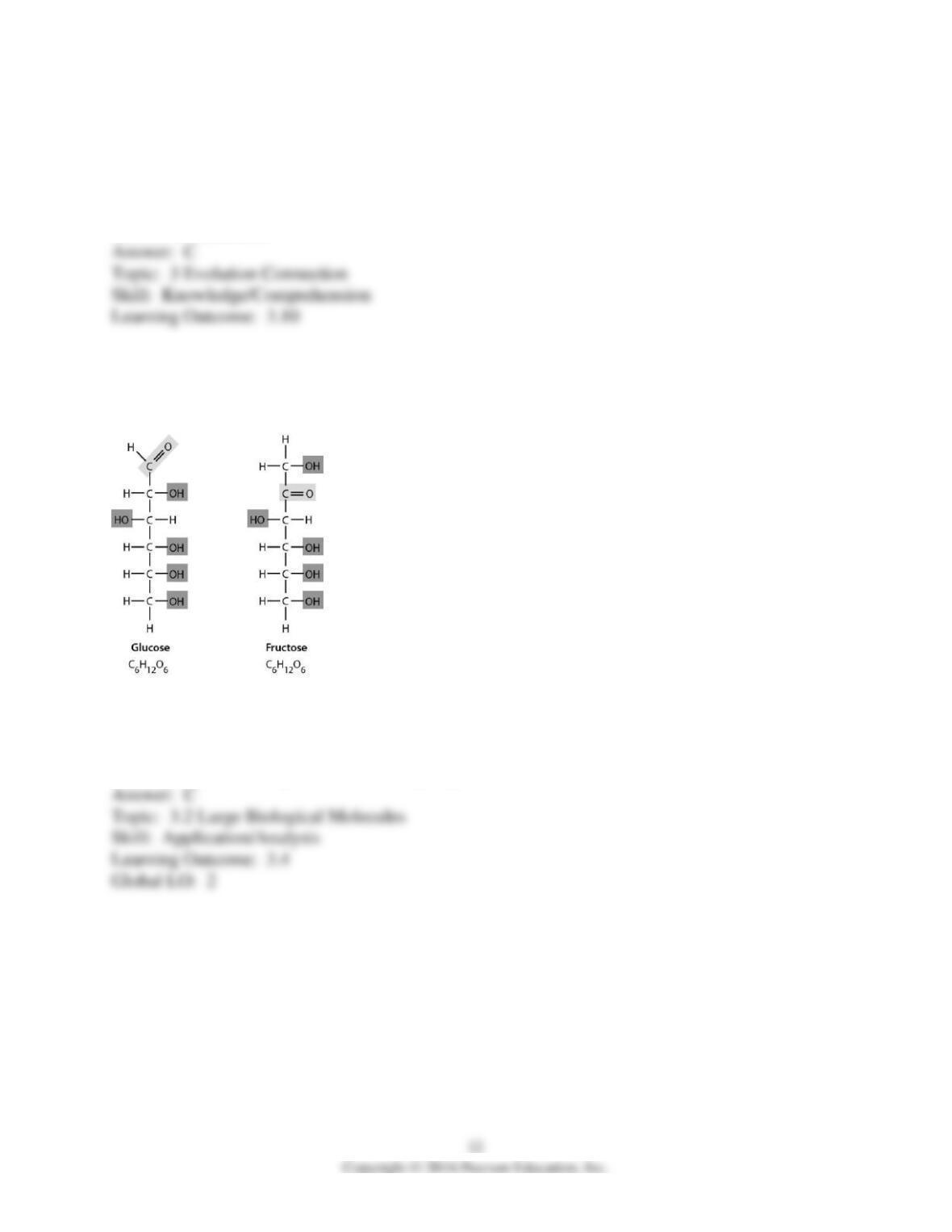
1) Examine the two sugars in the following figure. How do these two sugars compare?
A) Glucose has more hydrogen.
B) Glucose has more double bonds.
C) They have the same formula but different structures.
D) They are structurally identical in every way.
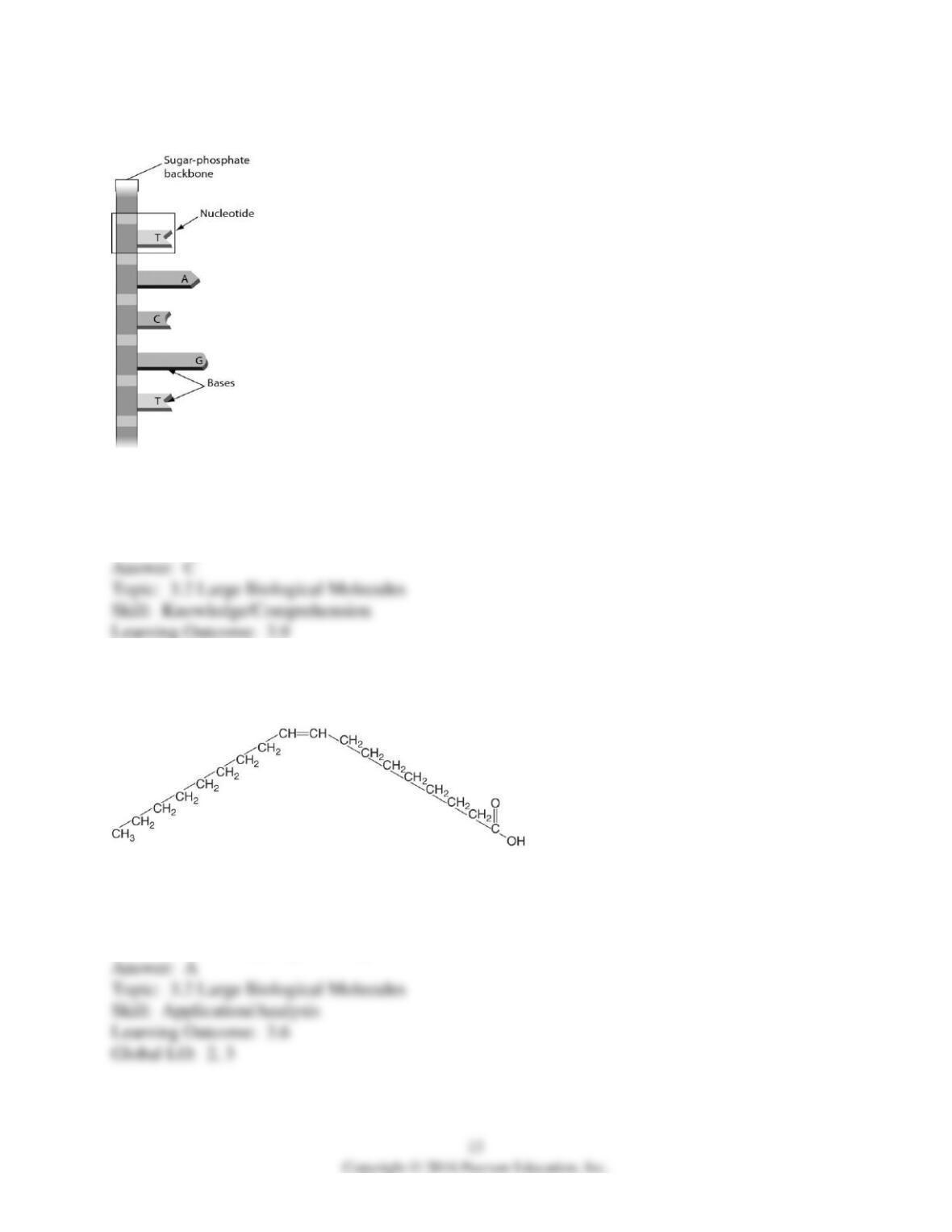
2) The figure below shows ________.
A) a single strand of RNA
B) double-stranded RNA
C) a single strand of DNA
D) double-stranded DNA
3) Oleic acid is a fatty acid that occurs naturally in many animal and vegetable fats and oils.
What can you tell about oleic acid just by looking at its structure?
A) Oleic acid is an unsaturated fatty acid.
B) Oleic acid is a saturated fatty acid.
C) Oleic acid is a trans fatty acid.
D) Oleic acid is a hydrophilic fatty acid.
3.3 Scenario Questions
Please read the following scenario to answer the following questions.
While shopping, you settle on two types of cookies. The nutritional label for the chocolate mint
cookies lists 5 grams of saturated fat, 0 grams of trans fat, 22 grams of carbohydrates, and 11
grams of protein per serving. The nutritional label for the peanut butter cookies lists 0 grams of
saturated fat, 5 grams of trans fat, 26 grams of carbohydrates, and 4 grams of protein per serving.
1) Which cookies are less healthy?
A) The chocolate mint cookies because they contain more saturated fat.
B) The chocolate mint cookies because they contain more total grams of protein and
carbohydrates.
C) The peanut butter cookies because they contain more trans fat.
D) The peanut butter cookies because they contain more grams of carbohydrates.
2) The manufacturer of the chocolate mint cookies changed the ingredients of its cookies. Each
serving now has 1 gram of saturated fat (4 fewer grams), 4 grams of trans fat (4 more grams), 21
grams of carbohydrates (1 fewer gram), and 11 grams of protein (no change). Do you think that
the manufacturer made these cookies healthier?
A) No, because they now have less saturated fat.
B) Yes, because they now have less saturated fat.
C) Yes, because they now have fewer grams of carbohydrates.
D) No, because they now have more grams of trans fat.
3) The amount of carbohydrates in a food product is usually separated into two groups: 1) sugars,
which refers only to mono- and disaccharides, and 2) fiber. Out of the 22 grams of total
carbohydrates, there are 12 grams of sugars and 2 grams of fiber in the chocolate mint cookies.
All of the following statements EXCEPT for one are true. Choose the exception.
A) There are more mono- and disaccharides than cellulose in the cookies.
B) There are 8 grams of carbohydrates in the cookies that are not monosaccharides,
disaccharides, or fiber.
C) The majority of the carbohydrates in the cookies will be able to be broken down via
hydrolysis reactions when eaten.
D) There are 6 grams of monosaccharides and 6 grams of disaccharides in the cookies.
Please read the following scenario to answer the following questions.
Cooking oils, such as olive oil, are largely made up of unsaturated fats. If you have ever heated
cooking oil in a pan, you might have noticed that eventually the oil begins to smoke. The
temperature when this occurs is called the “smoke point.” At the smoke point, the fatty acids and
glycerol molecules that make up the unsaturated fats in the oil begin to break down and form
smoke. Different oils have different smoke points, and these smoke points depend on the
molecular composition of the oils. Below is a table with data for four different types of cooking
oils, including their smoke points (values are for 1 tablespoon each [15 ml]).
Type of cooking oilCalories Saturated fat (g) Unsaturated fat (g) Smoke Point (∘F)
Olive 119 1.9 11.4 375
Avocado 124 1.6 11.9 520
Canola 120 1.0 12.0 400
Peanut 119 2.3 10.3 450
4) Suppose that you wanted to conduct an experiment to determine the smoke points of the oils
listed in the table. What would be the experiment that would give you the best information to
determine which oil has the highest smoke point?
A) Add some olive oil to a pan, heat it over a flame, and measure the temperature of the oil when
it begins to smoke. Repeat for the other three oils.
B) Mix all four oils in a pan, heat them over a flame, and measure the temperature of the oil
mixture when it begins to smoke.
C) Add some olive oil to a pan, heat it over a flame, and measure how long it takes for the oil to
begin to smoke. Repeat for the other three oils.
D) Mix all four oils in a pan, heat them over a flame, and measure how long it takes for the oil
mixture to begin to smoke.
5) Which of the following statements about the data in the table is TRUE?
A) Saturated fat content and smoke point are positively correlated (related to one another).
B) There is a negative (inverse) correlation between unsaturated fat content and smoke point.
C) You can use the saturated fat content of an oil to reliably predict the smoke point of an oil.
D) Unsaturated fat content and smoke point are not correlated.