
1
Campbell Essential Biology, 6e (Simon/Dickey/Hogan/Reece)
Chapter 2 Essential Chemistry for Biology
Chapter 2 Learning Outcomes
2 Biology and Society: Radioactivity and Health
2.1. Define radiation and explain how it can be dangerous. Explain how radiation can be used
in medicine.
2.1 Some Basic Chemistry
2.2. Distinguish between matter, mass, elements, and compounds. Give examples of each.
2.3. Explain why trace elements are important for human health.
2.4. Describe the relative size, location, and electrical charge of protons, neutrons, and
electrons within an atom. Explain how the atomic number, mass number, and atomic
mass are determined.
2.5. Define an isotope and explain how radioactive isotopes are used in biological research
and medicine.
2.6. Distinguish between ionic, covalent, and hydrogen chemical bonds.
2.7. Describe the structure of water and explain how its shape makes water a polar molecule.
2.8. Distinguish between the reactants and products of chemical reactions.
2.2 Water and Life
2.9. Describe the four life-supporting properties of water. Describe an example of how each
property affects some form of life.
2.10. Distinguish between the chemical properties of acids, bases, and neutral solutions.
Explain how buffers stabilize the pH of acidic and basic solutions.
2.11. Describe the potential impact of rising levels of carbon dioxide on the pH of the ocean.
2 Evolution Connection: Radioactivity as an Evolutionary Clock
2.12. Explain how radioactive isotopes are used in radiometric dating.
Global Learning Outcomes
1. Demonstrate an understanding of the principles of scientific inquiry.
2. Demonstrate the ability to think critically and employ critical-thinking skills.
3. Read and interpret models, graphs, and data.
4. Demonstrate the quantitative skills needed to succeed in biology.
5. Demonstrate an understanding of the impact of science on society.
6. Evaluate the credibility of scientific information from various sources.
7. Demonstrate the ability to make connections between concepts across biology.
8. Communicate effectively in writing.
9. Apply the scientific method to interpret information and draw conclusions.
2.1 Multiple Choice Questions
1) How can radiation be controlled and safely used in medicine?
A) Apply radiation throughout the body at uncontrolled doses.
B) Apply radiation throughout the body at controlled doses.
C) Apply radiation to specific parts of the body at uncontrolled doses.
D) Apply radiation to specific parts of the body at controlled doses.
2) ________ is an example of an element.
A) Water
B) Carbon
C) Glucose
D) Salt
3) The four most common elements found in living organisms are ________.
A) nitrogen, oxygen, phosphorus, and carbon
B) carbon, oxygen, nitrogen, and hydrogen
C) carbon, oxygen, potassium, and calcium
D) oxygen, calcium, hydrogen, and carbon
4) Which of the following elements, essential to life, is a trace element?
A) phosphorus
B) carbon
C) iodine
D) calcium
5) In order to have a positive charge, an atom must have ________.
A) more protons than electrons
B) more electrons than protons
C) more neutrons than protons
D) more protons than neutrons
6) All atoms of an element have the same number of ________.
A) protons plus neutrons
B) protons
C) electrons
D) neutrons
7) An atom’s ________ are found in its nucleus.
A) neutrons and protons
B) protons only
C) neutrons and electrons
D) electrons, protons, and neutrons
8) Beryllium’s atomic mass is 9, and its atomic number is 4. How many neutrons are found in a
beryllium atom?
A) 9
B) 13
C) 4
D) 5

9) An uncharged atom of gold has an atomic number of 79 and an atomic mass of 197. This atom
has ________ protons, ________ neutrons, and ________ electrons.
A) 79… 118… 79
B) 118… 79… 118
C) 118… 276… 118
D) 79… 34… 79
10) The way Earth moves about the sun is most like ________.
A) a neutron and electron moving around a proton
B) an electron moving around the nucleus of an atom
C) a proton moving about an electron
D) a neutron moving about a proton
11) Isotopes of an element have the same number of ________ and different numbers of
________.
A) protons… neutrons
B) protons… electrons
C) neutrons… protons
D) electrons… protons
12) How do radioactive isotopes differ from isotopes?
A) Radioactive isotopes have more neutrons than do isotopes.
B) Radioactive isotopes are stable; isotopes are unstable.
C) Radioactive isotopes have fewer neutrons than do isotopes.
D) Radioactive isotopes are unstable; isotopes are stable.
13) An atom with an electrical charge is a(n) ________.
A) isotope
B) molecule
C) ion
D) compound
14) The bond between oppositely charged ions is a(n) ________ bond.
A) ionic
B) polar
C) hydrogen
D) covalent
15) In the following reaction, what type of bond is holding the two atoms together?
K+Cl → K+ + Cl− → KCl
A) hydrophilic
B) ionic
C) hydrophobic
D) covalent
16) What name is given to bonds that involve the sharing of electrons?
A) covalent
B) hydrogen
C) ionic
D) polar
17) Sulfur has an atomic number of 16. How many covalent bonds can sulfur form?
A) 1
B) 2
C) 4
D) 0
18) The hydrogen and oxygen atoms of a water molecule are held together by ________ bonds.
A) ionic
B) hydrogen
C) covalent
D) polar
19) Why is water considered a polar molecule?
A) The oxygen atom is found between the two hydrogen atoms.
B) The oxygen atom attracts the hydrogen atoms.
C) The oxygen end of the molecule has a slight negative charge, and the hydrogen end has a
slight positive charge.
D) Both hydrogen atoms are at one end of the molecule, and the oxygen atom is at the other end.
20) Adjacent water molecules are joined by ________ bonds.
A) covalent only
B) ionic
C) polar and covalent
D) hydrogen
21) Adjacent water molecules are connected by the ________.
A) sharing of electrons between the hydrogen of one water molecule and the oxygen of another
water molecule
B) electrical attraction between the hydrogen of one water molecule and the oxygen of another
water molecule
C) sharing of electrons between adjacent oxygen molecules
D) electrical attraction between the hydrogen atoms of adjacent water molecules
22) How many oxygen atoms are in the products of the following reaction?
C6H12O6 + 6 H2O + 6 O2 → 6 CO2 + 12 H2O
A) 18
B) 6
C) 12
D) 24
23) What are the reactant(s) in the following chemical reaction?
C6H12O6 + 6 H2O + 6 O2 → 6 CO2 + 12 H2O
A) CO2 and H2O
B) C6H12O6, H2O, and O2
C) O2 only
D) C6H12O6, H2O, O2, CO2, and H2O
24) Human body cells are approximately ________ water.
A) 95–99%
B) 25–35%
C) 50–55%
D) 70–95%
25) The tendency of molecules of the same kind to stick together is called ________.
A) bonding
B) cohesion
C) polarity
D) adhesion
26) Why (if you are careful) are you able to float a needle on the surface of water?
A) Water has adhesive properties.
B) The surface tension that is a result of water’s cohesive properties makes this possible.
C) The covalent bonds that hold a water molecule together make this possible.
D) A single needle is less dense than water.
27) Sweating cools your body by ________.
A) cohesion
B) radiation
C) evaporative cooling
D) hydrogen bonding
28) As water freezes, ________.
A) its molecules move farther apart
B) it cools the surrounding environment
C) its hydrogen bonds break apart
D) it loses its polarity
29) Sugar dissolves when stirred into water. The sugar is the ________, the water is the
________, and the sweetened water is the ________.
A) solution… solvent… solute
B) solute… solvent… solution
C) solvent… solute… solution
D) solution… solute… solvent
30) Which of the following is an acid?
A) NaOH
B) NaCl
C) HCl
D) CH4
31) A base ________.
A) removes H2O molecules from a solution
B) decreases the pH of a solution
C) removes OH— ions from a solution
D) removes H+ ions from a solution
32) The lower the pH of a solution, the ________.
A) greater the number of oxygen atoms
B) more acidic the solution
C) less toxic the solution
D) higher the OH— concentration
33) Relative to a pH of 6, a pH of 4 has a ________.
A) 200 times higher H+ concentration
B) 100 times higher H+ concentration
C) 20 times higher H+ concentration
D) 100 times lower H+ concentration
34) What name is given to substances that resist changes in pH?
A) buffers
B) solutions
C) acids
D) bases
35) When a base is added to a buffered solution, the buffer will ________.
A) donate OH− ions
B) accept water molecules
C) donate H+ ions
D) form covalent bonds with the base
36) Which of the following is NOT a potential impact of ocean acidification?
A) Decreasing H+ concentrations
B) Coral bleaching
C) Changes in metabolism of marine animals
D) Increasing carbonic acid concentrations
37) A fossil was found and determined by radiometric dating to be 11,400 years old. What is the
ratio of carbon-14 to carbon-12 in this fossil compared to its environment?
A) 12.5%
B) 25%
C) 37.5%
D) 50%
2.2 Art Questions
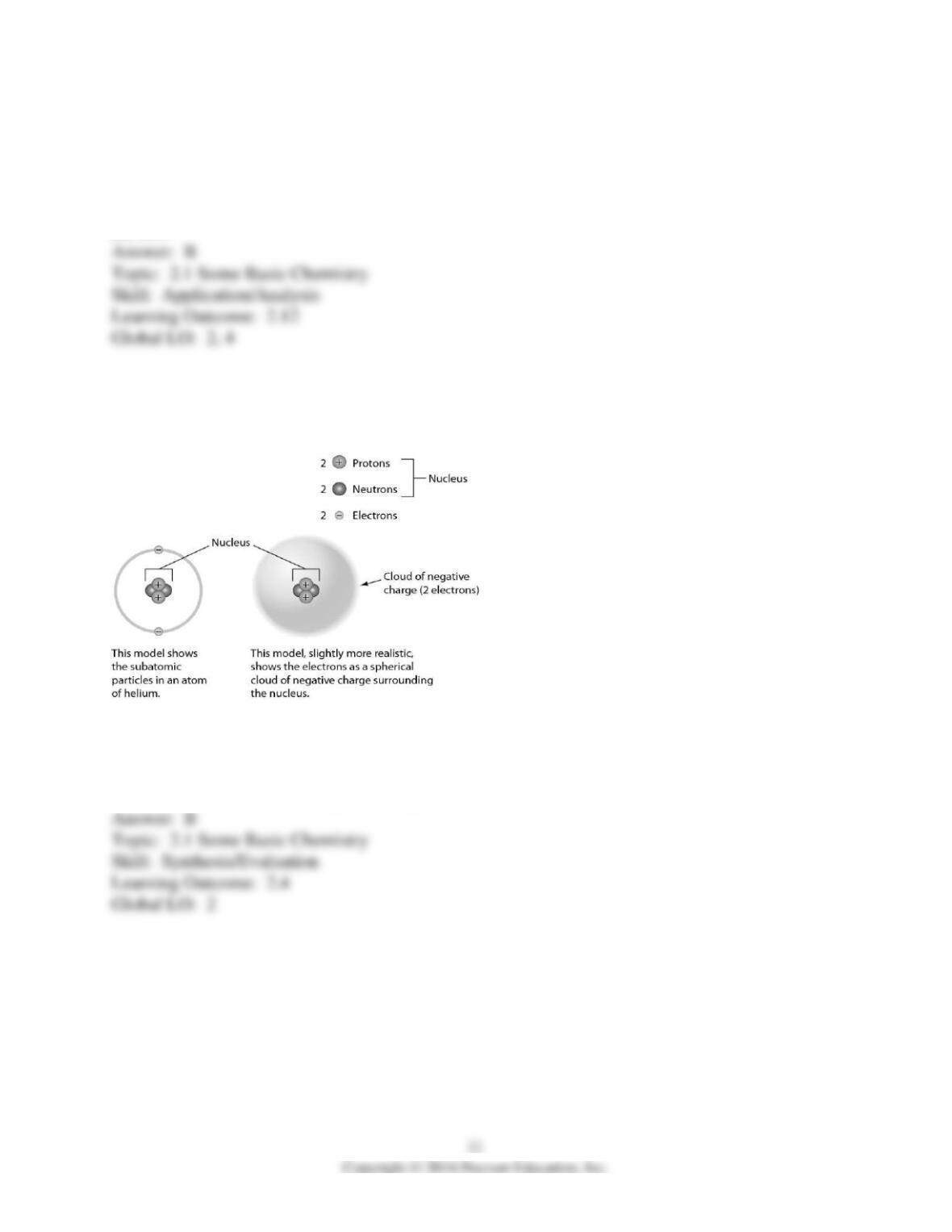
1) Examine the drawing of an atom below. The art is technically INCORRECT in that ________.
A) neutrons are not located in the nucleus
B) the electrons should be much farther away from the nucleus
C) electrons do not orbit the nucleus
D) electrons do not have a negative charge
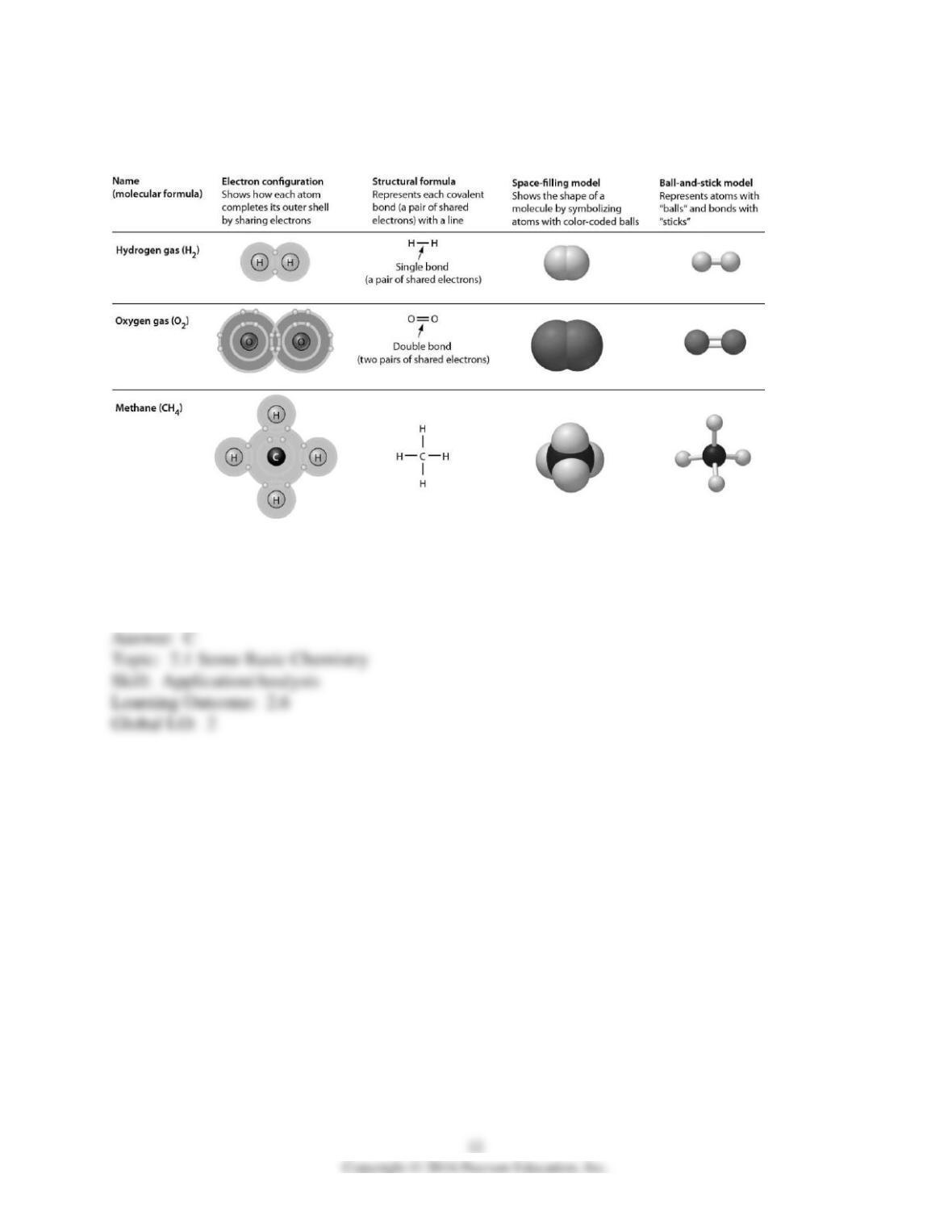
2) All of the representations in the following figure EXCEPT one clearly show double bonds.
Choose the exception.
A) electron configuration
B) structural formula
C) space-filling model
D) ball-and-stick model
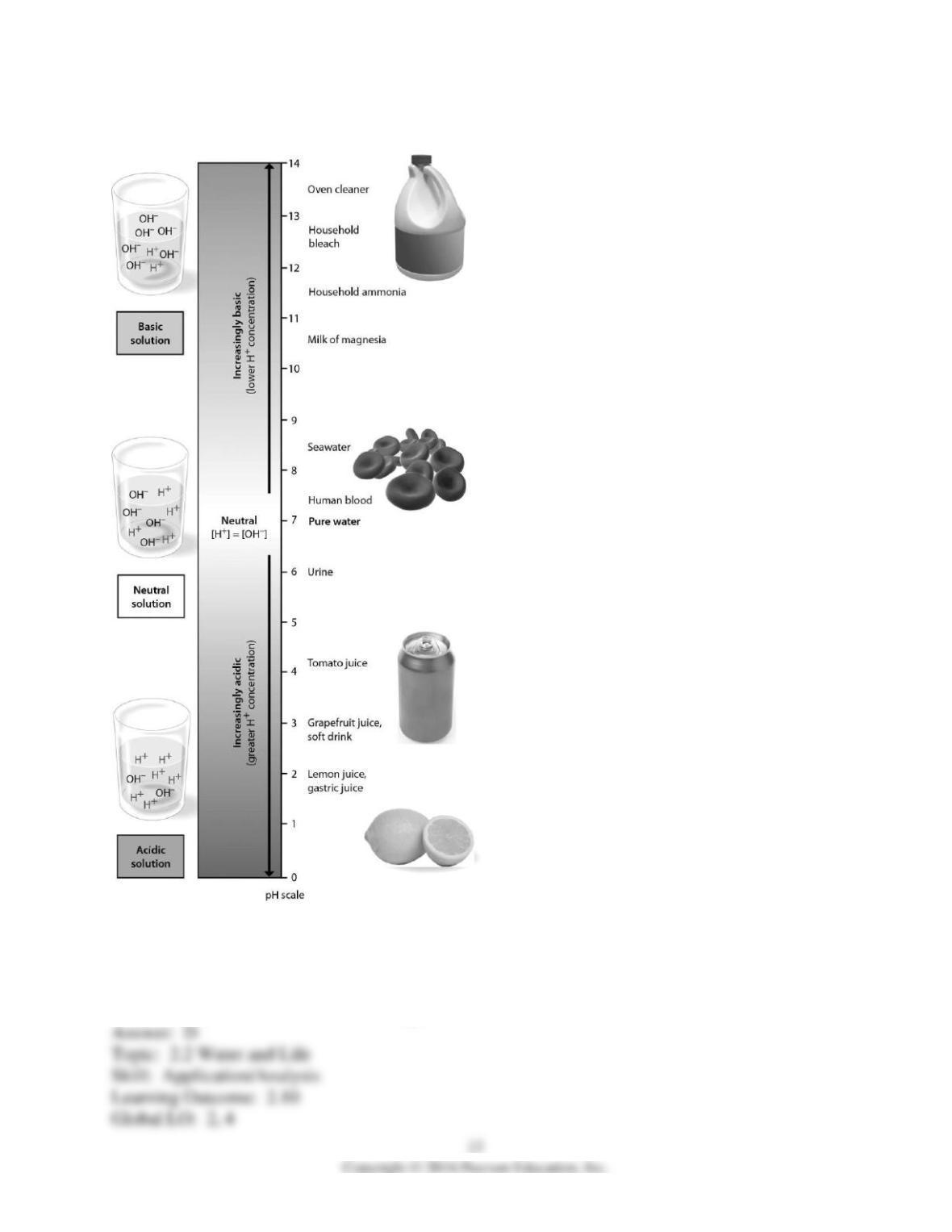
3) Examine the pH scale below. How does household bleach compare to household ammonia?
A) Household ammonia has 100 times higher H+ concentration than household bleach.
B) Household bleach has 10 times higher H+ concentration than household ammonia.
C) Household bleach has 100 times higher H+ concentration than household ammonia.
D) Household ammonia has 10 times higher H+ concentration than household bleach.
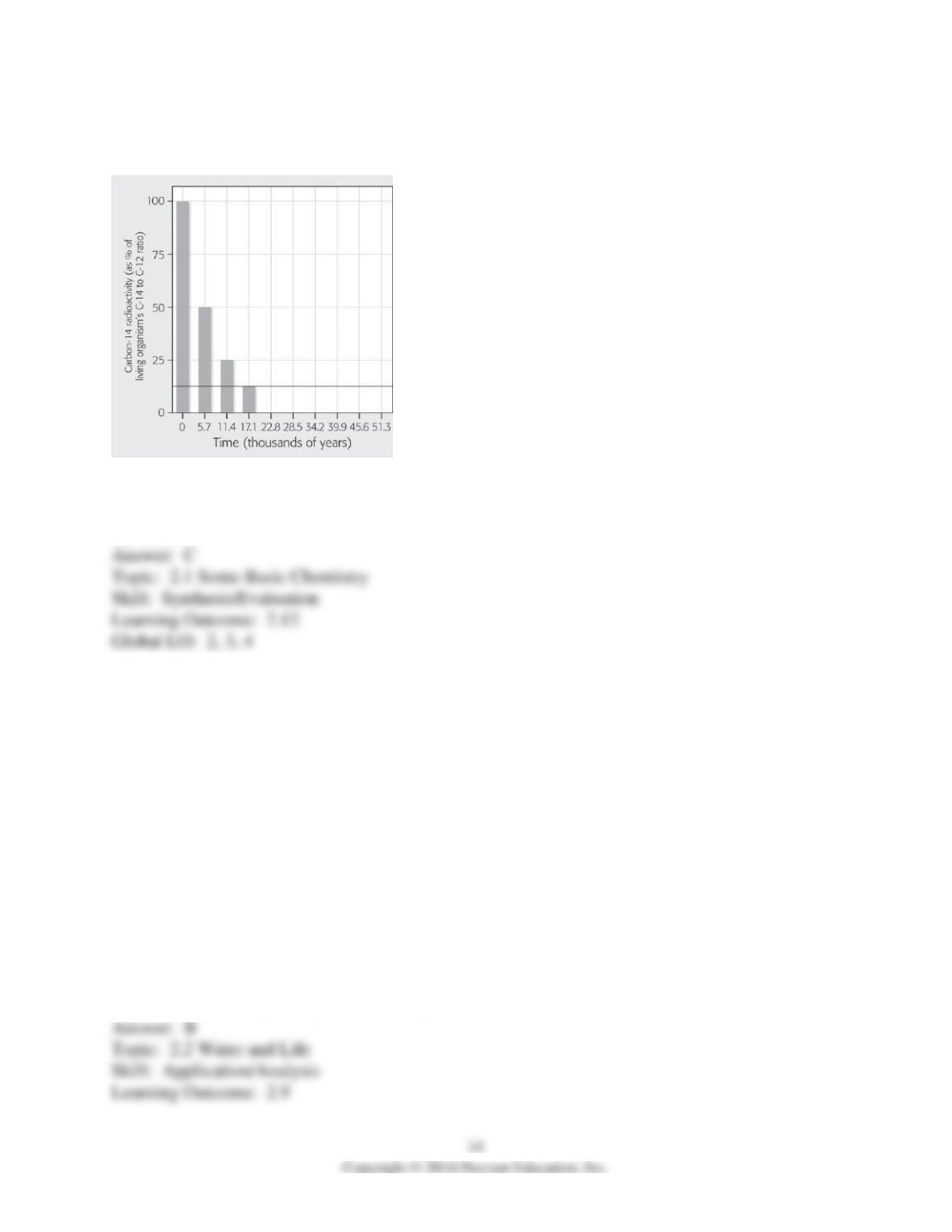
4) The graph below shows data regarding radioactive decay of carbon-14. If decay continues to
occur normally, how much C-14 will remain after 22,800 years?
A) 25%
B) 12.5%
C) 6.25%
D) 3.125%
2.3 Scenario Questions
Please read the following scenario to answer the following questions.
The last few miles of the marathon are the most difficult for Heather. Her hair is plastered to her
head, sweat clings to her arms, and her legs feel as if they had nothing left. Heather grabs a cup
of ice water. The ice cubes smash against her nose as she gulps some cool refreshment and keeps
on running. Then a breeze kicks up and she finally feels some coolness against her skin. Drops of
sweat, once clinging to her forehead, now spill down, and Heather feels a stinging as the sweat
flows into her eyes.
1) Why did the sweat on Heather‘s forehead and arms form drops?
A) because of the high salt content of sweat
B) because of the cohesive nature of water
C) because of the ability of water to moderate heat
D) because of the high evaporative cooling effect of water

2) When Heather grabbed the glass of ice water, the ice cubes were floating at the top. Why were
the ice cubes floating in the water?
A) Water can store large amounts of heat.
B) Water can moderate temperatures through evaporative cooling.
C) The density of water decreases when it freezes.
D) Water has a cohesive nature.
Please read the following scenario to answer the following questions.
While radioactive isotopes are used in medicine to identify tumors and other diseases, they can
also be used to treat diseases such as cancer. One method to treat cancerous tumors is to expose
them to radiation, which can kill the cancerous cells and the tumor. In 2013, the U.S. Food and
Drug Administration approved a new cancer treatment based on the radioactive isotope radium-
223; this isotope has a half-life of 11.4 days. The radioactive drug, known as Xofigo®, is
injected into the patient’s bloodstream and travels to certain regions of the body. Because it emits
high-energy radiation over short distances, it can kill cancerous cells in the sites where it
localizes.
After the drug was injected into a person, the following data were collected regarding the amount
of radiation measured in different organs in the person’s body.
Organ Measured radiation
Brain 0.37
Liver 11.01
Bones 4262.60
Lungs 0.27
Urinary bladder 14.90
3) Which of the following would be the best experiment to determine whether this drug is an
effective treatment option for cancer patients?
A) Give the drug to a single cancer patient and ask him how he feels several months later.
B) Give the drug to a group of mice that have artificially induced tumors and measure whether
their tumors are destroyed.
C) Give the drug to a group of cancer patients and measure whether their tumors are destroyed.
D) Give the drug to a single cancer patient and measure whether her tumor is destroyed.

4) A cancer patient receives an injection of the drug on March 1. Suppose that the patient must
receive a second injection once the amount of the drug decreases to less than 6% in his or her
body. On approximately what day should the cancer patient schedule an appointment to receive
another injection?
A) March 13
B) March 23
C) April 3
D) April 25
5) Using the table above, what kind of cancer do you think Xofigo® is used to treat?
A) liver cancer
B) bone cancer
C) brain cancer
D) lung cancer