
1
Campbell Essential Biology, 6e (Simon/Dickey/Hogan/Reece)
Chapter 1 Introduction: Biology Today
Chapter 1 Learning Outcomes
1 Biology and Society
1.1. Describe three examples of how biology is woven into the fabric of society.
1.1 The Scientific Study of Life
1.2. Compare discovery science and hypothesis-driven science. Provide examples of each.
1.3. Distinguish science from other styles of inquiry.
1.4. Distinguish between a hypothesis and a theory. Explain why natural selection is a
scientific theory.
1.2 The Nature of Life
1.5. Describe seven properties or processes we associate with life.
1.6. Define a species and describe the goals of taxonomy.
1.7. Distinguish between the three domains and four eukaryotic kingdoms of life.
1.3 Major Themes in Biology
1.8. Describe the two main points that Darwin made in his book On the Origin of Species by
Means of Natural Selection.
1.9. Compare and contrast artificial and natural selection.
1.10 Predict how structure and function are correlated using examples.
1.11 Identify and explain information flow and how it functions to regulate processes within
biological systems.
1.12 Contrast the movements of energy and matter through ecosystems.
1.13 List and give an example of each level of biological organization, starting with an
ecosystem and ending with atoms.
1.14 Define emergent properties and predict where they occur.
Global Learning Outcomes
1. Demonstrate an understanding of the principles of scientific inquiry.
2. Demonstrate the ability to think critically and employ critical-thinking skills.
3. Read and interpret models, graphs, and data.
4. Demonstrate the quantitative skills needed to succeed in biology.
5. Demonstrate an understanding of the impact of science on society.
6. Evaluate the credibility of scientific information from various sources.
7. Demonstrate the ability to make connections between concepts across biology.
8. Communicate effectively in writing.
9. Apply the scientific method to interpret information and draw conclusions.

2
1.1 Multiple Choice Questions
1) In what way(s) is the science of biology influencing and changing our culture?
A) by helping us understand the relevance of evolution to human health
B) by revealing how mutations in genes can lead to disease
C) by providing new tools for forensic investigations
D) all of the above
2) What is biology?
A) the scientific study of life
B) the scientific study of the environment
C) the scientific study of DNA
D) the scientific study of ecosystems
3) Which of the following is NOT a property of life?
A) Populations of organisms rarely change over time.
B) Living things exhibit complex but ordered organization.
C) Organisms take in energy and use it to perform all of life‘s activities.
D) Organisms reproduce their own kind.
4) What are the two main processes upon which ecosystems depend?
A) speciation and evolution
B) nutrient recycling and energy flow
C) decomposition and nutrient recycling
D) sunlight and photosynthesis
5) Which of the following is NOT recycled but is lost from ecosystems?
A) nitrogen
B) energy

C) magnesium
D) carbon
6) Which of the following is a producer?
A) oak tree
B) earthworm
C) sun
D) cat
7) Humans are ________.
A) producers
B) producers and consumers
C) consumers
D) producers and decomposers
8) Which of the following structures can perform all the activities required for life?
A) DNA molecules
B) cells
C) organelles
D) nuclei

9) Relative to prokaryotic cells, eukaryotic cells are usually ________.
A) larger and more complex
B) smaller and simpler
C) larger and equally complex
D) smaller and more complex
10) Humans are composed of ________ cells.
A) bacterial
B) eukaryotic
C) plant
D) prokaryotic
11) What name is given to the functional compartments of a cell?
A) genomes
B) nuclei
C) genes
D) organelles
12) The DNA of a eukaryotic cell is found within the ________.
A) archaea
B) nucleus
C) prokaryotic cell
D) insulin

13) What are eukaryotic genes composed of?
A) RNA
B) organelles
C) RNA and DNA
D) DNA
14) What is a gene?
A) a type of eukaryotic cell
B) an organelle that houses DNA
C) a type of prokaryotic cell
D) a unit of inheritance
15) The human genome consists of about ________ chemical letters.
A) 300,000
B) 1 million
C) 3 billion
D) 300 billion
16) More than half of all known species are ________.
A) plants
B) insects
C) bacteria
D) vertebrates

17) Taxonomy is the ________.
A) study of cells
B) naming and classifying of species
C) study of organisms and their interaction with the environment
D) study of genes
18) How does taxonomy assist biologists?
A) by providing easily remembered scientific names for organisms
B) by categorizing diverse items into smaller and smaller numbers of groups
C) by reducing life to its smallest common denominator, the cell
D) all of the above
19) Which domain(s) consist(s) of prokaryotic cells?
A) Bacteria only
B) Eukarya only
C) Archaea and Eukarya
D) Bacteria and Archaea
20) Which kingdom of Eukarya consists primarily of unicellular organisms?
A) Plantae
B) Bacteria
C) Fungi
D) Protista

21) A newly discovered multicellular organism obtains food by digesting dead organisms. Such
an organism is most likely a member of the kingdom ________.
A) Plantae
B) Fungi
C) Protista
D) Animalia
22) Members of the kingdom Plantae differ from members of the other kingdoms of Eukarya in
that most members of the kingdom Plantae ________.
A) are decomposers
B) are unicellular
C) are consumers
D) produce their own food
23) The branch of biology that explains both the diversity and the unity of life is ________.
A) evolution
B) microbiology
C) taxonomy
D) genetics
24) Which of these is most closely associated with Darwin?
A) energy flow
B) ecosystem structure
C) the three domains of life
D) natural selection

25) Which of these is required for natural selection to occur?
A) inheritance
B) unequal reproductive success
C) individual variation
D) all of the above
26) What does “adaptation” mean in an evolutionary context?
A) the way an individual’s body adjusts to its environment
B) the accumulation of favorable variations in a population over time
C) the ability of organisms to alter their appearance under changing environmental conditions
D) all of the above
27) What accounts for the different breeds of domesticated dogs?
A) overproduction
B) natural selection
C) competition
D) artificial selection
28) Over a span of two decades, scientists measured changes in the beak size of a population of
Galápagos ground finches. This ________.
A) provided evidence of natural selection in action
B) is an example of artificial selection
C) is an example of overproduction
D) led Darwin to his theory of evolution through natural selection

29) Science is ________.
A) the inquiry-based effort to describe and explain nature
B) the search for truth
C) an organized set of principles for how to behave ethically and morally
D) all of the above
30) What is the difference between discovery science and hypothesis-driven science?
A) Discovery science “discovers” new knowledge, whereas hypothesis-driven science does not.
B) Discovery science is based on deductive reasoning, whereas hypothesis-driven science is
based on inductive reasoning.
C) Discovery science is mostly about describing nature, whereas hypothesis-driven science tries
to explain nature.
D) Discovery science involves predictions about outcomes, whereas hypothesis-driven science
involves tentative answers to specific questions.
31) Which of these statements is CORRECT?
A) Scientific ideas are subjected to repeated testing.
B) Science can be used to prove or disprove the idea that deities or spirits cause earthquakes and
other natural disasters.
C) Science does not require observations that other people can confirm.
D) Only discovery science can lead to important conclusions about nature.
32) Discovery science is primarily based on ________.
A) hypothesis testing
B) deduction
C) experimentation
D) observation

33) Which of these would be a valid scientific hypothesis?
A) Human history is determined by a series of supernatural events.
B) Humans should help in the conservation of other animal species.
C) Humans are controlled by forces beyond our understanding.
D) Humans and bacteria share a common genetic code.
34) A hypothesis is a(n) ________.
A) tentative answer to a question
B) guess
C) observation
D) theory
35) You try to start your car, but it does not start. Which of these is a hypothesis?
A) My car’s battery is dead.
B) If I recharge the battery, then my car will start.
C) My car is too old to function properly.
D) What is wrong with my car?
36) You try to start your car, but it does not start. Which of these is a prediction?
A) My car’s battery is dead.
B) If I recharge the battery, then my car will start.
C) My car is too old to function properly.
D) What is wrong with my car?

37) Which of the following are the proper components of the scientific method?
A) experiment, conclusion, application
B) question, observation, experiment, analysis, prediction
C) observation, question, hypothesis, prediction, experiment, results, conclusion
D) observation, question, opinion, conclusion, hypothesis
38) How do hypotheses differ from theories?
A) Theories are more comprehensive than hypotheses.
B) Theories must be testable; hypotheses do not need to be testable.
C) Hypotheses are educated guesses, and theories are tentative explanations.
D) Hypotheses are derived from experimentation, whereas theories are derived from observation.
39) Antibiotic resistance evolves in bacteria when ________.
A) the presence of antibiotics favors bacteria that already have genes for resistance
B) farmers do not use enough antibiotics in animal feed
C) the antibiotics create resistance genes in bacteria
D) none of the above
40) Regulation in biological systems depends on feedback, which is an example of information
flow. When diabetes destroys insulin-producing cells, what information flow is disrupted?
A) The body is unable to send signals that indicate the amount of sugar in the blood.
B) Cells in the bladder are no longer able to send signals when the bladder fills.
C) The pancreas is unable to produce enzymes to break down proteins.
D) Appetite signals no longer regulate feeding.

41) Information flow in biological systems is necessary for negative or regulative feedback to
operate. Which of these examples does NOT involve flow of information providing feedback?
A) Heat receptors send signals to promote sweating.
B) Low blood sugar causes the liver to convert starch to sugar to be released in the blood.
C) Drought kills many trees.
D) Bacterial genes for breaking down lactose are activated in the presence of lactose.
42) Which of these results would you predict to occur if climate change results in increased
warming global temperatures?
A) Species competition will result in slower evolution in the tropics.
B) The tree line (at which it is too cold for trees to grow) moves toward the north and south
poles.
C) Winters will be longer toward the poles.
D) Land animals will suffer fewer consequences than marine animals.
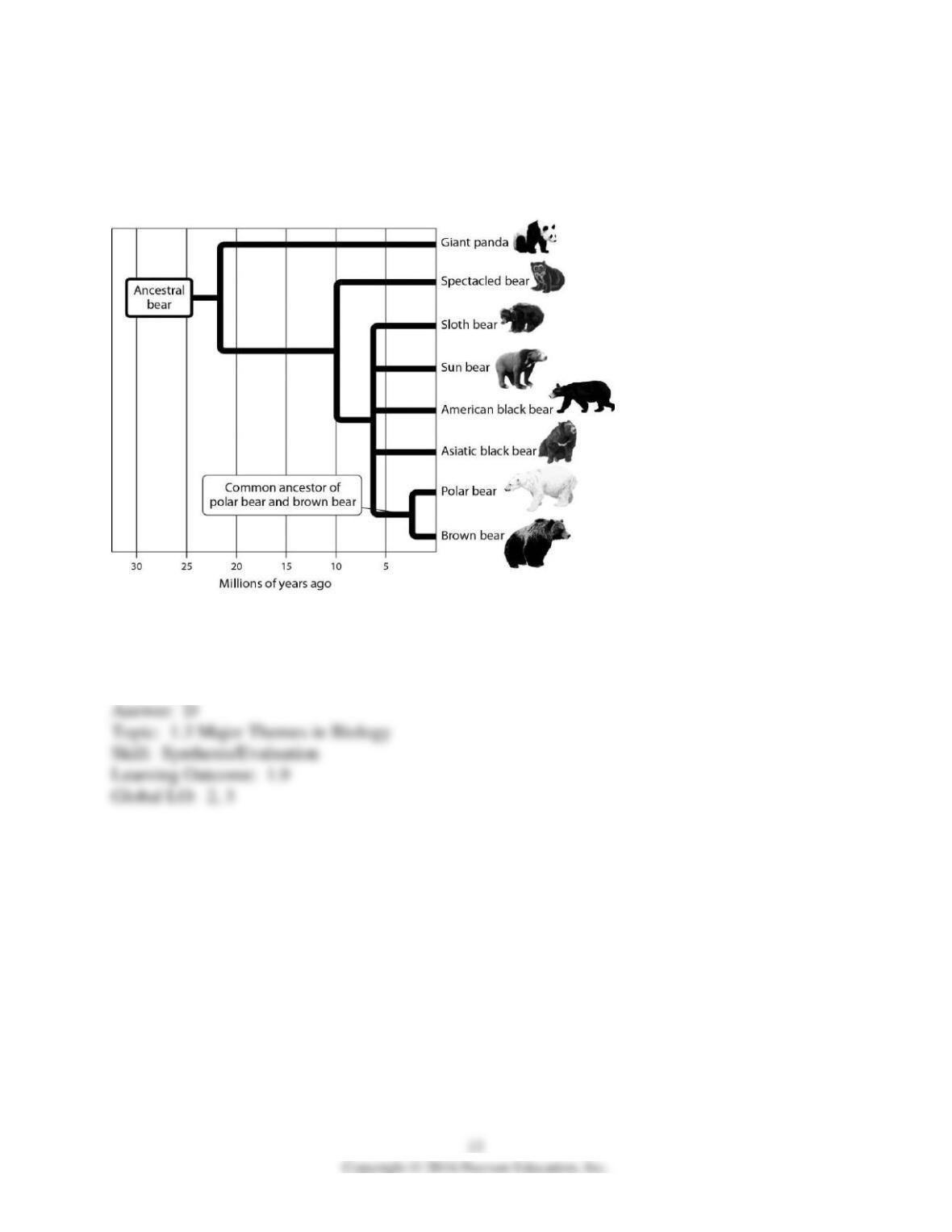
1.2 Art Questions
1) Using the branching tree of life for bears depicted in the accompanying figure, choose from
among the following bear species the one that is most distantly related to the sun bear.
A) brown bear
B) sloth bear
C) spectacled bear
D) giant panda
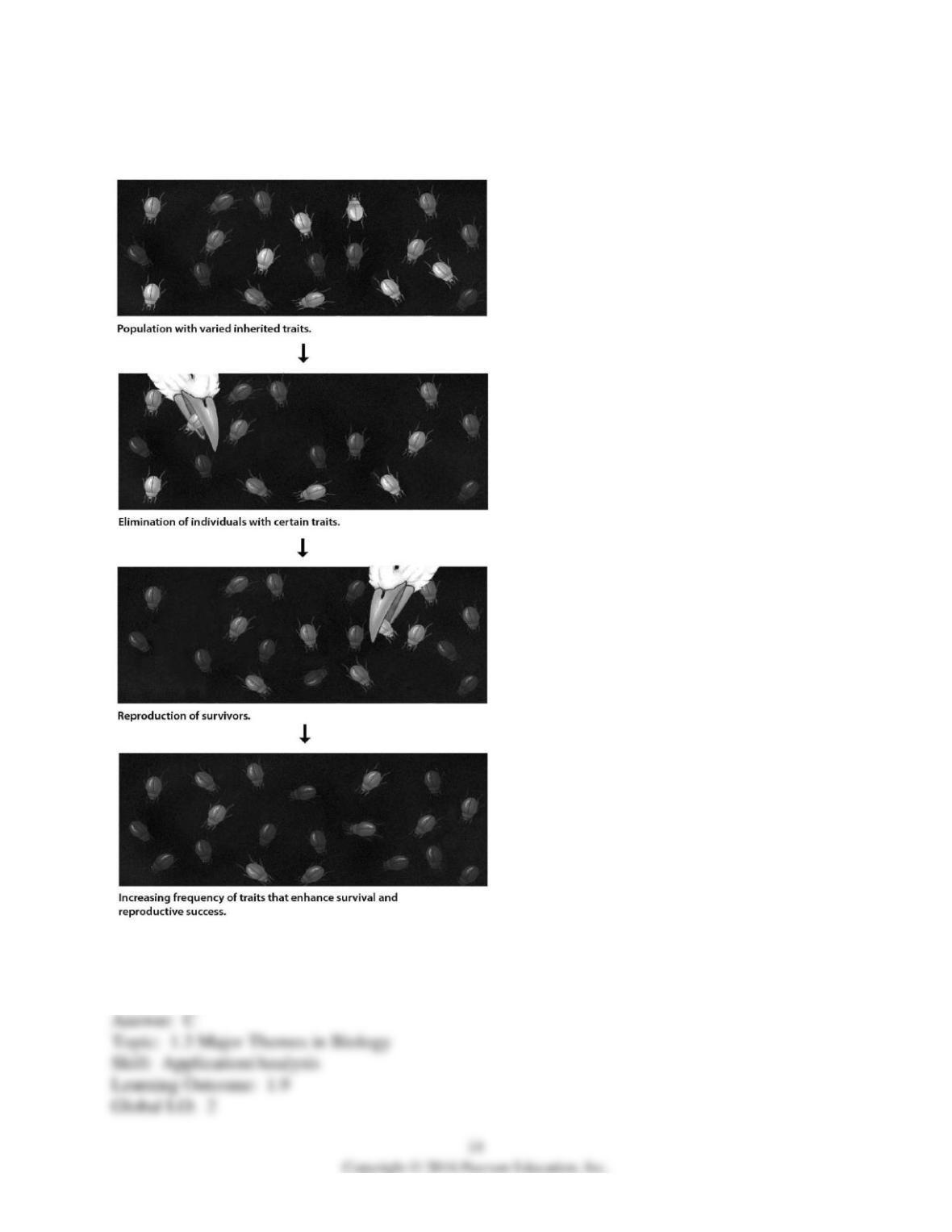
2) In the process of evolution by natural selection illustrated in the accompanying figure, which
of the following is the mechanism or agent of natural selection?
A) artificial selection
B) selective breeding
C) selective predation
D) genetic drift

1.3 Scenario Questions
Please use the following information to answer the following question(s).
The collared lizard is a species found in the Desert Southwest. Male collared lizards show
considerable color variation, ranging from brightly colored to a very dull pattern. Your goal is to
determine the function, if any, of male color patterns in collared lizards, using the scientific
method. Your tentative explanation is that male color plays a role in attracting females for
mating purposes. You predict that females will preferentially choose brightly colored males over
dull-colored ones. To test your prediction, you observed the interactions of female collared
lizards with their male counterparts. You selected males that were the same age and size, and that
differed only in their coloration pattern. You placed equal numbers of the two types of male
lizards, bright and dull, in aquariums, along with one female lizard per aquarium. Out of 350
aquariums observed, the female chose to mate with the brightly colored male 277 times, and the
dull-colored male 70 times. In three instances, the females did not mate with either type.
Create a bar graph of your data, plotting the type of male (dull or brightly colored) on the x-axis.
On the y-axis, plot the frequency with which each type of male was chosen by females. Using
this graph, answer the following questions.
1) Is it reasonable to conclude (i.e., is it supported by the data) that female collared lizards prefer
more brightly colored male lizards over dull-colored males?
A) Yes, this conclusion is supported by the data.
B) No, this conclusion is not supported by the data.
C) The data do not clearly indicate a preference one way or the other.
D) None of the above choices are correct.
2) Dull-colored males were used in this experiment to ________.
A) serve as a comparison (control) group to the brightly colored males
B) be sure that females could recognize the gender of the other lizards
C) give the experiment more trials so that the data would be more persuasive
D) be sure all females had a male with which they could mate

3) Which of the following is the hypothesis of this case study?
A) Male collared lizards exhibit color variation.
B) Dull-colored males are less likely to be eaten by predators.
C) A function of male coloration is to attract females.
D) Males prefer brightly colored females.
4) “Male collared lizards show considerable color variation.” This is a(n) ________.
A) hypothesis
B) conclusion
C) observation
D) result
5) Which of the following conclusions can be drawn from the data?
A) Dull-colored females are more likely to choose dull-colored males.
B) Dull-colored males are likely to choose dull-colored females.
C) Brightly colored males are stronger and more fertile than dull-colored males
D) Females do not always choose brightly colored males.
6) If the proportion of brightly colored male lizards increased steadily in future generations, this
would ________.
A) reject the original hypothesis
B) be an example of evolution due to natural selection
C) illustrate the relationship between structure and function
D) demonstrate the flow of energy through a system