
A woman struggling with a bacterial illness is prescribed a month’s supply of a potent
antibiotic. She takes the antibiotic for about two weeks and feels much better. Should
she save the remaining two-week supply, or should she continue taking the drug?
A) She should save the drug for later, because if she keeps taking it the bacteria will
evolve resistance.
B) She should save the drug for use the next time the illness strikes.
C) She should save the drug because antibiotics are in short supply and she may need it
to defend herself against a bioterrorism incident.
D) She should continue taking the drug until her immune system can completely
eliminate the infection. Otherwise, some bacteria may remain in her system, and they
will probably be resistant.
Which of the following statements about Alzheimer’s disease is true?
A) Alzheimer’s disease is suspected if a patient cannot retain his or her balance.
B) Alzheimer’s disease is age-related, increasing in frequency as people age.
C) Alzheimer’s disease often reverses or improves with time.
D) Alzheimer’s disease frequently involves positive changes in personality.
Dinoflagellates are best described as

A) protozoans that use cilia to move and feed.
B) marine and freshwater algae that can produce harmful red tides.
C) parasitic protozoans that must spend part of their life cycles in vertebrate hosts.
D) large, multicellular algae that resemble plants but do not have true leaves, stems, or
roots.
Which of the following statements best describes the power stroke of muscle
contraction?
A) The myosin head bends, pulling the thick filament toward the center of the
sarcomere.
B) The myosin head bends, pulling the thin filament toward the center of the sarcomere.
C) The actin head bends, pulling the thin filament toward the center of the sarcomere.
D) The actin head bends, pulling the thick filament toward the center of the sarcomere.
Radioactive isotopes
A) are frequently added to foods as nutritional supplements.
B) can be used in conjunction with PET scans to diagnose diseases.

C) do not occur naturally.
D) are never incorporated into organic compounds.
Which adaptation is a key characteristic of annelids that greatly increases their
flexibility and mobility?
A) complete digestive tract
B) exoskeleton
C) segmentation
D) three true tissue layers
Which part of this figure depicts an arteriole?
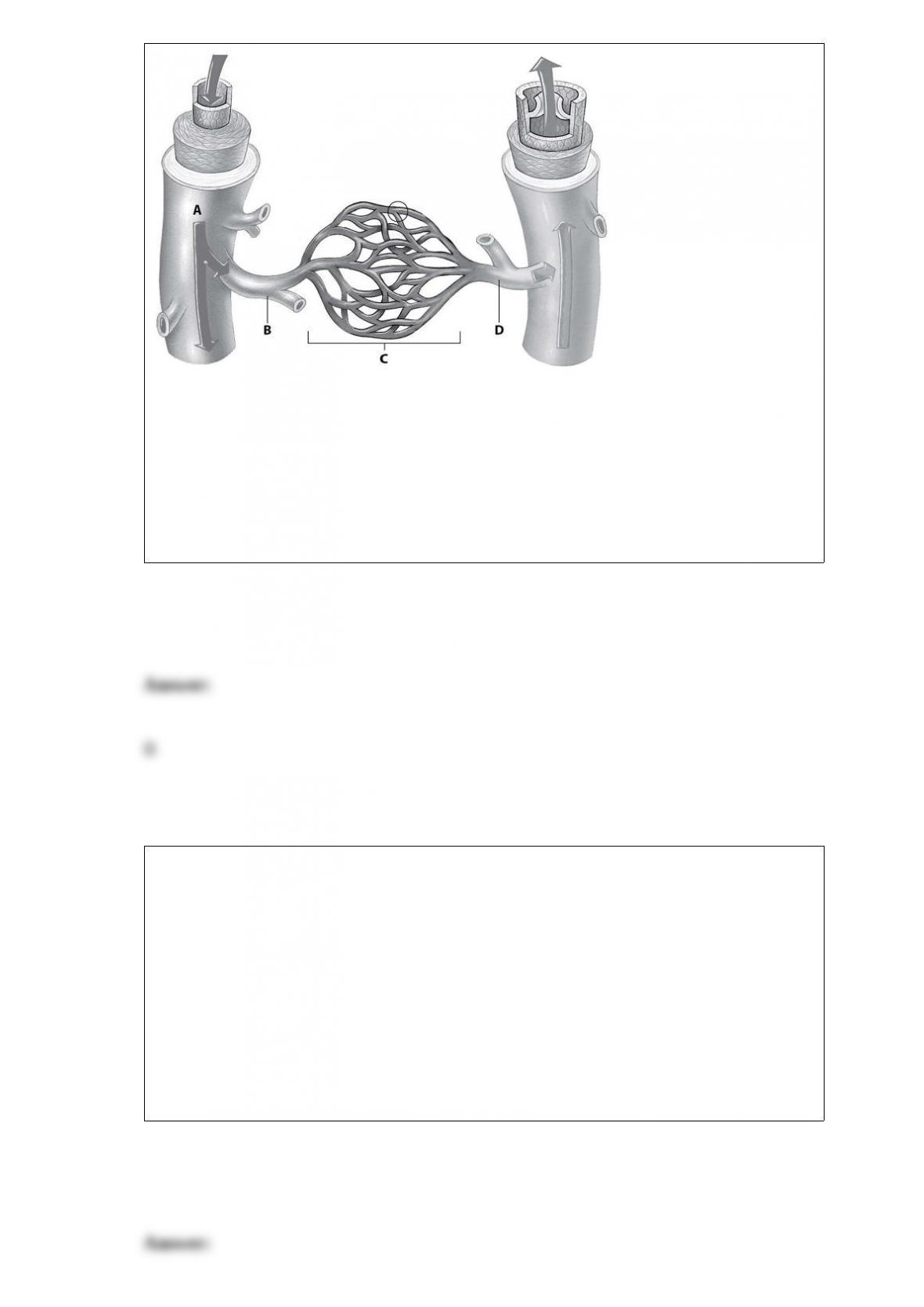
A) part A
B) part B
C) part C
D) part D
White blood cells (WBCs) are more resistant to lysis than red blood cells (RBCs).
When looking at a sample of blood for WBCs, what could you do to reduce interference
from RBCs?
A) Mix the blood in a salty solution to cause the RBCs to lyse.
B) Mix the blood in an isotonic solution and allow the WBCs to float to the top.
C) Mix the blood in a hypotonic solution, which will cause the RBCs to lyse.
D) Mix the blood in a hypertonic solution, which will cause the RBCs to lyse.

The 2009 H1N1 flu virus
A) was an avian flu virus.
B) was spread by mosquitoes.
C) evolved through the genetic reshuffling of viruses that infect humans, birds, and
pigs.
D) killed over 50 million people worldwide.
Schizophrenia
A) can best be described as feeling a sense of worthlessness.
B) is often associated with hallucinations and paranoid delusions.
C) causes changes in body weight and sleeping patterns.
D) is best defined as a type of mental deterioration or dementia.

In your backyard you overturn a large rock. In the damp soil underneath the rock, you
see various insects scurrying for cover: two black beetles, five black ants, two brown
beetles, and three pillbugs. In this community of organisms, relative abundance favors
A) pillbugs.
B) ants.
C) beetles.
D) pillbugs and beetles equally.
The advantage of being able to clone the gene for human insulin is that
A) there are too few cows, pigs, and horses to provide an adequate supply of their
insulin.
B) human insulin is less likely to cause harmful side effects than cow, pig, or horse
insulin.
C) cow, pig, or horse insulin cannot keep a diabetic alive for more than three months.
D) using human insulin increases the probability that, in the future, the person suffering
from diabetes can be weaned from a dependence on insulin.

After reading the paragraphs below, answer the questions that follow.
Scientists believe that a shift from pollination by insects to pollination by birds occurred
several times over the course of angiosperm evolution. Two researchers designed an
experiment to investigate how these shifts might evolve using two species of monkey
flower (Mimulus spp.). M. lewisii has violet-pink flowers and is pollinated by
bumblebees. M. cardinalis has orange-red flowers and is pollinated by hummingbirds.
The researchers switched flower-color genes between the two species. As a result of the
gene transfer, they produced a variation of M. cardinalis with dark pink flowers (instead
of the original orange-red) and a variation of M. lewisiis with orange flowers (instead of
the original violet-pink). Plants of both genetically altered varieties were placed in their
original habitats and observed. The genetically altered variety of M. cardinalis was
visited by bumblebees 74 times more often than plants with the original color flowers.
The genetically altered variety of M. lewisii was visited by hummingbirds 68 times
more often than plants with the original color flowers.
Based on the results of this study, you can conclude that
A) petal color won’t contribute to speciation, since pollinators will select familiar plant
species regardless of petal color.
B) gene mutations that affect petal color will also affect nectar production.
C) gene mutations affecting petal color can contribute to speciation through a shift in
pollinator species.
D) flower color does not appear to be an important factor in the speciation of flowering
angiosperms.
Which hormone prevents a seed released in the fall from germinating immediately?
A) auxins
B) abscisic acid
C) gibberellins
D) ethylene

The lac operon inEscherichia coli
A) prevents lactose-utilizing enzymes from being expressed when lactose is absent
from the environment.
B) prevents lactose intolerance.
C) prevents lactose-utilizing enzymes from being expressed when lactose is present in
the environment.
D) promotes the expression of lactose-utilizing enzymes when lactose is absent from
the environment.
Which of the following are important in breaking down organic material in fertile
topsoil?
A) abrasive granite particles
B) humus and cations
C) bacteria and fungi
D) plant roots

You find a wormlike, soft-bodied adult animal in a mudflat. It is bilaterally
symmetrical, is segmented, has a true coelom, and has a complete digestive tract. Based
on these characteristics, what phylum does the animal represent?
A) Cnidaria
B) Platyhelminthes
C) Nematoda
D) Annelida
Suppose that during the embryonic development of a hand, homeotic gene expression is
altered such that the dorsal-ventral axis is switched. What is the most likely outcome of
this scenario?
A) The palm and back of the hand will be switched.
B) The pinky and thumb would be switched.
C) The shoulder and hand would be switched.
D) The foot and hand would be switched.

Which of the following statements about ecosystems is false?
A) Energy cycles from organisms through the atmosphere and back to the organisms.
B) Carbon cycles from the atmosphere through organisms and back to the atmosphere.
C) Energy of sunlight is converted to energy stored in sugar molecules.
D) Most energy that enters the ecosystem leaves the system as heat.
Which of the following statements regarding antigens and antibodies is false?
A) An antibody usually recognizes and binds to an antigenic determinant.
B) A single antigen may stimulate the immune system to make several distinct
antibodies to it.
C) Most antigens are proteins or large polysaccharides on the surfaces of viruses or
foreign cells.
D) Each antibody has only one antigen-binding site.
Why must some hormones bind to a membrane receptor on a target cell’s surface in
order to activate it?

A) for activation by ATP
B) because they are not water-soluble
C) because they cannot cross cell membranes
D) to stimulate endocytosis to internalize the hormone
Which of the following statements characterizes the lytic cycle of a viral infection?
A) The cycle typically ends when the host bacterium divides.
B) The cycle typically leads to the lysis of the host cell.
C) The virus reproduces outside of the host cell.
D) The viral genes typically remain inactive once they are inside the host cell.
Which division of the human nervous system carries signals to skeletal muscles?
A) autonomic nervous system
B) parasympathetic nervous system
C) sympathetic nervous system
D) motor system

What dense storage granules in plant cells are thought to contribute to gravitropism?
A) starch
B) cellulose
C) proteins
D) chlorophyll
Researchers are trying to make a genetically modified (GM) pig that expresses bovine
(cow) growth hormone to make it grow bigger. They isolated the bovine growth
hormone gene, cut it and a plasmid with the same restriction enzyme, and mixed them
together. They inserted the mixture into pig zygotes, but only normal pigs, not GM pigs,
grew. What did they likely do wrong?
A) They are trying to make a GM animal, which is impossible.
B) They forgot to add DNA ligase after mixing the plasmid and gene together.
C) They should have used different restriction enzymes to cut the plasmid and the gene.
D) They forgot to use PCR and make multiple copies of the growth hormone gene.
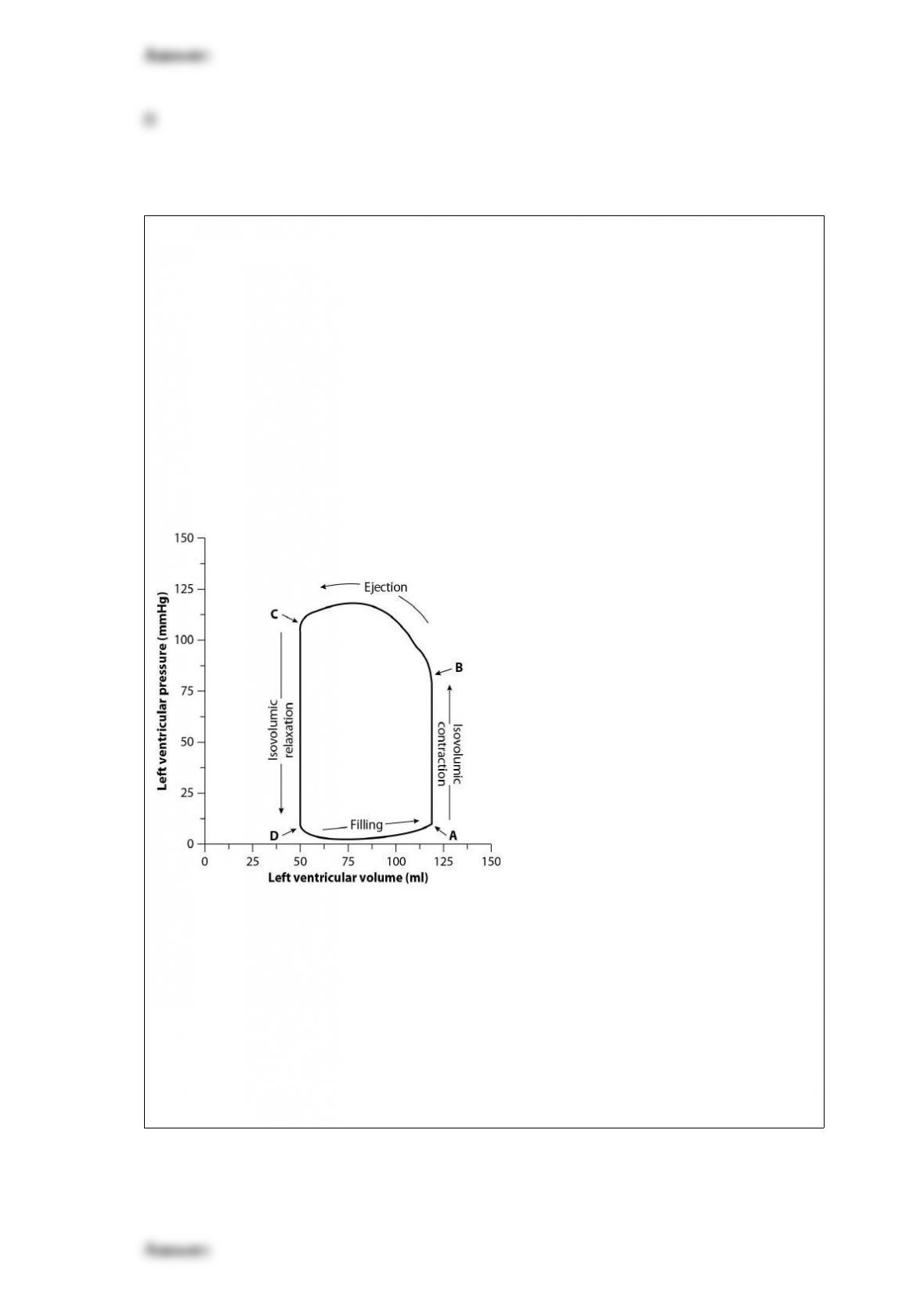
To evaluate cardiac function, scientists and physicians measure both the pressure and
the volume inside the heart. When both pressure and volume data are plotted on the
same graph, the resulting graph is called a pressure-volume loop. To create a
pressure-volume loop, a catheter (a thin tube) is inserted into the vessels of the heart,
and measurements of both left ventricular pressure and left ventricular volume are
taken. The data are plotted on a graph, and cardiac function can then be evaluated from
the distribution of the data and the shape of the loop.
The figure below shows a typical left ventricle pressure-volume loop for a healthy
young adult. The cardiac cycle proceeds counterclockwise. Each complete turn around
the loop (for example, starting at point A and ending back at point A) represents one
complete cardiac cycle.
What part of the diagram represents diastole?
A) point B
B) point C
C) the line between points A and B
D) the line between points C and D

Species in widely separated but similar biomes often appear to display similar
characteristics because of
A) convergent evolution.
B) coevolution.
C) mutations.
D) evolutionary drift.
Coral reefs are made up of genetically identical coral polyps. New polyps develop as
offshoots from the parental polyp. What type of reproduction do coral polyps use?
A) budding
B) fission
C) fragmentation
D) sexual reproduction

Which of the following statements about cells is true?
A) All cells have cell walls.
B) All cells have internal structures that move.
C) All cells are attached to other cells.
D) All cells are motile.
Greenhouse gases include
A) nitrous oxide and oxygen.
B) nitrogen and oxygen.
C) carbon dioxide and nitrogen.
D) carbon dioxide and methane.
Which of the following is an example of exaptation?
A) Wings are longer in some birds than others.
B) Human middle ear bones are derived from ancestral gill arch tissue.
C) Wings of bats and wings of birds are homologous.

D) Mutation rates can increase at higher temperatures.
Which of the following items demonstrates radial symmetry?
A) a glove
B) a tennis racket
C) a pair of sunglasses
D) an apple pie
Low levels of the neurotransmitter dopamine can lessen the ability to focus effectively
on tasks. However, high levels of dopamine can result in feelings of motivation. How
would you classify dopamine and why?
A) Dopamine is excitatory because it enhances motivation levels.
B) Dopamine is inhibitory because it diminishes the ability to focus.
C) Dopamine is both inhibitory and excitatory because it can enhance motivation levels
but diminish the ability to focus.
D) There is not enough information given to answer the question.

Which of the following would have the greatest number of muscle cells per motor unit?
A) muscles controlling the movement of our hands
B) facial muscles
C) a thigh muscle
D) muscles controlling the movement of an eyeball
When two different populations in a community benefit from their relationship with
each other, the result is called
A) herbivory.
B) mutualism.
C) parasitism.
D) competition.