1) cnidaria and flatworms exchange gases and remove wastes by way of their
a. open circulatory systems.
b. closed circulatory systems.
c. gastrovascular cavities.
d. moist skin surfaces.
e. respiratory and excretory systems.
2) which of the following organisms will contain hemolymph as the fluid of their
circulatory system?
a. grasshopper
b. sea star
c. molluscs
d. all of the above have hemolymph
3) which of these characteristics first developed in reptiles?
a. amniotic egg
b. scales on skin
c. four-legged body
d. skull and vertebral column
e. animals living completely on land
4) what are the end products of photosynthesis?
a. water and carbon dioxide
b. water and oxygen
c. oxygen and carbohydrate
d. carbohydrate and water
5) the cycle of viral infection of a bacterial cell that will cause its death most rapidly is
called the _______ cycle.
a. lysogenic
b. lysozyme
c. lytic
d. lysol
e. lysosome
6) skeletal muscle
a. is made of extremely small cells with one nucleus.
b. is not under voluntary control.
c. is found in the walls of the intestines and stomach.
d. has bands of actin and myosin filaments perpendicular to the length of the cell that
produce contractions.
7) which of the following statements about an action potential is not true?
a. repolarization occurs when potassium leaves the axon.
b. there is a rapid change in polarity from about -65 mv to about +40 mv during
depolarization.
c. an action potential takes 2 to 5 seconds.
d. depolarization occurs when sodium gates open and allow sodium ions to enter the
axon.
e. potassium gates open after the sodium gates and allow potassium ions to leave the
cell.
8) both 18o and 16o are found in nature. however, 16o is the most common. therefore,
a. these are different elements.
b. oxygen atoms can have eight or 10 neutrons.
c. 18o has two additional electrons in its outer shell.
d. 18o is the form of oxygen that provides living cells with life.
e only the common form of 16o can bond with hydrogen atoms to form h2o.
9) all of the following are taproots that are consumed as vegetables except
a. carrots.
b. celery.
c. turnips.
d. radishes.
e. beets.
10) in humans, the central nervous system consists of the _____, which is housed in the
_____ and the ______, which is housed in the _____.
a. peripheral nervous system; limbs; brain; skull
b. brain; skull; spinal cord; vertebral column
c. spinal cord; vertebral column; sensory neurons; limbs
d. brain; vertebral column; spinal cord; skull
11) which stage is most associated with a cell that is unable to divide again, such as a
muscle or nerve cell?
a. m phase
b. g1 phase
c. g2 phase
d. s phase
e. g0 phase
12) dr. james isolated staphylococcus aureus, a type of bacteria, from the leg wound of
a ten year old boy. he suspected these bacteria would grow better at body temperature
than room temperature (72f), but thought that he should collect data to support his
thinking. dr. james introduced the same number of staphylococcus bacteria into each of
six test tubes containing the same type and amount of nutrient broth. three test tubes
were incubated at 98.6f (group 1), while three test tubes (group 2) sat at 72f. after 24
hours, dr. james compared the turbidity (indicative of growth) of all six tubes and rated
each on a scale of 0 – 4. 0 indicates no turbidity (no growth), while 4 indicates high
turbidity (high growth). the following data was collected:
the independent (experimental) variable is:
a. temperature
b. growth of bacteria
c. incubation period
d. amount of initial inoculum
13) what tissue type is characterized by being a transport medium for nutrients and also
includes blood and adipose tissues?
a. muscle tissue
b. nervous tissue
c. epithelial tissue
d. connective tissue
14) identify the features unique to protostome development.
a. coelom forms by a splitting of the mesoderm, the blastophore becomes the mouth and
the cleavage is spiral.
b. coelom forms by a splitting of the mesoderm, the blastophore becomes the anus and
the cleavage is spiral.
c. coelom forms by a splitting of the mesoderm, the blastophore becomes the mouth and
the cleavage is radial.
d. none of the above features are unique to the protostomes.
15) the alternation of circular muscle contraction and longitudinal muscle contraction
allows the earthworm to move forward. what type of support system aids locomotion in
the earthworm?
a. an exoskeleton
b. an endoskeleton
c. a calcium carbonate shell
d. a hydrostatic skeleton
16) which of the following reptilian features enabled them to adapt to a terrestrial
environment?
a. a dry skin, ectothermy and external fertilization
b. two pairs of paired limbs, a septum that divides the ventricle, and well developed
kidneys
c. skin that allows for respiration, a septum that divides the ventricle and an amniotic
egg
d. efficient respiration, ectothermy and external fertilization
e. live birth, efficient excretion and two pairs of limbs
17) which description best fits that of an open circulatory system?
a. the heart pumps hemolymph into tissue spaces that are enlarged into saclike sinuses.
b. the heart pumps blood across gills and then into tissue spaces that are enlarged into
saclike sinuses.
c. gases diffuse across a cutaneous membrane and then move into tissue spaces that are
enlarged into saclike sinuses.
d. the heart pumps hemolymph into tissue spaces that route the fluid across the gills for
gas exchange.
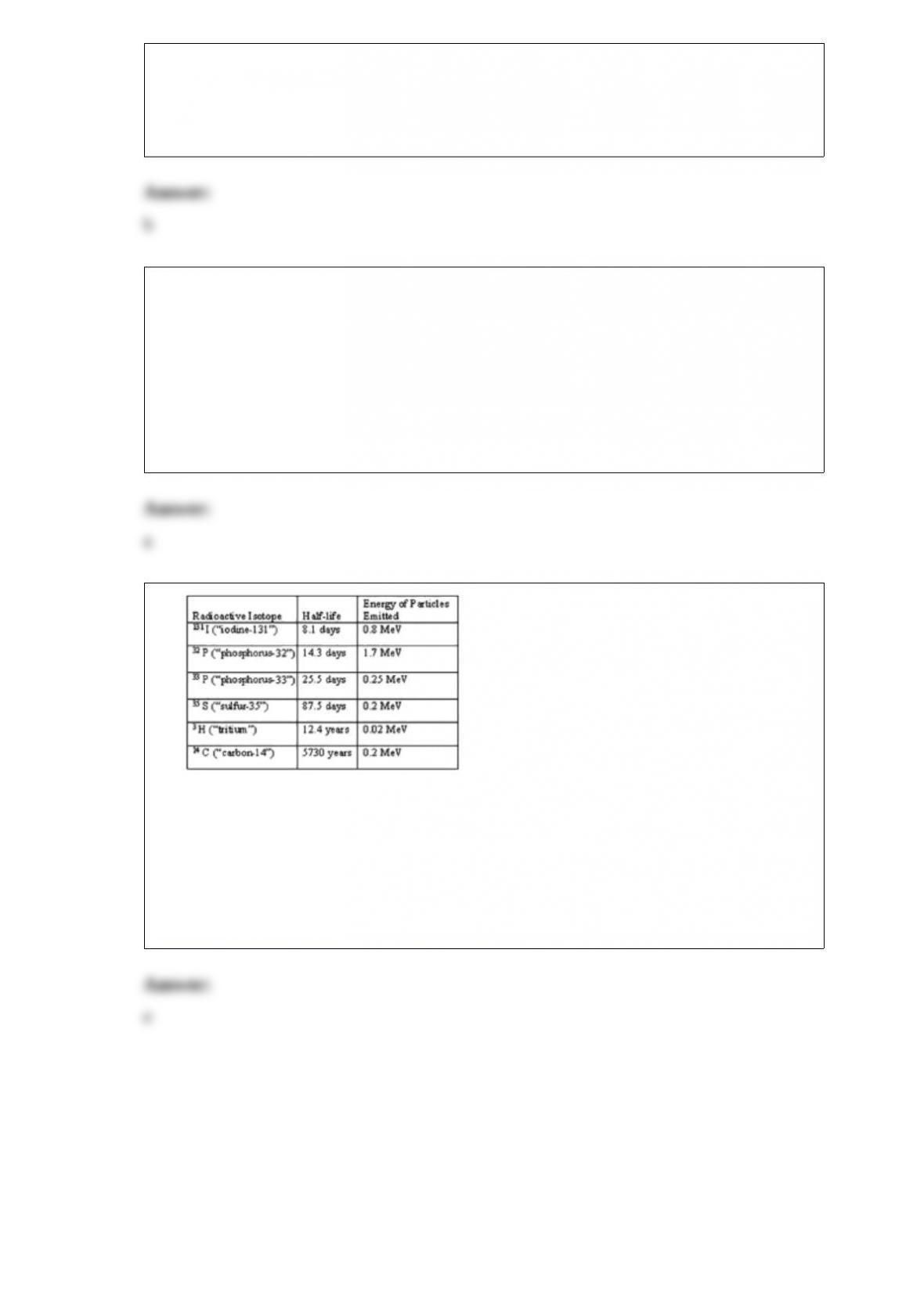
18)
from the above table of radioisotopes and their properties, it is obvious that
a. the longer the half-life, the more energy emitted by the particles.
b. the longer the half-life, the less energy emitted by the particles.
c. radioisotopes of the same element must emit the same amount of energy in their
emissions and decay at the same rate.
d. adjusted for time, radioisotopes emit the same amount of energy in their emissions.
e. energy and half-life are not directly related.