
Why has C. elegans proven to be a useful model for understanding apoptosis?
A) The animal does not naturally use apoptosis, but can be induced to do so in the
laboratory.
B) The nematode undergoes a fixed and easy-to-visualize number of apoptotic events
during its normal development.
C) This plant has a long-studied aging mechanism that has made understanding its
death just a last stage.
D) While the organism ages, its cells die progressively until the whole organism is
dead.
The tertiary structure of a protein is the _____.
A) order in which amino acids are joined in a polypeptide chain
B) unique three-dimensional shape of the fully folded polypeptide
C) organization of a polypeptide chain into an α-helix or β-pleated sheet
D) overall protein structure resulting from the aggregation of two or more polypeptide
subunits
Keystone predators can maintain species diversity in a community if they _____.

A) competitively exclude other predators
B) prey on the community’s dominant species
C) allow immigration of other predators
D) prey only on the least abundant species in the community
Although transposable elements and short tandem repeats (STRs) are repetitive DNAs,
they differ in that _____.
A) STRs occur within exons; transposable elements occur within introns
B) STRs occur within introns; transposable elements occur within exons
C) the repeated unit in STRs is clustered one after another; transposable element repeats
are scattered throughout the genome
D) the repeated unit in STRs is much larger than the repeated unit of transposable
elements
The following questions refer to the figure below, which depicts the age structure of
three populations.
Which population(s) appear(s) to be stable?
A) I
B) III
C) I and II
D) II and III
Use the following information to answer the question(s) below.
Researchers studying a small milkweed population note that some plants produce a
toxin and other plants do not. They identify the gene responsible for toxin production.
The dominant allele (T) codes for an enzyme that makes the toxin, and the recessive
allele (t) codes for a nonfunctional enzyme that cannot produce the toxin.
Heterozygotes produce an intermediate amount of toxin. The genotypes of all
individuals in the population are determined (see chart) and used to determine the actual
allele frequencies in the population.
If, on average, 46% of the loci in a species’ gene pool are heterozygous, then the
average homozygosity of the species should be _____.
A) 23%
B) 46%
C) 54%
D) 92%

While looking at a flower in your garden, you notice that it has carpels with very long
styles, and stamens with very short filaments. This plant is most likely to reproduce by
_____.
A) cross-pollination
B) selfing
C) asexual reproduction
Elevated carbon dioxide levels have been shown to contribute to the greenhouse effect,
resulting in an increase in mean global temperature. Ecosystems where the largest
warming has already occurred include snow-covered northern coniferous forests,
tundra, and arctic sea ice habitats. Which statement best explains how the elimination of
ice-covered ecosystems affects the rise or fall in global temperature?
A) Melting ice releases dissolved ozone gas, which adds to the greenhouse effect.
B) More reflective surfaces of ice are replaced with darker, more absorptive surfaces,
thereby contributing to the warming trend.
C) Large-scale ice melts actually contribute toward lowering global temperatures by
decreasing salinity of the oceans.
D) Carbon dioxide levels are lowered as a result of greater volume of water to
accommodate greater dissolved gas.

The multicellular condition of animals and fungi seems to have arisen _____.
A) due to common ancestry
B) by convergent evolution
C) by inheritance of acquired traits
D) by serial endosymbioses
Which of these would a paleontologist most likely do to determine if a fossil represents
a reptile or a mammal?
A) Look for the presence of milk-producing glands.
B) Look for the mammalian characteristics of a four-chambered heart and a diaphragm.
C) Use molecular analysis to look for the protein keratin.
D) Examine the teeth.
Which of the following would increase the electrochemical gradient across a

membrane?
A) a sucrose-proton cotransporter
B) a proton pump
C) a potassium channel
D) both a proton pump and a potassium channel
The cities of Portland, Oregon, and Minneapolis, Minnesota, are at about the same
latitude, but Minneapolis has much hotter summers and much colder winters than
Portland. Why?
A) They are not at the same exact latitude.
B) The ocean near Portland moderates the temperature.
C) Fresh water is more likely to freeze than salt water.
D) Minneapolis is much windier, due to its location in the middle of North America.
Among protostomes, which morphological trait has shown the most variation?
A) type of symmetry (bilateral vs. radial vs. none)
B) type of body cavity (coelom vs. pseudocoelom vs. no coelom)

C) number of embryonic tissue types (diploblasty vs. triploblasty)
D) type of development (protostome vs. deuterostome)
Use this information to answer the question(s) below.
A researcher introduces double-stranded RNA into a culture of mammalian cells and
can identify its location or that of its smaller subsections experimentally, using a
fluorescent probe.
Some time later, she finds that the introduced strand separates into single-stranded
RNAs, one of which is degraded. What does this enable the remaining strand to do?
A) attach to histones in the chromatin
B) bind to complementary regions of target mRNAs
C) activate other siRNAs in the cell
D) bind to noncomplementary RNA sequences
Which pair of terms most accurately describes life history traits for a stable population
of wolves?
A) semelparous; r-selected

B) semelparous; K-selected
C) iteroparous; r-selected
D) iteroparous; K-selected
Use the following information to answer the question(s) below.
Paulinella chromatophora is one of the few cercozoans that is autotrophic, carrying out
aerobic photosynthesis with its two elongated “chromatophores.” The chromatophores
are contained within vesicles of the host cell, and each is derived from a
cyanobacterium, though not the same type of cyanobacterium that gave rise to the
chloroplasts of algae and plants.
Which of the following is responsible for nearly 100,000 human deaths worldwide
every year?
A) Entamoeba histolytica
B) Amoeba proteus
C) plasmodial slime molds
D) Dictyostelium discoideum
Fatty acids usually have an even number of carbons in their structures. They are
catabolized by a process called beta-oxidation. The end products of the metabolic
pathway are acetyl groups of acetyl CoA molecules. These acetyl groups _____.

A) directly enter the electron transport chain
B) directly enter the energy-yielding stages of glycolysis
C) are directly decarboxylated by pyruvate dehydrogenase
D) directly enter the citric acid cycle
If an organism was discovered that had no epithelial tissues, it would require
adaptations to maintain homeostasis in which of the following areas? The organism
would require adaptations _____.
A) in its skeleton for structure
B) in its nervous system for sensing external stimuli
C) that would prevent water loss from the body in a terrestrial environment
D) in its muscular system for movement
Use the following information to answer the question(s) below.
Estrogens found in the environment have raised concerns about effects on reproductive
health of animals. Researchers studied the effects that estrogens in the water have on
sexual differentiation in zebrafish. They exposed embryo-larval (0-21 days
post-hatching), juvenile (21-42 days post-hatching), and adult (over 200 days

post-hatching) fish to three concentrations of 17β-estradiol (5, 25, and 100
nanograms/liter) that are within the range of concentrations found in water leaving
sewage treatment plants in different countries. They then examined the proportion of
males and females when the fish exposed at embryo-larval and juvenile stages reached
adulthood. Embryo-larval stage fish that had been exposed to 100 ng/l 17β-estradiol
resulted in adult populations that had substantially more females than males compared
to control groups. Embryo-larval fish that had been exposed to 5 and 25 ng/l of
17β-estradiol did not show a statistically significant shift in the proportion of females.
(Brion, F., C. R. Tyler, X. Palazzi, B. Laillet, J. M. Porcher, J. Garric, and P.
Flammarion. 2004. Impacts of 17β-estradiol, including environmentally relevant
concentrations, on reproduction after exposure during embryo-larval-, juvenile-, and
adult-life stages in zebrafish (Danio rerio). Aquatic Toxicology 68:193-217.)
Refer to the paragraph on the effects of estrogens in the environment. What is the
significance of using the concentrations of 5, 25, and 100 ng/l of 17β-estradiol for the
dose in this experiment?
A) These concentrations are similar to those found in many animals.
B) These concentrations are found in the environment.
C) These concentrations are effective, yet not lethal to the fish.
D) These concentrations are standard in toxicology assays.
Which of the following are directly associated with photosystem I?
A) receiving electrons from the thylakoid membrane electron transport chain
B) generation of molecular oxygen
C) extraction of hydrogen electrons from the splitting of water
D) passing electrons to the cytochrome complex

Adenylyl cyclase has the opposite effect of which of the following?
A) protein kinase
B) protein phosphatase
C) phosphodiesterase
D) phosphorylase
For many years scientists believed that almost all animal lineages burst into being
during the Cambrian era (just after the end of the Precambrian super eon). However,
there have been many recent findings of animal-like fossils and “trace fossils” (fossils
of an animal-like organisms movement) from the late Precambrian. Which of the
following best explains why it took so long to realize there was animal-like life in the
Precambrian?
A) Animals from the late Precambrian had soft bodies.
B) There were many hard-shelled animals in the Cambrian.
C) The global climate was such that there was poor fossilization in the Precambrian.
D) There were very few animals during this period.
Use the following information to answer the questions below.
A series of enzymes catalyze the reaction X → Y → Z → A. Product A binds to the
enzyme that converts X to Y at a position remote from its active site. This binding
decreases the activity of the enzyme.
What is substance X?
A) an allosteric inhibitor
B) a substrate
C) an intermediate
D) the product
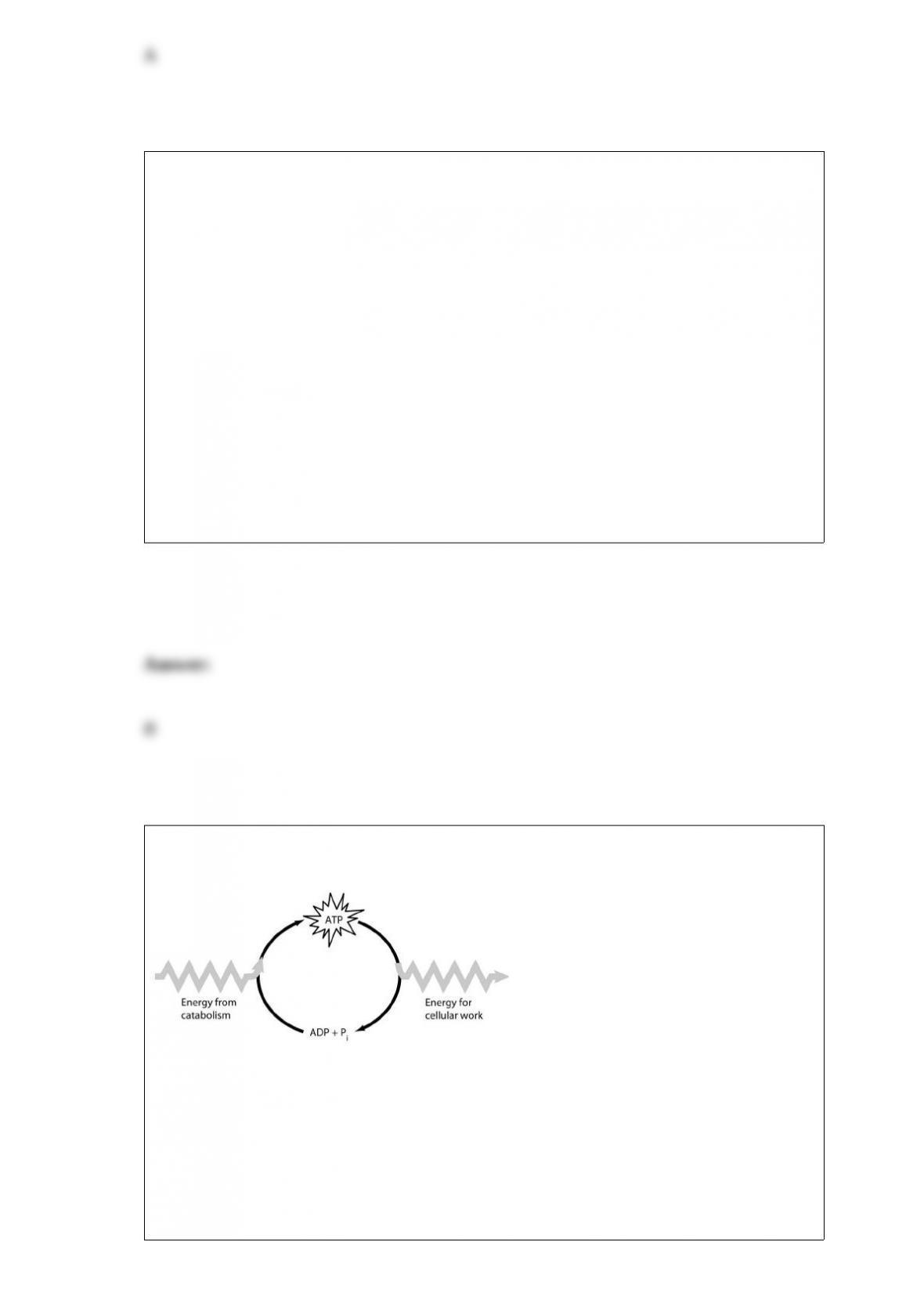
How do cells use the ATP cycle shown in the figure?
A) Cells use the cycle to recycle ADP and phosphate.
B) Cells use the cycle to recycle energy released by ATP hydrolysis.
C) Cells use the cycle to recycle ADP, phosphate, and the energy released by ATP

hydrolysis.
D) Cells use the cycle primarily to generate heat.
Assume a thylakoid is somehow punctured so that the interior of the thylakoid is no
longer separated from the stroma. This damage will most directly affect the _____.
A) splitting of water
B) flow of electrons from photosystem II to photosystem I
C) synthesis of ATP
D) reduction of NADP+
Which one of the following is NOT a component of each monomer used to make
proteins?
A) a phosphorus atom, P
B) an amino functional group, NH2
C) a side chain, R
D) a carboxyl group, COOH
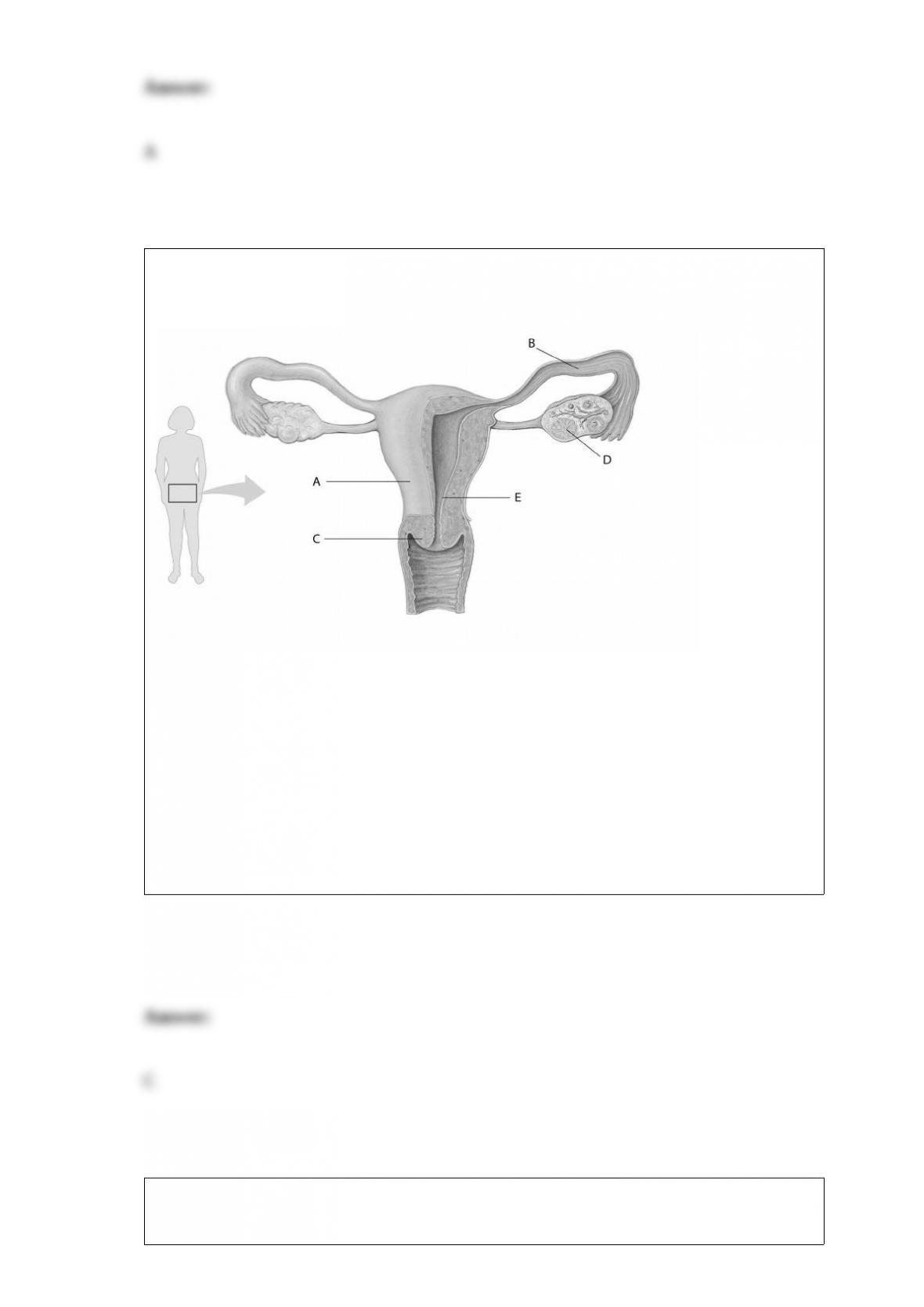
Refer to the following figure, which diagrams the reproductive anatomy of the human
female, to answer the question(s) below.
In the above figure, which letter points to the cervix?
A) A
B) B
C) C
D) D
Osmoregulatory adjustment via the renin-angiotensin-aldosterone system can be
triggered by _____.

A) sleeping for one hour
B) severe sweating on a hot day
C) eating a pizza with olives and pepperoni
D) drinking several glasses of water
Who performed classic experiments that supported the semiconservative model of DNA
replication?
A) Watson and Crick
B) Meselson and Stahl
C) Hershey and Chase
D) Franklin and Wilkins
There are advantages and disadvantages to adaptations. Animals that are endothermic
are likely to be at the greatest disadvantage in _____.
A) very cold environments
B) very hot environments

C) environments with a constant food source
D) environments with variable and limited food sources