
In a single molecule of water, two hydrogen atoms are bonded to a single oxygen atom
by _____.
A) hydrogen bonds
B) nonpolar covalent bonds
C) polar covalent bonds
D) ionic bonds
The first genetic material on Earth was probably _____.
A) DNA produced by reverse transcriptase from abiotically produced RNA
B) DNA molecules whose information was transcribed to RNA and later translated in
polypeptides
C) self-replicating RNA molecules
D) oligopeptides located within protobionts
Steroids are considered to be lipids because they _____.
A) are essential components of cell membranes
B) are not soluble in water

C) are made of fatty acids
D) contribute to atherosclerosis
The termite gut protist Mixotricha paradoxa has at least two kinds of bacteria attached
to its outer surface. One kind is a spirochete that propels its host through the termite
gut. A second type of bacteria synthesizes adenosine triphosphate (ATP), some of which
is used by the spirochetes. The locomotion provided by the spirochetes introduces the
ATP-producing bacteria to new food sources. Which term(s) is (are) applicable to the
relationship between the two kinds of bacteria?
1. mutualism
2. parasitism
3. symbiosis
4. metabolic cooperation
A) 1 and 2
B) 2 and 3
C) 1, 3, and 4
D) 2, 3, and 4

Which of the following can be sensed by plants?
I) gravity
II) pathogens
III) wind
IV) light
A) only I and III
B) only I, II, and IV
C) only II, III, and IV
D) I, II, III, and IV
What strategy was used to rescue Illinois prairie chickens from a recent extinction
vortex?
A) determining the minimum viable population size by taking into account the effective
population size
B) establishing a nature reserve to protect its habitat
C) introducing individuals from other populations to increase genetic variation
D) reducing the population size of its predators and competitors

In angiosperms, which number in the figure above represents a component contributing
to the formation of endosperm?
A) 1
B) 7
C) 9
D) 11
Why do moderate levels of disturbance result in an increase in community diversity?
A) Habitats are opened up for less competitive species.
B) Competitively dominant species infrequently exclude less competitive species after a
moderate disturbance.
C) The resulting uniform habitat supports stability, which in turn supports diversity.
D) Less-competitive species evolve strategies to compete with dominant species.
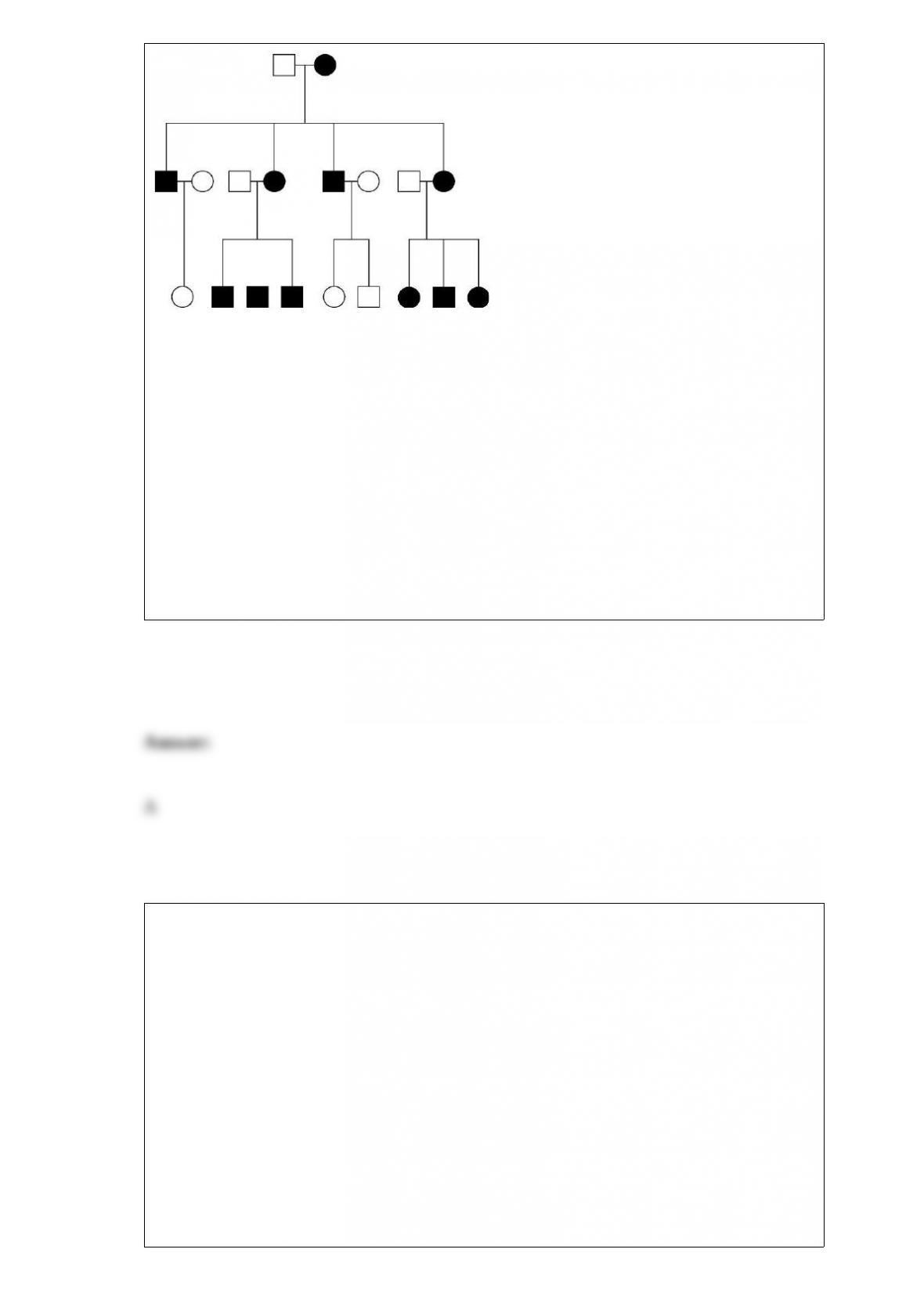
A certain kind of snail can have a right-handed direction of shell coiling (DD or Dd) or
left-handed coiling (dd). However, if direction of coiling is due to a protein deposited
by the mother in the egg cytoplasm, then a Dd egg-producing snail and a dd
sperm-producing snail will have offspring of which genotype(s) and phenotype(s)?
A) 1/2 Dd:1/2 dd; all right-coiling
B) all Dd; all right-coiling
C) 1/2 Dd:1/2 dd; half right-coiling and half left-coiling
D) all Dd; half right-coiling and half left-coiling
Lymphocytes mature in the _____.
I) spleen
II) thymus
III) bone marrow
A) only I and III
B) only I and II
C) only II and III
D) I, II, and III
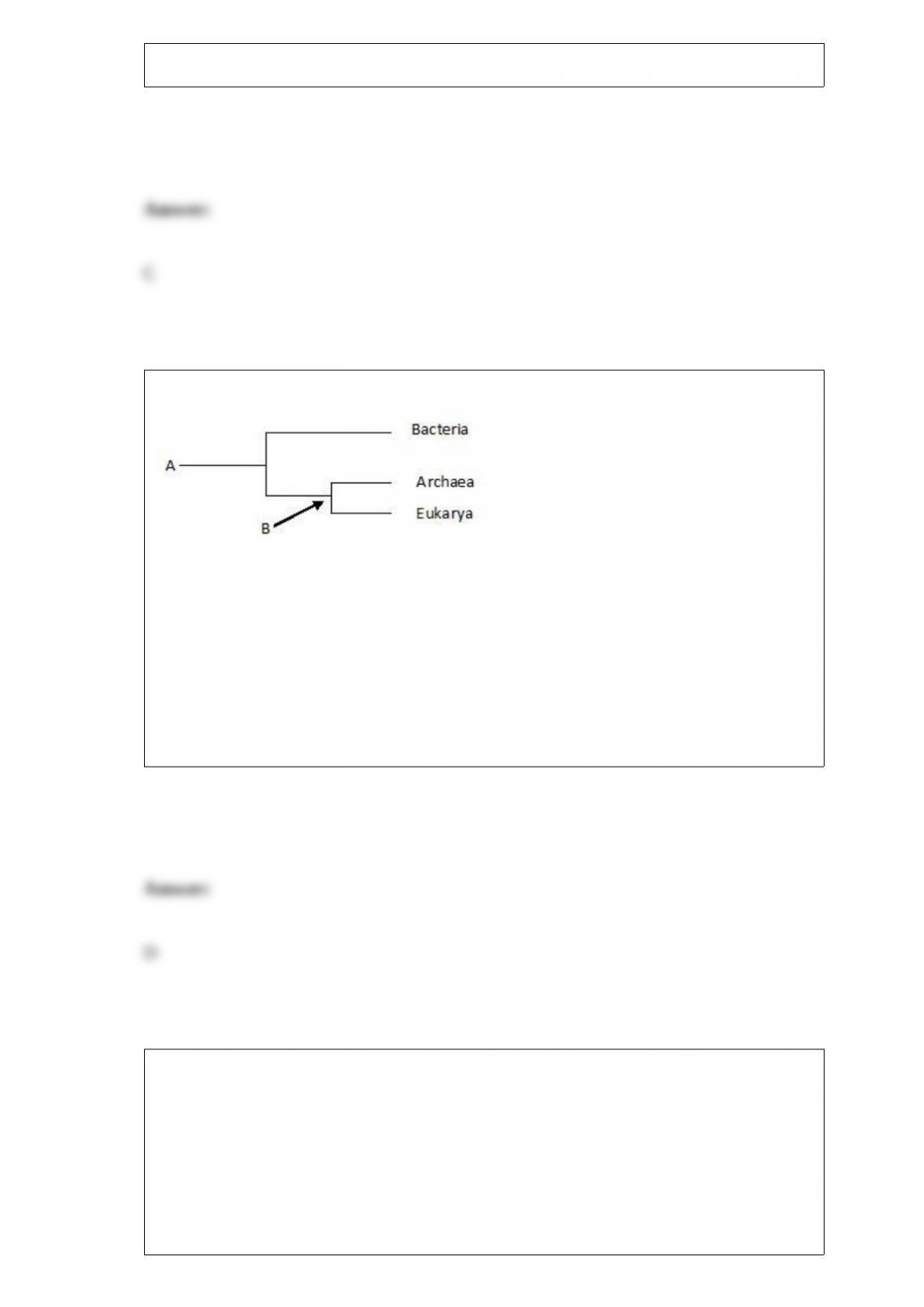
In the diagram below, “A” is _____ ; “B” is _____.
A) the most recent species to evolve on Earth; an ancestor of group “A”
B) the most recent species to evolve on Earth; the last common ancestor of Archaea and
Eukarya
C) the common ancestor of all life; the common ancestor of Bacteria and Archaea
D) the common ancestor of all life; the last common ancestor of Archaea and Eukarya
A botanist discovers a new species of land plant with a dominant sporophyte,
chlorophylls a and b, and cell walls made of cellulose. In assigning this plant to a
phylum, which of the following, if present, would be LEAST useful?
A) endosperm
B) seeds

C) flowers
D) spores
Which of the following types of plants are incapable of self-pollination?
A) dioecious
B) monoecious
C) wind-pollinated
D) insect-pollinated
Acetylcholine released into the junction between a motor neuron and a skeletal muscle
binds to a sodium channel and opens it. This is an example of _____.
A) a voltage-gated potassium channel
B) a ligand-gated sodium channel
C) a second-messenger-gated sodium channel
D) a chemical that inhibits action potentials

What is the reason that closely linked genes are typically inherited together?
A) They are located close together on the same chromosome.
B) The number of genes in a cell is greater than the number of chromosomes.
C) Alleles are paired together during meiosis.
D) Genes align that way during metaphase I of meiosis.
Which process is most directly driven by light energy?
A) creation of a pH gradient by pumping protons across the thylakoid membrane
B) carbon fixation in the stroma
C) reduction of NADP+ molecules
D) removal of electrons from chlorophyll molecules
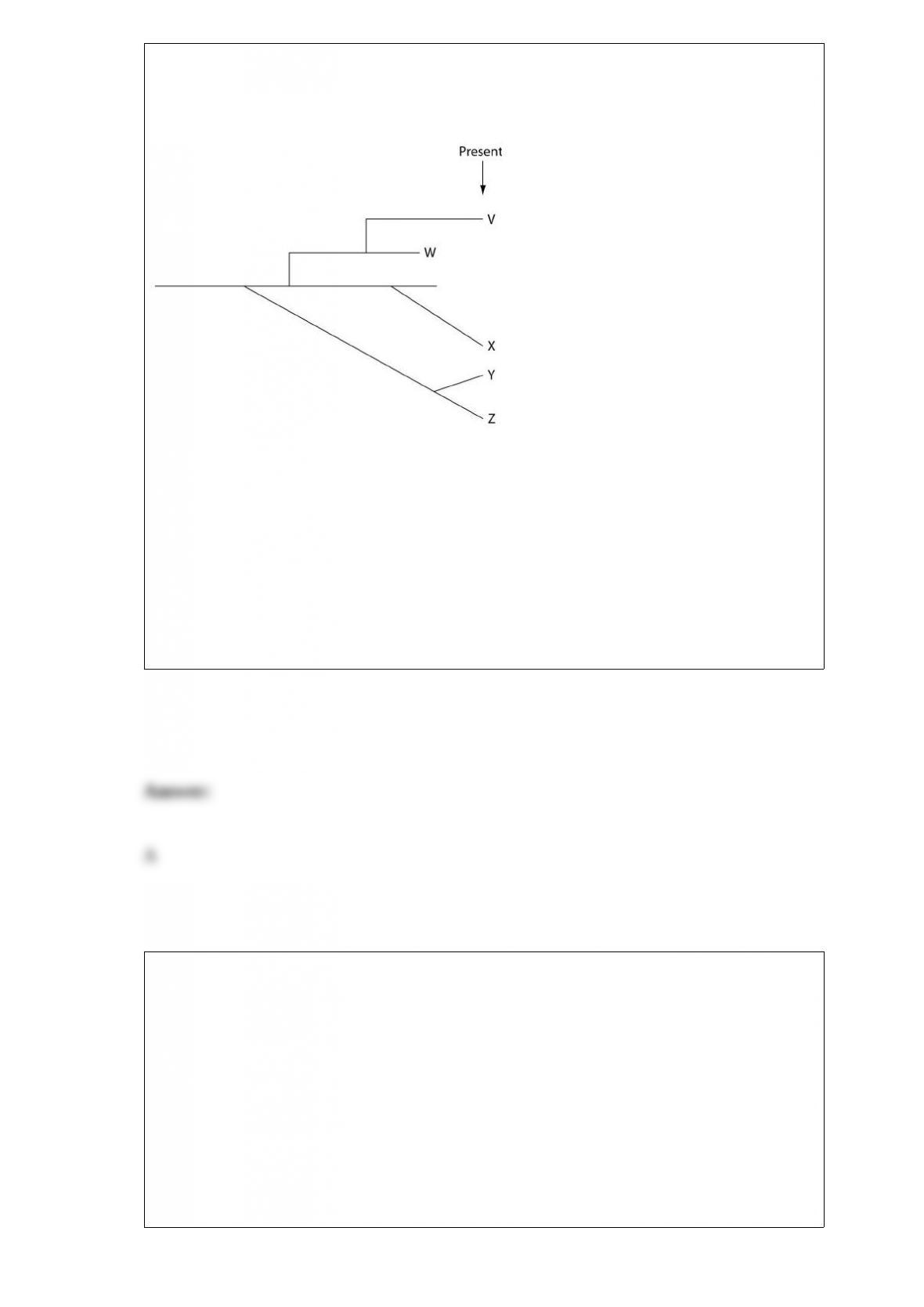
The questions below refer to the following evolutionary tree, in which the horizontal
axis represents time (present time is on the far right) and the vertical axis represents
morphological change.
Which of these is the extant (that is, living) species most closely related to species X?
A) V
B) W
C) Y
D) Z
Which of the following provides an example of epistasis?
A) Recessive genotypes for each of two genes (aabb) results in an albino corn snake.
B) In rabbits and many other mammals, one genotype (ee) prevents any fur color from
developing.
C) In Drosophila (fruit flies), white eyes can be due to an X-linked gene or to a
combination of other genes.
D) In cacti, there are several genes for the type of spines.
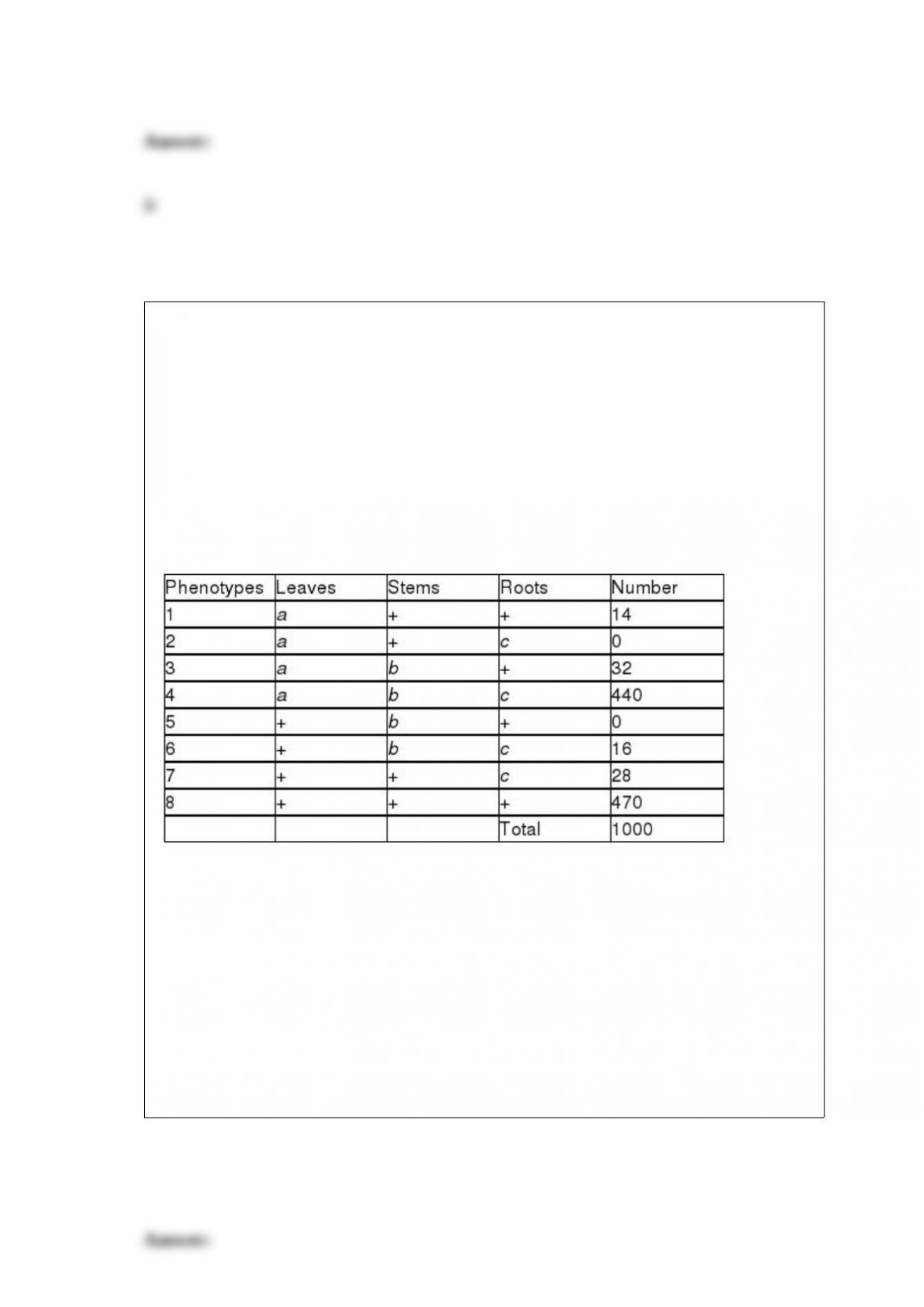
Use the following information to answer the question(s) below.
A plantlike organism on the planet Pandora can have three recessive genetic traits:
bluish leaves, due to an allele (a) of gene A; a feathered stem, due to an allele (b) of
gene B; and hollow roots due to an allele (c) of gene C. The three genes are linked and
recombine as follows:
A geneticist did a testcross with an organism that had been found to be heterozygous for
the three recessive traits and she was able to identify progeny of the following
phenotypic distribution (+ = wild type):
If recombination frequency is equal to distance in map units, what is the approximate
distance between genes A and B?
A) 3 map units
B) 6 map units
C) 15 map units
D) 30 map units

Which of the following best describes “game theory” as it applies to animal behavior?
A) The fitness of a particular behavior is influenced by other behavioral phenotypes in a
population.
B) The total of all of the behavioral displays, both male and female, is related to
courtship.
C) The play behavior performed by juveniles allows them to perfect adult behaviors
that are needed for survival, such as hunting, courtship, and so on.
D) The evolutionary “game” is played between predator and prey. The prey evolve a
behavior in response to the nature of the predatory behavior.
Injury localized to the hypothalamus would most likely disrupt _____.
A) short-term memory
B) coordination during locomotion
C) executive functions, such as decision making
D) regulation of body temperature

What is the greatest benefit of having used a testcross for this experiment?
A) The homozygous recessive parents are obvious to the naked eye.
B) The homozygous parents are the only ones whose crossovers make a difference.
C) The phenotypes of the progeny reveal the allelic content of the gamete from the
heterozygous parent.
D) All of the progeny will be heterozygous.
Which of the following is true of innate behaviors? Innate behaviors _____.
A) are only weakly influenced by genes
B) occur in invertebrates and some vertebrates but not mammals
C) are limited to invertebrate animals
D) are expressed in most individuals in a population
Use the following figure and information to answer the question(s) below.
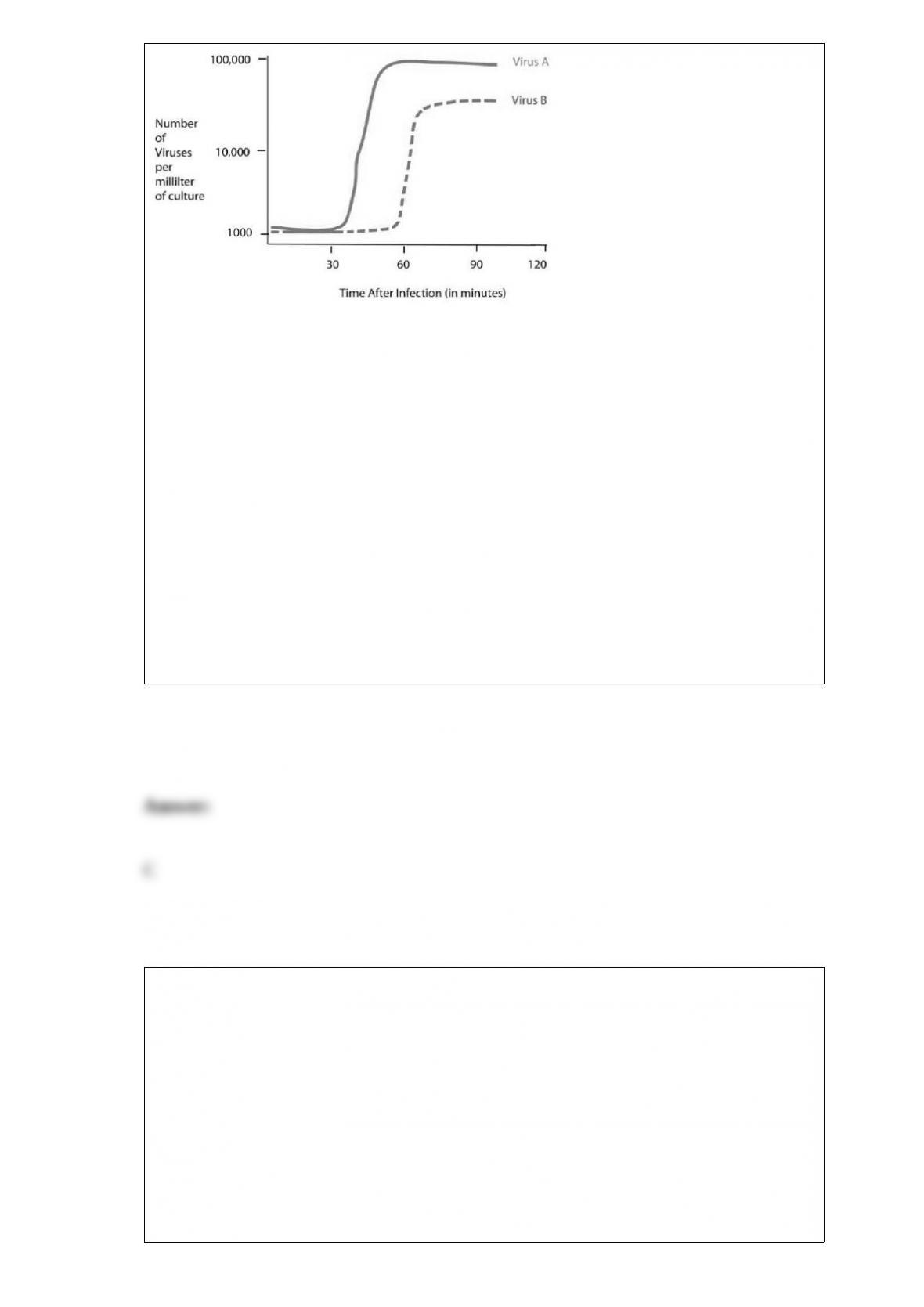
Cells were infected with approximately 1000 copies of either virus A or virus B at the 0
time point. At five-minute intervals, a sample of the virus and cell mixture was
removed. The intact cells were removed from the sample, and the number of viruses per
milliliter of culture was determined.
Using the data in the figure above, how long does it take for virus A to go through one
lytic cycle?
A) 15 minutes
B) 30 minutes
C) 45 minutes
D) 90 minutes
The following questions refer to this hypothetical situation.
A female fly, full of fertilized eggs, is swept by high winds to an island far out to sea.
She is the first fly to arrive on this island and the only fly to arrive in this way.
Thousands of years later, her numerous offspring occupy the island, but none of them
resembles her. There are, instead, several species, each of which eats only a certain type
of food. None of the species can fly and their balancing organs (halteres) are now used
in courtship displays. The male members of each species bear modified halteres that are
unique in appearance to their species. Females bear vestigial halteres. The ranges of all
of the daughter species overlap.

Fly species W, found in a certain part of the island, produces fertile offspring with
species Y. Species W does not produce fertile offspring with species X or Z. If no other
species can hybridize, then which of the following statements about species W and Y
are true?
I) Species W and Y have genomes that are still similar enough for successful meiosis to
occur in hybrid flies.
II) Species W and Y have more genetic similarity with each other than either did with
the other two species.
III) Species W and Y may fuse into a single species if their hybrids remain fertile over
the course of many generations.
A) Only I is correct.
B) Only II is correct.
C) Only III is correct.
D) I, II, and III are correct.
Assuming independent assortment for all gene pairs, what is the probability that the
following parents, AABbCc AaBbCc, will produce an AaBbCc offspring?
A) 1/2
B) 1/16
C) 1/8
D) 3/4

Assuming that they all belong to the same plant, arrange the following structures from
largest to smallest.
1. antheridia
2. gametes
3. gametophytes
A) 2, 3, 1
B) 2, 1, 3
C) 3, 2, 1
D) 3, 1, 2
What happens if MPF (mitosis-promoting factor) is introduced into immature frog
oocytes that are arrested in G2?
A) Nothing happens.
B) The cells undergo meiosis.
C) The cells enter mitosis.
D) Cell differentiation is triggered.

The chemiosmotic hypothesis is an important concept in our understanding of cellular
metabolism in general because it explains _____.
A) how ATP is synthesized by a proton motive force
B) how electron transport can fuel substrate-level phosphorylation
C) the sequence of the electron transport chain molecules
D) the reduction of oxygen to water in the final steps of oxidative metabolism
Plant hormones _____.
A) in plant cells naturally exist in very large amounts
B) change their shape in response to stimulus
C) are unable to move from one cell to another
D) affect only cells with the appropriate receptor