
Pronghorn antelopes are well adapted for dry conditions with extremes of temperature,
especially cold. As global climate change causes the area where the pronghorn live to
change, not only in temperature but also in what plants grow there and what predators
and prey live there, what is likely to happen to the pronghorn?
A) The animals will learn to eat whatever plants exist in their area and escape from any
new predators that arrive.
B) If the pronghorn population includes genetic variation that allows survival and
reproduction in the new conditions, they will adapt.
C) If climate change is not too rapid, the pronghorn can produce new traits needed to
survive and reproduce in the changed conditions.
D) Because pronghorns will need to be cooler, their fur will become thinner.
The evolutionary explanations for behavior are called the
A) evolutionary schematics.
B) selected advantage.
C) proximal causes.
D) ultimate causes.
Which of the following correctly pairs a biome and its characteristics?

A) temperate broadleaf forestmild winters; scarce rainfall; predominantly dicot
vegetation
B) chaparralmild, rainy winters; long, hot, but wet summers
C) savannalong, cold winters; vegetation dominated by conifers
D) tundravery cold winters; only the upper layer of the soil thaws during summer
By-products of cellular respiration include
A) oxygen and heat.
B) carbon dioxide and water.
C) FADH2 and NADH.
D) NADH and ATP.
A kilocalorie is defined as
A) the quantity of glucose needed to increase the body temperature by 1C.
B) the quantity of heat needed to raise the temperature of 1 kg of water by 1C.
C) the quantity of food used to maintain normal bodily functions.
D) the quantity of food consumed during a given type of exercise.
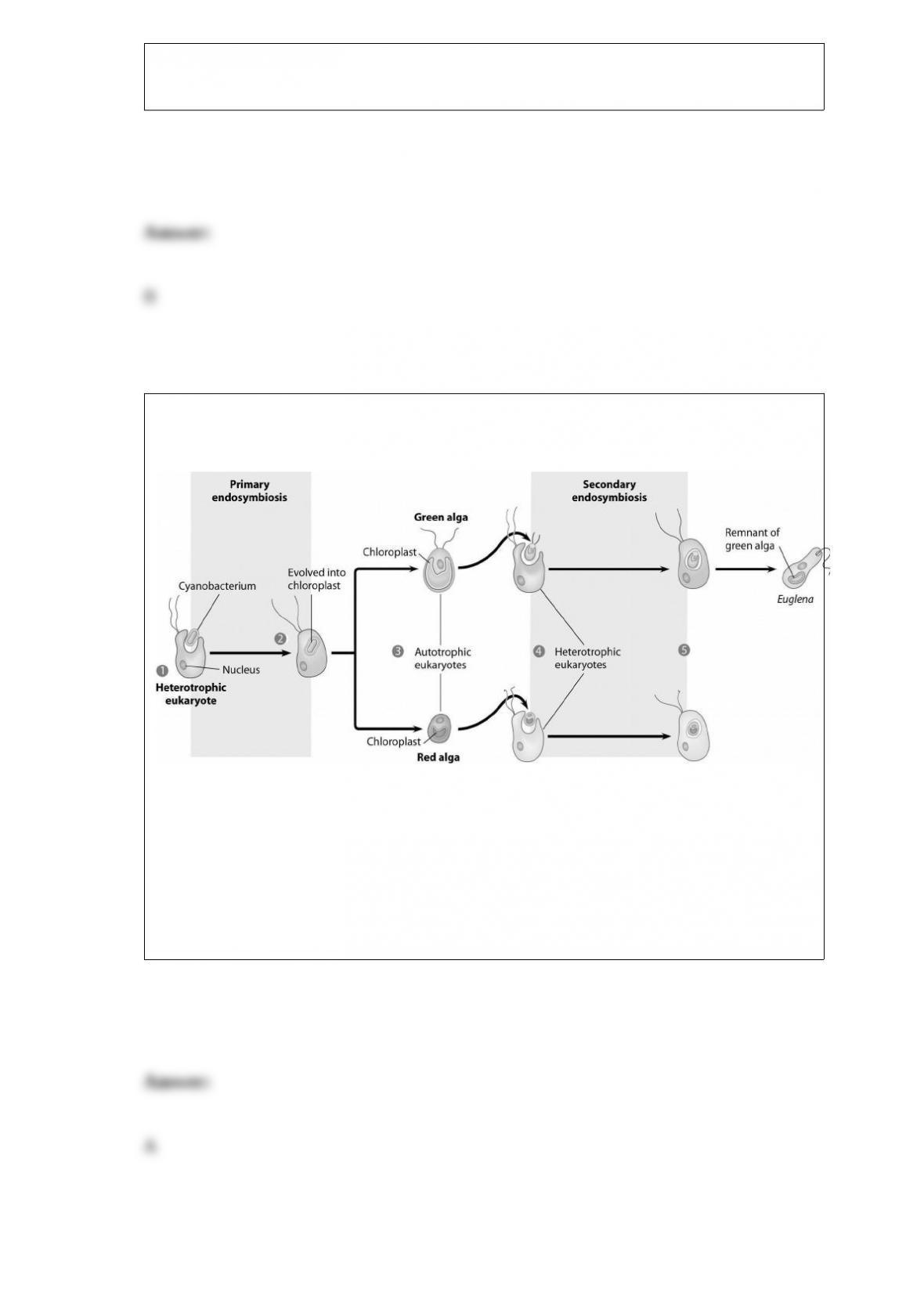
According to the figure, green alga resulted from ________, and Euglena resulted from
________.
A) primary endosymbiosis; both primary and secondary endosymbiosis
B) primary endosymbiosis; primary endosymbiosis
C) both primary and secondary endosymbiosis; secondary endosymbiosis only
D) secondary endosymbiosis only; primary endosymbiosis

Fall is coming, with the prospect of frost, so you decide to pick the last tomatoes on the
vine even though they are still green. If you wanted to ripen these tomatoes, which
method would be most effective?
A) Put all the green tomatoes in a closed paper bag.
B) Put the green tomatoes in a dark closet, but with a flash of light about every 4 hours.
C) Put the green tomatoes in a plastic bag with an overripe apple.
D) Store each green tomato in a separate plastic bag and put them in the dark.
The dominant herbivores in savannas are
A) gophers.
B) insects.
C) antelope.
D) giraffes.
A benign tumor differs from a malignant tumor in that a benign tumor
A) is cancerous.
B) spreads from the original site.

C) does not metastasize.
D) never causes health problems.
Consider the following statement from the textbook: “Scientists hypothesize that higher
anti-HPV antibody levels provide greater protection from HPV-related cancers
compared to lower levels, but they don’t yet have strong evidence to support this
hypothesis.”
Suppose you design a study to test this hypothesis. Your study participants are adults
between the ages of 25 and 40 (mean age = 32). From the following choices, select the
groups of individuals who would make the best participants for the control group in
your study.
A) a group of 100 vaccinated adult males and a group of 100 vaccinated adult females
B) a group of 100 unvaccinated adult males and a group of 100 vaccinated adult males
C) a group of 50 vaccinated adult males and a group of 150 vaccinated adult females
D) a group of 100 unvaccinated adult males and a group of 100 unvaccinated adult
females
Plant hormones
A) must be produced in large quantities to be effective.

B) act on all cells they encounter.
C) are chemical signals that influence growth and development.
D) are rare and produced only in response to stress.
A newly mated queen ant establishes an ant nest in an unoccupied patch of suitable
habitat. The population of the nest grows quickly at first, then levels off at carrying
capacity. Which of the following models best describes its population growth?
A) linear
B) logarithmic
C) logistic
D) exponential
One centimeter = ________ millimeters.
A) 0.01
B) 0.10
C) 10

D) 100
Recall that the cuticle seals plant surfaces and helps plants conserve water, and the seed
helps derived plant groups to reproduce effectively on dry land. The analogous
adaptations in reptiles are ________ (analogous to the cuticle) and ________
(analogous to the seed).
A) scales; jellylike egg masses
B) scales; the amniotic egg
C) scales; aquatic larvae
D) claws; lungs
When plasmids are used to produce a desired protein,
A) the plasmids are inserted into the bacterial chromosome.
B) the plasmids multiply and produce the protein outside of the bacterium.
C) the desired gene is inserted into the plasmid, and the plasmid is returned to the
bacterium by transformation.
D) the bacterial genome and plasmid are inserted into the genome of the cell containing
the desired gene (often the cell of a plant or animal).

Enzymes are to active sites as
A) antigenic binding sites are to antigenic determinants.
B) viruses are to antigens.
C) antigens are to epitopes.
D) antigenic determinants are to epitopes.
When plants undergo allopatric speciation, an initial reproductive barrier is often
A) polyploidy.
B) gametic isolation.
C) temporal isolation.
D) pollinator choice.

Which of the following components of the human eye forms the iris?
A) sclera
B) choroid
C) retina
D) pupil
Which of the following is an example of a transgenic organism?
A) a fern grown from a single fern root cell
B) a rat with rabbit hemoglobin genes
C) a cow that has been fed pig growth hormone in its food
D) a human given a corrected human blood-clotting gene
The speed of impulse conduction along an axon may be increased by
A) a myelin sheath.
B) a graded potential.

C) neurotransmitters.
D) effector cells.
Which of the following is the factor that initiates flowering in long-day plants?
A) nights shorter than a critical length
B) nights longer than a critical length
C) days longer than the intervening nights
D) days shorter than a critical length
Myocardial infarction, also called a heart attack,
A) is caused by excessive blood pressure in the heart.
B) actually causes no permanent damage to the heart.
C) is unrelated to cigarette smoking.
D) is the damage or death of cardiac muscle tissue.

Much research is being done to increase the nitrogen-fixing ability of plants with root
nodules. Why is this an important goal for agricultural researchers?
A) Decreasing the size of nodules will allow plants to fix more nitrogen into their own
molecules.
B) Nitrogen is an essential component of the amino acids used to form protein.
C) Increasing the nitrogen-fixing ability of plants will allow them to make better use of
nitrogen fertilizers.
D) Removing the bacteria from the root nodules will allow more fixed nitrogen to be
available to the plants.
Myosin is a contractile protein found in muscles that is composed of three pairs of
subunits, two heavy chains, and two pairs of two different types of light chains, for a
total of six subunits. Myosin contains what level(s) of protein structure?
A) primary
B) primary and secondary
C) primary, secondary, and tertiary
D) primary, secondary, tertiary, and quaternary

Watching salt crystals form as ocean water evaporates, a student says, “Look”more and
more crystals are appearing. The ocean water is alive!” Which of the following
statements is an accurate evaluation of the student’s remark?
A) The student is correct: Crystals are ordered structures and they are reproducing, so
the ocean water is alive.
B) The student is correct because crystals are formed by processing energy from the sun
to create new structures, so ocean water is alive.
C) The student is incorrect because the solution is processing energy from the sun rather
than gaining energy from other organisms, so the ocean water is not alive.
D) The student is incorrect because all of the crystals reproduce the same kind of
crystals with no variation to provide adaptation, so the ocean water is not alive.
Which of the following is an example of incomplete dominance in humans?
A) albinism
B) hypercholesterolemia
C) skin color
D) ABO blood groups
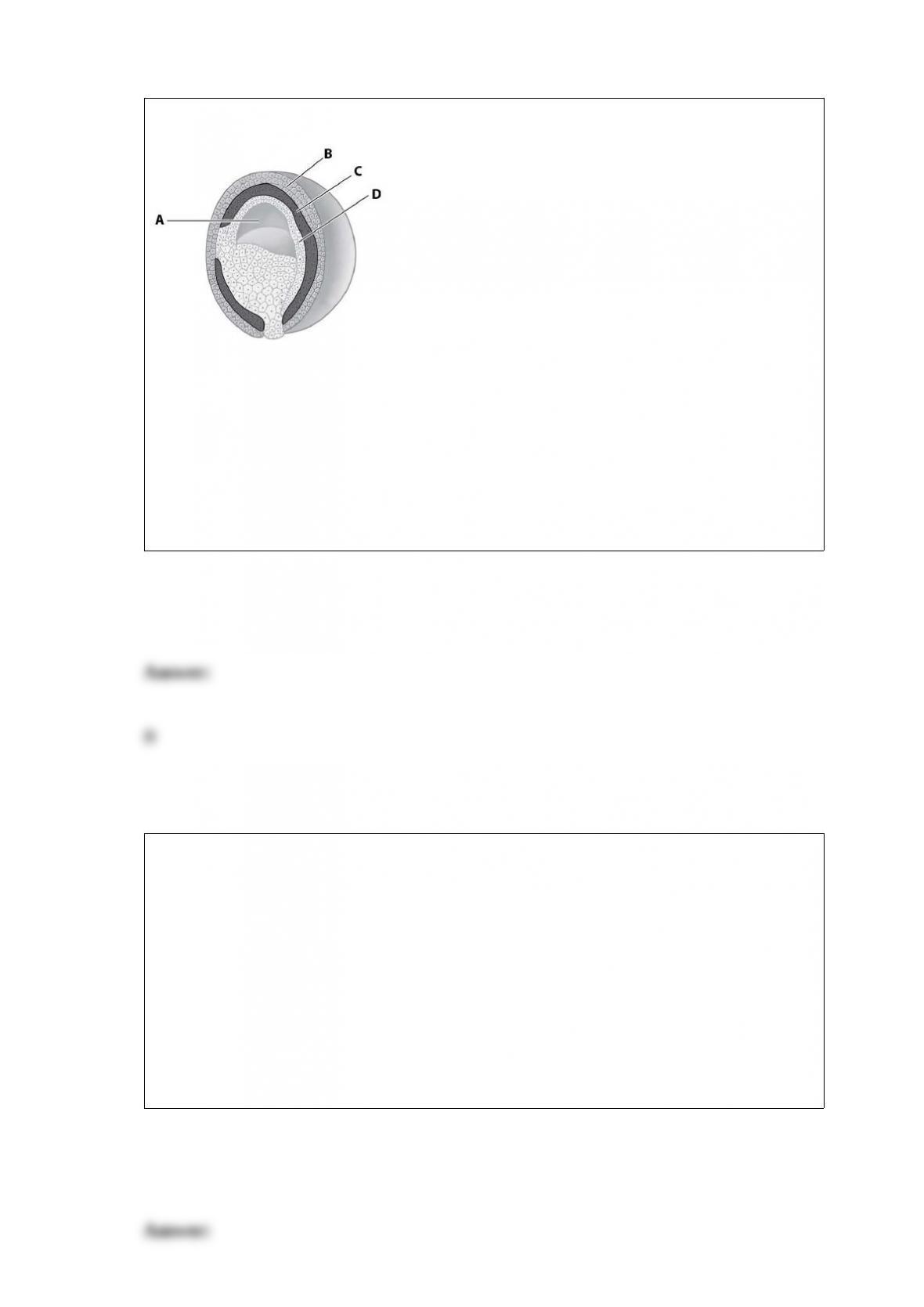
From which part of this figure will the nervous system develop?
A) part A
B) part B
C) part C
D) part D
During the spring, male sage grouse gather in an open area and strut about, erecting
their feathers in a fanlike display. They also make booming sounds using their inflated
air sacs. The function of this dance is to
A) frighten off smaller birds from the territory.
B) select the showiest females and mate.
C) attract the attention of females.
D) imprint the younger male birds.

Which of the following behaviors is unlikely to involve imprinting?
A) A nestling male sparrow learns the “dialect” of song that is used in his native district.
B) A nestling male songbird raised in the nest of a different species grows up to sing the
song of his foster species.
C) A songbird that engages in solitary migration using star navigation returns each year
to the district where it was hatched.
D) A migrating mother gazelle leaves her calf hidden in grass while she feeds and
always returns to the correct patch of grass.
Most homeostasis depends on
A) positive feedback control.
B) negative feedback control.
C) hormonal regulation.
D) predictable environmental conditions.

Mr. and Mrs. Smith have three sons in elementary school. Two of their children are
progressing normally, but their youngest son, Charles, has been much slower than his
siblings in developing speech and language skills. His parents are concerned that he has
a learning disability and decide to investigate further. Since some learning disabilities
can be genetically based, their pediatrician recommends a chromosomal analysis.
The results show that Charles has a trisomy of the sex chromosomes, diagnosed as
XYY, which is caused by nondisjunction in the formation of the father’s sperm. The
nondisjunction resulted in an extra copy of the Y chromosome. The extra copy was
passed on to Charles during fertilization. Most often, this chromosomal change causes
no unusual physical features or medical problems, but those with trisomy of the sex
chromosomes do have a higher than normal risk of delays in learning development.
During which stage of meiosis could this nondisjunction have occurred?
A) telophase I
B) prophase I
C) anaphase II
D) telophase II
Fungal diseases common in ________ include ________ and ________.
A) plants; smuts; rusts
B) animals; smuts; chytrids
C) plants; ringworm; coccidioidomycosis
D) humans; rusts; vaginal yeast

Darwin was the first person to draw an evolutionary tree, a diagram that represents
A) records of breeding in domesticated animals.
B) records of lineages in humans (also known as a family tree).
C) evidence-based hypotheses regarding our understanding of patterns of evolutionary
descent.
D) groupings of organisms based on overall similarity.
Rachel Carson’s book Silent Spring deals with the
A) destruction of polar habitats caused by global warming.
B) environmental effects of pesticides.
C) effects of lynx predation on snow hare populations.
D) fate of tropical rain forests.
The ripened ovary of a flower, which is adapted to disperse seeds, is called a/an

A) ovule.
B) casing.
C) fruit.
D) sporangium.