1)
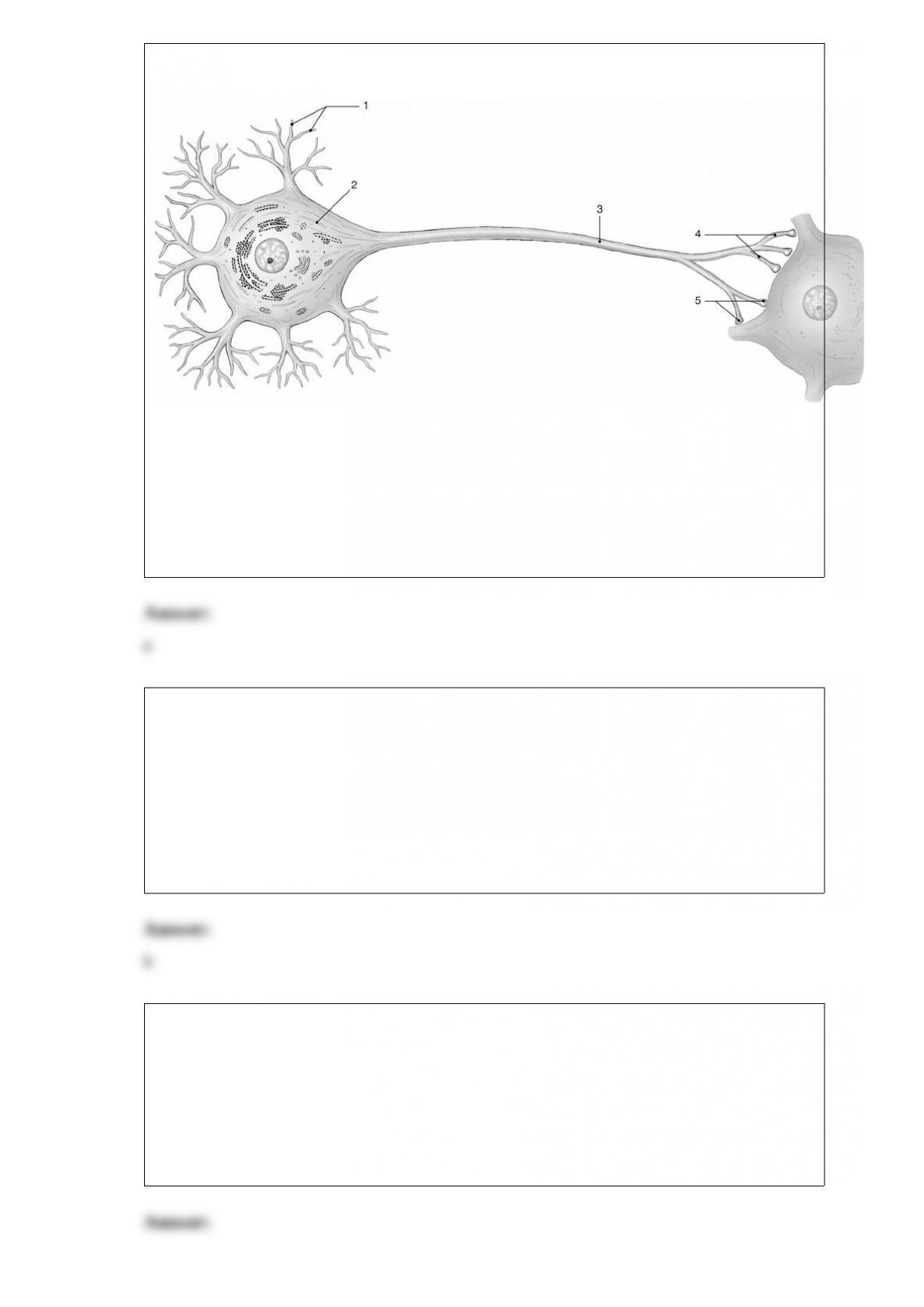
figure 12-1 the neuron
which type of membrane channels are found at label “3”?
a) voltage-gated na+ channels
b) voltage-gated k+ channels
c) chemically-gated na+ and k+ channels
d) voltage-gated ca2+ channels
e) both voltage-gated na+ channels and voltage-gated k+ channels
2) while you’re visiting your friend who recently gave birth, she comments on her
infant’s soft spot. you think to yourself that the correct term for the ‘soft spot” located at
the intersection of the frontal, sagittal, and coronal sutures is
a) sphenoidal fontanel.
b) anterior fontanel.
c) occipital fontanel.
d) mastoid fontanel.
e) cushion spot.
3) in a penetrating wound, ________ divide to produce mobile cells that repair the
dermis.
a) granulation cells
b) dendritic cells
c) macrophages
d) fibroblasts
e) muscle cells

4) the occipital condyles of the skull articulate with the
a) atlas.
b) mandible.
c) first thoracic vertebra.
d) occipital bone.
e) axis.
5) the following are important steps in the process of endochondral ossification.
1. enlarged chondrocytes die.
2. osteoblasts replace calcified cartilage with spongy bone.
3. chondrocytes enlarge and the surrounding matrix begins to calcify.
4. blood vessels invade the perichondrium.
5. perichondrial cells become osteoblasts and produce a thin shell of bone.
the correct order for these events is
a) 3, 1, 5, 4, 2
b) 1, 3, 5, 4, 2
c) 1, 5, 3, 4, 2
d) 2, 3, 1, 5, 4
e) 3, 1, 4, 5, 2
6) overseeing the postural muscles of the body and making rapid adjustments to
maintain
balance and equilibrium are functions of the
a) cerebrum.
b) mesencephalon.
c) cerebellum.
d) pons.
e) medulla oblongata.
7) the ________ allows you to look up.
a) inferior rectus
b) medial rectus
c) lateral rectus
d) superior rectus
e) inferior oblique

8) adenine and guanine are
a) purines represented by t and c.
b) pyrimidines represented by a and g.
c) purines represented by a and g.
d) pyrimidines represented by t and c.
e) nucleotides represented by a and g.
9) ________ involves active inspiratory and expiratory movements and calls on
accessory muscles to assist with inhalation, while exhalation involves contraction of the
internal intercostal muscles and sometimes abdominal muscles too.
a) eupnea
b) forced breathing
c) costal breathing
d) vital breathing
e) passive breathing
10) which eye muscle sends its tendon of origin through a pulley or trochlea before
inserting on the globe?
a) superior rectus
b) superior oblique
c) lateral rectus
d) inferior rectus
e) inferior oblique
11) lipoproteins that are intermediate in size and lipid composition between vldls and
ldls are called ________.
12) the cell that results from the fusion of a secondary oocyte and a spermatozoon is
called a ________.

13) when one hormone is needed for a second hormone to produce an effect, it is called
________.
14) the phase of hemostasis that involved clotting of blood is called ________.
15) a unique feature of the left lung is the ________.
16) ________ carry sensory information to the cns. (note: be sure to capitalize the first
letter of your answer).
17) compounds that contain carbon as the primary structural atom are called ________
molecules.
18) the ligament that surrounds the ________ attaches to the tibial tuberosity.
19) the ________ provides mechanical protection, nutritional support, and waste
removal for the developing embryo.