Suppose two AaBbCc individuals are mated. Assuming that the genes are not linked,
what fraction of the offspring are expected to be homozygous recessive for the three
traits?
A) 1/4
B) 1/8
C) 1/16
D) 1/64
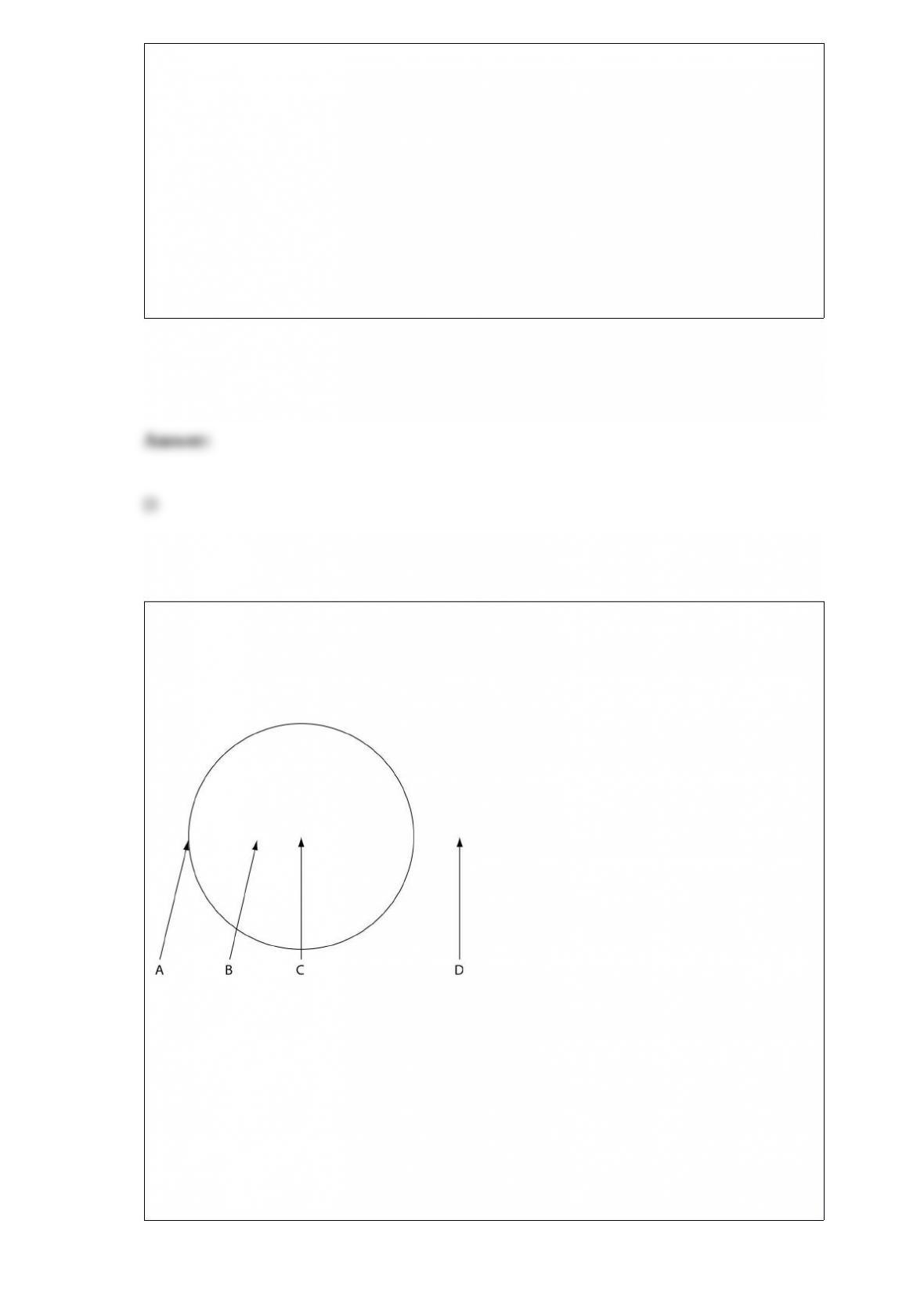
The following figure depicts the outline of a large fairy ring that has appeared overnight
in an open meadow, as viewed from above. The fairy ring represents the furthest
advance of this mycelium through the soil. Locations A-D are all 0.5 meters below the
soil surface.
What is the most probable location of the oldest portion of this mycelium?
A) A
B) B
C) C
D) D

H. V. Wilson worked with sponges to gain some insight into exactly what was
responsible for holding adjacent cells together. He exposed two species of differently
pigmented sponges to a chemical that disrupted the cell-cell interaction (cell junctions),
and the cells of the sponges dissociated. Wilson then mixed the cells of the two species
and removed the chemical that caused the cells to dissociate. Wilson found that the
sponges reassembled into two separate species. The cells from one species did not
interact or form associations with the cells of the other species. How do you explain the
results of Wilson’s experiments?
A) The two species of sponge had different enzymes that functioned in the reassembly
process.
B) The molecules responsible for cell-cell adhesion (cell junctions) were irreversibly
destroyed during the experiment.
C) The molecules responsible for cell-cell adhesion (cell junctions) differed between the
two species of sponge.
D) One cell functioned as the nucleus for each organism, thereby attracting only cells of
the same pigment.
The following questions are based on the reaction A+ B ↔C+ Dshown in the
accompanying figure.
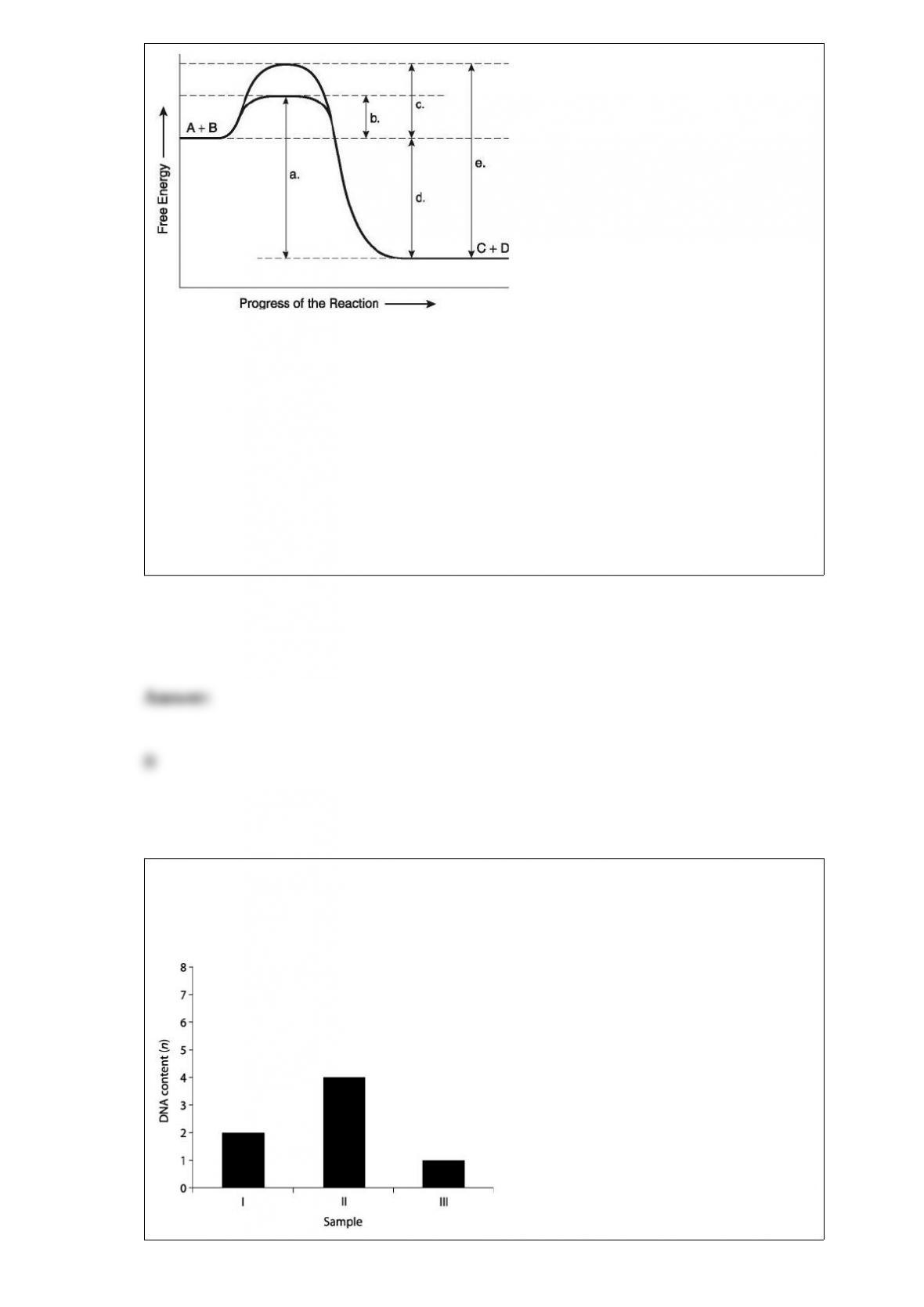
Which of the following represents the activation energy required for the
enzyme-catalyzed reaction in the figure?
A) a
B) b
C) c
D) d
You have isolated DNA from three different cell types of the same organism,
determined the relative DNA content for each type, and plotted the results on the graph
shown in the figure below. Refer to the graph to answer the following question(s).

Which sample might represent a zygote?
A) I
B) II
C) III
D) either I or II
When Thomas Hunt Morgan crossed his red-eyed F1 generation flies to each other, the
F2 generation included both red- and white-eyed flies. Remarkably, all the white-eyed
flies were male. What was the explanation for this result?
A) The gene involved is on the Y chromosome.
B) The gene involved is on the X chromosome.
C) The gene involved is on an autosome, but only in males.
D) Other male-specific factors influence eye color in flies.
A potassium ion gradient is set up in insect Malpighian tubules through an active
transport process. As a result, potassium concentration is higher in the lumen of the
tubules than in hemolymph. How would the potassium gradient affect water movement?

A) Water would be forced out of the lumen of the Malpighian tubules through an
osmotic gradient.
B) The potassium gradient would have no effect on water movement.
C) There would be a net movement of water into the lumen of the tubules.
D) Water would be conserved, forming a hypertonic solution in the Malpighian tubules.
Sexual reproduction _____.
A) allows animals to conserve resources and reproduce only during optimal conditions
B) can produce diverse phenotypes that may enhance survival of a population in a
changing environment
C) enables males and females to remain isolated from each other while rapidly
colonizing habitats
D) guarantees that both parents will provide care for each offspring
Animals that migrate great distances would obtain the greatest energetic benefit of
storing chemical energy as _____.
A) proteins

B) minerals
C) carbohydrates
D) fats
The existence of evolutionary trends, such as increasing body sizes among horse
species, is evidence that _____.
A) a larger volume-to-surface area ratio is adaptive in many mammals
B) evolution generally progresses toward some goal
C) evolution tends toward increased complexity or increased size
D) in particular environments, similar adaptations can be beneficial to more than one
species
Imagine that you’ve isolated a yeast mutant that contains histones resistant to
acetylation. What phenotype do you predict for this mutant?
A) The mutant will grow rapidly.
B) The mutant will require galactose for growth.
C) The mutant will show low levels of gene expression.

D) The mutant will show high levels of gene expression.
A fruit fly, internally infected by a potentially pathogenic fungus, is protected by its
_____.
A) immunoglobulins
B) antibodies
C) antimicrobial peptides
D) B cells
The number of major histocompatability (MHC) protein combinations possible in a
given population is enormous. However, an individual in that diverse population has a
far more limited array of MHC molecules because _____.
A) the MHC proteins are made from several different gene regions that are capable of
rearranging in a number of ways
B) MHC proteins from one individual can only be of class I or class II
C) each of the MHC genes has a large number of alleles, but each individual only
inherits two for each gene
D) once a B cell has matured in the bone marrow, it is limited to two MHC response
categories

The olfactory bulbs are located in the _____.
A) nasal cavity
B) anterior pituitary gland
C) brain
D) brainstem
The following question(s) are based on information in Hopi E. Hoekstra, Kristen E.
Drumm, and Michael W. Nachman, “Ecological Genetics of Adaptive Color
Polymorphism in Pocket Mice: Geographic Variation in Selected and Neutral Genes,”
Evolution 58(6), 2004: 1329-41.
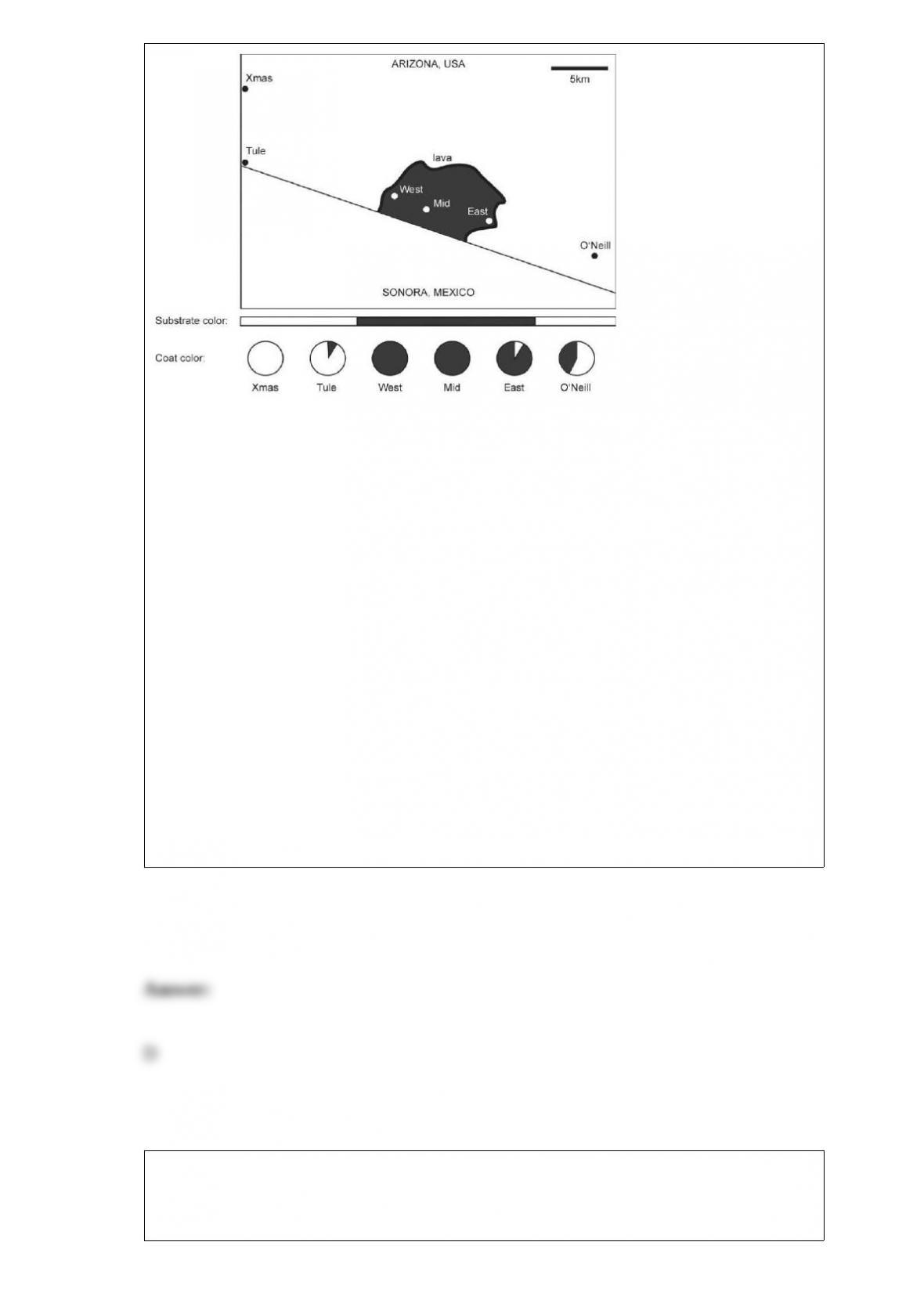
Refer to the figure above. In their investigation of natural selection on Mc1r alleles (the
gene that determines coat color) in Arizona pocket mice, Hoekstra et al. determined the
frequency of the D and d alleles in each population. They also determined the frequency
of alleles for two neutral mitochondrial DNA genes (genes that do not affect and are not
linked to coat color). Why did the researchers include the mitochondrial DNA genes as
part of their experimental design?
A) Allele change for the neutral mitochondrial genes serves as an experimental group
and gives information on any general background genetic difference among these
populations.
B) Allele change for the neutral mitochondrial genes serves as a control and determines
coat-color differences among these populations.
C) Allele change for the neutral mitochondrial genes serves as an experimental group
and gives information on coat-color differences among these populations.
D) Allele change for the neutral mitochondrial genes serves as a control and gives
information on any general background genetic difference among these populations.
The first step in ecosystem restoration is to _____.
A) restore the physical structure

B) restore native species that have been extirpated due to disturbance
C) remove competitive invasive species
D) remove toxic pollutants
One function of both alcohol fermentation and lactic acid fermentation is to _____.
A) reduce NAD+ to NADH
B) reduce FAD+ to FADH2
C) oxidize NADH to NAD+
D) reduce FADH2 to FAD+
Single-celled Paramecium live in pond water (a hypotonic environment). They have a
structural feature, a contractile vacuole, which enables them to osmoregulate. If you
observed them in the following solutions, at which sucrose concentration (in
millimolars, mM) would you expect the contractile vacuole to be most active?
A) 0.0 mM sucrose
B) 0.05 mM saline

C) 0.08 mM sucrose
D) 1.0 mM saline
If, someday, an archaean cell is discovered whose rRNA sequence is more similar to
that of humans than the sequence of mouse rRNA is to that of humans, the best
explanation for this apparent discrepancy would be _____.
A) homology
B) homoplasy
C) common ancestry
D) retro-evolution by humans
Phosphorylation cascades involving a series of protein kinases are useful for cellular
signal transduction because they _____.
A) are species specific
B) always lead to the same cellular response
C) amplify the original signal many times
D) counter the harmful effects of phosphatases

A research team began a study of a cultured cell line. Their preliminary observations
showed them that the cell line did not exhibit either density-dependent inhibition or
anchorage dependence. What could they conclude right away?
A) The cells are unable to form spindle microtubules.
B) They have altered the series of cell cycle phases.
C) The cells show characteristics of tumors.
D) They were originally derived from an elderly organism.
Which of the following would be LEAST likely to affect osmosis in plants?
A) a difference in solute concentrations
B) receptor proteins in the membrane
C) aquaporins
D) a difference in water potential

Totipotency is a term used to describe a cell’s ability to give rise to a complete new
organism. In plants, this means that _____.
A) plant development is not under genetic control
B) the cells of shoots and the cells of roots have different genes
C) cell differentiation depends largely on the control of gene expression
D) a cell’s environment has no effect on its differentiation
Feather color in budgies is determined by two different genes, Y and B, one for pigment
on the outside and one for the inside of the feather. YYBB, YyBB, or YYBb is green;
yyBB or yyBb is blue; YYbb or Yybb is yellow; and yybb is white. Two blue budgies
were crossed. Over the years, they produced twenty-two offspring, five of which were
white. What are the most likely genotypes for the two blue budgies?
A) yyBB and yyBB
B) yyBB and yyBb
C) yyBb and yyBb
D) yyBb and yybb

You are given four test tubes, each containing an unknown protist, and your task is to
read the following description and match these four protists to the correct test tube.
When light, especially red and blue light, is shone on the tubes, oxygen bubbles
accumulate on the inside of test tubes 1 and 2. Chemical analysis of test tube 1 indicates
the presence of a chemical that is toxic to fish and humans. Chemical analysis of test
tube 2 indicates the presence of substantial amounts of silica. Microscopic analysis of
organisms in test tubes 1, 3, and 4 reveals the presence of permanent,
membrane-bounded sacs just under the plasma membrane. Microscopic analysis of
organisms in test tube 3 reveals the presence of an apicoplast in each. Microscopic
analysis of the contents in test tube 4 reveals the presence of one large nucleus and one
small nucleus in each organism.
Test tube 3 contains _____.
A) Paramecium
B) Pfiesteria (dinoflagellate)
C) Entamoeba
D) Plasmodium
Cells from advanced malignant tumors often have very abnormal chromosomes and an
abnormal number of chromosomes. What might explain the association between
malignant tumors and chromosomal abnormalities?
A) Cancer cells are no longer density-dependent.
B) Cancer cells are no longer anchorage-dependent.
C) Cell cycle checkpoints are not in place to stop cells with chromosome abnormalities.
D) Transformation introduces new chromosomes into cells.

If the vertical axis of the figure above refers to relative fitness, then which of the
following is the most valid and accurate measure of fitness?
A) number of daughter cells produced per mother cell per generation
B) average swimming speed of cells through the growth medium
C) amount of glucose synthesized per unit time
D) number of generations per unit time
Sulfur is in the same column of the periodic table as oxygen, but has electronegativity
similar to carbon. Compared to water molecules, molecules of H2S will _____.
A) have greater cohesion to other molecules of H2S
B) have a greater tendency to form hydrogen bonds with each other
C) have a higher capacity to absorb heat for the same change in temperature
D) not form hydrogen bonds with each other

Singer and Nicolson’s fluid mosaic model of the membrane proposed that
membranes_____.
A) are a phospholipid bilayer between two layers of hydrophilic proteins
B) are a single layer of phospholipids and proteins
C) consist of protein molecules embedded in a fluid bilayer of phospholipids
D) consist of a mosaic of polysaccharides and proteins
The last common ancestor of all animals was probably a _____.
A) unicellular chytrid
B) multicellular algae
C) multicellular fungus
D) flagellated protist
Tay-Sachs disease is a human genetic abnormality that results in cells accumulating and
becoming clogged with very large, complex, undigested lipids. Which cellular organelle
must be involved in this condition?

A) the endoplasmic reticulum
B) the Golgi apparatus
C) the lysosome
D) mitochondrion
Reactants capable of interacting to form products in a chemical reaction must first
overcome a thermodynamic barrier known as the reaction’s _____.
A) entropy
B) activation energy
C) equilibrium point
D) free-energy content
SRY is best described as _____.
A) a gene present on the X chromosome that triggers female development
B) an autosomal gene that is required for the expression of genes on the Y chromosome
C) a gene region present on the Y chromosome that triggers male development

D) an autosomal gene that is required for the expression of genes on the X chromosome
The following questions refer to this hypothetical situation.
A female fly, full of fertilized eggs, is swept by high winds to an island far out to sea.
She is the first fly to arrive on this island and the only fly to arrive in this way.
Thousands of years later, her numerous offspring occupy the island, but none of them
resembles her. There are, instead, several species, each of which eats only a certain type
of food. None of the species can fly and their balancing organs (halteres) are now used
in courtship displays. The male members of each species bear modified halteres that are
unique in appearance to their species. Females bear vestigial halteres. The ranges of all
of the daughter species overlap.
Which of these fly organs, as they exist in the description above, best illustrates an
exaptation?
A) vestigial halteres
B) halteres
C) mouthparts
D) eggs
The difference between vertical and horizontal transmission of plant viruses is that
vertical transmission is _____.

A) transmission of a virus from a parent plant to its progeny, and horizontal
transmission is one plant spreading the virus to another plant
B) the spread of viruses from upper leaves to lower leaves of the plant, and horizontal
transmission is the spread of a virus among leaves at the same general level
C) the spread of viruses from trees and tall plants to bushes and other smaller plants,
and horizontal transmission is the spread of viruses among plants of similar size
D) the transfer of DNA from a plant of one species to a plant of a different species, and
horizontal transmission is the spread of viruses among plants of the same species