
Besides the ability of some cancer cells to overproliferate, what else could logically
result in a tumor?
A) changes in the order of cell cycle stages
B) lack of appropriate cell death
C) inability to form spindles
D) inability of chromosomes to meet at the metaphase plate
Shoots that grow vertically toward the sun can be characterized as _____.
A) positive for phototropism and negative for gravitropism
B) neutral for phototropism and positive for gravitropism
C) negative for phototropism and positive for gravitropism
D) positive for phototropism and neutral for gravitropism
Basidiomycetes are the only fungal group capable of synthesizing lignin peroxidase.
What advantage does this group of fungi have over other fungi because of this
capability?
A) This is always the first group of fungi to begin any kind of plant decomposition.

B) This fungal group can break down the tough lignin, which cannot be harnessed for
energy, to get to the more useful cellulose.
C) This is the only group of fungi that can use lignin for adenosine triphosphate (ATP)
production.
D) This enzyme releases heat energy from the breakdown of lignin that is used to kill
off competing fungi.
Which of the following is a characteristic of all chordates at some point during their life
cycle?
A) jaws
B) post-anal tail
C) four-chambered heart
D) vertebrae
Refer to the following graph of an action potential to answer the question(s) below.
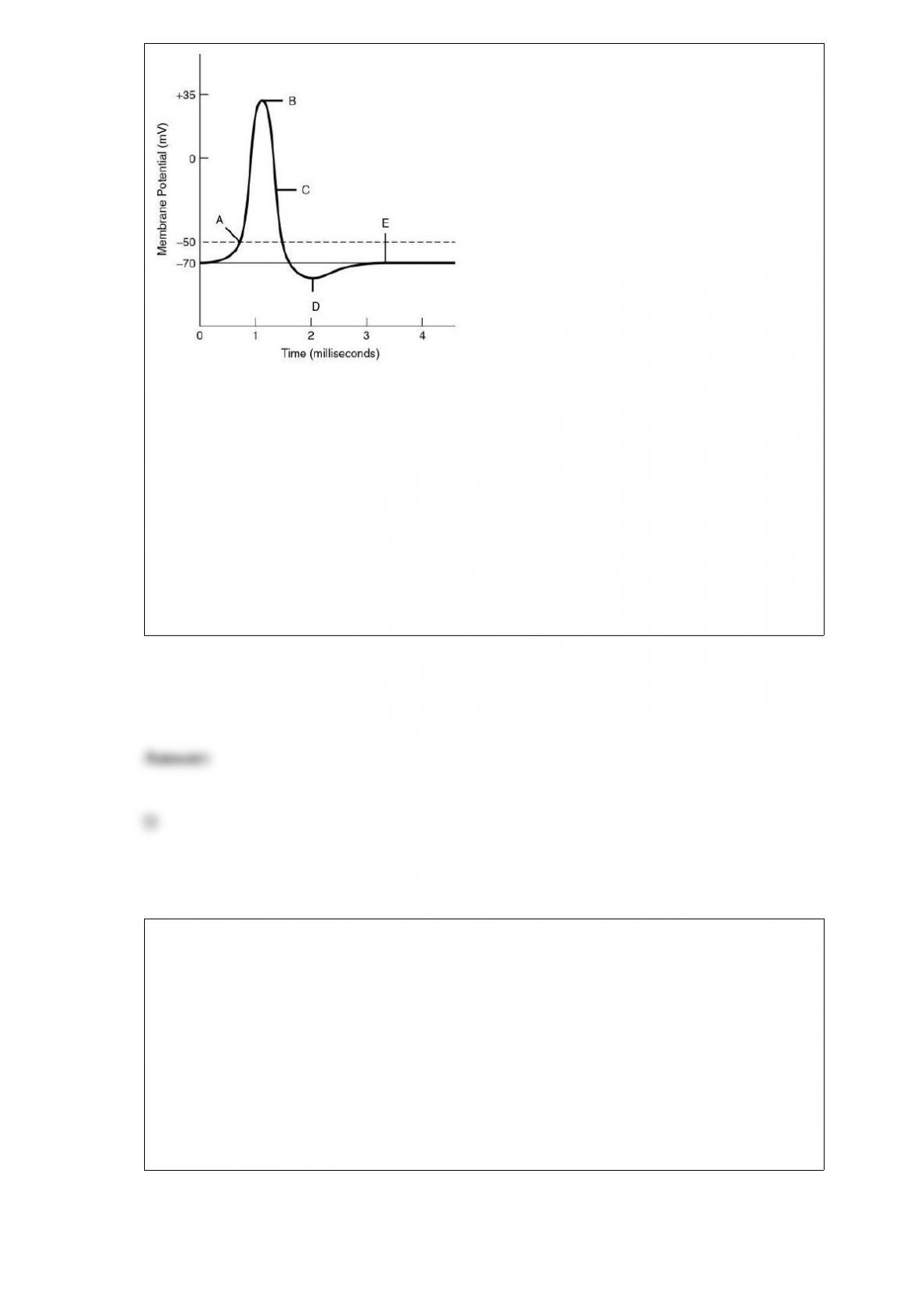
The membrane potential is closest to the equilibrium potential for potassium at label
_____.
A) A
B) B
C) C
D) D
Individuals with the disorder xeroderma pigmentosum are hypersensitive to sunlight.
This occurs because their cells cannot_____.
A) replicate DNA
B) undergo mitosis
C) exchange DNA with other cells
D) repair thymine dimers

Which of the following help(s) to hold the DNA strands apart while they are being
replicated?
A) primase
B) ligase
C) DNA polymerase
D) single-strand DNA binding proteins
Prokaryotes are classified as belonging to two different domains. What are the
domains?
A) Bacteria and Eukarya
B) Archaea and Monera
C) Bacteria and Protista
D) Bacteria and Archaea

A new organism is discovered in the forests of Costa Rica. Scientists there determine
that the polypeptide sequence of hemoglobin from the new organism has 72 amino acid
differences from humans, 65 differences from a gibbon, 49 differences from a rat, and 5
differences from a frog. These data suggest that the new organism is more closely
related to _____.
A) humans than to frogs
B) frogs than to humans
C) rats than to frogs
D) gibbons than to rats
As N approaches K for a certain population, which of the following is predicted by the
logistic equation?
A) The growth rate will not change.
B) The growth rate will approach zero.
C) The population will increase exponentially.
D) The carrying capacity of the environment will increase.
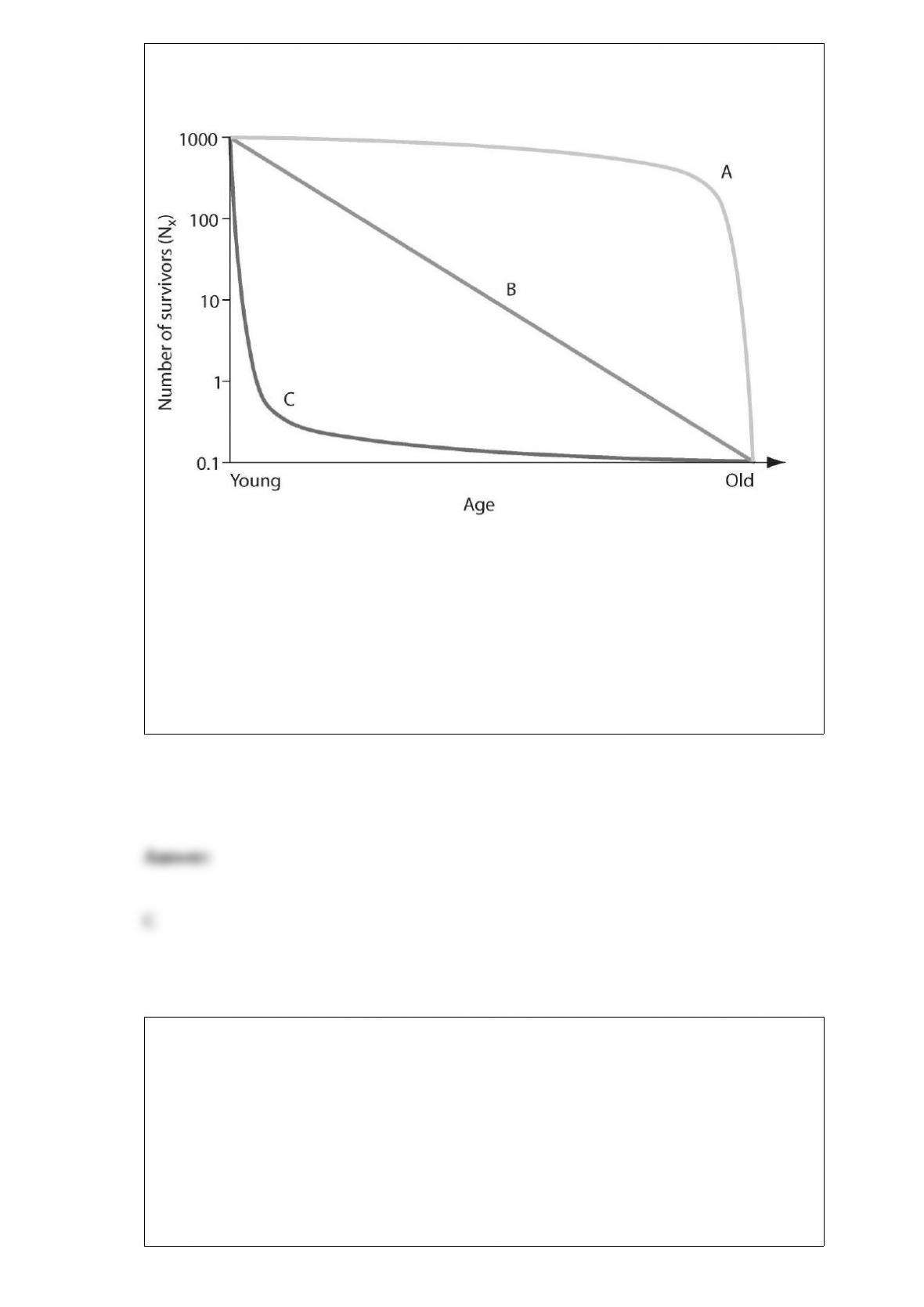
In the figure above, which of the following survivorship curves applies to most plant
species?
A) curve A
B) curve B
C) curve C
Partial or complete loss of hearing (deafness) can be caused by damage to the _____.
I) axons of the neurons associated with each hair cell that carry information to the brain
II) hair cells (the sensory receptors) in the cochlea
III) tympanic membrane, or eardrum
A) only II

B) only III
C) only I and II
D) I, II, and III
Which functional group(s) shown above is (are) present in all amino acids?
A) A and B
B) B and D
C) C only
D) B and C
Which of the following is a likely explanation for why invasive species take over
communities into which they have been introduced?

A) Invasive species are less efficient than native species in competing for the limited
resources of the environment.
B) Invasive species are not held in check by the predators and agents of disease that
have always been in place for native species.
C) Invasive species have a higher reproductive potential than native species.
D) Invasive species come from geographically isolated regions, so when they are
introduced to regions where there is more competition, they thrive.
In yeast signal transduction, a yeast cell releases a mating factor which _____.
A) acts back on the same cell that secreted the mating factor, changing its development
B) passes through the membranes of neighboring cells, binds to DNA, and initiates
transcription
C) binds to receptors on the membranes of other types of yeast cells
D) diffuses through the membranes of distant cells, causing them to produce factors that
initiate long-distance migrations
You are the lucky student of a wacky professor who develops a time machine. He asks
if you will test it with him. You get in and there is an immediate glitch”the date readout
fails so that when you land you are not sure what era you are in. Your professor begins
to panic, but you see something that tells you are in the Cenozoic era. Which of the

following could it be?
A) a rabbit eating a daisy
B) a water lily floating in a pond
C) masses of green ferns with dragonflies hovering above them
D) a bee pollinating a flower
Which of the following statements regarding flowering plants is correct?
A) The gametophyte is the dominant generation.
B) Female gametophytes develop from megaspores within the anthers.
C) Pollination is the delivery of pollen to the stigma of a carpel.
D) The food-storing endosperm is derived from the cell that contains one polar nucleus
and two sperm nuclei.
We would expect the greatest difference in plant health between two groups of plants of
the same species, one group with mycorrhizae and one group without mycorrhizae, in
an environment_____.
A) where nitrogen-fixing bacteria are abundant

B) that has soil with poor drainage
C) in which the soil is relatively deficient in mineral nutrients
D) that is near a body of water, such as a pond or river
You decide to study two species of birds, both of which form monogamous pairs (one
male and one female). In species 1, you find that the eggs in a pair’s nest are in fact
almost always the offspring of that pair. In species 2, you are surprised to find that
many of the eggs in a nest were actually fathered by males of neighboring pairs.
Apparently, mating outside of monogamous pairings is widespread in species 2. Given
this information, what would be the logical prediction to make before comparing testes
size of males of the two species?
A) Testes of species 1 are larger than testes of species 2.
B) Testes of species 2 are larger than testes of species 1.
C) There is no relationship between this observation and the size of testes.
Which observation suggested to Sutherland the involvement of a second messenger in
epinephrine’s effect on liver cells?
A) Receptor studies indicated that epinephrine was a ligand.
B) Glycogen breakdown was observed only when epinephrine was administered to
intact cells.

C) Glycogen breakdown was observed when epinephrine and glycogen phosphorylase
were combined.
D) Epinephrine was known to have different effects on different types of cells.
In many ways, the regulation of the genes of a particular group of viruses will be
similar to the regulation of the host genes. Therefore, which of the following would you
expect of the genes of a bacteriophage?
A) regulation via acetylation of histones
B) positive control mechanisms rather than negative
C) control of more than one gene in an operon
D) reliance on transcription activators
Most of the CO2 from the catabolism of glucose is released during _____.
A) glycolysis
B) electron transport
C) chemiosmosis
D) the citric acid cycle

A given photon of light may trigger an action potential with thousands of times more
energy because the signal strength is amplified by _____.
A) the receptor
B) a G protein
C) a signal transduction pathway
D) triggering several receptors at once
Use the following information to answer the question(s) below.
The following are an abstract and figure from a paper that explores the evolutionary
relationship between a protein kinase and behavior (M. Fitzpatrick and M. Sokolowski.
2004. In search of food: Exploring the evolutionary link between cGMP-dependent
protein kinase (PKG) and behavior. Integrative and Comparative Biology 44:28-36).
Abstract:
Despite an immense amount of variation in organisms throughout the animal kingdom,
many of their genes show substantial conservation in DNA sequence and protein
function. Here we explore the potential for a conserved evolutionary relationship
between genes and their behavioral phenotypes. We investigate the evolutionary history
of cGMP-dependent protein kinase (PKG) and its possible conserved function in
food-related behaviors. First identified for its role in the foraging behavior of fruit flies,
the PKG encoded by the foraging gene had since been associated with the maturation of
behavior (from nurse to forager) in honey bees and the roaming and dwelling
food-related locomotion in nematodes. These parallels encouraged us to construct
protein phylogenies using 32 PKG sequences that include 19 species. Our analyses
suggest five possible evolutionary histories that can explain the apparent conserved link
between PKG and behavior in fruit flies, honey bees, and nematodes. Three of these
raise the hypothesis that PKG influences the food-related behaviors of a wide variety of
animals including vertebrates. Moreover it appears that the PKG gene was duplicated
some time between the evolution of nematodes and a common ancestor of vertebrates
and insects whereby current evidence suggest only the for-like PKG might be
associated with food-related behavior.
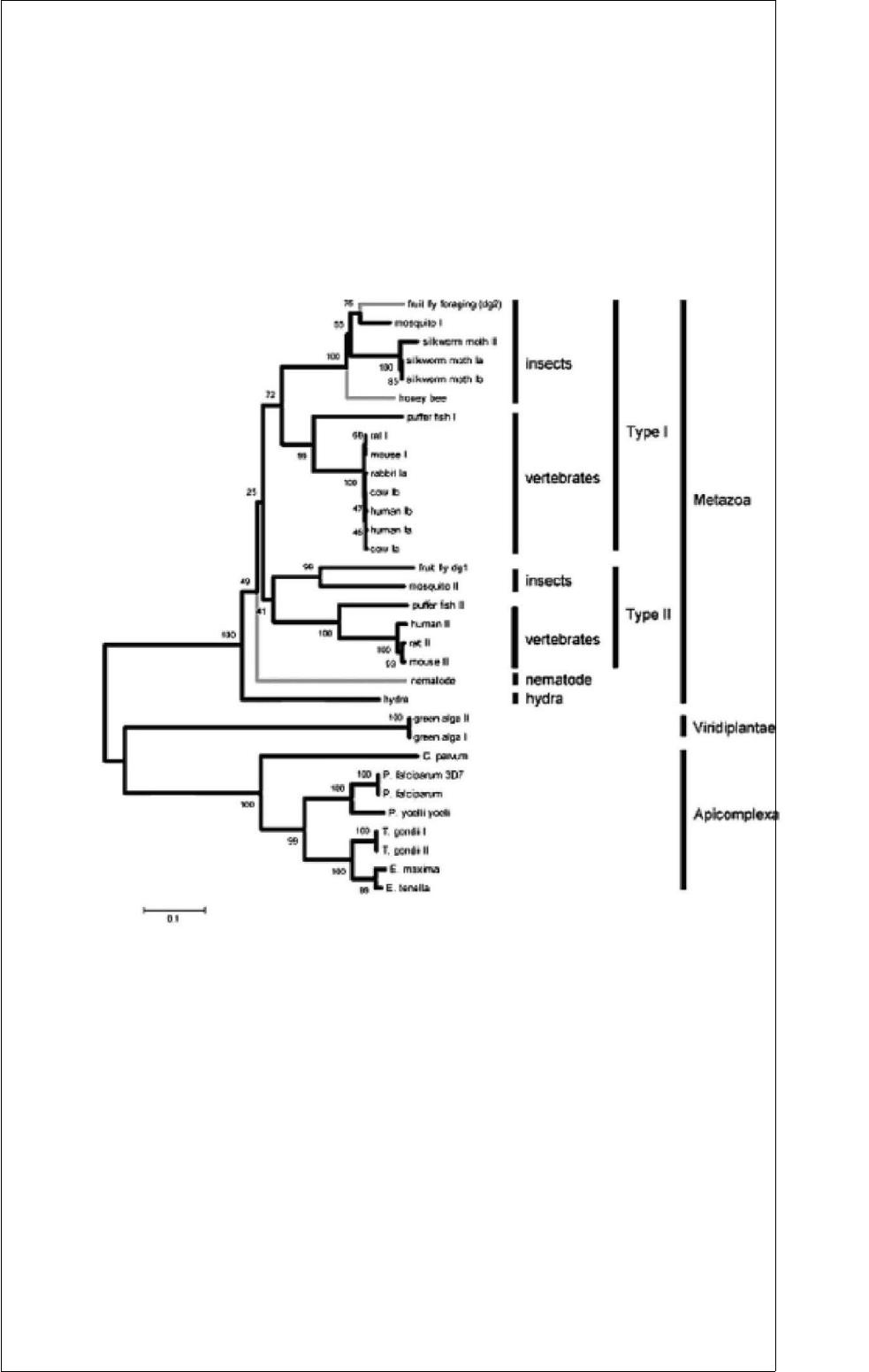
Neighbor joining trees depicting the evolutionary relationships of 32 PKG kinase
domain and C-terminal amino acid sequences spanning 19 species of protozoans and
metazoans. Values at the nodes represent the results of 5000 bootstrap replications.
Lineages with known behavioral links with PKG are indicated by gray branches.
Look at the evolutionary relationship of protein kinases in the figure above. Knowing
that there is evidence that this particular protein kinase is linked to food-related
behaviors in the animals studied, what conclusions can you draw?
A) There is enormous variation in amino acid sequences between taxa.
B) There is likely a conserved evolutionary relationship between these genes and their
behavioral phenotype.
C) PKG influences food-related behaviors in a wide variety of animals, and there is

enormous variation in amino acid sequences between taxa.
D) PKG influences food-related behaviors in a wide variety of animals, and there is
likely a conserved evolutionary relationship between these genes and their behavioral
phenotype.
According to the nonequilibrium model of community diversity, _____.
A) community structure remains stable in the absence of interspecific competition
B) communities are assemblages of closely linked species that are irreparably changed
by disturbance
C) interspecific interactions induce changes in community composition over time
D) communities are constantly changing after being influenced by disturbances
Which feature seen in chytrids supports the hypothesis that they diverged earliest in
fungal evolution?
A) the absence of chitin within the cell wall
B) coenocytic hyphae
C) flagellated spores
D) parasitic lifestyle

A patient complaining of watery, itchy eyes and sneezing after being given a flower
bouquet as a birthday gift should first be treated with _____.
A) a vaccine
B) sterile pollen
C) antihistamines
D) monoclonal antibodies
Among these choices, the most energetically efficient locomotion per unit mass is likely
_____.
A) running by a 50-gram rodent
B) running by a 40-kilogram ungulate
C) flying by a 100-gram bird
D) swimming by a 100-kilogram tuna (bony fish)

Use the following information to answer the question(s) below.
Scarlet gilia (Ipomopsis aggregata) usually has red flowers in an inflorescence of up to
250 flowers. In certain populations in the Arizona mountains, however, the flowers
range from red to pink to white. In early summer, most of the flowers were red. Six to
eight weeks later, the same individual plants were still present; the flowers ranged from
pink to white, and few red flowers were present. The major pollinators early in the
season were two species of hummingbirds active during the day; they emigrated to
lower elevations, and the major pollinator later in the season was a hawk moth (a type
of moth). The hawk moth was most active at sunset and later, and it preferred light pink
to white flowers after dark. When hummingbirds were present, more red flowers than
white flowers produced fruit. When only hawk moths were present, more white flowers
produced fruit (K. N. Paige and T. G. Whitham. 1985. Individual and population shifts
in flower color by scarlet gilia: A mechanism for pollinator tracking. Science
227:315-17).
Refer to the paragraph on scarlet gilia. Late in the season, when only hawk moths were
present, researchers painted the red flowers white. What would you expect?
A) Unpainted red flowers would produce more fruits than white flowers would.
B) Red flowers painted white would produce more fruits than red flowers would.
C) Red and white flowers would produce the same numbers of fruits.
Which of the following best describes the relationship between the atoms described
below?
A) They are isomers.
B) They are isotopes.
C) They contain 1 and 3 protons, respectively.
D) They each contain only 1 neutron.
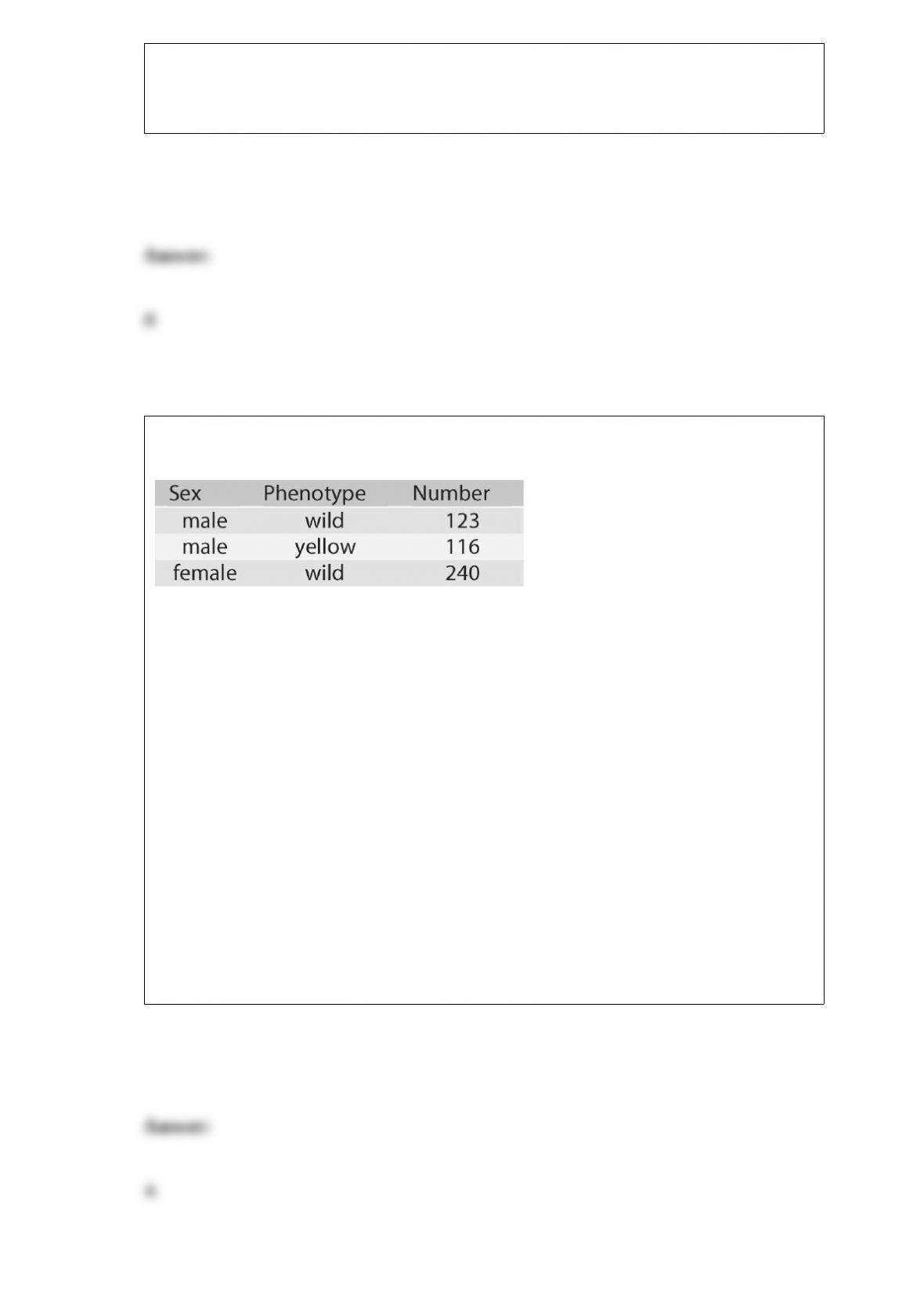
In a Drosophila experiment, a cross was made between homozygous wild-type females
and yellow-bodied males. All of the resulting F1s were phenotypically wild type.
However, adult flies of the F2 generation (resulting from matings of the F1s) had the
characteristics shown in the figure above. Consider the following questions:
(a) Is the mutant allele for yellow body recessive or dominant?
(b) Is the yellow locus autosomal (not X-linked) or X-linked?
A) (a) recessive; (b) X-linked
B) (a) recessive; (b) not X-linked
C) (a) dominant; (b) X-linked
D) (a) dominant; (b) not X-linked

The one-way flow of air along parabronchi makes what type of gas exchange
mechanism possible, at least theoretically?
A) the same as that occurring in fish gills
B) the same as that occurring in insect tracheae
C) the same as that occurring in mammalian lungs
D) the same as that occurring in echinoderm skin gills