
The four most common elements found in living organisms are ________.
A) nitrogen, oxygen, phosphorus, and carbon
B) carbon, oxygen, nitrogen, and hydrogen
C) carbon, oxygen, potassium, and calcium
D) oxygen, calcium, hydrogen, and carbon
The tendency of molecules of the same kind to stick together is called ________.
A) bonding
B) cohesion
C) polarity
D) adhesion
Which of these statements can be logically inferred from the amount of DNA shared by
chimpanzees and humans?
A) Humans and chimpanzees share a relatively recent common ancestor.
B) Humans evolved from chimpanzees.

C) Humans are unique and different from all other life forms.
D) Humans are a more complex life form than chimpanzees.
Read the following scenario to answer the following questions.
In the late 1800s, Charles Darwin and his son Francis conducted the first experiments
on phototropism. Several years later, their work was furthered by Peter Boysen-Jensen,
Arpad Paal, and Frits Went. Peter Boysen-Jensen separated the tip of grass shoots from
the rest of the plant using either tiny blocks of agar (a gelatin) or a mica wafer (an
impervious rock). Like the Darwins, Boysen-Jensen noticed that the grass did not grow
toward a light without its tips. However, when he separated the tip from the rest of the
plant using agar, the grass would grow toward a light. The grass would not grow toward
a light if the tip of the shoot was separated using a mica wafer. Arpad Paal cut off the
tips of grass shoots that were growing in the dark. He placed these cut tips back on the
shoots, but with only part of the tip covering the cut surface, and found that the plants
grew, in the dark, in the opposite direction from the side with the tip covering it. Lastly,
Frits Went removed the tips of many grass shoots and placed them on a large block of
agar for a few hours. Then, he cut up the agar block, and was able to make grass shoots
without any tips at all grow toward a light by putting these agar blocks on the cut
surfaces of the shoots (i.e., no tips were placed back on the shoots, only the agar).
Boysen-Jensen also used the mica to separate a tip of a grass shoot only partially, by
cutting the tip halfway and inserting a wafer of mica into the cut. If this experiment
supported the Darwins’ hypothesis, what would Boysen-Jensen have observed?
A) The grass shoot would not grow toward a light.
B) The grass shoot would grow toward a light when the mica wafer was on the side of
the grass that was facing the light.
C) The grass shoot would grow toward a light when the mica wafer was on the side of
the grass that was shaded from the light.
D) The grass shoot would grow toward a light no matter which direction the light was
coming from.

Read the following scenario to answer the following question(s).
Malaria is a disease caused by parasitic protists in the genusPlasmodium. The parasite is
transmitted to humans by female Anopheles mosquitoes. ThePlasmodium parasite feeds
on human red blood cells, eventually destroying them. Humans infected with malaria
can exhibit many symptoms. Depending on the severity of the infection, these can range
from fever, chills, sweating, and headaches to anemia and kidney failure. Ultimately,
malaria can result in death. However, if time and money permit, once a person is
infected, they can be treated with different antimalarial drugs. Two commonly used
drugs are artemisinin and quinine. In addition, one way to prevent the spread of malaria
is to apply pesticides to treat areas with Anopheles mosquitoes. The National Malaria
Eradication Program began work in 1947 with the goal of eliminating malaria from the
southern United States. In 1947, 15,000 cases of malaria were reported nationwide. By
1950, only 2,000 cases were reported, and by 1951, malaria was considered eradicated
from the United States. Today, the disease is most common in Africa and South
America, two continents that are highly impoverished. About one million people die
from malaria every year, many of them children. In Africa, it is estimated that one in
every five childhood deaths is due to malaria.
Suppose production of the pesticides used to treat malaria is halted because the
Environmental Protection Agency (EPA) has found that they are causing too much
environmental damage to warrant its continued use. In turn, this drives up the prices of
artemisinin and quinine since they are now in higher demand. How might this affect
those that live in South America and Africa?
A) They will likely experience a decrease in the number of male Anopheles mosquitoes.
B) They will likely experience an increase in the number of male Anopheles
mosquitoes.
C) They will likely experience a decrease in the number of malaria cases
D) They will likely experience an increase in the number of malaria cases.

Where would we expect to find electrical synapses?
A) within the brain
B) within the heart
C) within the spinal cord
D) between interneurons and motor neurons
Which of the following actions would increase your carbon footprint?
A) reusing or recycling items
B) eating more vegetables and less meat
C) eating more beef and less chicken
D) walking instead of driving
Researchers have found a general relationship between testicular cancer and exercise.
Increased exercise is associated with a decrease in incidence of testicular cancer.
However, a positive relationship (increased incidence of testicular cancer) was found
between testicular cancer and riding bikes or horses. Several factors might be
hypothesized to bring about this result. Which of these hypotheses is properly related to

a prediction that arises from it?
A) Hypothesis: Riding bikes or horses causes trauma to the testes. Prediction: Bike or
horse riding will cause testes to shrink.
B) Hypothesis: The seat on bikes and the saddle on horses are made of material
containing chemicals that damage testicular cells. Prediction: Chemicals found in bike
seats or horse saddles damage testicular cells.
C) Hypothesis: Riding bikes or horses increases scrotal temperature, which damages
testicular cells. Prediction: Bike riders are more likely to wear briefs than boxers as
their underwear of choice.
D) Hypothesis: Mutations that lead to testicular cancer make men more likely to ride
bikes or horses. Prediction: Men who ride bikes or horses have a higher rate of
mutations than nonriders.
Which of these would be a valid scientific hypothesis?
A) Human history is determined by a series of supernatural events.
B) Humans should help in the conservation of other animal species.
C) Humans are controlled by forces beyond our understanding.
D) Humans and bacteria share a common genetic code.
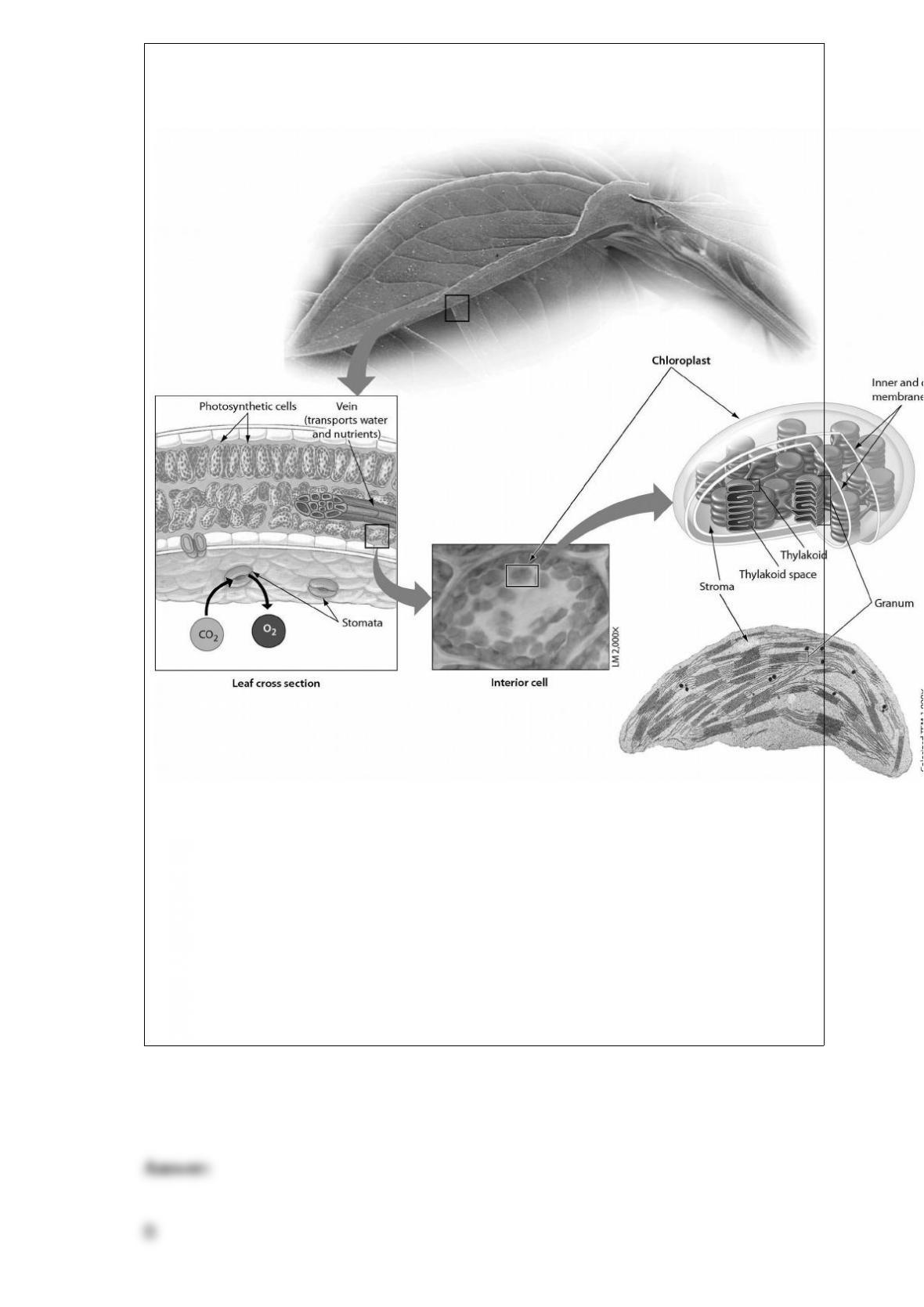
In the accompanying figure, the molecule that makes up the bulk of the mass of the
plant comes in mostly ________.
A) through the veins, which bring materials from the roots
B) through the transparent covering of the leaf into the photosynthetic cells
C) through the stomata
D) from the roots where they are stored during the night

Which of the following is an example of mechanical digestion?
A) the breakdown of proteins into amino acids
B) peristalsis
C) the digestion of fats by lipases
D) chewing
Why (if you are careful) are you able to float a needle on the surface of water?
A) Water has adhesive properties.
B) The surface tension that is a result of water’s cohesive properties makes this possible.
C) The covalent bonds that hold a water molecule together make this possible.
D) A single needle is less dense than water.
The ________ is most commonly found in nature.
A) recessive trait
B) wild-type trait

C) parental type
D) dominant trait
Data suggest that the normal version of BRCA1 functions as a(n) ________.
A) oncogene
B) tumor-suppressor gene
C) proto-oncogene
D) silencer
In an ideal, unlimited environment, what shape does a population’s growth curve most
closely resemble?
A) S
B) J
C) ∧
D) ∪

Read the following scenario to answer the following questions.
In some zoos, rare crosses between a male lion and a female tiger have produced hybrid
offspring called “ligers.” Male ligers are sterile but some female ligers are fertile. In the
wild, lion and tiger ranges do not naturally overlap, making such a cross unlikely.
Furthermore, the solitary behavior of tigers and the social organizations of lions create
behavioral differences.
The production of sterile male ligers is an example of ________.
A) sympatric speciation
B) the founder effect
C) a postzygotic barrier
D) a prezygotic barrier
Please use the following information to answer the following questions.
You work for a company selling tropical rain forest plants commonly found in the
understory of the forest. These plants are shade tolerant and can be grown indoors
because they require low light. Your employer wants you to find out what is the best
type of light to maximize growth of these understory plants. Using a full spectrum of
natural light would cause these plants to die because they are a shade-tolerant plant
species.
From your biology class, you recall that the light-dependent reactions of photosynthesis
involve pigment molecules that absorb light of specific wavelengths. You also
remember the experiments done by the German biologist Theodor Engelmann, in which
he separated light using a prism into different wavelengths and then determined which
wavelengths were best for promoting photosynthesis in the algae species he was
examining. Your goal is to determine which wavelengths (colors) of light are best for
promoting photosynthesis to enhance growth in your species of plant. To achieve this,
you grew your plants under different wavelengths of light and measured their growth
rates. The wavelengths were measured in nanometers (nm), and the growth rate was
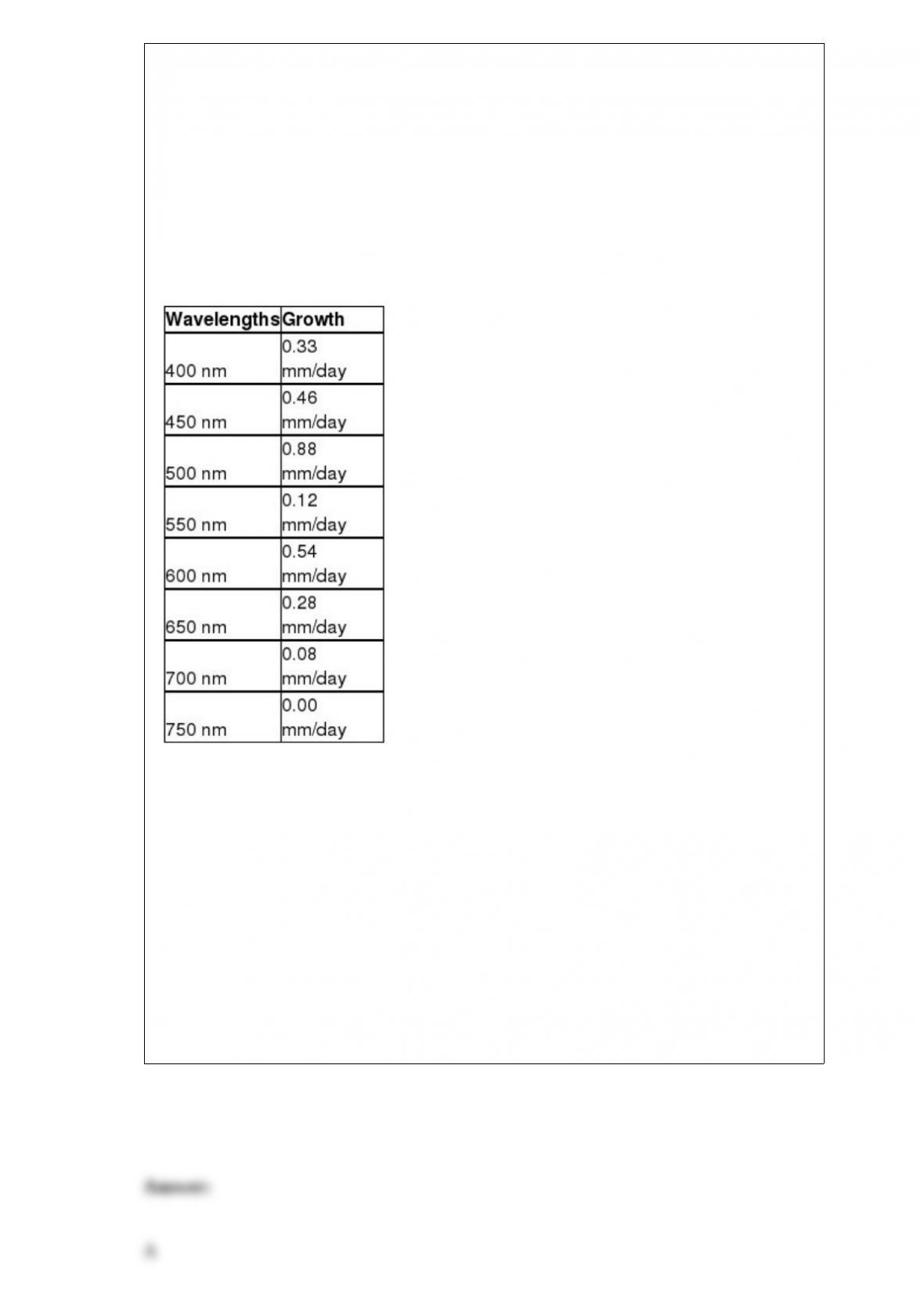
measured in millimeters per day (mm/day). The data you collected are as follows:
Make a bar graph plotting growth rates on the y-axis and wavelengths of light on the
x-axis. Referring to your graph, answer the following questions:
Which wavelength of light is the LEAST useful to your plant’s growth?
A) 750 nm
B) 650 nm
C) 550 nm
D) 500 nm

A pollen grain is a(n) ________.
A) female gametophyte
B) sporophyte
C) male gametophyte
D) integument
A diuretic is a substance that ________.
A) promotes sweating
B) regulates the contraction of cardiac muscle
C) inhibits urinary water loss
D) promotes urinary water loss
Like plants, fungi have ________; however, in plants they are composed of ________,
whereas in fungi they are composed of ________.
A) cell walls… cellulose… chitin

B) cell walls… cellulose… peptidoglycan
C) cell membranes… phospholipids… chitin
D) cell walls… phospholipids… cellulose
Which of the following cell types provide support in growing parts of a plant?
A) parenchyma cells
B) collenchyma cells
C) sclerenchyma cells
D) water-conducting cells
Please read the following paragraph and then answer the following questions.
Huntington’s disease is a genetic disorder in which a mutation causes the production of
a protein, which damages cells in the brain. Symptoms typically begin with changes in
personality, attention, and reasoning. Uncoordinated and uncontrolled movements
develop, such that physical abilities become limited. Cognitive problems worsen into
dementia. There is currently no cure for Huntington’s disease.
Given the symptoms of Huntington’s disease, which structure in the brain is being
damaged by the abnormal protein?

A) cerebellum
B) cerebrum
C) hypothalamus
D) brainstem
Your metabolic rate depends on ________.
I) your age
II) your activity levels
III) genetics
A) I only
B) I and II, but not III
C) II only
D) I, II, and III
Why do diseases involving widespread infection often result in a fever?

A) The inflammatory and immune responses result in extra heat production.
B) The microorganisms trick the brain’s temperature control center into creating a hot
environment that favors their growth.
C) The brain’s temperature control center responds to inflammation by creating a hot
environment unfavorable to the growth of microorganisms.
D) The inflammatory response result is less heat production.
The rate at which an ecosystem’s producers convert solar energy to chemical energy
stored in biomass is called ________.
A) energy flow
B) chemical cycle
C) primary productivity
D) trophic structure
Which of the following is an example of flowering plant/animal interdependence?
I) Most angiosperms depend on insects, birds, or mammals for pollination.
II) Most angiosperms depend on insects, birds, or mammals for seed dispersal.

III) Most land animals depend on angiosperms for food.
A) I only
B) I and II
C) III only
D) I, II, and III
Please read the following scenario to answer the following questions.
Salmon eggs hatch in freshwater streams and, during their first year of life, the young
salmon migrate distances up to 1,000 km in order to reach the ocean. Here they spend
up to 5 years where they feed and grow, acquiring more than 95% of their biomass.
During the summer of their maturing year, they begin the long journey back to their
home streams to spawn. Although it is still uncertain how salmon navigate back to their
spawning grounds, current hypotheses suggest that they have a highly developed sense
of smell that allows them to remember odors they encountered on their migration to the
ocean. They then use these odors to help them navigate back to the streams where they
were born. At the spawning grounds, females use their tails to form a hollow cavity in
the stream gravel where they lay up to 8,000 eggs. The males fertilize the eggs, and
both adults typically die soon thereafter.
At different times in their lives, salmon can be found in all of the following
EXCEPT________.
A) a freshwater biome
B) a chaparral
C) the pelagic realm
D) an estuary

Which animals have a cylindrical body that is tapered at both ends?
A) platyhelminthes
B) cnidarians
C) annelids
D) roundworms
The liver, pancreas, and lining of the digestive tract come from ________.
A) ectoderm
B) endoderm
C) mesoderm
D) endometrium

Similar to the nucleus, chloroplasts and mitochondria are ________.
A) surrounded by two membranes
B) able to synthesize carbohydrates
C) manufactured by the nucleolus
D) able to synthesize lipids