
A human blastomere is _____.
A) an embryonic cell that is smaller than the ovum
B) an embryonic structure that includes a fluid-filled cavity
C) that part of the acrosome that opens the egg’s membrane
D) a cell that contains a (degenerating) second polar body
A large proportion of archaeans are extremophiles, so called because they inhabit
extreme environments with high acidity, salinity, and/or temperature. Such
environments are thought to have been much more common on the primitive Earth.
Thus, modern extremophiles survive only in places that their ancestors became adapted
to long ago. Which of the following is, consequently, a valid statement about modern
extremophiles, assuming that their habitats have remained relatively unchanged?
A) Among themselves, they should share relatively few ancestral traits, especially those
that enabled ancestral forms to adapt to extreme conditions.
B) On a phylogenetic tree whose branch lengths are proportional to the amount of
genetic change, the branches of the extremophiles should be shorter than the
non-extremophilic archaeans.
C) They should contain genes that originated in eukaryotes that are the hosts for
numerous species of bacteria.
D) They should currently be undergoing a high level of horizontal gene transfer with
non-extremophilic archaeans.

A certain bacterium infects a plant’s upper leaves. A few days later, bacteria of the same
species attempt to infect the same plant’s roots but are unsuccessful. What process is
responsible for the plant’s ability to prevent this infection?
A) antivirulence response
B) pathogenesis resistance
C) systemic acquired resistance
D) sequential immunity
A neurophysiologist is investigating nerve reflexes in two different animals: a crab and
a fish. Action potentials are found to pass more rapidly along the fish’s neurons. What is
the most likely explanation?
A) The fish’s axons are smaller in diameter; small axons transmit action potentials faster
than large axons do.
B) Unlike the crab, the fish’s axons are wrapped in myelin.
C) There are more ion channels in the axons of the crab compared with fish axons.
D) Unlike the crab, the fish’s axons are wrapped in myelin, and the fish’s axons are
smaller in diameter; small axons transmit action potentials faster than large axons do.

In multiple sclerosis the myelin sheaths around the axons of the brain and spinal cord
are damaged and demyelination results. How does this disease manifest at the level of
the action potential?
I) Action potentials move in the opposite direction on the axon.
II) Action potentials move more slowly along the axon.
III) No action potentials are transmitted.
A) only I
B) only II
C) only III
D) only II and III
A particular species of protist has obtained a chloroplast via secondary endosymbiosis.
You know this because the chloroplasts _____.
A) have nuclear and cyanobacterial genes
B) are exceptionally small
C) have three or four membranes
D) have only a single pigment

Which of the following cells have reduced or very little active telomerase activity?
A) most normal somatic cells
B) most normal germ cells
C) most cancer cells
Ignoring all other factors, what kind of day would result in the fastest delivery of water
and minerals to the leaves of an oak tree?
A) cool, dry day
B) very hot, dry, windy day
C) warm, humid day
D) cool, humid day
Use the following figure to answer the questions below.
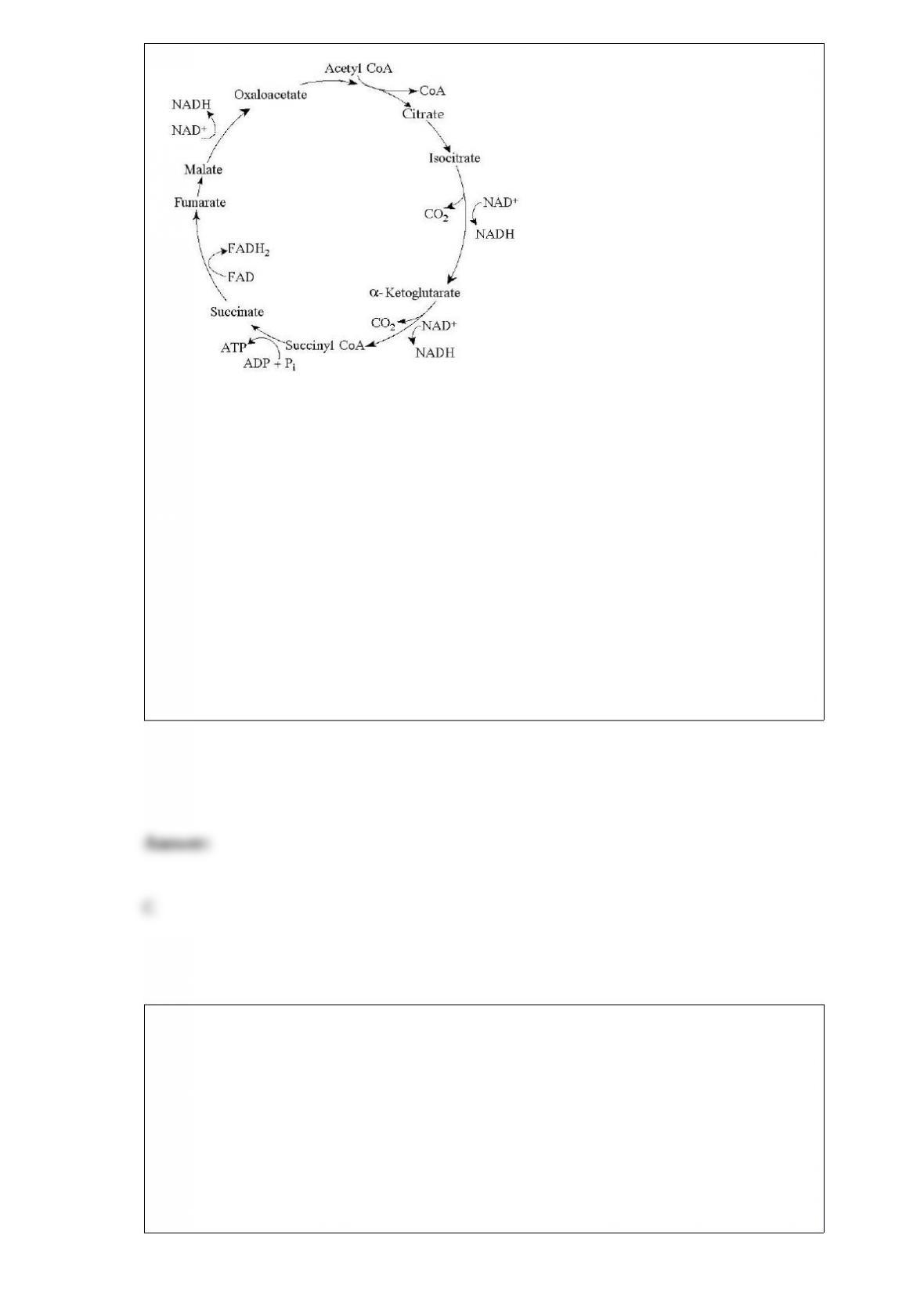
The citric acid cycle.
Starting with citrate, which of the following combinations of products would result
from three acetyl CoA molecules entering the citric acid cycle (see the accompanying
figure)?
A) 1 ATP, 2 CO2, 3 NADH, and 1 FADH2
B) 3 ATP, 3 CO2, 3 NADH, and 3 FADH2
C) 3 ATP, 6 CO2, 9 NADH, and 3 FADH2
D) 38 ATP, 6 CO2, 3 NADH, and 12 FADH2
What would probably happen if a long neuron had one continuous myelin sheath down
the length of the axon with no nodes of Ranvier?
A) The action potential would be propagated nearly instantaneously to the synapse.
B) There could be no action potential generated at the axon hillock.
C) The signal would fade because it is not renewed by the opening of more sodium
channels.

Which of the following are important components of the long-distance transport process
in plants?
I) the cohesion of water molecules
II) a negative water potential
III) the root parenchyma
IV) the active transport of solutes
V) bulk flow from source to sink
A) II, III, IV, and V
B) I, III, IV, and V
C) I, II, IV, and V
D) I, II, III, and V
Agricultural lands frequently require nutrient augmentation because _____.
A) nitrogen-fixing bacteria are not as plentiful in agricultural soils because of the use of
pesticides
B) the nutrients that become the biomass of plants are not cycled back to the soil on
lands where they are harvested

C) land that is available for agriculture tends to be nutrient-poor
D) cultivation of agricultural land inhibits the decomposition of organic matter
Which of the following animals generally has the lowest volume of urine production?
A) a vampire bat
B) a salmon in fresh water
C) a marine bony fish
D) a shark inhabiting the Mississippi River
Which branch of biology is concerned with the naming and classifying of organisms?
A) informatics
B) taxonomy
C) genomics
D) evolution

Uterine implantation due to enzymatic digestion of the endometrium is initiated by the
_____.
A) inner cell mass
B) endoderm
C) mesoderm
D) trophoblast
A person with a tidal volume of 450 mL (milliliters), a vital capacity of 4000 mL, and a
residual volume of 1000 mL would have a potential total lung capacity of _____.
A) 1450 mL
B) 4000 mL
C) 4450 mL
D) 5000 mL
Upon exposure to blue light, plants not only begin to grow toward the light, but move
their chloroplasts to the sunny side of each cell. The adaptive advantage of moving
chloroplasts to the sunny side of each cell _____.
A) maximizes light absorption by the chloroplasts for photosynthesis
B) increases production of phototropic hormones
C) maximizes heat absorption by the chloroplasts for cellular respiration
D) increases adenosine triphosphate (ATP) production during the light-independent
reactions
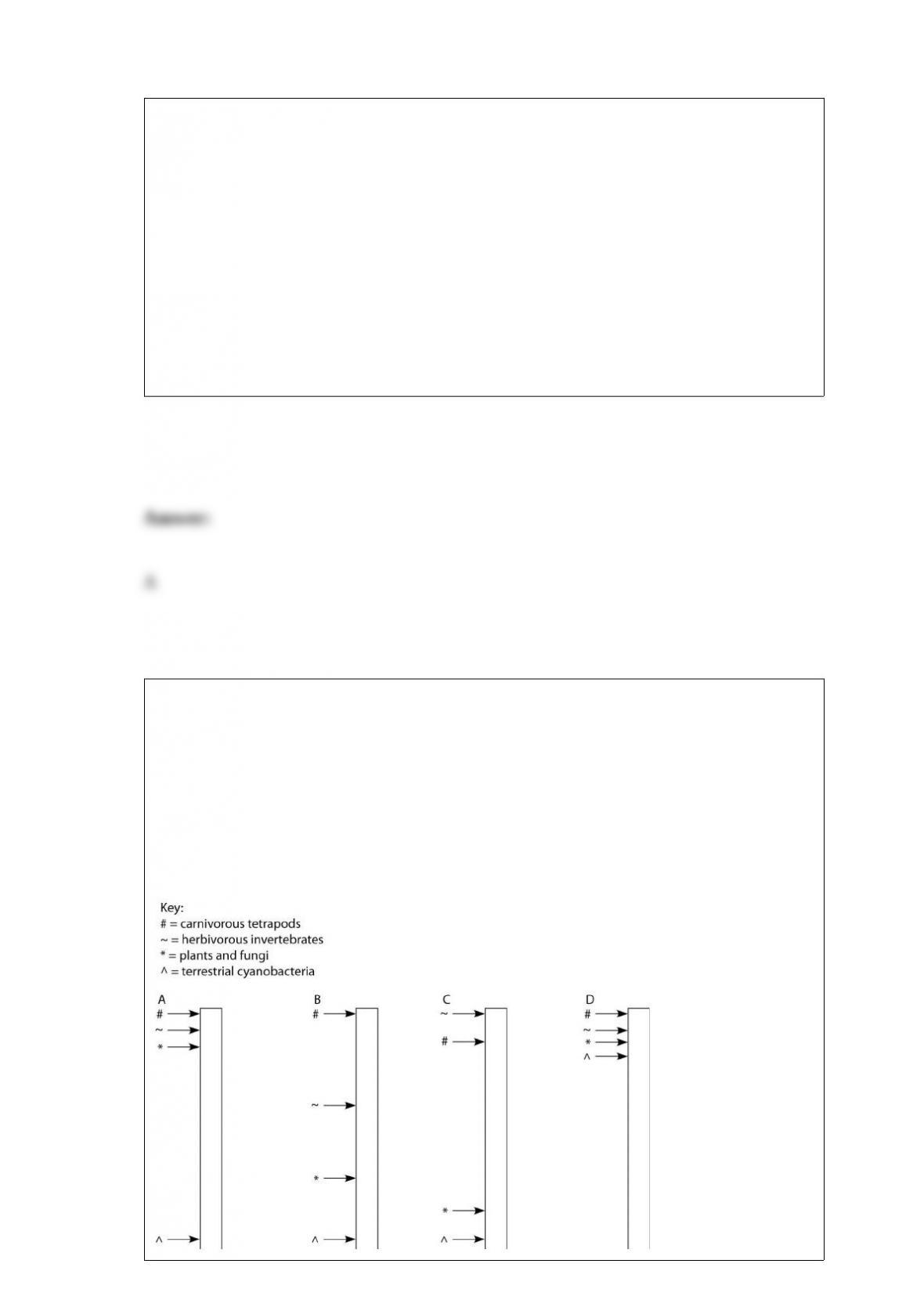
The questions below refer to the following paragraph.
A sediment core is removed from the floor of an inland sea. The sea has been in
existence, off and on, throughout the entire time that terrestrial life has existed.
Researchers wish to locate and study the terrestrial organisms fossilized in this core.
The core is illustrated as a vertical column, with the top of the column representing the
most recent strata and the bottom representing the time when land was first colonized
by life.

To assign absolute dates to fossils in this sediment core, it would be most helpful if
_____.
A) we knew the order in which the fossils occurred
B) the sediments had not been affected by underwater currents during their deposition
C) volcanic ash layers were regularly interspersed between the sedimentary strata
D) fossils throughout the column were equally spaced apart
A dietary Calorie equals 1 kilocalorie. Which of the following statements correctly
defines 1 kilocalorie? One kilocalorie equals _____.
A) 1000 calories, or the amount of heat required to raise the temperature of 1 g of water
by 1C
B) 10,000 calories, or the amount of heat required to raise the temperature of 1 kg of
water by 1F
C) 1000 calories, or the amount of heat required to raise the temperature of 1 kg of
water by 1C
D) 1000 calories, or the amount of heat required to raise the temperature of 100 g of
water by 100C

If glucose is the sole energy source, what fraction of the carbon dioxide exhaled by
animals is generated by the reactions of the citric acid cycle?
A) 1/6
B) 1/3
C) 2/3
D) all of it
Phylogenetic trees constructed from evidence from molecular systematics are based on
similarities in _____.
A) morphology
B) the pattern of embryological development
C) biochemical pathways
D) mutations to homologous genes
Most repressor proteins are allosteric. Which of the following binds with the repressor
to alter its conformation?
A) inducer

B) promoter
C) transcription factor
D) cAMP
Soil nitrogen is not solely contained within the rhizoids of the Dawsonia mosses
because rhizoids _____.
A) are associated with fungi that inhibit mineral transfer from soil to rhizoids
B) are not absorptive structures
C) lack direct attachment to the moss sporophytes
D) immediately transfer the nitrogen to the sporophyte
Which one of the following statements about transport of nutrients in phloem is correct?
A) Solute particles are actively transported from phloem at the source.
B) Companion cells control the rate and direction of movement of phloem sap.
C) Differences in osmotic concentration at the source and sink cause a hydrostatic
pressure gradient to be formed.
D) A sink is the part of a plant where a particular solute is produced.

Fertilization of an egg without activation is most like _____.
A) placing the key in the ignition of a car but not starting the engine
B) resting during halftime of a basketball game
C) preparing a pie from scratch and baking it in the oven
D) walking to the cafeteria and eating lunch
Which of the following is true of steroid receptors?
A) The receptor molecules are themselves lipids or glycolipids.
B) The receptor may be inside the nucleus of a target cell.
C) The unbound steroid receptors are quickly recycled by lysosomes.
D) Steroid receptors are typically bound to the external surface of the nuclear
membrane.

It can be very difficult to select an angle for sneaking up to a grasshopper to catch it
because grasshoppers have _____.
A) excellent hearing for detecting predators
B) compound eyes with multiple ommatidia
C) eyes with multiple fovea
D) a camera-like eye with multiple fovea
To prepare flight muscles for use on a cool morning, hawkmoths _____.
A) relax the muscles completely until after they launch themselves into the air
B) decrease their standard metabolic rate
C) rapidly contract and relax these muscles to generate metabolic warmth
D) reduce the metabolic rate of the muscles to rest them before flight
Phenylketonuria (PKU) is a recessive human disorder in which an individual cannot
appropriately metabolize the amino acid phenylalanine. This amino acid is not naturally
produced by humans. Therefore, the most efficient and effective treatment is which of
the following?

A) Feed them the substrate that can be metabolized into this amino acid.
B) Regulate the diet of the affected persons to severely limit the uptake of the amino
acid.
C) Feed the patients the missing enzymes in a regular cycle, such as twice per week.
D) Feed the patients an excess of the missing product.
Certain proteins of the complex motor that drives bacterial flagella are modified
versions of proteins that had previously belonged to plasma membrane pumps. This
evidence supports the claim that _____.
A) natural selection produces organs that will be needed in future environments
B) the motors of bacterial flagella must have originated in other organisms
C) natural selection can produce new structures by coupling together parts of other
structures
D) bacteria that possess flagella must have lost the ability to pump certain chemicals
across their plasma membranes
In colorectal cancer, several genes must be mutated for a cell to develop into a cancer
cell. Which of the following kinds of genes would you expect to be mutated?

A) genes coding for enzymes that act in the colon
B) genes involved in control of the cell cycle
C) genes that are especially susceptible to mutation
D) genes of the bacteria, which are abundant in the colon
Which organelle is the primary site of ATP synthesis in eukaryotic cells?
A) lysosome
B) mitochondrion
C) Golgi apparatus
D) peroxisome