
In the process of science, which of these is tested?
A) a result
B) an observation
C) a hypothesis
D) a control group
Use the following information to answer the question(s) below.
For several decades now, amphibian species worldwide have been in decline. A
significant proportion of the decline seems to be due to the spread of the chytrid fungus,
Batrachochytrium dendrobatidis (Bd). Chytrid sporangia reside within the epidermal
cells of infected animals, animals that consequently show areas of sloughed skin. They
can also be lethargic, which is expressed through failure to hide and failure to flee. The
infection cycle typically takes four to five days, at the end of which zoospores are
released from sporangia into the environment. In some amphibian species, mortality
rates approach 100%; other species seem able to survive the infection.
If infection primarily involves the outermost layers of adult amphibian skin, and if the
chytrids use the skin as their sole source of nutrition, then which term best applies to the
chytrids?
A) anaerobic chemoautotroph
B) aerobic chemoautotroph
C) anaerobic chemoheterotroph
D) aerobic chemoheterotroph

The Permian period ended and then rapid speciation occurred as new animal and plant
forms evolved. The most likely explanation for this is _____.
I) adaptive radiation
II) ecological opportunity
III) lack of competition
IV) morphological innovation
A) just one of the above
B) two of the above
C) three of the above
D) all of the above
Imagine that you compare two DNA sequences found in the same location on
homologous chromosomes. On one of the homologs, the sequence is AACTACGA. On
the other homolog, the sequence is AACTTCGA. Within a population, you discover
that each of these sequences is common. These sequences _____.
A) contain an SNP that may be useful for genetic mapping
B) identify a protein-coding region of a gene
C) cause disease
D) do none of the listed actions

Use the following information to answer the question(s) below.
A farm pond, usually dry during winter, has plenty of water and aquatic pond life
during the summer. One summer, Sarah returns to the family farm from college.
Observing the pond, she is fascinated by some six-legged organisms that can crawl
about on submerged surfaces or, when disturbed, seemingly “jet” through the water.
Watching further, she is able to conclude that the “mystery organisms” are ambush
predators, and their prey includes everything from insects to small fish and tadpoles.
As you are walking along a beach, you find an animal and believe that it belongs to the
class Asteroidea. Which of the following characteristics would support your hypothesis
that the animal is a sea star and not another type of echinoderm?
A) It is pentaradially symmetric.
B) It feeds on other animals.
C) It has a hydrostatic skeleton, formed from its water vascular system.
D) Its central region is not well-delineated from its appendages.
If the pH of a solution is decreased from 9 to 8, it means that the concentration of
_____.
A) H+ has decreased to one-tenth (1/10) what it was at pH 9
B) H+ has doubled compared to what it was at pH 9
C) H+ has increased tenfold (10X) compared to what it was at pH 9

D) OH- has increased tenfold (10X) compared to what it was at pH 9
In all vertebrate animals, development requires _____.
A) a large supply of yolk
B) an aqueous environment
C) extraembryonic membranes
D) a primitive streak
If you experimentally increase the concentration of K+ inside a cell while maintaining
other ion concentrations as they were, what would happen to the cell’s membrane
potential?
A) The membrane potential would become more negative.
B) The membrane potential would become less negative.
C) The membrane potential would remain the same.

Owls eat rats, mice, shrews, and small birds. Assume that, over a period of time, an owl
consumes 5000 J of animal material. The owl loses 2300 J in feces and owl pellets and
uses 2500 J for cellular respiration. What is the production efficiency of this owl?
A) 0.02%
B) 0.2%
C) 4%
D) 40%
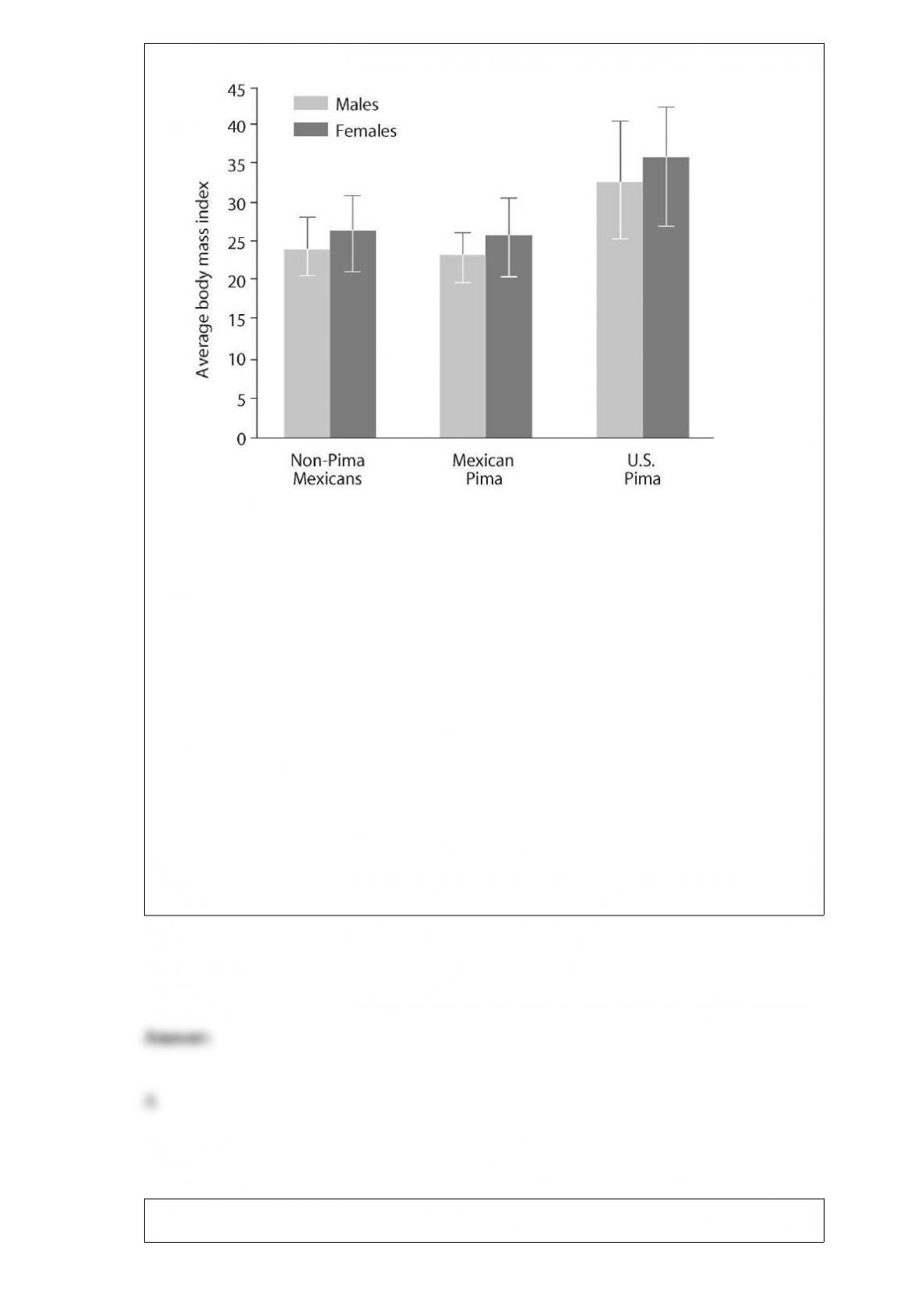
The Pimas are a group of people living in the southwestern United States and Mexico.
Although Pima Indians living in the United States and Mexico have a similar genetic
background, a five-fold increase in the incidence of type II diabetes mellitus among
U.S. Pima has been reported. The body mass index of Mexicans of non-Pima descent,
Mexicans of Pima descent, and Pimas living in the United States is shown in the figure
above. Based on this information and the graph above, what can you infer about the
incidence of type II diabetes mellitus?
A) Obesity is a risk factor for development of type II diabetes mellitus.
B) If you maintain a normal body weight (body mass index less than 25), you will not
get type II diabetes mellitus.
C) The incidence of type II diabetes mellitus has increased in the past ten years.
D) People who develop type II diabetes mellitus are typically diagnosed in childhood or
adolescence.
Use the following information to answer the question(s) below.

Trichoplax adhaerens (Tp) is the only living species in the phylum Placozoa.
Individuals are about 1 mm wide and only 27 μm high, are irregularly shaped, and
consist of a total of about 2000 cells, which are diploid (2n = 12). There are four types
of cells, none of which are nerve or muscle cells, and none of which have cell walls.
They move using cilia, and any “edge” can lead. Tp feeds on marine microbes, mostly
unicellular green algae, by crawling atop the algae and trapping it between its ventral
surface and the substrate. Enzymes are then secreted onto the algae, and the resulting
nutrients are absorbed. Tp sperm cells have never been observed, nor have embryos
past the 64-cell (blastula) stage.
On the basis of information in the paragraph above, which of these should be able to be
observed in Tp?
A) the act of fertilization
B) the process of gastrulation
C) eggs
D) All three of the listed responses are correct.
Which of the following is an adult organism that has fewer than 1,000 cells?
A) chickens, Gallus domesticus
B) African clawed frogs, Xenopus laevis
C) fruit flies, Drosophila melanogaster
D) nematodes, Caenorhabditis elegans
Among non-mammalian vertebrates, the cloaca is an anatomical structure that functions
as _____.
A) a specialized sperm-transfer device produced only by males
B) a shared pathway for the digestive, excretory, and reproductive systems
C) a source of nutrients for developing sperm in the testes
D) a gland that secretes mucus to lubricate the vaginal opening
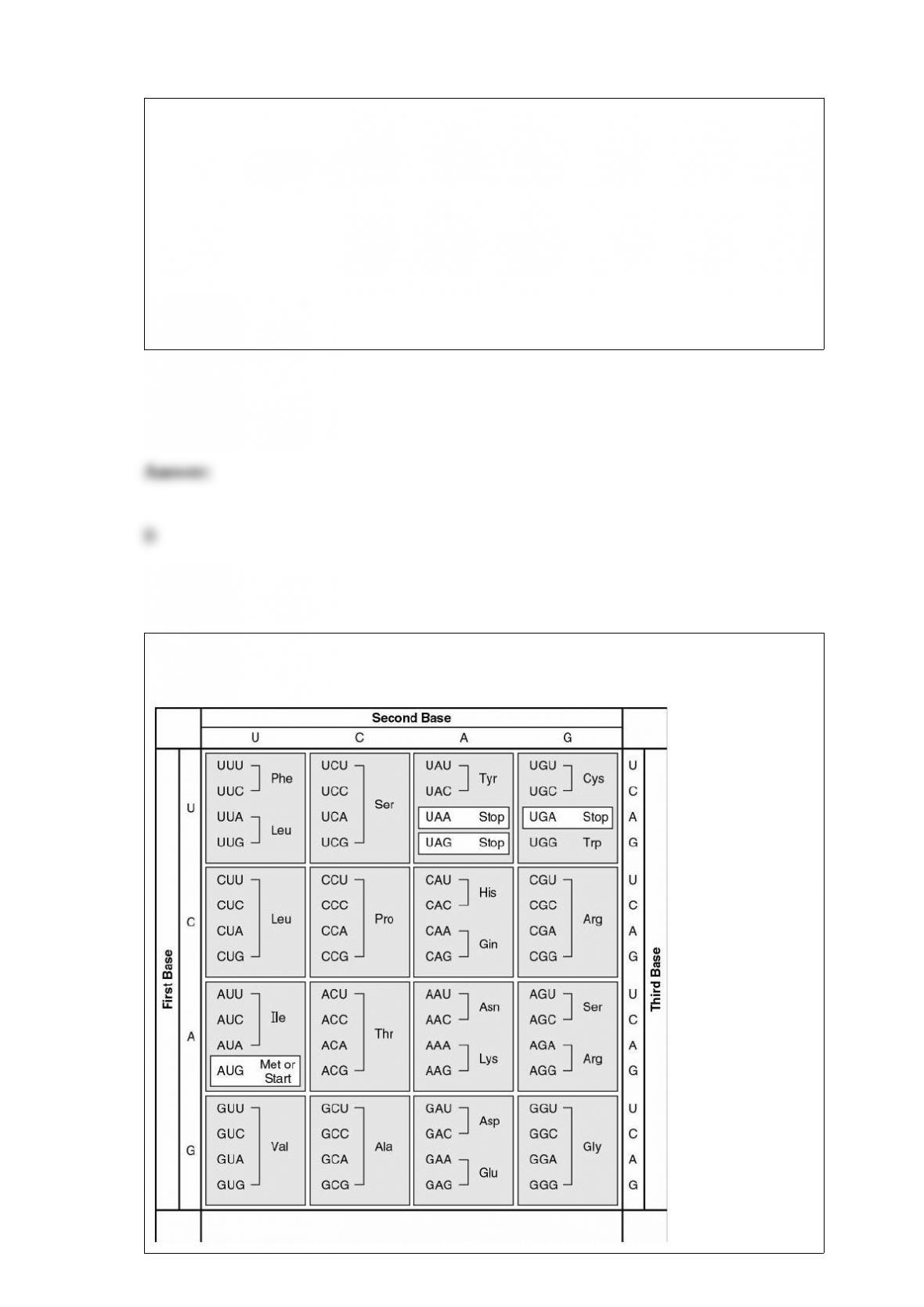
The following questions refer to this table of codons.

What amino acid sequence will be generated, based on the following mRNA codon
sequence?
5′ AUG-UCU-UCG-UUA-UCC-UUG
A) met-arg-glu-arg-glu-arg
B) met-glu-arg-arg-glu-leu
C) met-ser-leu-ser-leu-ser
D) met-ser-ser-leu-ser-leu
The Nernst equation specifies the equilibrium potential for a particular ion. This
equilibrium potential is a function of _____.
A) hydrostatic pressure
B) ion concentration gradient
C) osmotic gradient
D) temperature (thermal) gradient
Which of the following are primarily responsible for cytokinesis in plant cells but not in
animal cells?

A) kinetochores
B) Golgi-derived vesicles
C) actin and myosin
D) centrioles and centromeres
Which two processes are responsible for the shape of the curve at Time B?
1. transduction
2. entry of single-stranded Hfr DNA
3. rolling circle replication of single-stranded Hfr DNA
4. activation of DNA pumps in plasma membrane
A) 1 and 2
B) 1 and 4
C) 2 and 3
D) 3 and 4

Which structure is common to plant and animal cells?
A) chloroplast
B) central vacuole
C) mitochondrion
D) centriole
Which of the following shows a brain structure correctly paired with one of its primary
functions?
A) frontal lobe decision making
B) occipital lobe control of skeletal muscles
C) temporal lobe visual processing
D) occipital lobe speech production
Early investigators thought the oxygen produced by photosynthetic plants came from
carbon dioxide. In fact, it comes from _____.
A) water
B) glucose

C) air
D) electrons from NADPH
Use the following information to answer the question(s) below.
The most recently discovered phylum in the animal kingdom (1995) is the phylum
Cycliophora. It includes three species of tiny organisms that live in large numbers on
the outsides of the mouthparts and appendages of lobsters. The feeding stage
permanently attaches to the lobster via an adhesive disk and collects scraps of food
from its host’s feeding by capturing the scraps in a current created by a ring of cilia. The
body is sac-like and has a U-shaped intestine that brings the anus close to the mouth.
Cycliophorans are coelomates, do not molt (though their host does), and their embryos
undergo spiral cleavage.
Which of these, if discovered among cycliophorans, would cause the most confusion
concerning our current understanding of cycliophoran taxonomy?
A) if the ciliated feeding ring is a lophophore
B) if embryos are diploblastic
C) if the body cavity is actually a pseudocoelom
D) if the organisms show little apparent cephalization
A solution with a pH of 5 has how many more protons in it than a solution with a pH of
7?
A) 5 times
B) 10 times
C) 100 times
D) 1000 times
Use the following description to answer the question(s) below.
In the ocean, on either side of the Isthmus of Panama, are thirty species of snapping
shrimp; some are shallow-water species, others are adapted to deep water. There are
fifteen species on the Pacific side and fifteen different species on the Atlantic side. The
Isthmus of Panama started rising about ten million years ago. The oceans were
completely separated by the isthmus about three million years ago.
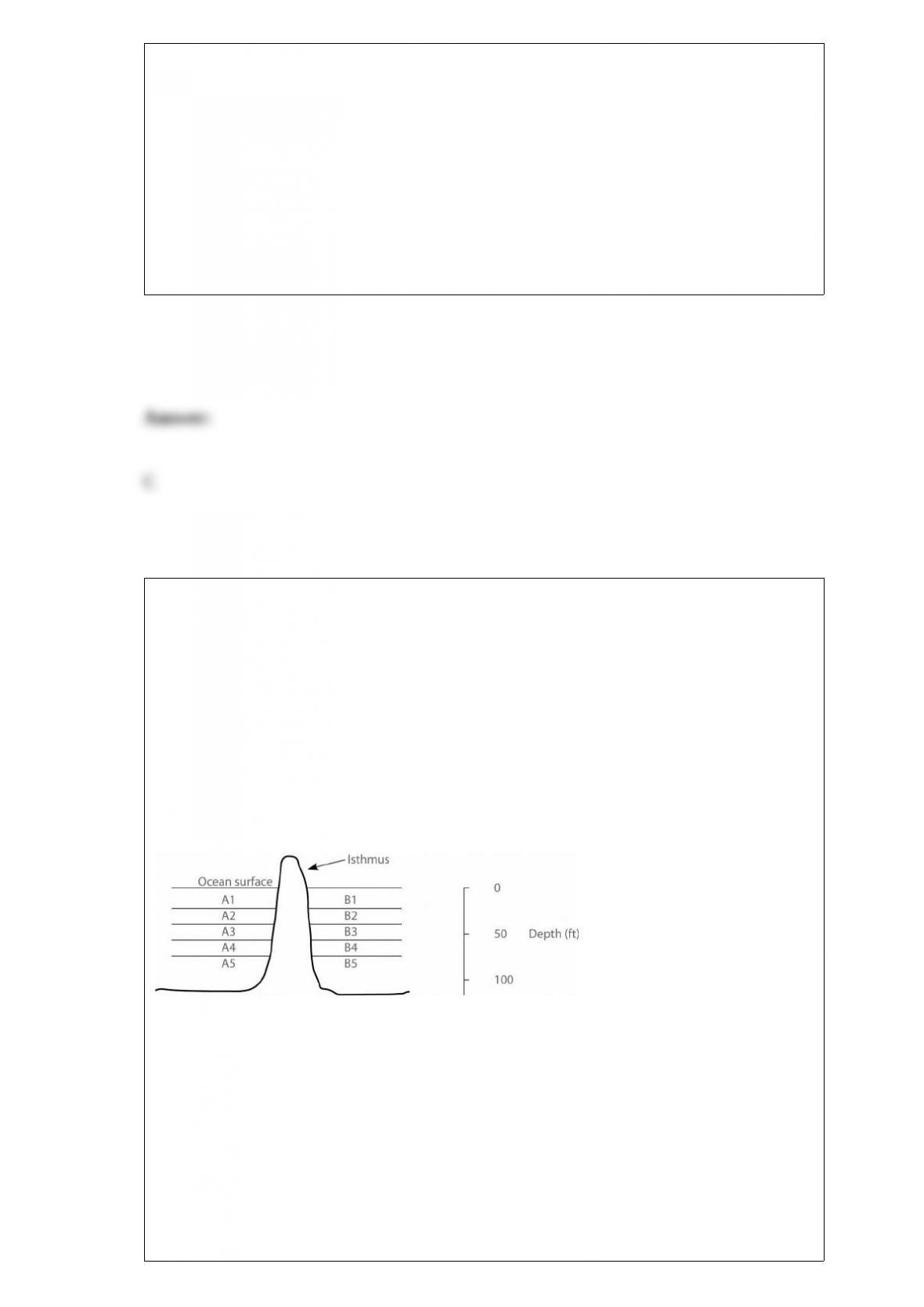
In the following figure, the isthmus separates the Pacific Ocean on the left (side A)
from the Atlantic Ocean on the right (side B). The seawater on either side of the isthmus
is separated into five depth habitats (1-5), with 1 being the shallowest.
In which habitat should one find snapping shrimp most closely related to shrimp that
live in habitat A4?
A) A3
B) A5
C) B4
D) either A3 or A5
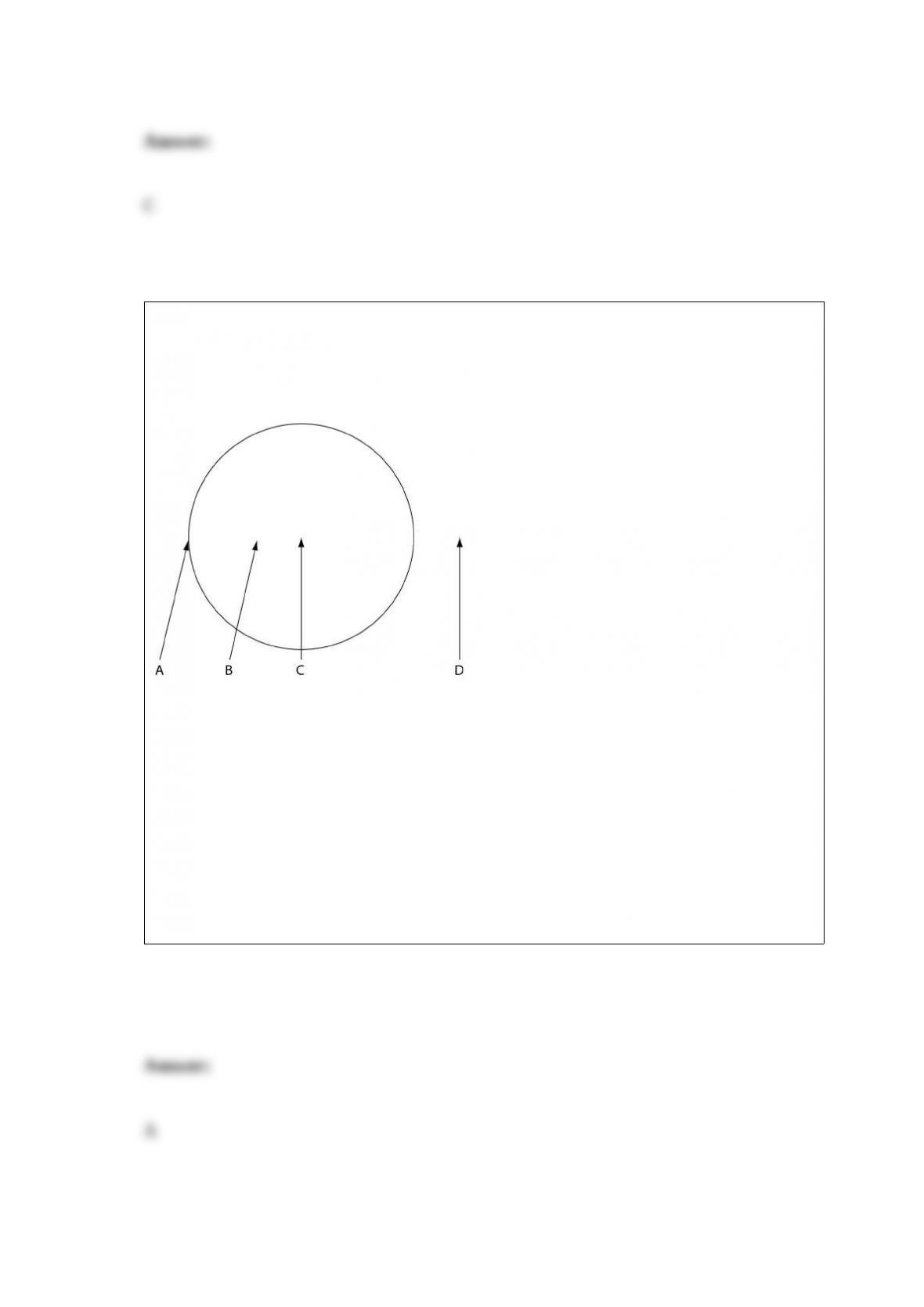
The following figure depicts the outline of a large fairy ring that has appeared overnight
in an open meadow, as viewed from above. The fairy ring represents the furthest
advance of this mycelium through the soil. Locations A-D are all 0.5 meters below the
soil surface.
If the fungus that produced the fairy ring can also produce arbuscules, then which of the
following is most likely to be buried at location “C”?
A) tree stump
B) deceased animal
C) fire pit
D) cement-capped well

Photosynthesis ceases when leaves wilt, mainly because _____.
A) the chlorophyll in wilting leaves is degraded
B) flaccid mesophyll cells are incapable of photosynthesis
C) stomata close, preventing carbon dioxide from entering the leaf
D) accumulation of carbon dioxide in the leaf inhibits enzymes
Pollen from a plant with the S1S2 genotype is recognized and allowed to germinate on
the stigma of the same plant with the S1S2 genotype. According to the S-system
hypothesis, this indicates that the plant is _____.
A) self-compatible and can self-pollinate.
B) self-compatible and must cross-pollinate.
C) self-incompatible and can self-pollinate.
D) self-incompatible and must cross-pollinate.
Use the following information to answer the question(s) below.
“Marine cone snails from the genus Conus are estimated to consist of up to 700 species.
These predatory molluscs have devised an efficient venom apparatus that allows them

to successfully capture polychaete worms, other molluscs, or in some cases fish as their
primary food sources. ” conotoxins from Australian species of Conus ” have the
capacity to inhibit specifically the nicotinic acetylcholine receptors in higher animals.”
(B. G. Livett, K. R. Gayler, and Z. Khalil. 2004. Drugs from the sea: Conopeptides as
potential therapeutics. Current Medicinal Chemistry 11:1715-23.)
Refer to the paragraph above on the venom of marine core snails. What is the adaptive
value of this toxin?
I) It would cause muscle spasms in the prey.
II) It would result in paralysis of the skeletal muscle of the prey.
III) It would stimulate digestive tract smooth muscle to cause nausea and vomiting of
the prey.
A) only I
B) only II
C) only III
D) only I and II
Which molecule shown above contains a carboxyl group?
A) A

B) B
C) C
D) D
Meroblastic cleavage occurs in _____.
A) sea urchins, but not in humans or birds
B) humans, but not in sea urchins or birds
C) birds, but not in sea urchins or humans
D) both sea urchins and birds, but not in humans
As electrons are passed through the system of electron carriers associated with
photosystem II, they lose energy. What happens to this energy?
A) It excites electrons of the reaction center of photosystem I.
B) It is lost as heat.
C) It is used to establish and maintain a proton gradient.
D) It is used to phosphorylate NAD+ to NADPH, the molecule that accepts electrons

from photosystem I.
Rhizobia, actinomycetes, and cyanobacteria all share the common feature that they
can_____.
A) increase water uptake in plants
B) kill parasites in the soil
C) exist in extreme environments
D) fix atmospheric nitrogen
To adjust blood pressure independently in the capillaries of the gas-exchange surface
and in the capillaries of the general body circulation, an organism would need a(n)
_____.
A) open circulatory system
B) hemocoel
C) two-chambered heart
D) four-chambered heart