
A plant cell in a hypotonic solution
A) becomes turgid because of an inflow of water.
B) bursts because of an inflow of water.
C) shrivels because of an outflow of water.
D) wilts because of an outflow of water.
Under the biological species concept, a species is a group of organisms that
A) are physically similar.
B) share a recent common ancestor.
C) live together in a location and carry out identical ecological roles.
D) have the potential to interbreed in nature and produce fertile offspring.
Which of the following pairs of hormones have opposite effects?
A) testosterone and melatonin
B) progesterone and insulin
C) parathyroid hormone and calcitonin

D) oxytocin and prolactin
Which of the following statements regarding DNA packing is false?
A) A nucleosome consists of DNA wound around a protein core of eight histone
molecules.
B) DNA packing tends to promote gene expression.
C) Highly compacted chromatin is generally not expressed at all.
D) Prokaryotes have proteins analogous to histones.
The key derived character of the lobe-finned fish is
A) the lateral line system.
B) the series of rod-shaped bones in their pectoral and pelvic fins.
C) the operculum.
D) the flattened scales covering their skin.

Which of the following are produced during the Calvin cycle?
A) glucose, ADP, NADP+
B) glucose, ADP, NADP+, CO2
C) ATP, NADPH, O2
D) ATP, NADPH, CO2
You want to use radioactively labeled oxygen to trace carbon fixation in a plant. You
should incorporate the radioactively labeled oxygen into
A) O2.
B) CO2.
C) H2O.
D) C6H12O6.

In leaf abscission, the abscission layer forms where the
A) leaf stalk joins the stem.
B) axillary bud joins the stem.
C) root joins the stem.
D) leaf stalk joins the leaf.
While hiking, you must push aside thick branches that are near your face. One of them
rips the skin on your arm and you begin to bleed from the cut. Which of the following
plays an important role in initially protecting you from infection?
A) nonspecific antibodies
B) barriers such as dead skin cells and mucus because they are part of the innate
immune system
C) increased production of certain hormones and changes in microcirculation
D) memory cells because they are part of the adaptive immune system
Segments of eukaryotic DNA that can move or be copied from one site to another in the
genome are called

A) exons.
B) plasmids.
C) transposable elements.
D) vectors.
In which of the following situations would speciation be most likely to occur?
A) A population of juniper shrubs is split in two by a canyon. Every year, strong winds
carry a small amount of the shrubs’ pollen across the canyon.
B) A Japanese mollusk species whose larvae are often carried from port to port in ship
bilge (waste) water now flourishes in San Francisco Bay, a busy commercial port.
C) Bighorn sheep occupy mountains from Canada to Death Valley in Southern
California, interbreeding all the way. The populations at the two ends of the range live
in very different environments.
D) Seven monkeys escape from an enclosure. To everyone’s surprise, they establish a
small but viable population, coexisting successfully with humans in a partly suburban
environment very different from their native African habitat.
An r-selected species typically

A) offers considerable parental care to offspring.
B) has an advantage in habitats that experience unpredictable disturbances.
C) is large-bodied and long-lived.
D) lives in stable climates.
Some protozoans have special organelles called contractile vacuoles that continually
eliminate excess water from the cell. The presence of these organelles tells you that the
environment
A) is isotonic to the protozoan.
B) is hypotonic to the protozoan.
C) contains a higher concentration of solutes than the protozoan.
D) is hypertonic to the protozoan.
You work for a company that manufactures food products. A new “wonder food” is
being distributed by a rival company. The researchers in your company determine that
the “wonder food” contains only carbon, oxygen, and hydrogen. At this point, your
researchers can say with certainty that the food
A) includes proteins.
B) could only be made of triglycerides.
C) could only be made of carbohydrates.
D) does not include proteins or nucleic acids.
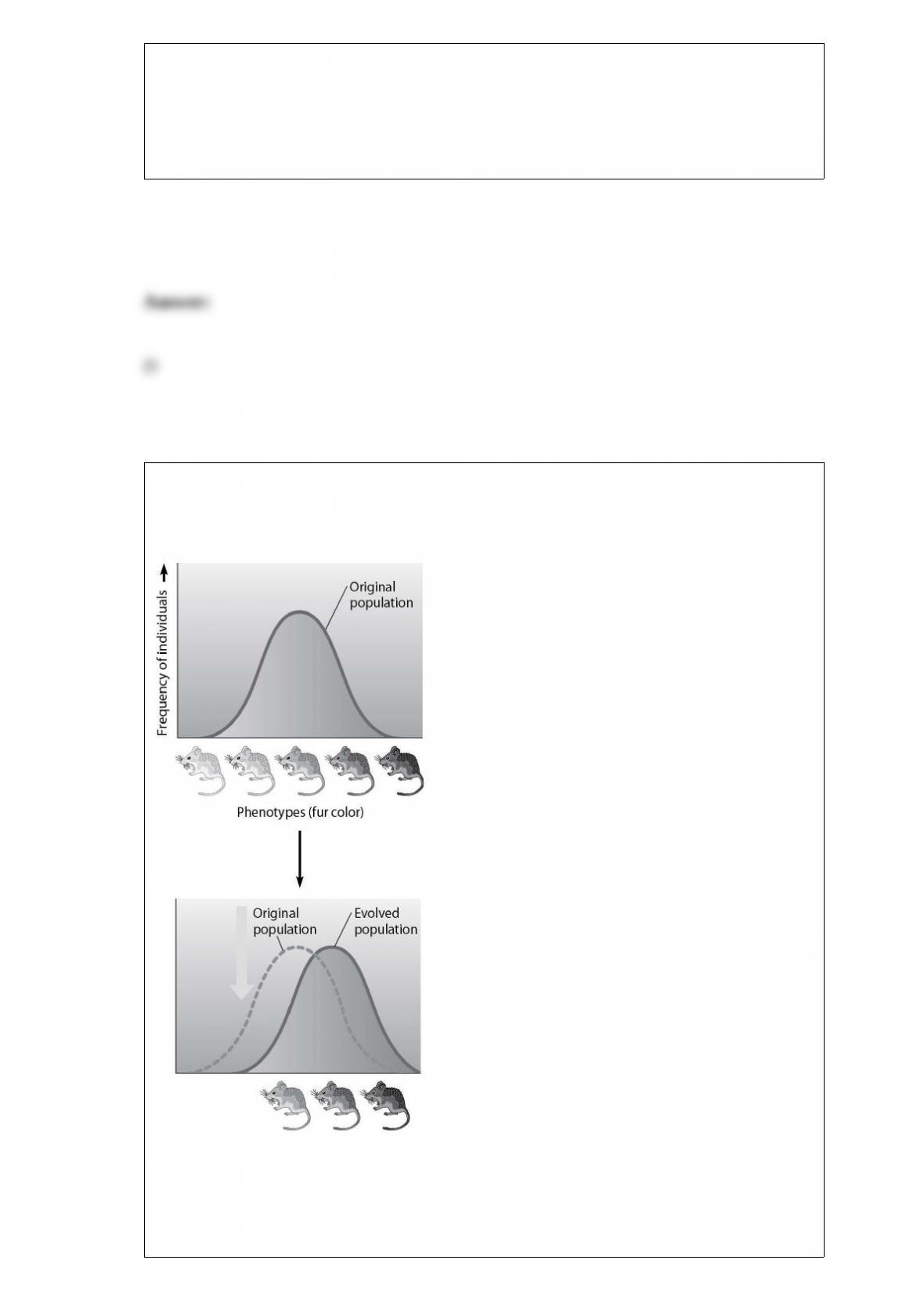
Which statement best describes the mode of selection depicted in the figure?
A) stabilizing selection, changing the average color of the population over time

B) directional selection, favoring the average individual
C) directional selection, changing the average color of the population over time
D) disruptive selection, favoring the average individual
The common waste product in bears (mammals) is ________, while most saltwater fish
get rid of wastes through ________.
A) ammonia; urea
B) uric acid; urea
C) urea; ammonia
D) ammonia; uric acid
Photosystem II
A) receives electrons from photosystem I.
B) passes electrons to photosystem I.
C) does not have a reaction center.
D) releases CO2 as a by-product.

Which of the following is formed from a matrix of collagen fibers embedded in a hard
mineral substance?
A) cartilage
B) bone
C) adipose tissue
D) fibrous connective tissue
Which of the following processes is classified as a metabolic pathway?
A) protein synthesis
B) osmosis
C) cell lysis
D) passive diffusion

Which location in the cell is unlikely to contain ribosomes or ribosomal subunits?
A) nuclear envelope
B) plasma membrane
C) endoplasmic reticulum
D) cytoplasm
In angiosperms, the process of ________ ensures that the endosperm will develop only
in ovules containing a fertilized egg.
A) cytogenesis
B) meiosis
C) double fertilization
D) cytokinesis
Which of the following statements regarding genetics is false?
A) In keeping with our greater complexity, the human genome has about 100 times
more genes than that of yeast.

B) Gene duplication helps to explain how mammals can detect and discriminate among
such a wide range of odors.
C) About 99% of the genes of humans and mice are related by descent from a common
ancestor.
D) The more recently two species have branched from a common ancestor, the more
similar we expect their DNA sequences to be.
Which of the following is a feature of plant cell division that distinguishes it from
animal cell division?
A) formation of a cell plate
B) formation of a cleavage furrow
C) lack of cytokinesis
D) production of four (rather than two) new cells per mitotic division
Bone marrow stem cells are sometimes used to treat certain blood cell diseases, such as
A) leukemia.
B) anemia.

C) cardiovascular disease.
D) hemophilia.
The function of mitochondria is
A) cellular respiration.
B) lipid synthesis.
C) photosynthesis.
D) intracellular digestion.
In the equation 2 H2 + O2 → 2 H2O, the H2 molecules are ________ and the H2O
molecules are ________.
A) reactants; products
B) products; reactants
C) created; destroyed
D) used; stored

A dog’s head is at its ________ end, and its belly is its ________ surface.
A) posterior; dorsal
B) anterior; dorsal
C) posterior; ventral
D) anterior; ventral
Small areas that are home to a large number of threatened species and an exceptional
concentration of species found nowhere else on Earth are called
A) biomes.
B) movement corridors.
C) biodiversity hot spots.
D) local populations

Tay-Sachs disease results from the malfunction of
A) mitochondria.
B) lysosomes.
C) endoplasmic reticulum.
D) nucleoli.
A key derived character of sharks and rays that distinguishes them from ray-finned
fishes is
A) jaws and a swim bladder.
B) vertebrae.
C) calcified (hard) bones.
D) a skeleton made of cartilage
Which of the following is an invertebrate chordate?
A) lancelets
B) snakes

C) sharks
D) sea urchins
Individual prokaryote cells are about ________ eukaryote cells; collectively, all
prokaryote cells on Earth ________.
A) the same size as; weigh about one-tenth the total mass of eukaryote cells
B) 10 times bigger than; weigh about 10 times as much as the total mass of eukaryote
cells
C) one-tenth as big as; weigh about one-tenth the total mass of eukaryote cells
D) one-tenth as big as; weigh about 10 times as much as the total mass of eukaryote
cells
Which of the following statements about radioactive isotopes is true?
A) The nuclei of radioactive isotopes are unusually stable, but the atoms tend to lose
electrons.
B) When given a choice between radioactive and nonradioactive isotopes of the same
atom, living cells are more likely to incorporate the radioactive isotopes into their
structures.
C) The energy emitted by radioactive isotopes can break chemical bonds and cause

molecular damage in cells.
D) Radioactive elements are natural and therefore not harmful.
You are asked to culture an unidentified sample of animal tissue. You notice that the
cells seem to fail to exhibit density-dependent inhibition. The source of this tissue
sample is most likely
A) a cancerous tumor.
B) skin from a human.
C) a liver from a cow.
D) the sperm-producing tissue of the testis.
Over the next several decades, world population growth will necessitate as much as a
60% increase in food production, primarily in developing countries. These countries are
often the most seriously affected by drought and salinity. Even if irrigation water is
available, flooding fields with irrigation water leads to the gradual accumulation of
sodium ions and other salts in the soil.
To respond to this growing problem, scientists at the University of Connecticut have
genetically engineered a plant that can survive in salty soil and withstand extended
drought conditions. The new transgenic plant contains a gene for an ion pump. Salt ions
are transported from the soil and stored in vacuoles in the cytoplasm. The enhanced
uptake of ions into their vacuoles in turn improves water retention in the transgenic

plants and their resistance to drought. The concentration of solutes inside and outside
plant cells affects the direction of water movement through osmosis.
The researchers found that the salt concentration in the cells of the new transgenic
plants was significantly higher than in wild plants used as a control. In addition, the
transgenic plants survived longer when deprived of water.
The experimental plants were more drought resistant because
A) their vacuoles pumped water directly into the cytoplasm.
B) salt stored in their vacuoles enabled the cytoplasm to retain water better.
C) salt stored in their vacuoles was equal in amount to the salt in the soil.
D) water was stored in their vacuoles until the next rainfall.