
Fat digestion yields fatty acids and glycerol, whereas protein digestion yields amino
acids; both digestive processes _____.
A) are catalyzed by the same enzyme
B) use water molecules when breaking bonds (hydrolysis)
C) require the presence of hydrochloric acid to lower the pH
D) require adenosine triphosphate (ATP) as an energy source
What group of mammals have (a) embryos that spend more time feeding through the
placenta than the mother’s nipples, (b) young that feed on milk, and (c) a prolonged
period of maternal care after leaving the placenta?
A) Eutheria
B) Marsupiala
C) Monotremata
The high osmolarity of the renal medulla is maintained by all of the following EXCEPT
_____.
A) active transport of salt from the upper region of the ascending limb
B) the spatial arrangement of juxtamedullary nephrons

C) diffusion of urea from the collecting duct
D) diffusion of salt from the descending limb of the loop of Henle
A flask containing photosynthetic green algae and a control flask containing water with
no algae are both placed under a bank of lights, which are set to cycle between 12 hours
of light and 12 hours of dark. The dissolved oxygen concentrations in both flasks are
monitored. Predict what the relative dissolved oxygen concentrations will be in the
flask with algae compared to the control flask. The dissolved oxygen in the flask with
algae will _____.
A) always be higher
B) always be lower
C) be higher in the light, but the same in the dark
D) be higher in the light, but lower in the dark
The receptors for steroid hormones are located inside the cell instead of on the
membrane surface like most other signal receptors. This is not a problem for steroids
because _____.
A) the receptors can be readily stimulated to exit and relocate on the membrane surface
B) steroids do not directly affect cells but instead alter the chemistry of blood plasma

C) steroid hormones are lipid soluble, so they can readily diffuse through the lipid
bilayer of the cell membrane
D) steroids must first bond to a steroid activator, forming a complex that then binds to
the cell surface
Imagine that there are twenty-five different species of protists living in a tide pool.
Some of these species reproduce both sexually and asexually, and some of them can
reproduce only asexually. The pool gradually becomes infested with disease-causing
viruses and bacteria. Which species are more likely to thrive in the changing
environment?
A) the sexually reproducing species
B) the asexually reproducing species
C) Sexually and asexually reproducing species are equally likely to thrive.
Use the following information and figure to answer the question(s) below.
The sea slug Pteraeolidia ianthina (P. ianthina) can harbor living dinoflagellates
(photosynthetic protists) in its skin. These endosymbiotic dinoflagellates reproduce
quickly enough to maintain their populations. Low populations do not affect the sea
slugs very much, but high populations (> 5 x 10⁵ cells/mg of sea slug protein) can
promote sea slug survival.
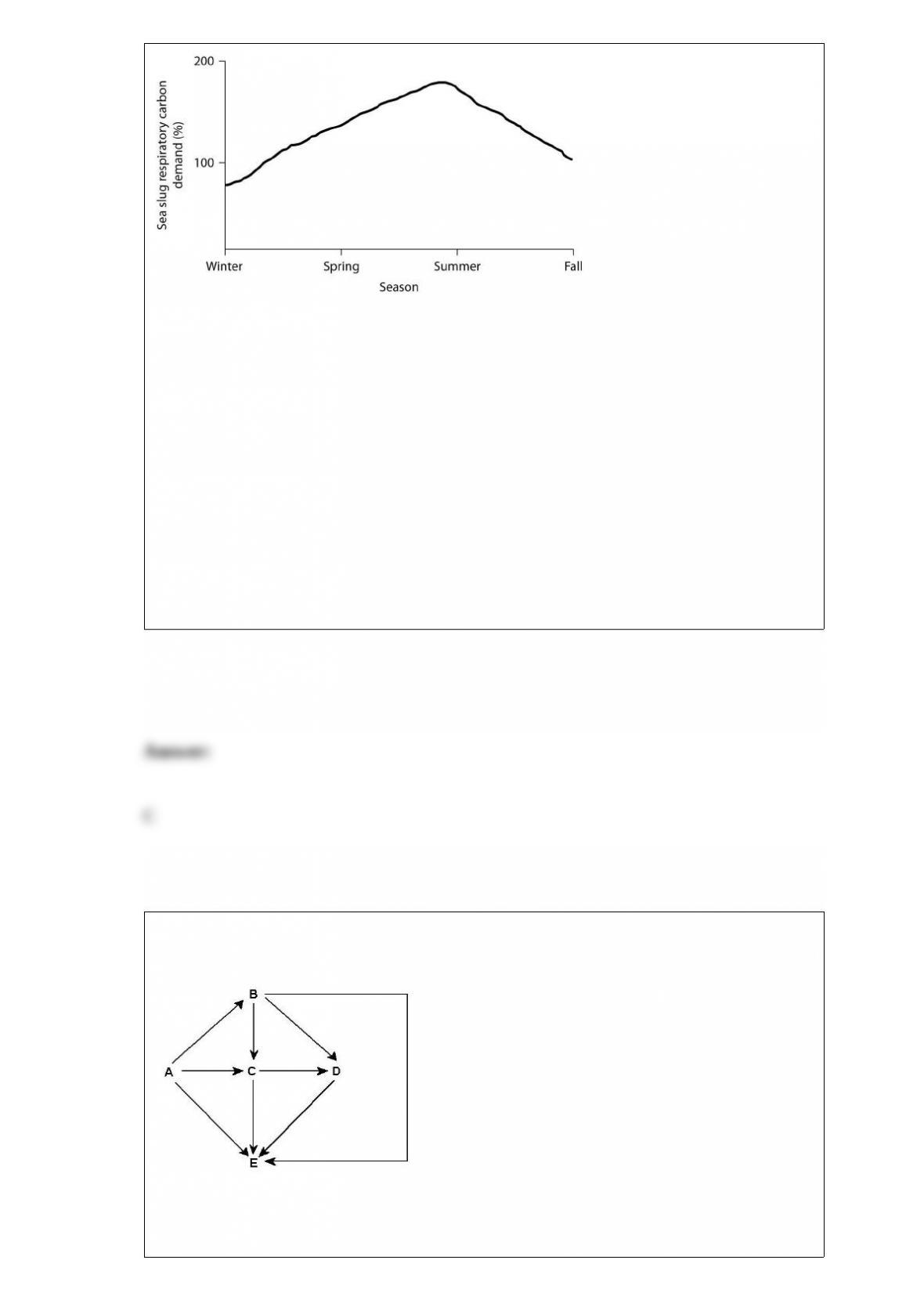
Percent of sea slug respiratory carbon demand provided by indwelling dinoflagellates.
If the dinoflagellate-containing sea slug P. ianthina preys on coral animals, then it
would be LEAST surprising to find that _____.
A) P. ianthina has no tolerance to the toxin in the nematocysts of its prey
B) P. ianthina can locate its coral prey by chemicals released into the water by corals
C) the coral prey harbor dinoflagellates in their tissues
D) the coral prey transform themselves into medusas to flee from approaching P.
ianthina
Food web for a particular terrestrial ecosystem

(arrows represent energy flow and letters represent species)
Examine this food web for a particular terrestrial ecosystem. Species C is toxic to
predators. Which species is most likely to benefit from being a mimic of C?
A) A
B) B
C) C
D) E
Which of the following observations about flagella is true and is consistent with the
scientific conclusion that the flagella from protists and bacteria evolved independently?
A) The flagella of both protists and bacteria are made of the same protein, but the
configuration is different.
B) The mechanics of movement and protein structure are the same in these flagella, but
there are significant genetic differences.
C) Although the mechanism of movement in both flagella is the same, the protein that
accomplishes the movement is different.
D) The protein structure and the mechanism of movement in protist flagella are
different from those of bacteria flagella.

The advantage of light microscopy over electron microscopy is that _____.
A) light microscopy provides for higher magnification than electron microscopy
B) light microscopy provides for higher resolving power than electron microscopy
C) light microscopy allows one to view dynamic processes in living cells
D) light microscopy provides higher contrast than electron microscopy
Two plant species live in the same biome but on different continents. Although the two
species are not at all closely related, they may appear quite similar as a result of _____.
A) convergent evolution
B) allopatric speciation
C) introgression
D) gene flow
Use the following information to answer the question(s) below.
The mechanism of cell crawling in protist species is not well defined. Pseudopodia
extension involves interactions between actin and myosin (the same molecules that are
involved in vertebrate muscle contraction). However, prior to the study described
below, no one had provided convincing data that actin and myosin were actually
involved in cell crawling in protists. Anatomical studies had identified the cytoskeletal
protein actin just below the surface of the cell membrane in several species of protist,
but physiological studies had failed to show a functional link between actin, myosin,
and cell crawling.
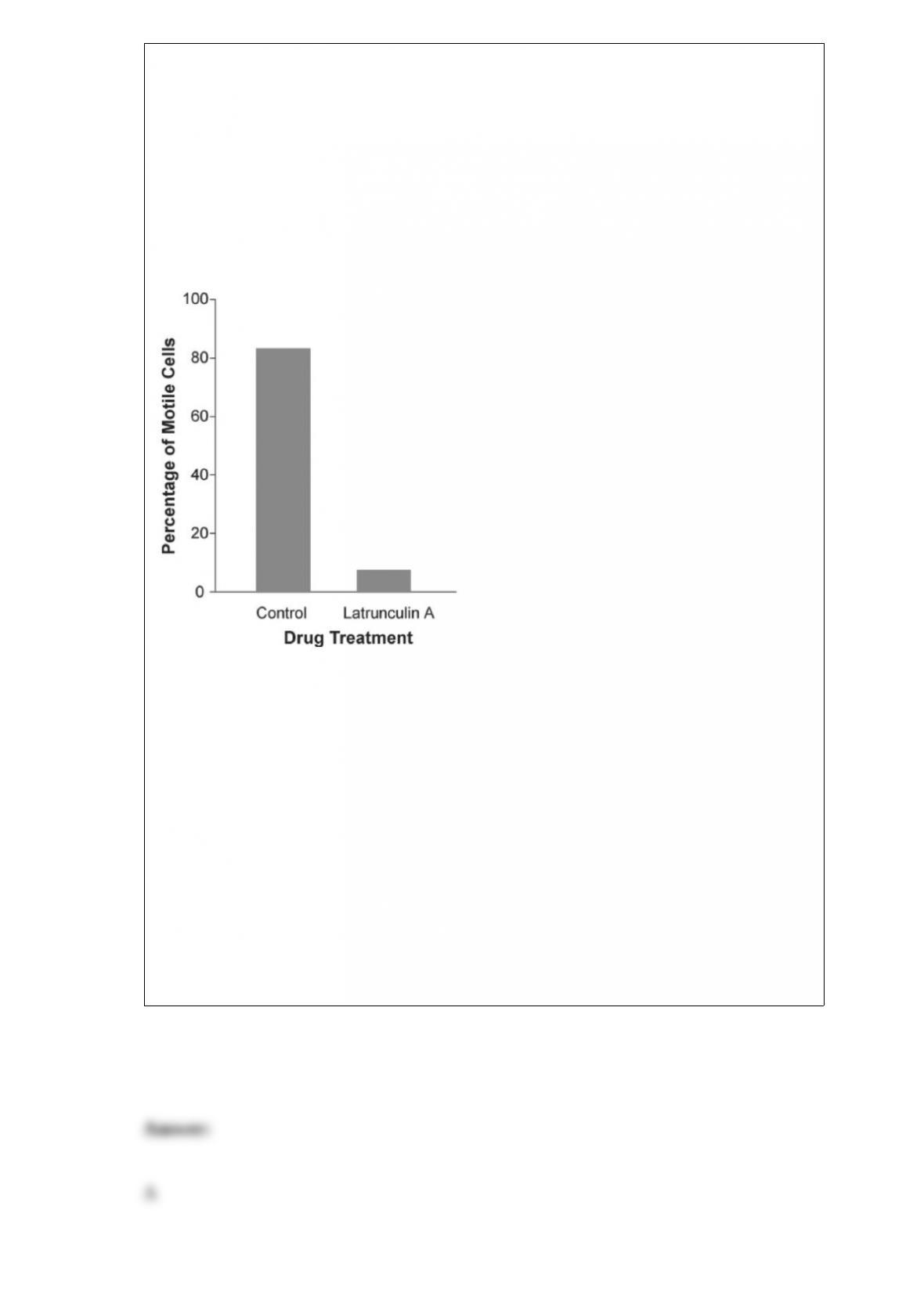
In a study by N. Poulsen et al. (Diatom gliding is the result of an actin-myosin motility
system, Cell Motility and the Cytoskeleton 44 (1999):23-22), researchers tested whether
motility in a particular species of diatom involves interactions between actin and
myosin.
Refer to the study by Poulsen et al. and the figure above. The data graphed in the figure
could be an artifact if latrunculin A kills this species of diatoms (that is, that may be
why the cells are not moving). Which of the following would be the best evidence that
latrunculin A is NOT killing the cells?
A) When the toxin was washed off the culture, the cells began to move again.
B) There were still a small percentage of motile cells in the culture treated with the
toxin.
C) Most of the cells in the control were moving, indicating that they were alive.
D) When the toxin was applied to another species of diatom, 25% of them continued to
move.

While looking at some seawater through your microscope, you spot the egg of an
unknown animal. Which of the following tests could you use to determine whether the
developing organism is a protostome or a deuterostome? See whether the embryo
_____.
A) develops germ layers
B) exhibits spiral cleavage or radial cleavage
C) develops a blastopore
D) develops an archenteron
How are the bryophytes and seedless vascular plants alike?
A) Plants in both groups have vascular tissue.
B) In both groups, sperm swim from antheridia to archegonia.
C) The dominant generation in both groups is the sporophyte.
D) Plants in both groups have true roots, stems, and leaves.
Formation of menisci, such as occurs in a tube filled with water, is an important factor
in plant water movement. A meniscus is created by _____.
A) the upward pull of gravity on the water column in the tube

B) downward pressure from the atmosphere on the topmost layer of water molecules
C) the water molecules being pulled upward by adhesion to the air
D) the topmost layer of water molecules being pulled downward by the hydrogen bonds
to the water molecules below
What will happen to a red blood cell (RBC), which has an internal ion concentration of
about 0.9 percent, if it is placed into a beaker of pure water?
A) The cell would shrink because the water in the beaker is hypotonic relative to the
cytoplasm of the RBC.
B) The cell would shrink because the water in the beaker is hypertonic relative to the
cytoplasm of the RBC.
C) The cell would swell because the water in the beaker is hypotonic relative to the
cytoplasm of the RBC.
D) The cell will remain the same size because the solution outside the cell is isotonic.
The release factor (RF) _____.
A) binds to the stop codon in the A site in place of a tRNA
B) releases the amino acid from its tRNA to allow the amino acid to form a peptide

bond
C) supplies a source of energy for termination of translation
D) releases the ribosome from the ER to allow polypeptides into the cytosol
The main reason polar regions are cooler than the equator is that _____.
A) sunlight strikes the poles at a lower angle
B) the poles are farther from the sun
C) the polar atmosphere is thinner and contains fewer greenhouse gases
D) the poles are permanently tilted away from the sun
The function of mechanical digestion is to break down large chunks of food into smaller
pieces. Why is this important? Smaller pieces of food _____.
A) do not taste as good as larger pieces of food
B) have more surface area for chemical digestion than do larger pieces of food
C) are easier to excrete than are larger pieces of food
D) are more easily stored in the stomach than are larger pieces of food

For living organisms, which of the following is an important consequence of the first
law of thermodynamics?
A) The energy content of an organism is constant.
B) The organism ultimately must obtain all of the necessary energy for life from its
environment.
C) The entropy of an organism decreases with time as the organism grows in
complexity.
D) Organisms grow by converting energy into organic matter.
The primary difference between enhancers and promoter-proximal elements is that
enhancers _____.
A) are transcription factors; promoter-proximal elements are DNA sequences
B) enhance transcription; promoter-proximal elements inhibit transcription
C) are at considerable distances from the promoter; promoter-proximal elements are
close to the promoter
D) are DNA sequences; promoter-proximal elements are proteins

Independent assortment of chromosomes is a result of _____.
A) the random way each pair of homologous chromosomes lines up at the metaphase
plate during meiosis I
B) the random combinations of eggs and sperm during fertilization
C) the random distribution of the sister chromatids to the two daughter cells during
anaphase II
D) the diverse combination of alleles that may be found within any given chromosome
In a simple synapse, neurotransmitter chemicals are released by _____.
A) the presynaptic membrane
B) axon hillocks
C) cell bodies
D) ducts on the smooth endoplasmic reticulum

Which of the following plant growth responses is primarily due to the action of auxins?
A) leaf abscission
B) cell division
C) the detection of photoperiod
D) phototropism
What would occur if the repressor of an inducible operon were mutated so that it could
not bind the operator?
A) irreversible binding of the repressor to the promoter
B) reduced transcription of the operon’s genes
C) continuous transcription of the operon’s genes
D) overproduction of catabolite activator protein (CAP)
Which of the following is characteristic of K-selected populations?
A) offspring with good chances of survival
B) many offspring per reproductive episode
C) small offspring
D) a high intrinsic rate of increase
Which of the following experiments is the best way to determine if an element is
essential for plant growth?
A) Measure the amount of the element stored in plant tissues.
B) Measure the amount of the element in the soil after plant growth.
C) Measure the weight of the plant and soil before and after plant growth.
D) Grow a plant using hydroponics with and without the element.
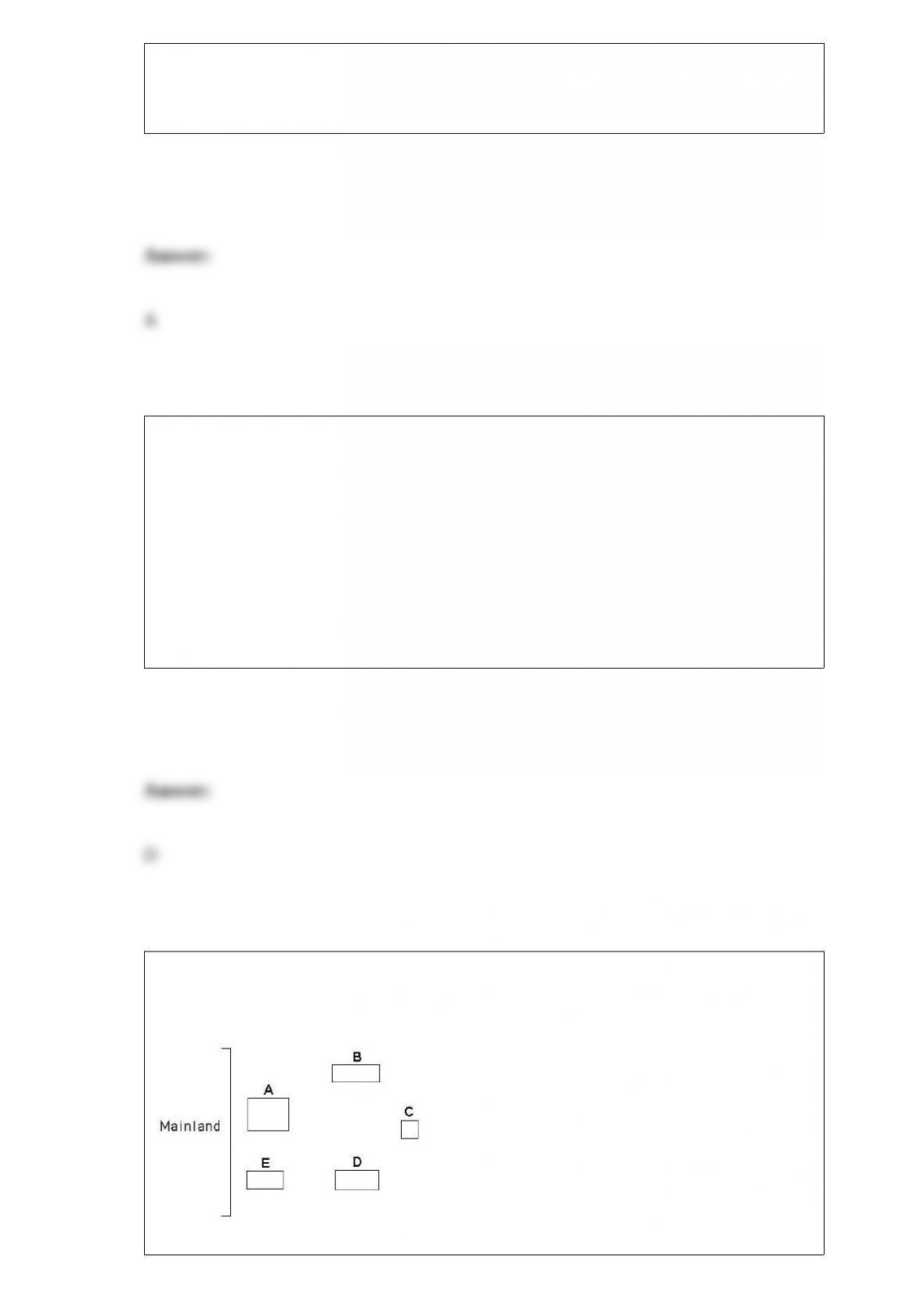
Use the following diagram of five islands formed at around the same time near a
particular mainland, as well as MacArthur and Wilson’s island biogeography principles,
to answer the question(s) below.

Which island would likely exhibit the most impoverished species diversity?
A) A
B) B
C) C
D) E
The embryonic precursor to the human spinal cord is the _____.
A) notochord
B) neural tube
C) mesoderm
D) archenteron
DNA microarrays have made a huge impact on genomic studies because they _____.
A) can be used to eliminate the function of any gene in the genome
B) can be used to introduce entire genomes into bacterial cells
C) allow the expression of many or even all of the genes in the genome to be compared

at once
D) allow physical maps of the genome to be assembled in a very short time