
When electrons move closer to a more electronegative atom, what happens? The more
electronegative atom is _____.
A) reduced, and energy is released
B) reduced, and energy is consumed
C) oxidized, and energy is consumed
D) oxidized, and energy is released
There is a mutation in the repressor that results in a molecule known as a
super-repressor because it represses the lac operon permanently. Which of these would
characterize such a mutant?
A) It cannot bind to the operator.
B) It cannot make a functional repressor.
C) It cannot bind to the inducer.
D) It makes a repressor that binds CAP.
Use the following information to answer the question(s) below.
There is much discussion in the media about protecting biodiversity. But does
biodiversity really matter? Canadian and Swiss researchers wanted to know if the
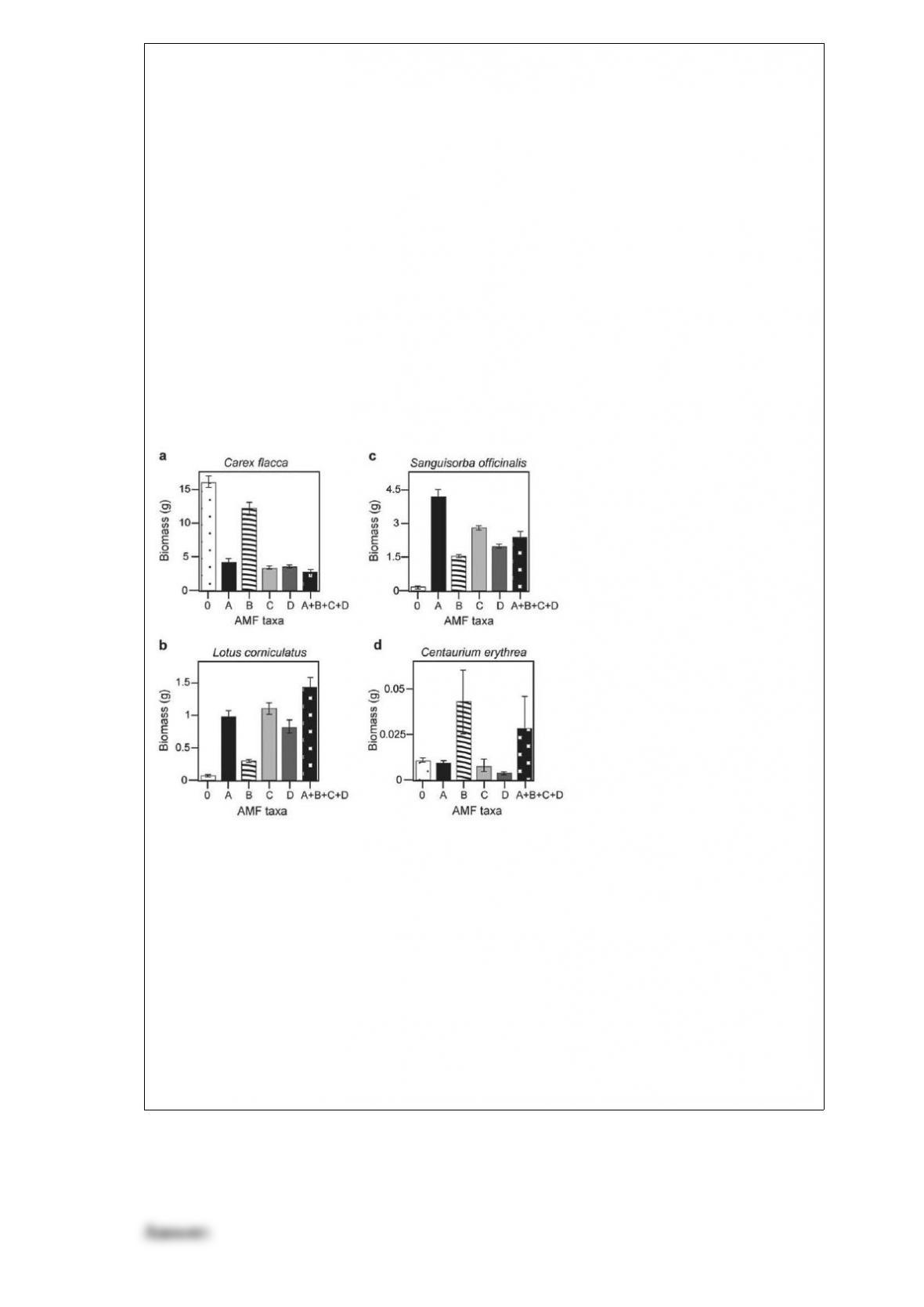
diversity of arbuscular mycorrhizal fungi (AMF) was important to the productivity of
grasslands (M.G.A. van der Heijden, J. N. Klironomos, M. Ursic, P. Moutoglis, R.
Streitwolf-Engel, T. Boler, A. Wiemken, and I. R. Sanders. 1998. Mycorrhizal fungal
diversity determines plant biodiversity, ecosystem variability and productivity. Nature
396:69-72). Specifically, they wanted to know if it mattered which specific AMF
species were present, or just that some type of AMF was present. They grew various
plants in combination with one of four AMF species (A, B, C, and D), no AMF species
(O), or all four AMF species together (A+B+C+D); and they measured plant growth
under each set of conditions. All plant species were grown in each plot, so they always
competed with each other with the only difference being which AMF species were
present.
On the graphs below, the x-axis labels indicate the number and identity of AMF species
(bar 0 = no fungi; bars A-D = individual AMF species; bar A+B+C+D = all AMF
species together). The y-axis indicates the amount (grams) of plant biomass for the
species shown in italics above each graph.
Based on the van der Heijden et al. (1998) graphs in the figure above, which of the
following is the best description of the data supporting the idea that a plant species did
not form mycorrhizae with a fungus? Its biomass is greatest when _____.
A) no AMF are present
B) AM fungus A is present
C) AM fungus B is present
D) AM fungus C is present

The stretch sensors of the sensory neurons in the human knee-jerk reflex are located in
the _____.
A) cartilage of the knee
B) quadriceps muscles on the front side of the thighs
C) hamstring muscles on the back side of the thighs
D) brain, the sensorimotor relay
Most of the dry mass of a plant is the result of uptake of_____.
A) water and minerals through root hairs
B) water and minerals through mycorrhizae
C) carbon dioxide through stoma
D) carbon dioxide and oxygen through stomata in leaves

Which of the following is a similarity between xylem and phloem transport?
A) Many cells in both tissues have sieve plates.
B) Expenditure of energy from ATP is required.
C) Transpiration is required for both processes.
D) Bulk flow of water is involved.
After eating a large meal, which nerves are most active in your digestive system?
I) parasympathetic nerves
II) somatic (motor) nerves
III) sympathetic nerves
A) only I
B) only II
C) only III
D) only II and III
What structural adaptation in chickens allows them to lay their eggs in arid

environments rather than in water?
A) amnion
B) yolk
C) gastrulation
D) development of the brain from ectoderm
The opening of stomata is thought to involve _____.
A) an increase in the solute concentration of the guard cells
B) active transport of water out of the guard cells
C) decreased turgor pressure in guard cells
D) movement of K+ from the guard cells
Which of the following molecules is polar?
C3H7OH
C2H5COOH

A) C3H7OH and C2H5COOH are both polar molecules.
B) Neither C2H5COOH or C3H7OH is polar.
C) C2H5COOH is polar, but C3H7OH is not polar.
D) C3H7OH is not polar, but C3H7OH is polar.
A triploid cell contains sets of three homologous chromosomes. If a cell of a usually
diploid species with 42 chromosomes per cell is triploid, this cell would be expected to
have which of the following?
A) 63 chromosomes in pairs
B) 63 chromosomes in 21 sets of 3
C) 63 chromosomes, each with three chromatids
D) 21 chromosome pairs and 21 unique chromosomes
What is the importance of the mucins that are released by salivary glands?
A) They aid in degradation of triglycerides to fatty acids and monoglycerides.
B) They are beginning the process of starch digestion.

C) They are hormonal molecules that stimulate the release of gastric juice by the
stomach in anticipation of receipt of the contents of the mouth.
D) They are glycoproteins that make food slippery enough to slide easily through the
esophagus.
Rods exposed to light will _____.
A) depolarize due to the opening of sodium channels
B) hyperpolarize due to the closing of sodium channels
C) depolarize due to the opening of potassium channels
D) hyperpolarize due to the closing of potassium channels
Think about this description of the colonial aquatic cyanobacterium, Anabaena. What
two questions below are important for understanding how nitrogen (N2) enters
heterocysts, and how oxygen (O2) is kept out of heterocysts?
1. If carbohydrates can enter the heterocysts from neighboring cells via the
“intracellular connections,” how is it that O2 doesn’t also enter via this route?
2. If the cell walls of Anabaena photosynthetic cells are permeable to O2 and carbon
dioxide (CO2), are they also permeable to N2?

3. If the nuclei of the photosynthetic cells contain the genes that code for nitrogen
fixation, how can these cells fail to perform nitrogen fixation?
4. If the nuclei of the heterocysts contain the genes that code for photosynthesis, how
can these cells fail to perform photosynthesis?
5. If the cell walls of Anabaena heterocysts are permeable to N2, how is it that N2
doesn’t diffuse out of the heterocysts before it can be fixed?
6. If the thick cell walls of Anabaena heterocysts exclude entry of oxygen gas, how is it
that they don’t also exclude the entry of nitrogen gas?
A) 1 and 3
B) 1 and 6
C) 2 and 5
D) 4 and 6
In 1986, a nuclear power accident in Chernobyl, USSR (now Ukraine), led to high
radiation levels for miles surrounding the plant. The high levels of radiation caused
elevated mutation rates in the surviving organisms, and evolutionary biologists have
been studying rodent populations in the Chernobyl area ever since. Based on your
understanding of evolutionary mechanisms, which of the following most likely
occurred in the rodent populations following the accident?
A) Mutations caused major changes in rodent physiology over time.
B) Mutation led to increased genetic variation.
C) Mutation caused genetic drift and decreased fitness.
D) Mutation caused the fixation of new alleles.

A group of cells is assayed for DNA content immediately following mitosis and is
found to have an average of 8 picograms of DNA per nucleus. How many picograms
would be found at the end of S and the end of G2?
A) 8; 8
B) 8; 16
C) 16; 8
D) 16; 16
Crossing over normally takes place during which of the following processes?
A) meiosis II
B) meiosis I
C) mitosis
D) mitosis and meiosis II

Which of the following is a type of local signaling in which a cell secretes a signal
molecule that affects neighboring cells?
A) hormonal signaling
B) autocrine signaling
C) paracrine signaling
D) synaptic signaling
In the formula for determining a population’s genotype frequencies, the “2” in the term
2pq is necessary because _____.
A) the population is diploid
B) heterozygotes can come about in two ways
C) the population is doubling in number
D) heterozygotes have two alleles
Use the accompanying figure and the molecules labeled A, B, C, D, and E to
answer the following questions.
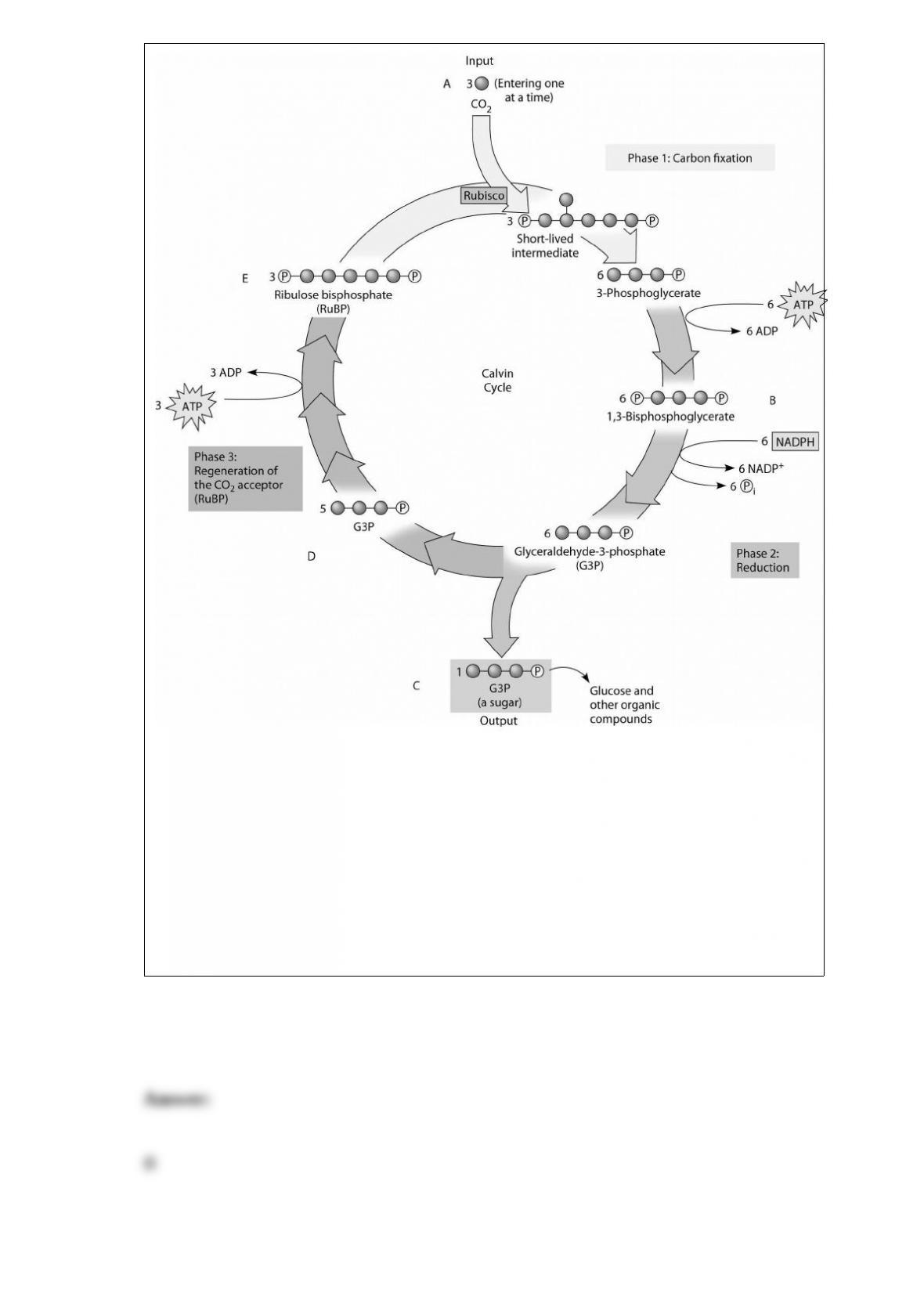
hich of the following does NOT occur during the Calvin cycle?
A) oxidation of NADPH
B) release of oxygen
C) regeneration of the CO2 acceptor
D) consumption of ATP

What is a syndrome?
A) a characteristic facial appearance
B) a trait that leads to cancer at some stage in life
C) a group of traits typically found in conjunction with a particular chromosomal
aberration or gene mutation
D) a specific characteristic that appears in conjunction with one specific aneuploidy
The following questions refer to the description below.
All animals with eyes or eyespots that have been studied so far share a gene in
common. When mutated, the gene Pax–6 causes lack of eyes in fruit flies, tiny eyes in
mice, and missing irises (and other eye parts) in humans. The sequence of Pax-6 in
humans and mice is identical. There are so few sequence differences with fruit fly
Pax-6 that the human/mouse version can cause eye formation in eyeless fruit flies, even
though vertebrates and invertebrates last shared a common ancestor more than five
hundred million years ago.
The appearance of Pax-6 in all animals with eyes can be explained in multiple ways.
Based on the information above, which explanation is most likely?
A) Pax-6 in all of these animals is not homologous; it arose independently in many
different animal phyla due to intense selective pressure favoring vision.
B) The Pax-6 gene is really not one gene. It is many different genes that, over
evolutionary time and due to convergence, have come to have a similar nucleotide
sequence and function.
C) The Pax-6 gene was an innovation of an ancestral animal of the early Cambrian
period. Animals with eyes or eyespots are descendants of this ancestor.
D) The need for eyes has resulted in the separate evolution of Pax-6 genes.

Asexual reproduction occurs during _____.
A) meiosis
B) mitosis
C) fertilization
D) chromosome exchange between organisms of different species
What adaptations should one expect of the seed coats of angiosperm species whose
seeds are dispersed by frugivorous (fruit-eating) animals, as opposed to angiosperm
species whose seeds are dispersed by other means?
1. The exterior of the seed coat should have barbs or hooks.
2. The seed coat should contain secondary compounds that irritate the lining of the
animal’s mouth.
3. The seed coat should be able to withstand low pHs.
4. The seed coat, upon its complete digestion, should provide vitamins or nutrients to
animals.
5. The seed coat should be resistant to the animals’ digestive enzymes.
A) 4 only
B) 1 and 2
C) 3 and 5

D) 3, 4, and 5
Why are there several structurally different pigments in the reaction centers of
photosystems?
A) Excited electrons must pass through several pigments before they can be transferred
to electron acceptors of the electron transport chain.
B) This arrangement enables the plant to absorb light energy of a variety of
wavelengths.
C) They enable the plant to absorb more photons from light energy, all of which are at
the same wavelength.
D) They enable the reaction center to excite electrons to a higher energy level.
In an animal that switches between sexual and asexual reproduction, when is sexual
reproduction more likely to occur?
A) when conditions for survival are favorable
B) when conditions for survival are unfavorable
C) when males and females find each other
D) What conditions favor sexual over asexual remains a complete mystery.
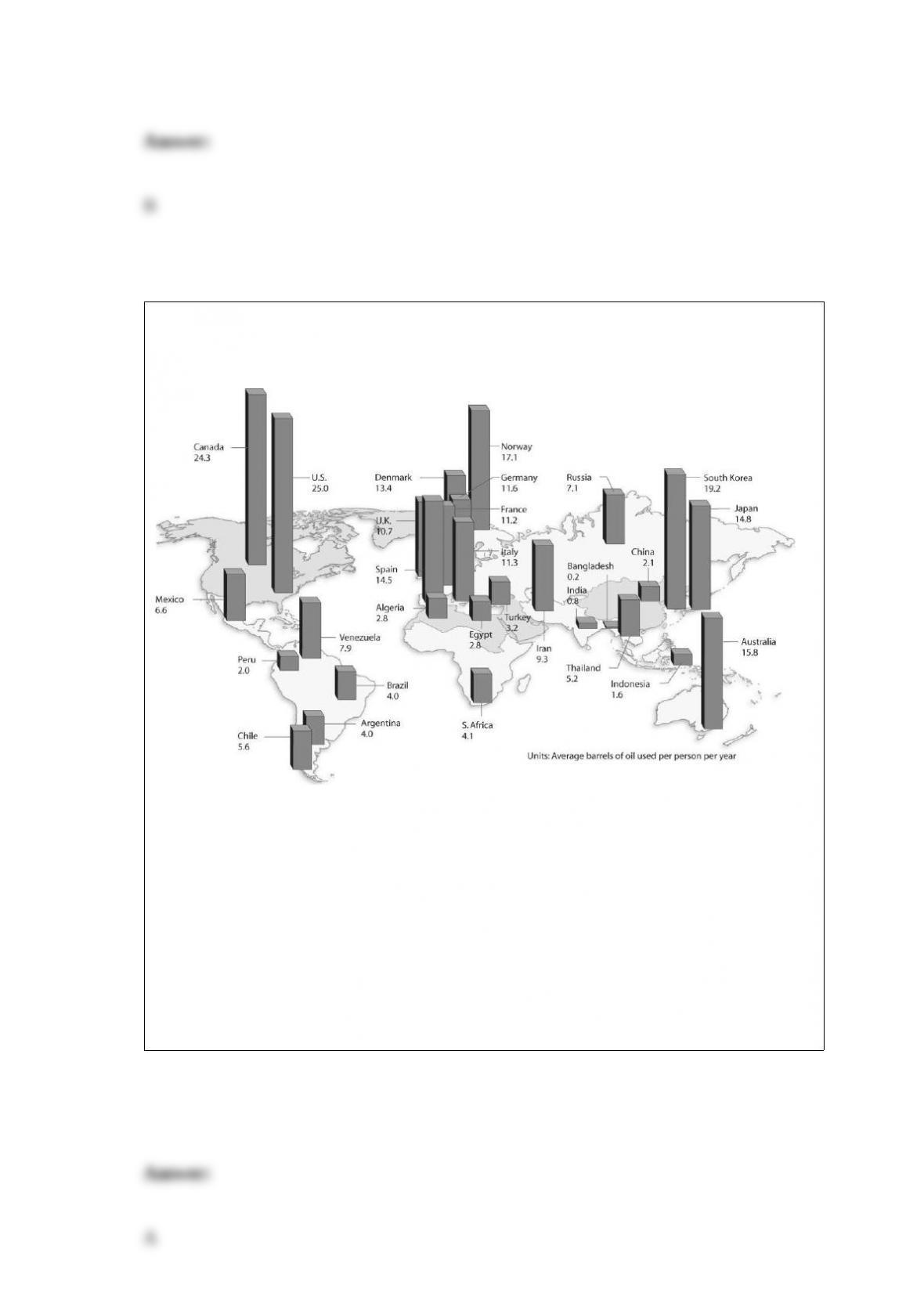
Based on the figure above and given the populations of the following countries, which
country uses the most oil overall?
A) United States (population = 320 million)
B) Canada (population = 36 million)
C) China (population = 1.33 billion)
D) Russia (population = 144 million)

Retaining the zygote on the living gametophyte of land plants _____.
A) protects the zygote from herbivores
B) evolved concurrently with pollen
C) helps in dispersal of the zygote
D) allows it to be nourished by the parent plant
Which of the following examples describes a behavioral pattern that results from a
proximate cause?
A) A cat kills a mouse to obtain nutrition.
B) A male sheep fights with another male because it helps to improve its social position.
C) A female bird lays its eggs because the amount of daylight is decreasing slightly
each day.
D) A goose squats and freezes motionless to escape a predator.
An anthropologist discovers the fossilized heart of an extinct animal. The evidence
indicates that the organism’s heart was large, was well-formed, and had four chambers,
with no connection between the right and left sides. A reasonable conclusion supported

by these observations is that the _____.
A) animal had evolved from birds
B) animal was endothermic and had a high metabolic rate
C) animal was most closely related to alligators and crocodiles
D) species had little to no need to regulate blood pressure
Plants photosynthesize _____.
A) only in the light but respire only in the dark
B) only in the dark but respire only in the light
C) only in the light but respire in light and dark
D) and respire only in the light
Semiconservative replication involves a template. What is the template?
A) single-stranded binding proteins
B) DNA polymerase
C) one strand of the DNA molecule

D) an RNA molecule