
Foods can be preserved in many ways by slowing or preventing bacterial growth.
Which of these methods should be LEAST effective at inhibiting bacterial growth?
A) Refrigeration: slows bacterial metabolism and growth.
B) Closing previously opened containers: prevents more bacteria from entering, and
excludes oxygen.
C) Pickling: creates a pH at which most bacterial enzymes cannot function.
D) Canning in heavy sugar syrup: creates osmotic conditions that remove water from
most bacterial cells.
The atomic number of chlorine is 17. The atomic number of magnesium is 12. What is
the formula for magnesium chloride?
A) MgCl
B) MgCl2
C) Mg2Cl
D) MgCl3
Albinism is an autosomal (not sex-linked) recessive trait. A man and woman are both of
normal pigmentation and have one child out of three who is albino (without melanin

pigmentation). What are the genotypes of the albino’s parents?
A) One parent must be homozygous for the recessive allele; the other parent can be
homozygous dominant, homozygous recessive, or heterozygous.
B) One parent must be heterozygous; the other parent can be homozygous dominant,
homozygous recessive, or heterozygous.
C) Both parents must be heterozygous.
D) One parent must be homozygous dominant; the other parent must be heterozygous.
The 1-m height attainable by Dawsonia moss is at the upper end of the size range
reached by mosses. What accounts for the relative tallness of Dawsonia?
A) the cuticle that is found along the ridges of “leaves”
B) “leaves” that are more than one cell layer thick
C) reduced size, mass, and persistence of the sporophytes, which allows gametophores
to grow taller
D) the presence of conducting tissues in the ‘stem”
A system at chemical equilibrium _____.
A) consumes energy at a steady rate

B) releases energy at a steady rate
C) has zero kinetic energy
D) can do no work
Why did the F1 offspring of Mendel’s classic pea cross always look like one of the two
parental varieties?
A) No genes interacted to produce the parental phenotype.
B) Each allele affected phenotypic expression.
C) The traits blended together during fertilization.
D) One allele was dominant.
Engulfing-phagocytic cells of innate immunity of vertebrates include _____.
I) neutrophils
II) macrophages
III) dendritic cells
IV) natural killer cells

A) I and III
B) II and IV
C) I and IV
D) I, II, and III
You are given the task of designing an aquatic protist that is a primary producer. It
cannot swim on its own, yet must stay in well-lit surface waters. It must be resistant to
physical damage from wave action. It should be most similar to a(n) _____.
A) diatom
B) dinoflagellate
C) apicomplexan
D) red alga
The oak tree fungal pathogen, Phytophthora ramorum, has migrated eight hundred
kilometers in fifteen years. West Nile virus spread from New York State to forty-six
other states in five years. The difference in the rate of spread is probably related to
_____.
A) the lethality of each pathogen

B) the mobility of their hosts
C) the fact that viruses are very small
D) innate resistance
To apply parsimony to constructing a phylogenetic tree, _____.
A) choose the tree that assumes all evolutionary changes are equally probable
B) choose the tree in which the branch points are based on as many shared derived
characters as possible
C) choose the tree that represents the fewest evolutionary changes, either in DNA
sequences or morphology
D) choose the tree with the fewest branch points
A beaker contains 100 milliliters (mL) of NaOH solution at pH = 13. A technician
carefully pours into the beaker 10 mL of HCl at pH = 1. Which of the following
statements correctly describes the result of this mixing?
A) The concentration of Na+ ions will rise.
B) The pH of the beaker’s contents will increase.

C) The pH of the beaker’s contents will be neutral.
D) The pH of the beaker’s contents will decrease.
Our understanding of mental illness has been most advanced by discoveries involving
the _____.
A) degree of convolutions in the brain’s surface
B) sequence of developmental specialization
C) chemicals involved in brain communications
D) nature of the blood-brain barrier
Plasmids are used as vectors in plant and bacterial genetic engineering. However, there
is a major difference in the fate of genes introduced into bacteria on most bacterial
plasmids and into plants on tumor-inducing (Ti) plasmids. What is this difference?
A) In bacteria, genes are stably expressed; in plants, gene expression is always lost
quickly.
B) Gene expression tends to decrease rapidly and unpredictably in bacteria; gene
expression is much more stable in plants.
C) Bacterial plasmids are circular DNAs; Ti plasmid DNA is linear.

D) Bacterial plasmids and the genes they carry usually are not integrated into the
chromosome; Ti plasmids and the genes they carry are integrated into the chromosome.
In addition to seeds, which of the following characteristics is unique to the
seed-producing plants?
A) sporopollenin
B) lignin present in cell walls
C) pollen
D) megaphylls
The questions below refer to the following description and figure.
The figure below represents a cross section of the sea floor through a mid-ocean rift
valley, with alternating patches of black and white indicating sea floor with reversed
magnetic polarities. At the arrow labeled “I” (the rift valley), the igneous rock of the sea
floor is so young that it can be accurately dated using carbon-14 dating. At the arrow
labeled “III,” however, the igneous rock is about one million years old, and
potassium-40 dating is typically used to date such rocks. Note: The horizontal arrows
indicate the direction of sea-floor spreading, away from the rift valley.
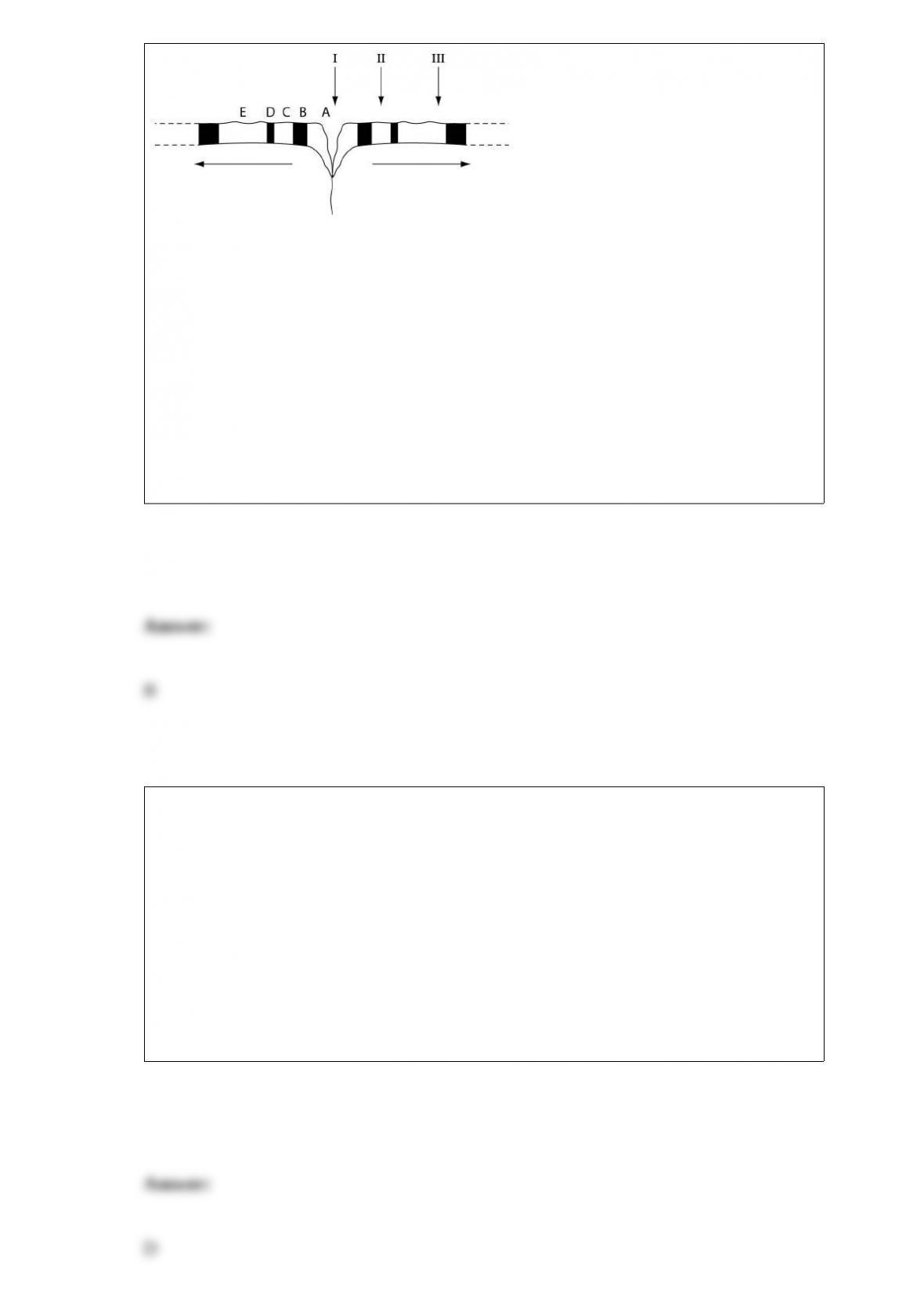
If a particular marine organism is fossilized in the sediments immediately overlying the
igneous rock at the arrow labeled “II,” at which other location, labeled A-E, would a
search be most likely to find more fossils of this organism?
A) B
B) C
C) D
D) E
Which of the following represents the strongest evidence that two of the three middle
ear bones of mammals are homologous to certain reptilian jawbones?
A) They are similar in size to the reptilian jawbones.
B) They are similar in shape to the reptilian jawbones.
C) The mammalian jaw has fewer bones than does the reptilian jaw.
D) These bones can be observed to move from the evolving jaw to the evolving middle
ear in mammalian embryos.

What kind of evidence has recently made it necessary to assign the prokaryotes to either
of two different domains, rather than assigning all prokaryotes to the same kingdom?
A) mtDNA
B) rRNA genes
C) morphological
D) ecological
The protein of the bicoid gene in Drosophila determines the _____ of the embryo.
A) anterior-posterior axis
B) anterior-lateral axis
C) posterior-dorsal axis
D) posterior-ventral axis
Use the following information to answer the question(s) below.
Trichoplax adhaerens (Tp) is the only living species in the phylum Placozoa.
Individuals are about 1 mm wide and only 27 μm high, are irregularly shaped, and
consist of a total of about 2000 cells, which are diploid (2n = 12). There are four types

of cells, none of which are nerve or muscle cells, and none of which have cell walls.
They move using cilia, and any “edge” can lead. Tp feeds on marine microbes, mostly
unicellular green algae, by crawling atop the algae and trapping it between its ventral
surface and the substrate. Enzymes are then secreted onto the algae, and the resulting
nutrients are absorbed. Tp sperm cells have never been observed, nor have embryos
past the 64-cell (blastula) stage.
Tp’s body symmetry seems to be most like that of _____.
A) most sponges
B) cnidarians
C) worms
D) tetrapods
Cinnabar eyes is a sex-linked, recessive characteristic in fruit flies. If a female having
cinnabar eyes is crossed with a wild-type male, what percentage of the F1 males will
have cinnabar eyes?
A) 0%
B) 25%
C) 50%
D) 100%

Erwin and Scott used an insecticidal fog to knock down insects from the top of a L.
seemannii tree. The researchers identified over 900 species of beetles among the
individuals that fell. Erwin also projected that this entire tree is host to about 600
arthropod species unique to this tree species. There are approximately 50,000 species of
tropical trees. Although it could not be entirely accurate, what would be the best way to
estimate the total number of arthropod species?
A) Estimate the species density and then multiply by 50,000.
B) Multiply 900 by 50,000.
C) Multiply 600 by 50,000.
D) Divide 900 by 600 and then multiply by 50,000.
Based on graphs (e) and (f) in the figure above, which is the most well-supported
prediction for the effect on total plant biomass if AMF diversity were increased to eight
species?
A) No effect is predicted, because the dominant species is unaffected by AMF diversity.
B) Total biomass for eight species would double in comparison to that for four species.
C) Rare species would produce more biomass compared to the case when fewer AMF
are present.
D) No effect is predicted, because the dominant species is non-mycorrhizal.

Skin color in a certain species of fish is inherited via a single gene with four different
alleles. One fish of this type has alleles 1 and 3 (S1S3) and its mate has alleles 2 and 4
(S2S4). If each allele confers a unit of color darkness such that S1 has one unit, S2 has
two units, and so on, then what proportion of their offspring would be expected to have
five units of color?
A) 1/4
B) 1/8
C) 1/2
D) 0
Which of the following would prevent allergic attacks?
A) blocking the attachment of the IgE antibodies to the mast cells
B) blocking the antigenic determinants of the IgM antibodies
C) reducing the number of helper T cells in the body
D) reducing the number of cytotoxic cells
Which event during the evolution of land plants favored the synthesis of secondary
compounds?

A) the greenhouse effect throughout the Devonian period
B) the reverse-greenhouse effect during the Carboniferous period
C) the association of the roots of land plants and fungi
D) the rise of herbivory
Immediately after putting on a shirt, your skin might feel itchy. However, this
perception soon fades due to _____.
A) sensory adaptation
B) accommodation
C) reduced motor unit recruitment
D) reduced receptor amplification
The molecular formula for glucose is C6H12O6. What would be the molecular formula
for a molecule made by linking three glucose molecules together by dehydration
reactions?
A) C18H36O18

B) C18H32O16
C) C6H10O5
D) C18H30O15
Which of the following is a statement of the first law of thermodynamics?
A) Energy cannot be created or destroyed.
B) The entropy of the universe is decreasing.
C) The entropy of the universe is constant.
D) Energy cannot be transferred or transformed.
Which of the following is a protein maintained at steady levels throughout the cell cycle
that requires cyclin to become catalytically active?
A) PDGF
B) MPF
C) cyclin
D) Cdk

Increased atmospheric CO2 concentrations might have what effect on seawater?
A) Seawater will become more alkaline, and carbonate concentrations will decrease.
B) There will be no change in the pH of seawater, because carbonate will turn to
bicarbonate.
C) Seawater will become more acidic, and carbonate concentrations will decrease.
D) Seawater will become more acidic, and carbonate concentrations will increase.
Use this information to answer the question(s) below.
A researcher found a method she could use to manipulate and quantify phosphorylation
and methylation in embryonic cells in culture.
One of her colleagues suggested she try increased methylation of C nucleotides in the
DNA of promoters of a mammalian system. Which of the following results would she
most likely see?
A) decreased chromatin condensation
B) activation of histone tails for enzymatic function
C) higher levels of transcription of certain genes
D) inactivation of the selected genes

Use the following abstract from Theoretical Population Biology to answer the question.
Abstract:
We derive measures for assessing the value of an individual habitat fragment for the
dynamics and persistence of a metapopulation living in a network of many fragments.
We demonstrate that the most appropriate measure of fragment value depends on the
question asked. Specifically, we analyze four alternative measures: the contribution of a
fragment to the metapopulation capacity of the network, to the equilibrium
metapopulation size, to the expected time to metapopulation extinction and the
long-term contribution of a fragment to colonization events in the network. The latter
measure is comparable to density-dependent measures in general matrix population
theory, though some differences are introduced by the fact that “density dependence” is
spatially localized in the metapopulation context. We show that the value of a fragment
depends not only on the properties of the landscape but also on the properties of the
species. Most importantly, variation in fragment values between the habitat fragments is
greatest in the case of rare species that occur close to the extinction threshold, as these
species are likely to be restricted to the most favorable parts of the landscape. We
expect that the measures of habitat fragment described and analyzed here have
applications in landscape ecology and in conservation biology.
Copyright 2003 Elsevier Inc. All rights reserved. (Otso Ovaskainen and Ilkka Hanski.
2003. How much does an individual habitat fragment contribute to metapopulation
dynamics and persistence? Theoretical Population Biology 64:481-95.)
One measure for the value of the patch was given by the long-term contribution of a
fragment to colonization events in the network. How do the properties of a landscape
and the properties of a species affect the value of a patch? The value of the fragment
depends _____.
A) on the properties of the landscape and the properties of the species
B) only on the properties of the landscape and not on the properties of the species
C) not on the properties of the landscape but only on the properties of the species
D) on neither the properties of the landscape nor on the properties of the species

Which of the following would most likely be an immediate result of a growth factor
binding to its receptor?
A) protein kinase activity
B) adenylyl cyclase activity
C) protein phosphatase activity
D) phosphorylase activity