
Use the following information to answer the question(s) below.
A farm pond, usually dry during winter, has plenty of water and aquatic pond life
during the summer. One summer, Sarah returns to the family farm from college.
Observing the pond, she is fascinated by some six-legged organisms that can crawl
about on submerged surfaces or, when disturbed, seemingly “jet” through the water.
Watching further, she is able to conclude that the “mystery organisms” are ambush
predators, and their prey includes everything from insects to small fish and tadpoles.
Sarah observed that the mystery pond organisms never come up to the pond’s surface. If
she catches one of these organisms and observes closely, perhaps dissecting the
organism, she should find _____.
A) gills
B) spiracles
C) tracheae
D) book lungs
Phenylketonuria is an inherited disease caused by a recessive autosomal allele. If a
woman and her husband are both carriers, what is the probability that their first child
will be a phenotypically normal girl?
A) 1/4
B) 1/16
C) 3/16
D) 3/8

Vines in tropical rain forests must grow toward large trees before being able to grow
toward the sun. To reach a large tree, the most useful kind of growth movement for a
tropical vine presumably would be_____.
A) negative thigmotropism
B) negative phototropism
C) negative gravitropism
D) the opposite of circadian rhythms
A man who carries an allele of an X-linked gene will pass it on to _____.
A) all of his daughters
B) half of his daughters
C) all of his sons
D) all of his children

During a study session about evolution, one of your fellow students remarks, “The
giraffe stretched its neck while reaching for higher leaves; its offspring inherited longer
necks as a result.” Which statement is most likely to be helpful in correcting this
student’s misconception?
A) Characteristics acquired during an organism’s life are generally not passed on
through genes.
B) Spontaneous mutations can result in the appearance of new traits.
C) Only favorable adaptations have survival value.
D) Disuse of an organ may lead to its eventual disappearance.
A P. bursaria cell that has lost its zoochlorellae is aposymbiotic. If aposymbiotic cells
have population growth rates the same as those of healthy, zoochlorella-containing P.
bursaria in well-lit environments with plenty of prey items, then such an observation
would be consistent with which type of relationship?
A) parasitic
B) commensalistic
C) toxic
D) mutualistic
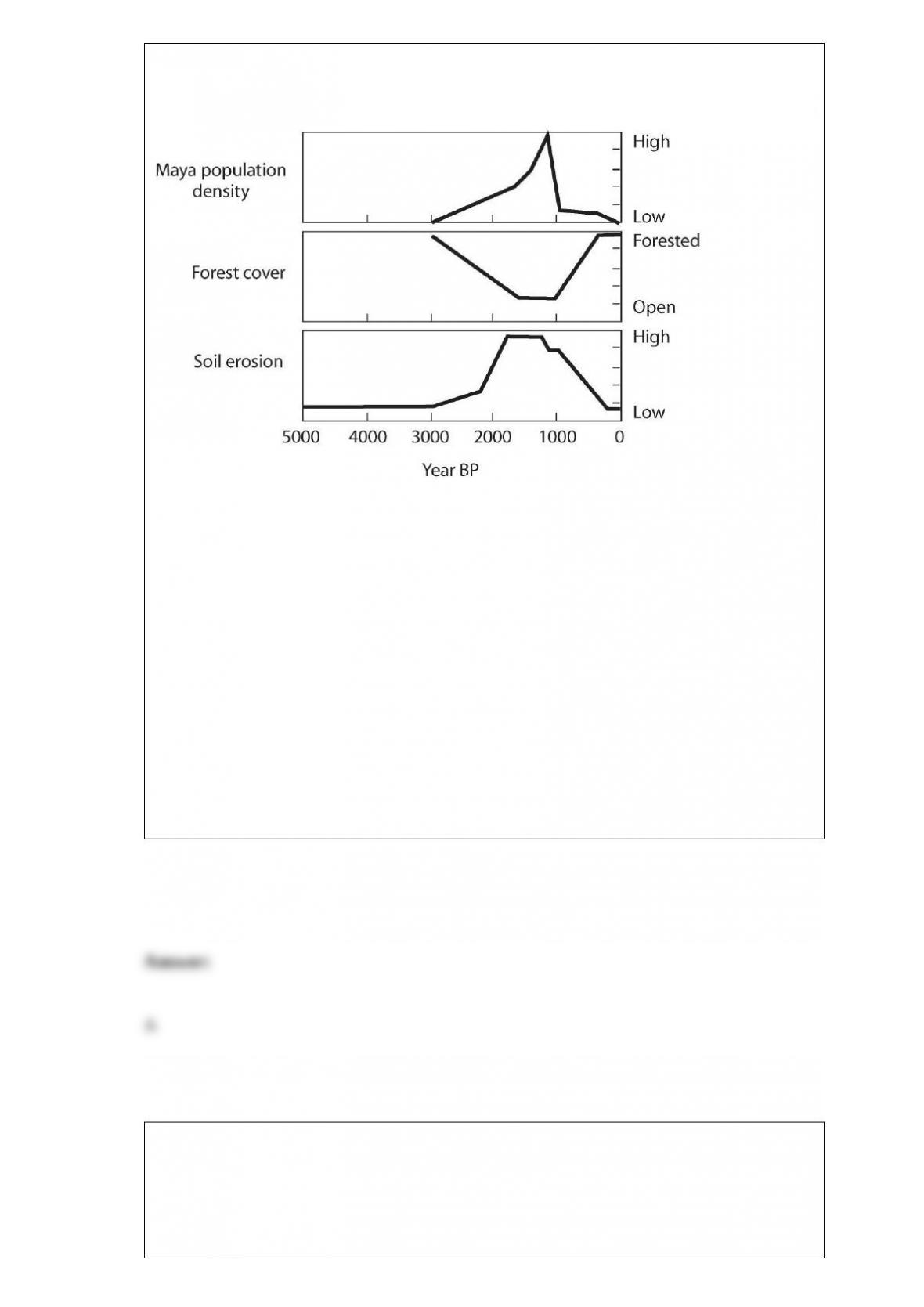
Copyright 2003 American Institute of Biological Sciences. (Foster, D.R., F. Swanson, J.
Aber, D. Tilman, N. Brokaw, I. Burke and A. Knapp. 2003. The importance of land-use
and its legacies to ecology and environmental management. BioScience 53:77-88.)
Which of the following nations has become a world leader in the establishment of
zoned reserves?
A) Costa Rica
B) China
C) United States
D) Mexico
Use the following information to answer the question(s) below.
An otherwise healthy student in your class is infected with EBV, the virus that causes
infectious mononucleosis. The same student had already been infected when she was a
child, at which time she had merely experienced a mild sore throat and swollen lymph

nodes in her neck. This time, though infected, she does not get sick.
Her immune system’s recognition of the second infection involves memory _____.
A) helper T cells
B) natural killer cells
C) plasma cells
D) cytotoxic T cells
Homeotic genes contain a homeobox sequence that is highly conserved among very
diverse species. The homeobox is the code for that domain of a protein that binds to
DNA in a regulatory developmental process. Therefore, you would expect that _____.
A) homeotic genes are selectively expressed as an organism develops
B) homeoboxes cannot be expressed in nonhomeotic genes
C) homeotic genes in apes and humans are very different
D) all organisms must have homeotic genes
What is the biggest problem with selecting a site for a preserve?
A) Making a proper selection is difficult because currently the environmental

conditions of almost any site can change quickly.
B) Keystone species are difficult to identify in potential preserve sites.
C) Only lands that are not useful to human activities are available for preserves.
D) Most of the best sites are inaccessible by land transportation, so making roads to
them is often prohibitively expensive.
Which of the following statements describes the lysogenic cycle of lambda (λ) phage?
A) After infection, the viral genes immediately turn the host cell into a
lambda-producing factory, and the host cell then lyses.
B) Most of the prophage genes are activated by the product of a particular prophage
gene.
C) The phage genome replicates along with the host genome.
D) The phage DNA is copied and exits the cell as a phage.
Use of synthetic fertilizers often leads to the contamination of groundwater with
nitrates. Nitrate pollution is also a suspected cause of anoxic “dead zones” in the ocean.
Which of the following might help reduce nitrate pollution?
A) growing improved crop plants that have nitrogen-fixing enzymes

B) adding nitrifying bacteria to the soil
C) adding denitrifying bacteria to the soil
D) using ammonia instead of nitrate as a fertilizer
Use the following information to answer the question(s) below.
Abstract:
Increased radiative forcing is an inevitable part of global climate change, yet little is
known of its potential effects on the energy fluxes in natural ecosystems. To simulate
the conditions of global warming, we exposed peat monoliths (depth, 0.6 cm; surface
area, 2.1 m2) from a bog and fen in northern Minnesota, USA, to three infrared (IR)
loading (ambient, +45, and +90 W m-2) and three water table (-16, -20, and -29 cm in
bog and -1, -10 and -18 cm in fen) treatments, each replicated in three mesocosm plots.
Net radiation (Rn) and soil energy fluxes at the top, bottom, and sides of the mesocosms
were measured in 1999, five years after the treatments had begun. Soil heat flux (G)
increased proportionately with IR loading, comprising about 3%-8% of Rn. In the fen,
the effect of IR loading on G was modulated by water table depth, whereas in the bog, it
was not. Energy dissipation from the mesocosms occurred mainly via vertical exchange
with air, as well as the deeper soil layers through the bottom of the mesocosms, whereas
lateral fluxes were 10- to 20-fold smaller and independent of IR loading and water table
depth. The exchange with deeper soil layers was sensitive to water table depth, in
contrast to G, which responded primarily to IR loading. The qualitative responses in the
bog and fen were similar, but the fen displayed wider seasonal variations and greater
extremes in soil energy fluxes. The differences of G in the bog and fen are attributed to
differences in the reflectance in the long waveband as a function of vegetation type,
whereas the differences in soil heat storage may also depend on different soil properties
and different water table depth at comparable treatments. These data suggest that the
ecosystem-dependent controls over soil energy fluxes may provide an important
constraint on biotic response to climate change.
Copyright 2004 Springer-Verlag (A. Noormets et al. 2004. The effects of infrared
loading and water table on soil energy fluxes in northern peatlands. Ecosystems
7:573-582.)
The Noormets et al. study (2004) shows that there was an ecosystem-specific control
over soil energy fluxes, and this constrained the biotic response to climate change. How

do you think radiative heat would affect the water table in a wetland versus a temperate
forest?
A) The wetland would likely absorb less heat than the temperate forest and, therefore,
not significantly change water table depth.
B) The wetland would likely absorb more heat than the temperate forest and
significantly change water table depth.
C) The temperate forest would likely absorb more heat than the wetland and
significantly change water table depth.
D) Both areas would absorb similar amounts of radiative heat and, therefore, affect the
water table equally.
You have a cube of modeling clay in your hands. Which of the following changes to the
shape of this cube of clay will decrease its surface area relative to its volume?
A) Pinch the edges of the cube into small folds.
B) Flatten the cube into a pancake shape.
C) Round the clay up into a sphere.
D) Stretch the cube into a long, shoebox shape.
During fertilization, the acrosomal contents _____.

A) block polyspermy
B) help propel more sperm toward the egg
C) digest the protective jelly coat on the surface of the egg
D) trigger the completion of meiosis by the sperm
Which structure is correctly paired with its tissue system?
A) root hair vascular tissue
B) guard cell vascular tissue
C) companion cell ground tissue
D) tracheid vascular tissue
Both the volume and the surface area for three different cells were measured. These
values are listed in the following table:

Using data from the table above, select the best explanation for why that cell will be
able to eliminate waste most efficiently?
A) Cell 1 since it has the smallest volume and will not produce as much waste as the
other cells.
B) Cell 2 since it has the highest surface area-to-volume ratio which facilitates the
exchange of materials between a cell and its environment.
C) Cell 3 since it has the largest surface area which will enable it to eliminate all of its
wastes quickly.
D) Cell 3 because it is big enough to allow wastes to easily diffuse through the plasma
membrane.
Which elements are most often the limiting nutrients for plant growth?
A) nitrogen, potassium, phosphorus
B) nitrogen, oxygen, hydrogen
C) carbon, sodium, chlorine
D) carbon, nitrogen, oxygen
Which of the following can occur by the process of meiosis but not mitosis?

A) Haploid cells fuse to form diploid cells.
B) Haploid cells multiply into more haploid cells.
C) Diploid cells form haploid cells.
D) A diploid cell combines with a haploid cell.
Two researchers experimentally formed tetraploid frogs by fertilizing diploid eggs from
Rana porosa brevipoda with diploid sperm from Rana nigromaculata. When they
mated these tetraploid frogs with each other, most of the offspring that survived to
maturity were tetraploid, with chromosome sets of both diploid parent species. Based
on these results, if this type of tetraploid formed in the wild, what would be the result?
(Y. Kondo and A. Kashiwagi. 2004. Experimentally induced autotetraploidy and
allotetraploidy in two Japanese pond frogs. Journal of Herpetology 38(3):381-92.)
A) The two parent species would interbreed and fuse into one species.
B) The two parent species would recognize each other as mates.
C) The tetraploids would be reproductively isolated from both parent species.
D) The tetraploids would be selected against.
Viral infections in plants _____.

A) can be controlled with antibiotics
B) can spread within a plant via plasmodesmata
C) have little effect on plant growth
D) are not spread by animals
The loss of ventral spines by modern freshwater sticklebacks is due to natural selection
operating on the phenotypic effects of Pitx1 gene _____.
A) duplication (gain in number)
B) elimination (loss)
C) mutation (change)
D) silencing (loss of expression)
When a mosquito infected with Plasmodium first bites a human, the Plasmodium
_____.
A) gametes fuse, forming an oocyst
B) cells infect the human liver cells
C) cells cause lysing of the human red blood cells

D) oocyst undergoes meiosis
Use the following information to answer the question(s) below.
Suzanne Simard and colleagues knew that the same mycorrhizal fungal species could
colonize multiple types of trees. They wondered if the same fungal individual would
colonize different trees, forming an underground network that potentially could
transport carbon and nutrients from one tree to another (S. Simard et al. 1997. Net
transfer of carbon between mycorrhizal tree species in the field. Nature 388:579-82).
Figure A illustrates the team’s experimental setup. Pots containing seedlings of three
different tree species were set up and grown under natural conditions for three years;
two of the three species (Douglas fir, birch) formed ectomycorrhizae and the other
(cedar) formed arbuscular mycorrhizae. For the experiment, the researchers placed
airtight bags over the Douglas fir and birch seedlings; into each bag, they injected either
carbon dioxide made from carbon-13 or carbon-14 (13CO2 and 14CO2, isotopes of
carbon). As the seedlings photosynthesized, the radioactive carbon dioxide was
converted into radioactively labeled sugars that could be tracked and measured by the
researchers.
Referring to Simard et al. (1997), what is the result that would most strongly refute their
hypothesis? [Hypothesis: Sugars made by one plant during photosynthesis can travel
through a mycorrhizal fungus and be incorporated into the tissues of another plant.]
A) No movement: Carbon-14 is found in the birch seedling’s tissues and carbon-13 in
the Douglas fir.
B) Reciprocal exchange: Carbon-14 is found in the Douglas fir seedling’s tissues and
carbon-13 in the birch.
C) Either carbon-13 or carbon-14 is found in the fungal tissues.
D) Either carbon-13 or carbon-14 is found in the cedar seedling’s tissues.

A patient is hospitalized with muscle spasms caused by failure of back muscles to relax
after contraction. Which of the following would be most likely to help?
A) Inject calcium into the muscle cell, because it is not being released from the
sarcoplasmic reticulum.
B) Induce tropomycin and troponin to bind to the myosin binding sites on actin.
C) Increase the amount of acetylcholine at the synapses between motor neurons and
muscle cells.
D) Depolarize the motor neurons to send an action potential to the muscle cells.
Cell size is limited by _____.
A) the number of proteins within the plasma membrane
B) the surface area of mitochondria in the cytoplasm
C) surface to volume ratios
D) the size of the endomembrane system

If gastrulation was blocked by an environmental toxin, then _____.
A) cleavage would not occur in the zygote
B) embryonic germ layers would not form
C) the blastula would not be formed
D) the blastopore would form above the gray crescent in the animal pole
Use the following information to answer the question(s) below.
In onions (Allium), cells of the sporophyte have 16 chromosomes within each nucleus.
Match the number of chromosomes present in each of the following onion tissues.
How many chromosomes should be in a megasporangium nucleus?
A) 8
B) 16
C) 24
D) 32

What happens if a neuron is stimulated enough midway in an axon to trigger an action
potential?
A) The nerve impulse would go both directions from the stimulus point, but only the
axon end could transfer the message trough neurotransmitters to another neuron.
B) Since neuron transmission is one-way, the nerve impulse would only be transmitted
to the end of the axon and then through neurotransmitters to the next neuron.
C) The nerve impulse could not be transmitted because it must be initiated at the
dendrite end of a neuron.
D) The nerve impulse would go both directions and the dendrite end would be
stimulated to send a second message through this neuron.
Which of the following statements correctly describes the normal tonicity conditions for
typical plant and animal cells? The animal cell is in _____.
A) a hypotonic solution, and the plant cell is in an isotonic solution
B) an isotonic solution, and the plant cell is in a hypertonic solution
C) a hypertonic solution, and the plant cell is in an isotonic solution
D) an isotonic solution, and the plant cell is in a hypotonic solution
Which of the following have chloroplasts (or structures since evolved from

chloroplasts) thought to be derived from ancestral green algae?
A) stramenopiles
B) apicomplexans
C) dinoflagellates
D) chlorarachniophytes
Micronutrients are needed in very small amounts because_____.
A) most of them are mobile in the plant
B) most serve mainly as cofactors of enzymes
C) they play only a minor role in the growth and health of the plant
D) only the most actively growing regions of the plants require micronutrients