
For a chemotherapeutic drug to be useful for treating cancer cells, which of the
following is most desirable?
A) It is safe enough to limit all apoptosis.
B) It does not alter metabolically active cells.
C) It interferes with cells entering G0.
D) It interferes with rapidly dividing cells.
Will treating a viral infection with antibiotics affect the course of the infection?
A) No; antibiotics work by inhibiting enzymes specific to bacteria. Antibiotics have no
effect on eukaryotic or virally encoded enzymes.
B) No; antibiotics do not kill viruses because viruses do not have DNA or RNA.
C) Yes; antibiotics activate the immune system, and this decreases the severity of the
infection.
D) Yes; antibiotics can prevent viral entry into the cell by binding to host-receptor
proteins.
With regard to the destruction of tropical forests, the focus is often on biodiversity and
the impact to these ecosystems. What is a direct benefit to humans that helps explain
why these forests need to be preserved?

A) This diversity could contain undocumented insect species.
B) Natural and undisturbed areas are important wildlife habitats.
C) The diversity could contain novel drugs for consumers.
D) The plant diversity provides shade, which lowers global warming.
Use the following information to answer the question(s) below.
For your internship at the local zoo, you have been assigned to help with the new
orangutan-breeding program. Little is known about orangutan reproductive hormones,
but hormone feedback cycles are often the same in closely related animals. You have
been asked to use your knowledge of the interactions of human reproductive hormones
to recommend injections to promote ovulation in a female orangutan when a visiting
male arrives for a brief breeding visit.
Refer to the paragraph on the orangutan breeding program. Which of the following
hormones would you use if you want to induce ovulation in a few days?
A) estradiol (estrogen)
B) progesterone
C) luteinizing hormone (LH)
D) human chorionic gonadotropin (hCG)

An inactivating mutation in the progesterone receptor gene would likely result in
_____.
A) the absence of secondary sex characteristics
B) the inability of the uterus to support pregnancy
C) enlarged and hyperactive uterine endometrium
D) the absence of mammary gland development
Eukaryotic telomeres replicate differently than the rest of the chromosome. This is a
consequence of which of the following?
A) the evolution of telomerase enzyme
B) DNA polymerase that cannot replicate the leading strand template to its end
C) gaps left at the end of the lagging strand
D) gaps left at the end of the lagging strand because of the need for a primer
Which of the following events might you predict to occur if the tilt of Earth’s axis
relative to its plane of orbit was increased to degrees?
A) Summers and winters in the United States would likely become warmer and colder,

respectively.
B) Seasonal variation at the equator might decrease.
C) Both northern and southern hemispheres would experience summer and winter at the
same time.
D) Both poles would experience massive ice melts.
Removing which of the following glands would have the most wide-reaching effect on
bodily functions of an adult human?
A) adrenal glands
B) pituitary gland
C) thyroid gland
D) ovaries (in female) or testes (in male)
The motility that permits P. bursaria to move toward a light source is provided by
_____.
A) pseudopods
B) a single flagellum featuring the 9 + 2 pattern
C) many cilia
D) contractile vacuoles
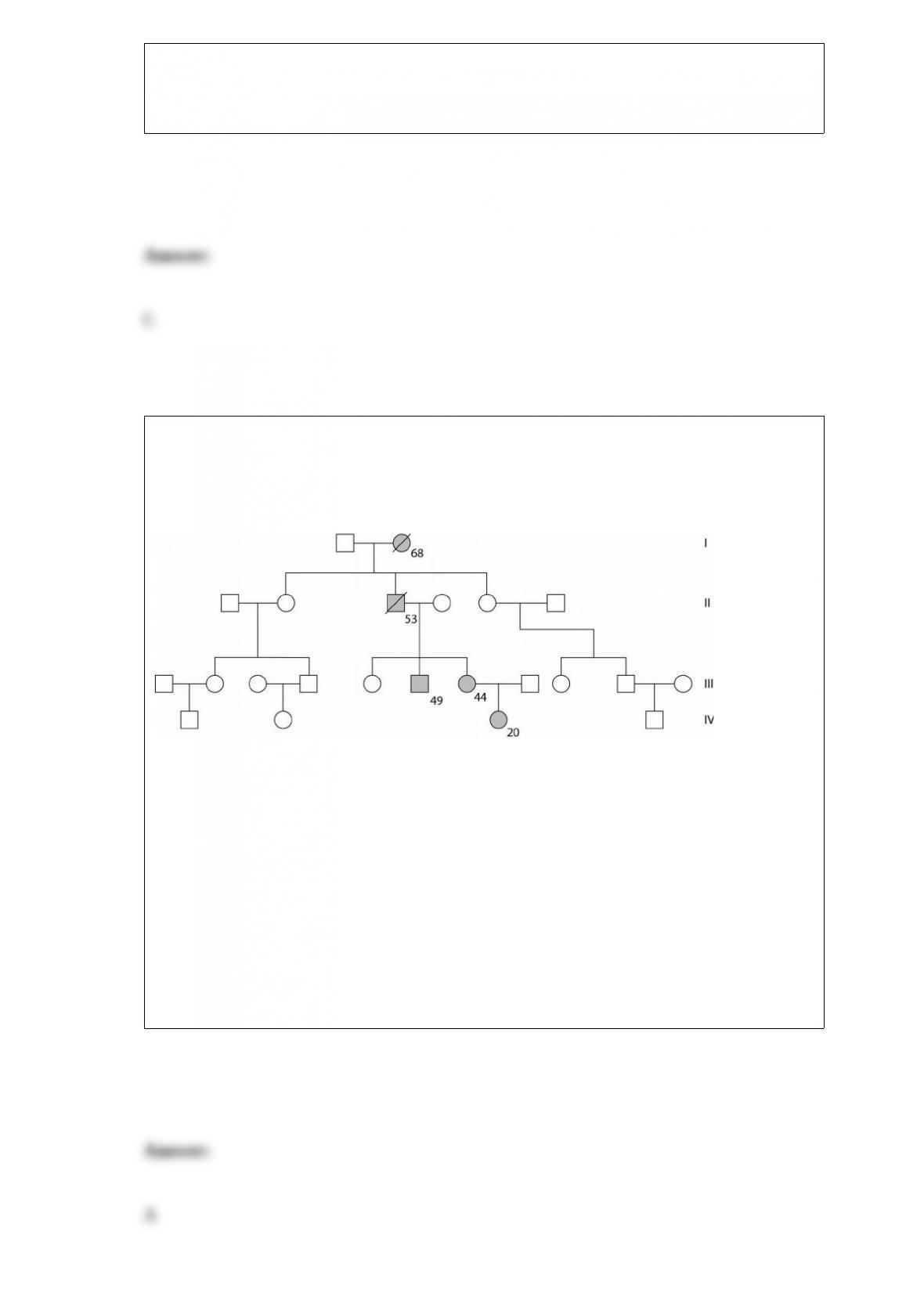
The figure below shows the pedigree for a family. Dark-shaded symbols represent
individuals with one of the two major types of colon cancer. Numbers under the
symbols are the individual’s age at the time of diagnosis. Males are represented by
squares, females by circles.
Which of the following statements is a correct explanation for the observation that all
offspring exhibit a phenotype for a particular trait that appears to be a blend of the two
parental varieties?
A) Neither of the parental genes is dominate over the other.
B) The genes for the trait are dominant in both of the parents.
C) The genes are linked and do not separate during meiosis.
D) The genes for the trait are recessive in both of the parents.
How do phospholipids interact with water molecules?
A) The polar heads avoid water; the nonpolar tails attract water (because water is polar
and opposites attract).
B) Phospholipids do not interact with water because water is polar and lipids are
nonpolar.
C) The polar heads interact with water; the nonpolar tails do not.
D) Phospholipids dissolve in water.
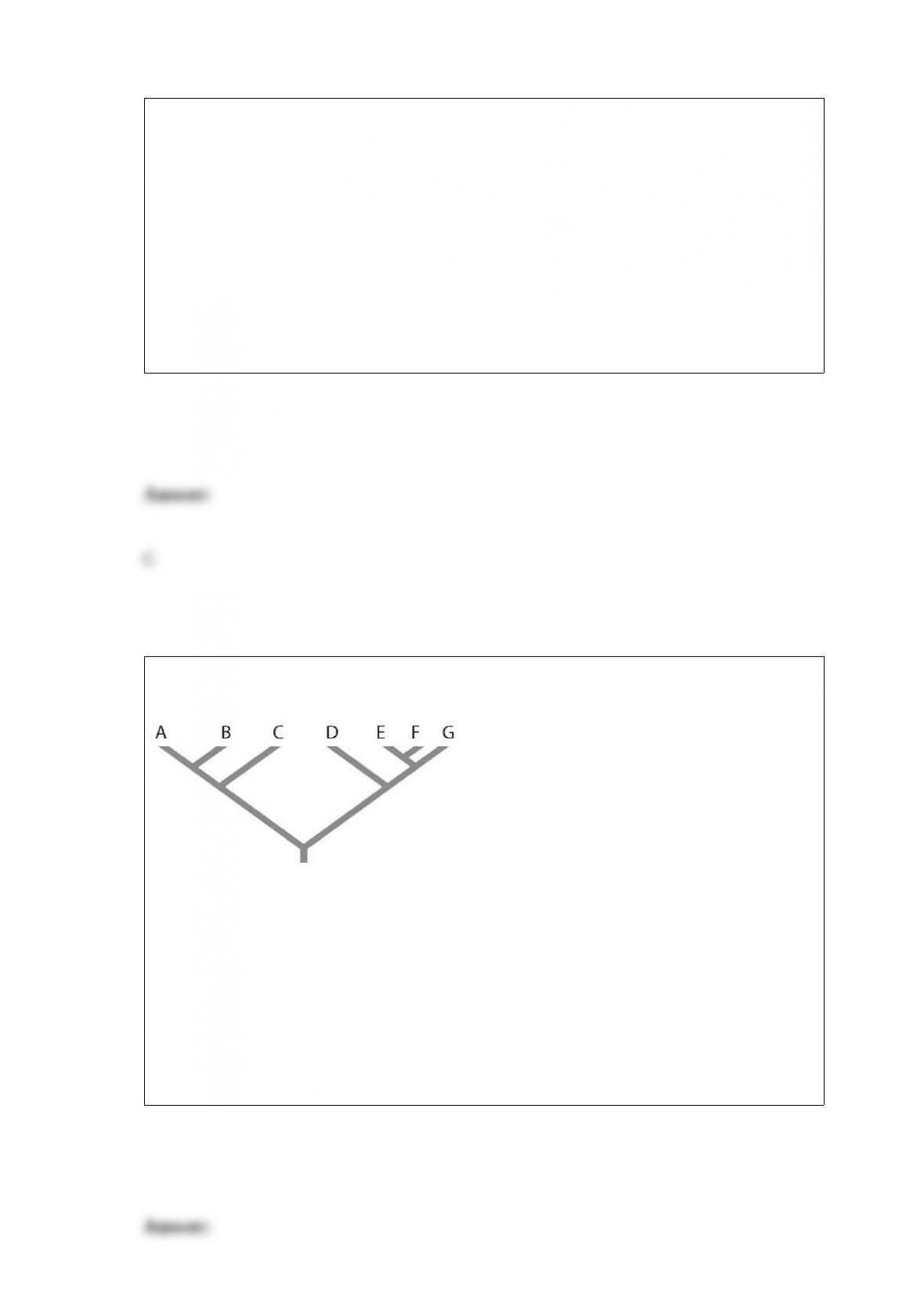
Refer to the figure above. Which of the following forms a monophyletic group?
A) A, B, C, D
B) C and D
C) D, E, and F
D) E, F, and G

A primary transcript in the nucleus of a eukaryotic cell is _____ the functional mRNA,
while a primary transcript in a prokaryotic cell is _____ the functional mRNA.
A) the same size as; smaller than
B) larger than; the same size as
C) larger than; smaller than
D) the same size as; larger than
On the basis of their morphologies, how might Linnaeus have classified the Hawaiian
silverswords? Linnaeus would have _____.
A) placed them all in the same species.
B) classified them the same way that modern botanists do.
C) placed more of them in different genera than modern botanists do.
D) used evolutionary relatedness as the primary criterion for their classification.

Which of the following would inhibit the growth of most plants?
A) abundant humus
B) air spaces
C) good drainage
D) a pH above 10.0
Use the following information to answer the question(s) below.
In onions (Allium), cells of the sporophyte have 16 chromosomes within each nucleus.
Match the number of chromosomes present in each of the following onion tissues.
How many chromosomes should be in a tube cell nucleus?
A) 8
B) 16
C) 24
D) 32
Why do adult urochordates (tunicates) lack notochords, even though larval urochordates
have them? Larvae use notochords to _____.

A) aid in swimming; adults are sessile and thus no longer propel themselves.
B) stiffen their bodies; in adults, the notochord is replaced by a column of bone.
C) induce tissue differentiation; in adults, tissue is already differentiated.
D) organize their nervous systems; adults’ nervous systems are fully developed and do
not change.
Most Swiss starlings produce four to five eggs in each clutch. Starlings producing fewer
or more than this have reduced fitness. Which of the following terms best describes this
situation?
A) directional selection
B) stabilizing selection
C) disruptive selection
D) sexual selection
The most ancient branch point in animal phylogeny is the characteristic of having
_____.
A) radial or bilateral symmetry

B) diploblastic or triploblastic embryos
C) true tissues or no tissues
D) a body cavity or no body cavity
On Easter Island, data show that it was once covered by massive palm trees. How can
an ecosystem collapse from removal of just one species of large tree?
I) Without large trees, soil erosion increases and reduces productivity.
II) Species of plants needing shade no longer have it.
III) Large trees are habitats for many species.
A) only I
B) only II
C) only III
D) I, II, and III
Correns found that the inheritance of variegated color on the leaves of certain plants
was determined only by the maternal parent. What phenomenon explains this pattern?
A) ribosome structure

B) chloroplast inheritance
C) genomic imprinting
D) sex-linkage
Small swollen areas in the neck, groin, and axillary region are associated with _____.
A) increased activity of the immune system
B) blood sugar that is abnormally high
C) dehydration
D) sodium depletion
The term applied to a morphogenetic process whereby cells extend themselves, making
the mass of the cells narrower and wider, is _____.
A) convergent extension
B) induction
C) elongational streaming
D) bi-axial elongation

Clonal selection is an explanation for how _____.
A) V, J, and C gene segments are rearranged
B) an antigen can provoke production of high levels of specific antibodies
C) HIV (human immunodeficiency virus) can disrupt the immune system
D) macrophages can recognize specific T cells and B cells
Evidence of which structure or characteristic would be most surprising to find among
fossils of the Ediacaran fauna?
A) true tissues
B) hard parts
C) bilateral symmetry
D) embryos
In some rare salamander species, all individuals are females. Reproduction relies on
those females having access to sperm from males of another species. However, the
resulting embryos receive no genetic contribution from the males. In this case, the
sperm appear to be used only for _____.
A) morphogenesis
B) egg activation
C) cell differentiation
D) the creation of a diploid cell
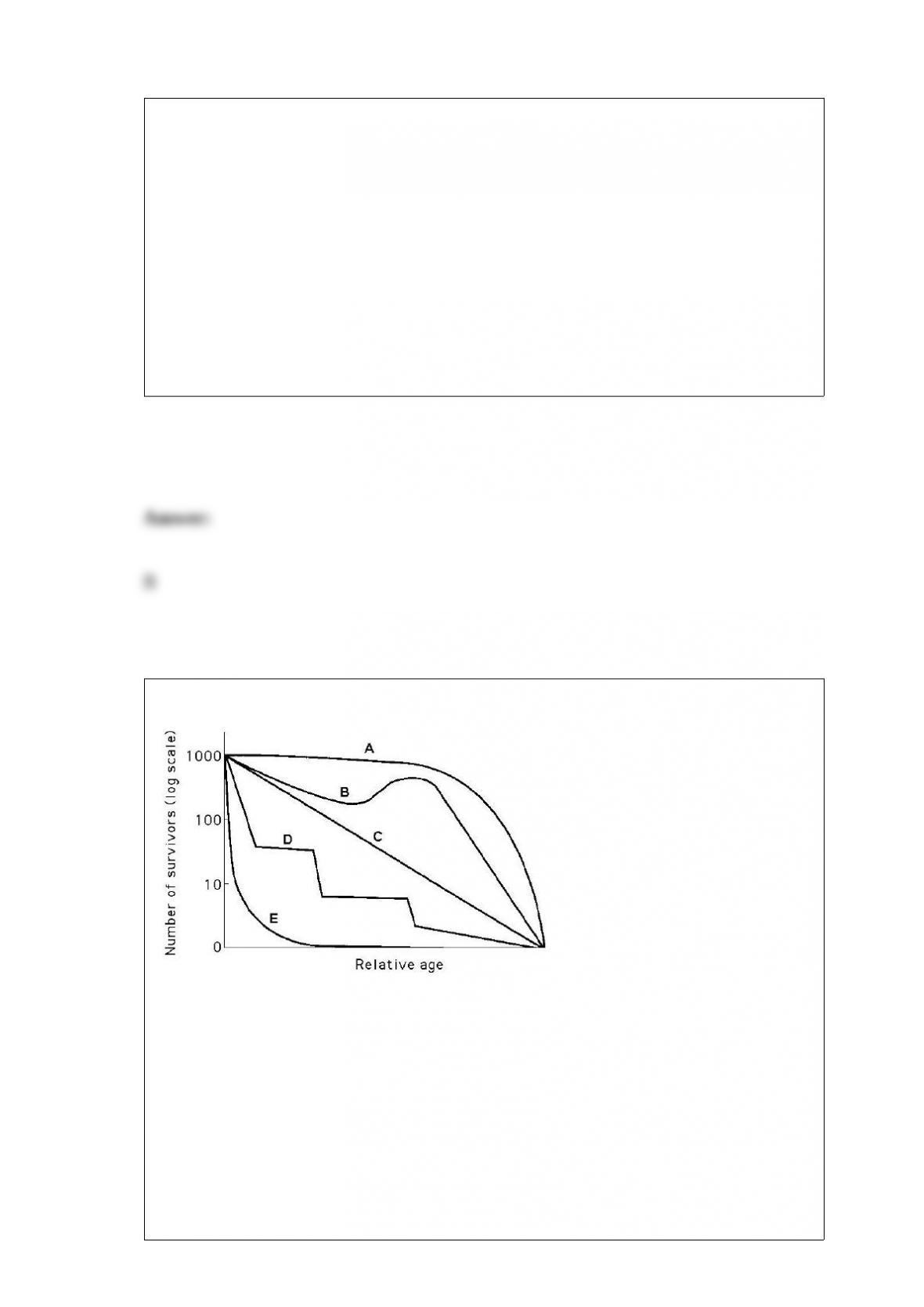
Use the survivorship curves in the figure below to answer the following questions.
Refer to the figure above. Which statement best explains survivorship curve B?
A) It is likely a species that provides little postnatal care, but lots of care for offspring
during midlife as indicated by increased survivorship.
B) This curve is likely for a species that produces lots of offspring, only a few of which
are expected to survive.
C) It is likely a species where no individuals in the cohort die when they are at 60-70%
relative age.

D) Survivorship can only decrease; therefore, this curve could not happen in nature.
The _____ is the most efficient route of water movement in plants, while the _____ is
the most select.
A) apoplast: symplast
B) apoplast: transmembrane
C) symplast apoplast
D) transmembrane: symplast
Which of the following contribute to the surface area available for water absorption
from the soil by a plant root system?
I) root hairs
II) endodermis
III) mycorrhizae
IV) fibrous arrangement of the roots
A) II and III

B) I, III, and IV
C) I, II, and IV
D) I, II, III, and IV
In plant roots, the Casparian strip _____.
A) aids in the uptake of nutrients
B) provides energy for the active transport of minerals into the stele from the cortex
C) ensures that all minerals are absorbed from the soil in equal amounts
D) ensures that all water and dissolved substances must pass through a cell membrane
before entering the stele
Use the following description to answer the question(s) below.
On the Bahamian island of Andros, mosquitofish populations live in various,
now-isolated, freshwater ponds that were once united. Currently, some predator-rich
ponds have mosquitofish that can swim in short, fast bursts; other predator-poor ponds
have mosquitofish that can swim continuously for a long time. When placed together in
the same body of water, the two kinds of female mosquitofish exhibit exclusive
breeding preferences.
Which two of the following have operated to increase divergence between mosquitofish

populations on Andros?
1. improved gene flow
2. bottleneck effect
3. sexual selection
4. founder effect
5. natural selection
A) 1 and 3
B) 2 and 3
C) 2 and 4
D) 3 and 5
Which of the following contain the 9 + 2 arrangement of microtubules, consisting of
nine doublets of microtubules surrounding a pair of single microtubules?
A) motile cilia and primary (nonmotile) cilia
B) flagella and motile cilia
C) basal bodies and primary (nonmotile) cilia
D) centrioles and basal bodies

Recent genetic studies of the structure of microsporidian genomes, as well as the
sequences of their tubulin genes and the gene for RNA polymerase II, indicate that
microsporidians are closely related to the fungi. Microsporidians lack flagella,
centrioles, peroxisomes, and mitochondria (although they do have degenerate
mitochondria, called mitosomes). They have the smallest genome of any eukaryote, and
it is a genome that changes quickly. The genome is contained within two haploid nuclei.
All microsporidians are obligate intracellular parasites. They use a unique organelle
called a polar filament to gain access to the cells of their hosts. One species causes
chronic diarrhea in AIDS patients. Another parasitizes Anopheles gambiae, the
mosquito that transmits a fatal form of malaria to humans.
Given the eukaryotic structures they lack, it should be expected that microsporidians
also lack _____.
A) the “9 + 2 pattern” of microtubules
B) centrosomes
C) lysosomes
D) nuclei
A population of white-footed mice becomes severely overpopulated in a habitat that has
been disturbed by human activity. Sometimes intrinsic factors cause the population to
increase in mortality and lower reproduction rates to occur in reaction to the stress of
overpopulation. Which of the following is an example of intrinsic population control?
A) Owl populations frequent the area more often because of increased hunting success.
B) Females undergo hormonal changes that delay sexual maturation, and many
individuals suffer depressed immune systems and die due to the stress of
overpopulation.
C) Clumped dispersion of the population leads to increased spread of disease and
parasites, resulting in a population crash.
D) All of the resources (food and shelter) are used up by overpopulation, and much of

the population dies of exposure and/or starvation.
If you change the number of neutrons in an atom, you create _____.
A) a cation
B) an anion
C) an isotope
D) a different element