
The same bees that pollinate the flowers of the Brazil nut trees also pollinate orchids,
which are epiphytes (in other words, plants that grow on other plants); however, orchids
cannot grow on Brazil nut trees. These observations explain _____.
A) the coevolution of Brazil nut trees and orchids
B) why Brazil nut trees do not set fruit in monoculture plantations
C) why male orchid bees do not pollinate Brazil nut tree flowers
D) why male orchid bees are smaller than female orchid bees
Abnormal chromosomes are frequently found in malignant tumors. Errors such as
translocations may place a gene in close proximity to different control regions. Which
of the following might then occur to make the cancer worse?
A) an increase in nondisjunction
B) expression of inappropriate gene products
C) a decrease in mitotic frequency
D) failure of the cancer cells to multiply
What is a major difference between meiosis II and mitosis in a diploid animal?
A) Homologues align on the metaphase plate in meiosis II.

B) Sister chromatids separate in mitosis, and homologues separate in meiosis II.
C) Meiosis II occurs in a haploid cell, while mitosis occurs in diploid cells.
D) Crossover takes place in meiosis II.
In eukaryotes there are several different types of RNA polymerase. Which type is
involved in transcription of mRNA for a globin protein?
A) RNA polymerase I
B) RNA polymerase II
C) RNA polymerase III
D) primase
During most daily activities, the human respiration rate is most closely linked to the
blood levels of _____.
A) nitrogen
B) oxygen
C) carbon dioxide
D) carbon monoxide
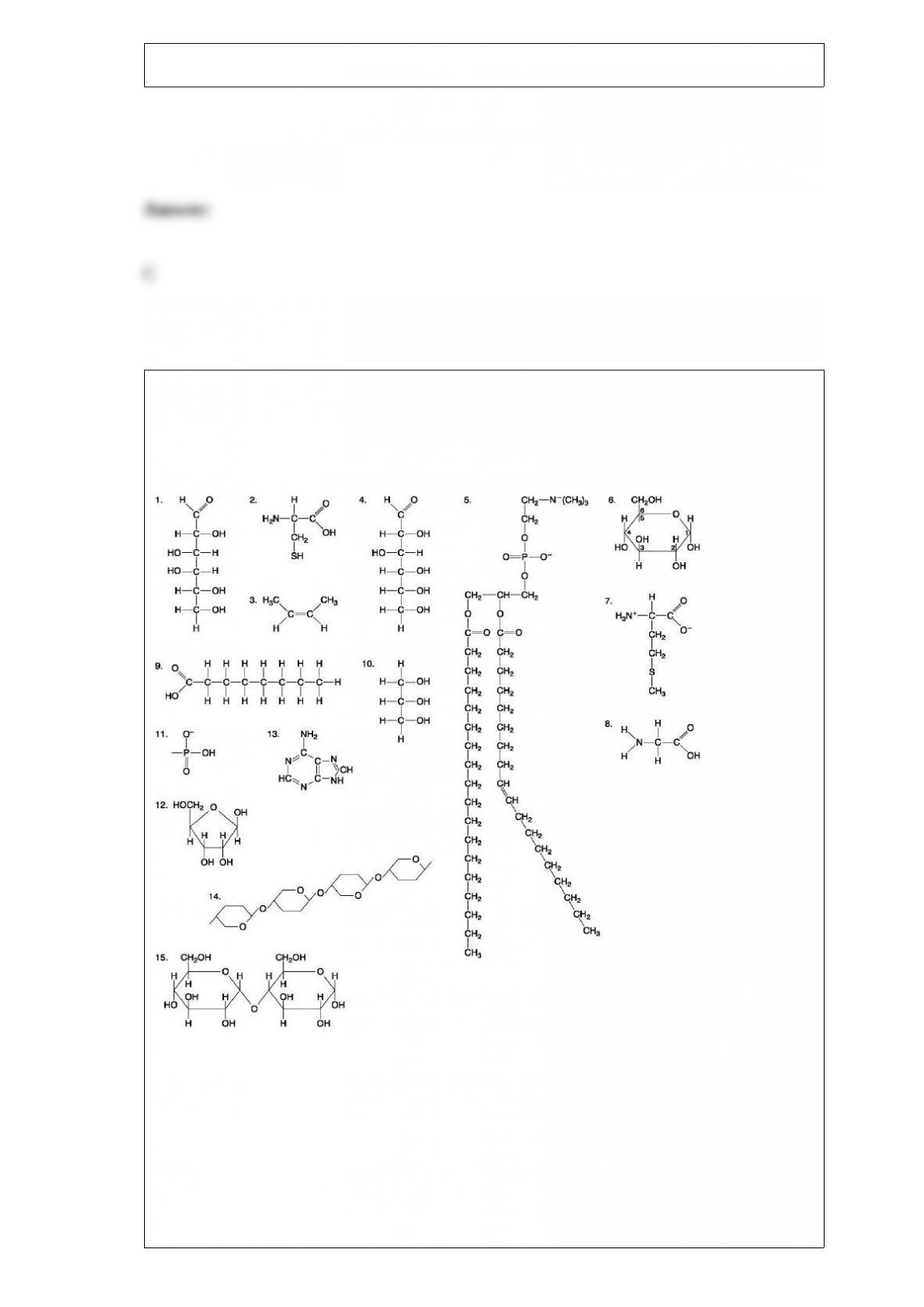
The following questions are based on the 15 molecules illustrated in the accompanying
figure. Each molecule may be used once, more than once, or not at all.
Which molecule has both hydrophilic and hydrophobic properties and is found in
plasma membranes?
A) 1
B) 5
C) 12

D) 14
Catastrophism was Cuvier’s attempt to explain the existence of _____.
A) evolution
B) the fossil record
C) uniformitarianism
D) the origin of new species
In trying to determine whether DNA or protein is the genetic material, Hershey and
Chase made use of which of the following facts?
A) DNA contains sulfur, whereas protein does not.
B) DNA contains phosphorus, whereas protein does not.
C) DNA contains nitrogen, whereas protein does not.
D) DNA contains purines, whereas protein includes pyrimidines.

Which of the following statements describes chromatin?
A) Heterochromatin is composed of DNA, whereas euchromatin is made of DNA and
RNA.
B) Both heterochromatin and euchromatin are found in the cytoplasm.
C) Heterochromatin is highly condensed, whereas euchromatin is less compact.
D) Euchromatin is not transcribed, whereas heterochromatin is transcribed.
Use the following information to answer the question(s) below.
Two populations of birds with somewhat different coloration live on opposite sides of a
peninsula. The habitat between the populations is not suitable for these birds. When
birds from the two populations are brought together, they produce young whose
appearance is intermediate between the two parents. These offspring will breed with
each other or with birds from either parent population, and all offspring of these
pairings appear intermediate to various degrees.
Three populations of crickets look very similar, but the males have courtship songs that
sound different. What function would this difference in song likely serve if the
populations came in contact?
A) a temporal reproductive isolating mechanism
B) a postzygotic isolating mechanism
C) a behavioral reproductive isolating mechanism
D) a gametic reproductive isolating mechanism

At puberty, an adolescent female body changes in both structure and function of several
organ systems, primarily under the influence of changing concentrations of estrogens
and other steroid hormones. How can one hormone, such as estrogen, mediate so many
effects?
A) Estrogen is produced in very large concentration by nearly every tissue of the body.
B) Each cell responds in the same way when steroids bind to the cell surface.
C) Estrogen is kept away from the surface of any cells not able to bind it at the surface.
D) Estrogen binds to specific receptors inside many kinds of cells, each with different
responses.
During a laboratory experiment, you discover that an enzyme-catalyzed reaction has a
∆G of -20 kcal/mol. If you double the amount of enzyme in the reaction, what will be
the ∆G for the new reaction?
A) -40 kcal/mol
B) -20 kcal/mol
C) 0 kcal/mol
D) +20 kcal/mol

Which of the following conditions would most likely be due to high blood pressure in a
mammal?
A) bursting of blood vessels in capillary beds
B) inability of the right ventricle to contract
C) reversal of normal blood flow direction in arteries
D) destruction of red blood cells
How is plant cell cytokinesis different from animal cell cytokinesis?
A) The contractile filaments found in plant cells are structures composed of
carbohydrates; the cleavage furrow in animal cells is composed of contractile
phospholipids.
B) Plant cells deposit vesicles containing cell-wall building blocks on the metaphase
plate; animal cells form a cleavage furrow.
C) The structural proteins of plant cells separate the two cells; in animal cells, a cell
membrane separates the two daughter cells.
D) Plant cells divide after metaphase but before anaphase; animal cells divide after
anaphase.

Why are lipids and proteins free to move laterally in membranes?
A) The interior of the membrane is filled with liquid water.
B) Lipids and proteins repulse each other in the membrane.
C) Hydrophilic portions of the lipids are in the interior of the membrane.
D) There are only weak hydrophobic interactions in the interior of the membrane.
A relatively long cecum is characteristic of animals that are_____.
A) carnivores
B) herbivores
C) autotrophs
D) omnivores
Archegonia _____.
A) are the sites where male gametes are produced
B) may contain sporophyte embryos
C) have the same function as sporangia
D) make asexual reproductive structures
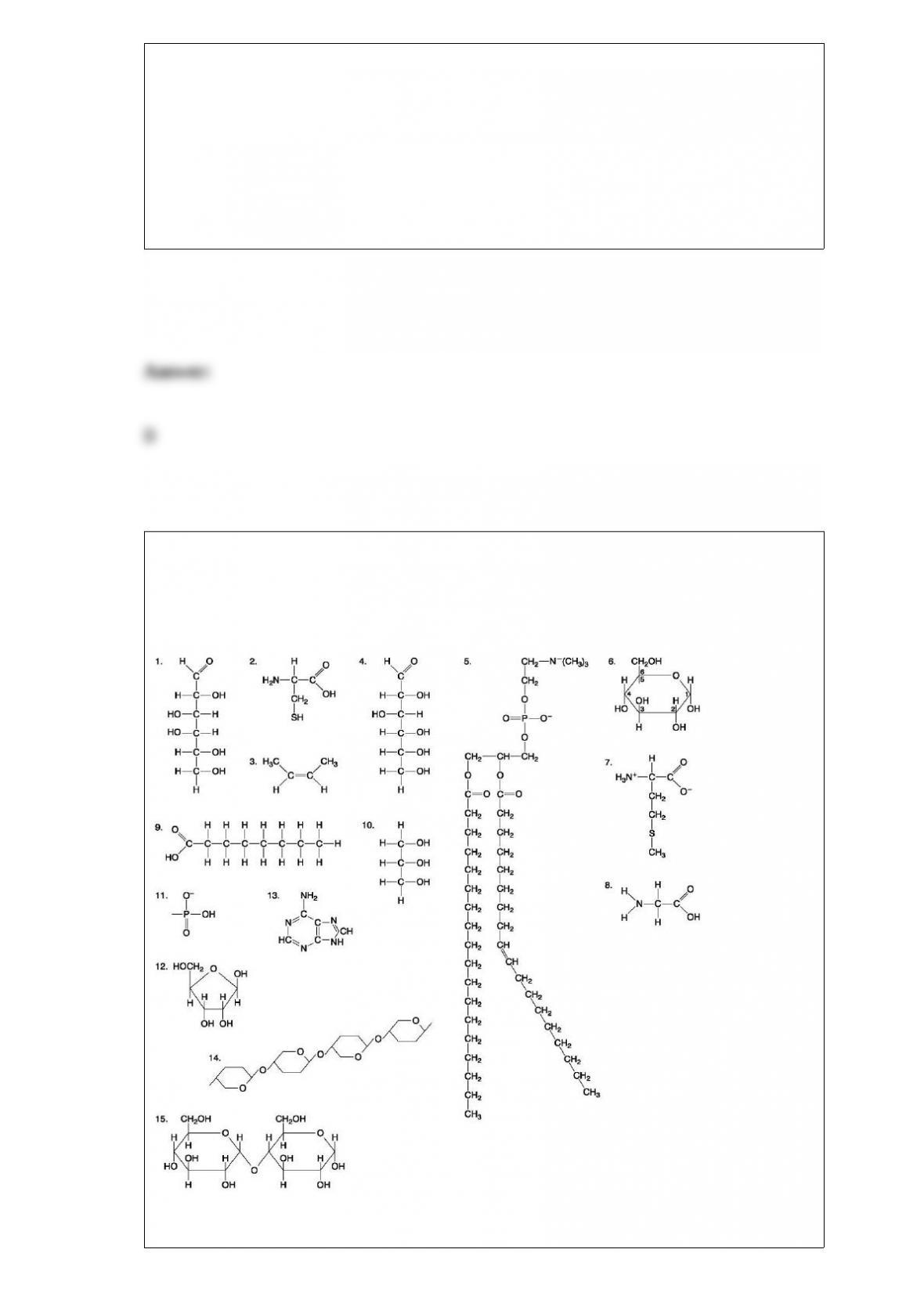
The following questions are based on the 15 molecules illustrated in the accompanying
figure. Each molecule may be used once, more than once, or not at all.
Which of the following combinations of molecules illustrated could be linked to form a

nucleotide?
A) 1, 2, and 11
B) 3, 7, and 8
C) 5, 9, and 10
D) 11, 12, and 13
What is the oxidizing agent in the following reaction?
Pyruvate + NADH + H+ → Lactate + NAD+
A) NADH
B) NAD+
C) lactate
D) pyruvate
In humans, clear gender differentiation occurs, not at fertilization, but after the second
month of gestation. What is the first event of this differentiation?
A) formation of testosterone in male embryos

B) formation of estrogens in female embryos
C) activation of SRY in male embryos and masculinization of the gonads
D) activation of SRY in females and feminization of the gonads
If organisms A, B, and C belong to the same class but to different orders and if
organisms C, D, and E belong to the same order but to different families, which of the
following pairs of organisms would be expected to show the greatest degree of
structural homology?
A) A and D
B) B and D
C) B and C
D) D and E
A human who has no access to fresh water but is forced to drink seawater instead will
_____.
A) thrive under such conditions, as long as he has lived at the ocean most of his life
B) excrete more water molecules than taken in, because of the high load of ion
ingestion

C) develop structural changes in the kidneys to accommodate the salt overload
D) risk becoming overhydrated within twelve hours
Dogs (Canis lupus familiaris) and gray wolves (Canis lupus) can interbreed to produce
viable, fertile offspring. These species shared a common ancestor recently (in geologic
time) and have a high degree of genetic similarity, although their anatomies vary
widely. Judging from this evidence, which two species concepts are most likely to place
dogs and wolves together into a single species?
A) ecological and morphological
B) ecological and phylogenetic
C) biological and morphological
D) biological and phylogenetic
Choose the pair of terms that correctly completes this sentence: Catabolism is to
anabolism as _____ is to _____.
A) exergonic; spontaneous
B) exergonic; endergonic
C) free energy; entropy

D) work; energy
Quaking aspen can send out underground stems for asexual reproduction. Sexual
reproduction is not as common, but when it does happen, the haploid gametes have 19
chromosomes. How many chromosomes are in the cells of the underground stems?
A) 9
B) 10
C) 19
D) 38
Hormones are chemical substances produced in one organ that are released into the
bloodstream and affect the function of a target organ. For the target organ to respond to
a particular hormone, it must _____.
A) modify its plasma membrane to alter the hormone entering the cytoplasm
B) be from the same cell type as the organ that produced the hormone
C) experience an imbalance that disrupts its normal function
D) have receptors that recognize and bind the hormone molecule

Biological rhythms in animals isolated from light and dark cues _____.
A) continue to have cycles of exactly twenty-four hours’ duration
B) continue to have cycles of approximately twenty-four hours duration; some more
rapid, some slower
C) synchronize activity with whatever lighting cycle is imposed on them
D) cease having any rhythms
What is the maximum number of covalent bonds that an oxygen atom with atomic
number 8 can make with hydrogen?
A) 1
B) 2
C) 4
D) 6

One idea to mitigate the effects of burning fossil fuels on atmospheric CO2
concentrations is to pipe liquid CO2 into the ocean at depths of 2500 feet or greater. At
the high pressures at such depths, CO2 is heavier than water. What potential effects
might result from implementing such a scheme?
A) increased carbonate concentrations in the deep waters
B) increased growth of corals from a change in the carbonate”bicarbonate equilibrium
C) no effect because carbon dioxide is not soluble in water
D) increased acidity and decreased carbonate concentrations in the deep waters
In autotrophic bacteria, where is chlorophyll located?
A) in chloroplast membranes
B) in the ribosomes
C) in the nucleoid
D) in the infolded plasma membrane
A phylogenetic tree constructed using sequence differences in mitochondrial DNA

would be most valid for discerning the evolutionary relatedness of _____.
A) archaeans and bacteria
B) fungi and animals
C) chimpanzees and humans
D) sharks and dolphins
The circulatory systems of bony fishes, rays, and sharks are most similar to _____.
A) those of birds, with a four-chambered heart
B) the portal systems of mammals, where two capillary beds occur sequentially, without
passage of blood through a pumping chamber
C) those of sponges, where gas exchange in all cells occurs directly with the external
environment
D) those of humans, where there are four pumping chambers to drive blood flow
Use the following information when to answer the question(s) below.
Many terrestrial arthropods exchange gases with their environments by using tracheae,
tubes that lead from openings (called spiracles) in the animal’s exoskeleton or cuticle
directly to the animal’s tissues. Some arthropods can control whether their spiracles are
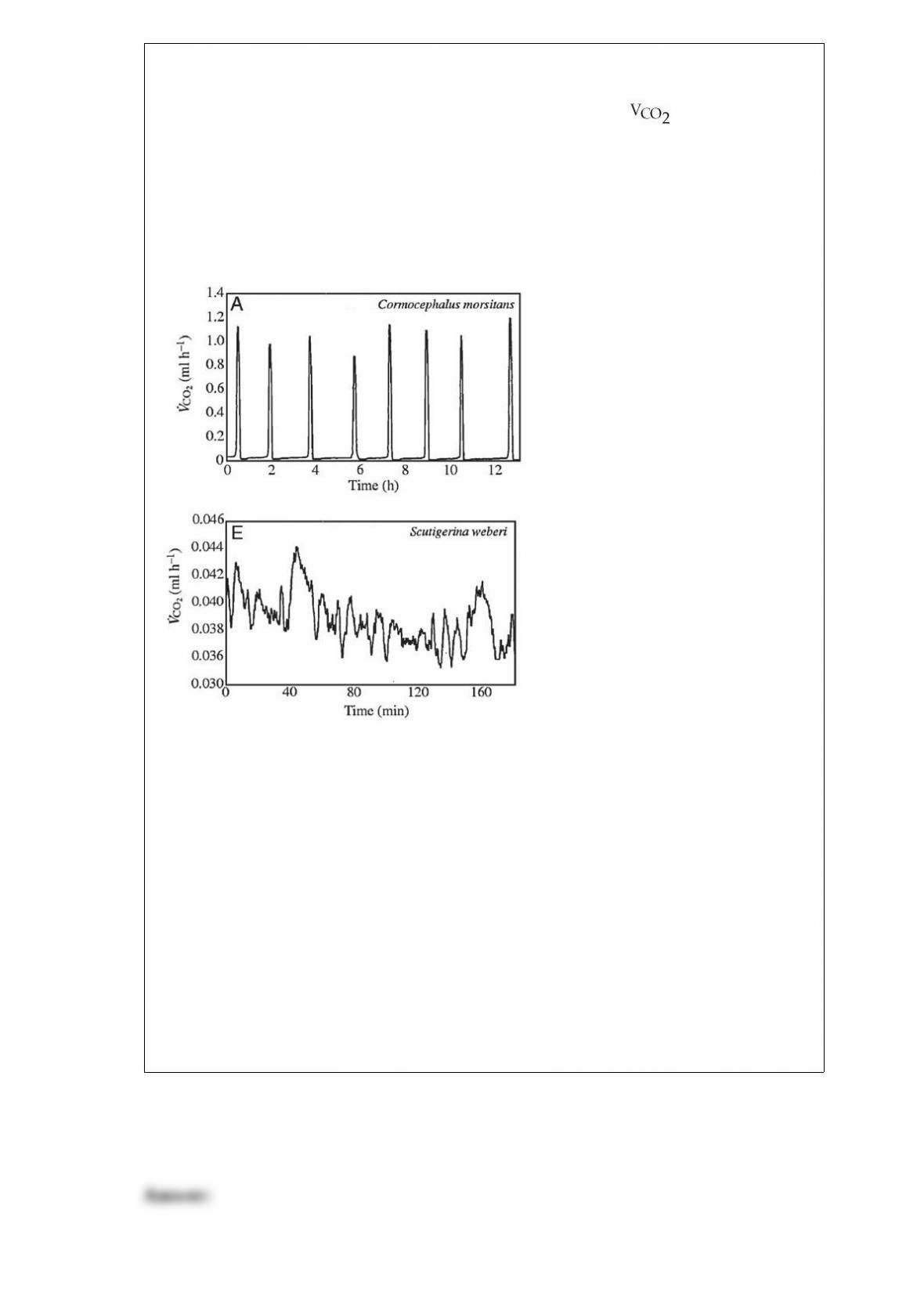
opened or closed; opening the spiracles allows the carbon dioxide produced in the
tissues to travel down the tracheae and be released outside the animal. Klok et al.
measured the carbon dioxide emitted over time (represented by ) by several
species of centipedes. The figure below presents graphs of their results for two species,
Cormocephalus morsitans and Scutigerina weberi. (C. J. Klok, R. D. Mercer, and S. L.
Chown. 2002. Discontinuous gas-exchange in centipedes and its convergent evolution
in tracheated arthropods. Journal of Experimental Biology 205:1019-29.) Copyright
2002 The Company of Biologists and the Journal of Experimental Biology.
Look at the graph for Scutigerina weberi (note the scale of the y-axis) in the figure
above. What is the best interpretation of these results?
A) The centipede had its spiracles open the entire time.
B) The centipede had its spiracles closed the entire time.
C) The centipede had its spiracles open when carbon dioxide (CO2) emission peaked
and closed when CO2 emission was low.
D) The centipede had its spiracles closed when carbon dioxide (CO2) emission peaked
and open when CO2 emission was low.

You have a cube of modeling clay in your hands. Which of the following changes to the
shape of this cube of clay will decrease its surface area relative to its volume?
A) Pinch the edges of the cube into small folds.
B) Flatten the cube into a pancake shape.
C) Round the clay up into a sphere.
D) Stretch the cube into a long, shoebox shape.
The peppered moth provides a well-known example of natural selection. The
light-colored form of the moth was predominant in England before the Industrial
Revolution. In the mid-nineteenth century, a dark-colored form appeared. The
difference is produced by a dominant allele of one gene. By about 1900, approximately
90% of the moths around industrial areas were dark colored, whereas light-colored
moths were still abundant elsewhere. Apparently, birds could readily find the light
moths against the soot-darkened background in industrial areas and, therefore, were
eating more light moths. Recently, use of cleaner fuels has greatly reduced soot in the
landscape, and the dark-colored moths have been disappearing. Should the two forms of
moths be considered separate species?
A) Yes, because natural selection has affected the frequency of the two different forms.
B) Yes, because they have completely different coloration.
C) Yes, because they are reproductively isolated based on habitat.
D) No.